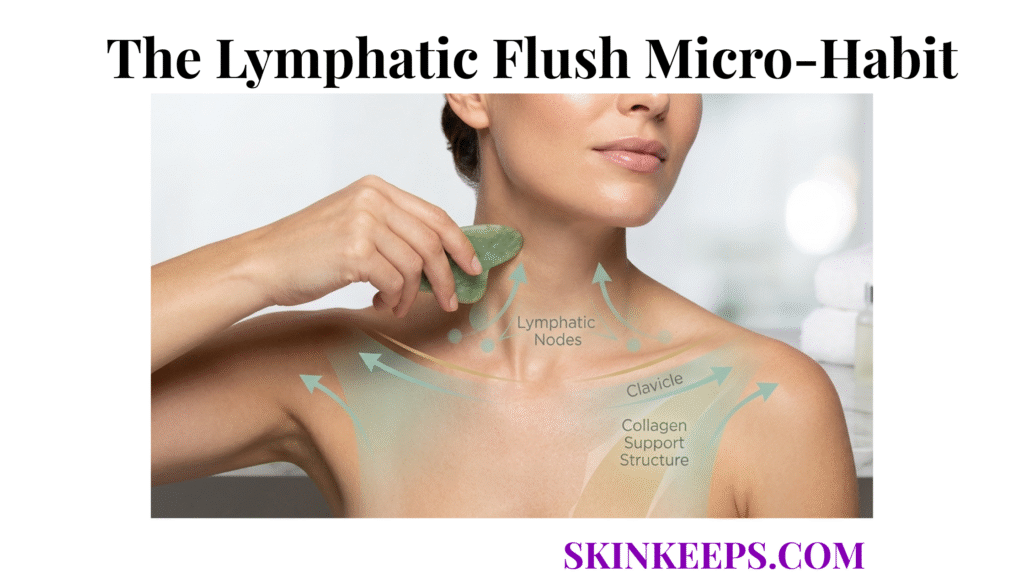
You do not need a complex, 20-minute spa routine to reduce puffiness; you need a repeatable system. The Lymphatic Flush Micro-Habit uses a 60-second, light-pressure neck protocol designed to support lymph movement toward terminal drainage routes where lymph returns to circulation.
Most individuals fail to maintain manual lymphatic drainage (MLD) routines because they are too long and complicated. This guide implements a Minimum Viable Habit (MVH) designed to remove friction so consistency beats intensity.
This habit involves physical manipulation of tissues near lymphatic pathways. Use light pressure only, consistent with the “gentle/light-touch” approach described in lymphatic drainage methods.
CONTRAINDICATION: Do not perform drainage if you have fever, active infection, or painful/swollen neck nodes, or if you notice a new lump. Swollen nodes often reflect immune activity and deserve proper medical evaluation.
What is the Science Behind the Lymphatic Flush?
The efficacy of the flush relies on understanding the lymphatic network of the head and neck, and why the supraclavicular region is a clinically recognized terminal zone in lymph drainage pathways [1,5].
The “Drain Plugs” (Terminus Nodes)
The supraclavicular fossa (hollow above the collarbone) is an important terminal drainage region in the overall head/neck lymphatic return route [1,5]. The lymphatic system helps maintain tissue fluid balance and returns fluid from interstitial spaces toward central circulation [6,7]. Puffiness is often linked to soft-tissue fluid distribution, and lymphatic function is part of how the body clears excess fluid [6,8].
Think of it as an engineering problem: if the exit ramp is ignored, face-only rolling becomes a “circling the parking lot” problem [1,6].
The Solution (Gravity & Flow)
Gravity doesn’t need motivation. It needs a clear path. When you guide fluid downward with light strokes, you’re assisting the direction lymph already travels as part of fluid homeostasis [6–8].
Tissue fluid movement is influenced by hydrostatic and oncotic pressure gradients, which govern microvascular filtration and reabsorption [7–9]. Increased interstitial pressure can increase lymph flow and help drain excess interstitial fluid [8]. Ensure you aren’t causing swelling through barrier damage by understanding the skin barrier.
Phase 1 — The Protocol Mission (MVH)
The success of this protocol is not based on skill, but on the philosophy of the Minimum Viable Habit: the smallest action that can be repeated daily until it becomes automatic [10,11].
The Philosophy
The goal is to reduce the barrier to entry so much it becomes hard to say “no.” A 60-second routine done daily outperforms a 20-minute routine done occasionally [10,11].
The Mission Briefing
- The Action: Perform 10 light downward strokes on the neck, behind ear → collarbone, both sides.
- The Pressure: Use light, skin-level pressure (not deep tissue), consistent with gentle MLD descriptions [2,4].
- The Mindset: You do not need to touch the face. Neck-only = win condition.
Phase 2 — The Anchor Protocol
To install this habit permanently, use implementation intentions (if-then planning): you attach the new behavior to a stable cue so the routine becomes automatic [14].
The Trigger and Script
- Trigger: The “Slip” — applying moisturizer/oil (provides glide).
- Anchor Script: “Immediately after I apply moisturizer, I will do 10 downward neck strokes” [14].
System Setup
Visual Cue: Place gua sha tool (or sticky note) on top of moisturizer jar.
Constraint: Touching the cue becomes unavoidable. Stable cues support repetition and habit formation [10].
Phase 3 — The Consistency Matrix (7-Day Log)
Tracking compliance strengthens habit formation because repetition + context stability builds automaticity. Use the tool below to build the data-driven proof you need to establish this habit.
| Day | Trigger Used (e.g., Moisturizer) | Flush Completed? | Puffiness Score (1-10) | Notes |
|---|---|---|---|---|
| Mon | ||||
| Tue | ||||
| Wed | ||||
| Thu | ||||
| Fri | ||||
| Sat | ||||
| Sun |
Your Routine Analysis
Phase 4 & 5 — System Debrief and Refinement
After 30 days, use your data log to find what breaks consistency, then redesign the system.
Analyzing Gaps
Look for blank days and identify triggers (travel, oversleeping, tool missing).
Refinement Loop (Action Plan)
Obstacle: “Tool dependency.”
New strategy: Learn the knuckle technique so the system runs anywhere.
Key Takeaways of the Lymphatic Flush Micro-Habit
- Open the Drains: Focus on the neck/supraclavicular region to support terminal drainage directionality.
- MVH Approach: 10 strokes daily beats rare long routines.
- Anchor the Habit: Use an if-then script after moisturizer.
- Adaptability: Fingers/knuckles keep the chain unbroken.
Frequently Asked Questions
Extremely lightly. The lymphatic vessels are located just beneath the surface of the skin, above the muscle tissue. If you press hard enough to feel the muscle, you are collapsing the lymph vessels, which prevents fluid flow. Think of the pressure required to move a coin across a table without scratching it.
Yes, consistency is the priority. However, most people prefer the morning because fluid tends to accumulate in the face overnight due to lying horizontal (hydrostatic pressure changes). Flushing in the morning provides an immediate cosmetic reduction in puffiness.
No. While a tool can provide a nice tactile cue, your knuckles or the flats of your fingers work perfectly well. The “Knuckle Technique” ensures you can maintain the habit even when traveling or if you lose your tool.
Conclusion
The Lymphatic Flush Micro-Habit is a systems approach that prioritizes physiology (fluid movement) and behavior design (micro-habits) over complex routines.
By consistently “opening the drains” each morning with light pressure, you build a repeatable method that can reduce the look of puffiness without turning skincare into a second job.
Reference List
- [1] Koroulakis A, et al. Anatomy, Head and Neck, Lymph Nodes. StatPearls. NCBI Bookshelf.
- [2] Vairo GL, Miller SJ, et al. Systematic Review of Efficacy for Manual Lymphatic Drainage Techniques in Sports Medicine and Rehabilitation. PM&R. 2009. PMC.
- [3] Müller M, et al. Manual lymphatic drainage and quality of life in patients with lymphoedema or mixed oedema: systematic review of RCTs. 2018. PMC.
- [4] Cleveland Clinic. Lymphatic Drainage Massage: What It Is & Benefits. Cleveland Clinic.
- [5] Banjar FK, et al. Anatomy, Head and Neck, Supraclavicular Lymph Node. StatPearls. Europe PMC.
- [6] Huxley VH, Scallan JP. Lymphatic fluid: exchange mechanisms and regulation. 2011. PMC.
- [7] Moore JE Jr, et al. Lymphatic System Flows. 2018. PMC.
- [8] NCBI Bookshelf. Interaction of Capillary and Interstitial Forces. NCBI.
- [9] Woodcock TE, Woodcock TM. Advances in the Starling Principle and microvascular fluid exchange. 2021. PMC.
- [10] Gardner B, Lally P, Wardle J. Making health habitual: the psychology of habit-formation and general practice. 2012. PMC.
- [11] Singh B, et al. Time to Form a Habit: A Systematic Review and Meta-Analysis. 2024. PMC.
- [12] Cleveland Clinic. Swollen Lymph Nodes (Lymphadenopathy). Cleveland Clinic.
- [13] StatPearls. Lymphadenopathy. NCBI Bookshelf.
- [14] Wieber F, Thürmer JL, Gollwitzer PM. Promoting the translation of intentions into action by implementation intentions. 2015. PMC.