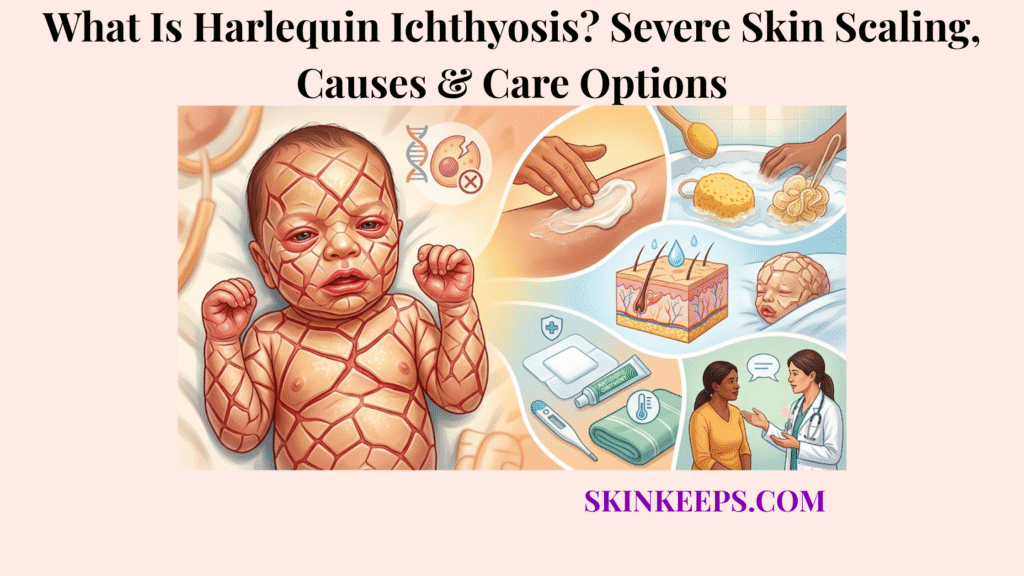
Harlequin ichthyosis is a rare, severe genetic disorder of skin formation present at birth. Newborns develop thick, hard skin plates separated by deep fissures, with ectropion, eclabium, restricted chest expansion and reduced limb or digit movement.
Pathogenic ABCA12 variants disrupt lipid transport needed for a functional outer skin barrier. Modern intensive care has improved survival, but the newborn period remains a medical emergency and survivors require lifelong skin and multidisciplinary care.
How Can Harlequin Ichthyosis Be Recognized at Birth?
Harlequin ichthyosis is usually recognized at birth by thick, hard, plate-like skin separated by deep red fissures.
The tight shiny skin may appear armour-like. Eyelids can turn outward, called ectropion, and lips can be pulled outward, called eclabium.
The nose may look flattened, ears may be compressed or covered with scale, hands and feet may be swollen, and fingers or toes may be held in restricted positions.
Joint and limb movement can be reduced, the eyes or mouth may not close fully, and chest expansion may be restricted. Some affected babies are born prematurely.
These changes result from severe skin thickening and tension; the underlying facial structures are not absent.
- Thick, rigid plate-like skin over much of the body.
- Deep red fissures between plates.
- Tight shiny surface.
- Ectropion with exposed eyes.
- Eclabium with restricted mouth movement.
- Compressed or folded external ears.
- Swollen hands and feet.
- Restricted fingers, toes and joints.
- Reduced chest expansion.
- Possible premature birth.
Figure 1. Harlequin ichthyosis is recognized by rigid plate-like skin and deep fissures with mechanical and barrier complications; suspected newborns need immediate NICU stabilization and multidisciplinary care.
What Should Happen Immediately After a Baby With Harlequin Ichthyosis Is Born?
A baby suspected of having harlequin ichthyosis should be stabilized and transferred to neonatal intensive care immediately.
Care starts with airway, breathing and circulation, followed by a humidified temperature-controlled incubator, fluid and electrolyte monitoring, respiratory assessment, feeding support, bland barrier ointment, eye protection, infection surveillance, pain relief and digit-circulation checks.
The whole newborn must be treated, not only the visible scaling. Stabilization should not wait for genetic confirmation.
- Stabilize airway, breathing and circulation.
- Transfer to a NICU.
- Use a humidified, temperature-controlled incubator.
- Monitor fluids, electrolytes, urine output and weight.
- Assess chest movement and respiratory effort.
- Evaluate feeding and nutritional needs.
- Apply bland emollients under specialist direction.
- Protect exposed eyes and assess corneas.
- Monitor for bacterial and fungal infection.
- Provide appropriate pain control.
- Assess circulation and movement in fingers and toes.
- Coordinate neonatology, dermatology, ophthalmology, genetics and nutrition.
How Does Harlequin Ichthyosis Damage the Skin Barrier?
Harlequin ichthyosis damages the skin barrier because ABCA12 dysfunction disrupts lipid transport needed to build the outer epidermis.
Healthy outer skin contains organised lipids that reduce water loss and block microorganisms. ABCA12 normally moves lipids and related material within developing epidermal cells.
When this transport fails, the stratum corneum becomes excessively thick and structurally abnormal. It loses flexibility, forms plates and splits into deep fissures.
The defective barrier permits water and heat loss, allows microbial entry and creates mechanical restriction around the chest, eyes, mouth, limbs and digits.
This is far more severe than ordinary dry skin; the scale reflects a barrier-construction disorder rather than inadequate moisturising.
Figure 2. ABCA12 dysfunction disrupts lipid delivery to the stratum corneum, producing severe hyperkeratosis, fissuring, water loss, microbial entry and mechanical restriction.
What Causes Harlequin Ichthyosis?
Harlequin ichthyosis is caused by pathogenic variants in the ABCA12 gene.
The condition is genetic and present from conception. It is not caused by infection, pregnancy diet, poor hygiene, parental behaviour or contact with another person.
Different ABCA12 variants can reduce or eliminate transporter function to different degrees, contributing to variation in severity.
| True Cause | Not a Cause |
|---|---|
| Pathogenic ABCA12 variants | Infection |
| Autosomal recessive inheritance | Pregnancy diet or behaviour |
| Disrupted epidermal lipid transport | Poor hygiene |
| Defective skin-barrier formation | Touching a person with a skin condition |
How Is Harlequin Ichthyosis Inherited?
Harlequin ichthyosis usually follows an autosomal recessive inheritance pattern.
An affected child typically inherits one altered ABCA12 copy from each parent. Parents with one altered copy are usually healthy carriers.
When both biological parents are confirmed carriers, each pregnancy has a 25% chance of an affected child, a 50% chance of a carrier child and a 25% chance of a child inheriting neither familial variant.
The probabilities reset with each pregnancy. The condition can appear without known family history because carriers usually have no symptoms.
| Parent 1 | Parent 2 | Child Possibility Per Pregnancy |
|---|---|---|
| Carrier | Carrier | 25% affected |
| Carrier | Carrier | 50% carrier |
| Carrier | Carrier | 25% neither familial variant |
Which Problems Can Thick Harlequin Skin Cause in a Newborn?
Thick plate-like skin can affect breathing, feeding, hydration, electrolytes, movement and circulation during the neonatal period.
How Can Harlequin Ichthyosis Affect Breathing?
Tight chest skin can restrict chest-wall expansion and impair ventilation.
Prematurity may increase respiratory vulnerability. Some babies require oxygen, non-invasive respiratory support or intubation.
How Can Harlequin Ichthyosis Affect Feeding and Nutrition?
Eclabium and restricted mouth movement can interfere with latching, sucking and oral feeding.
High skin turnover, healing and water loss increase nutritional and fluid needs, and tube feeding may be required.
How Can Harlequin Ichthyosis Affect Hydration and Electrolytes?
The defective barrier can permit rapid transepidermal water loss, dehydration and dangerous electrolyte imbalance.
Weight, urine output, sodium and other laboratory values guide carefully calculated fluid replacement.
How Can Harlequin Ichthyosis Affect Movement and Circulation?
Tight skin can restrict joints and compress fingers or toes.
Swelling, constricting bands and poor circulation can threaten distal tissue, while contractures may require therapy or surgical release.
| Skin Problem | Newborn Risk |
|---|---|
| Chest tightness | Breathing restriction |
| Mouth tightness | Feeding difficulty |
| Barrier failure | Water and electrolyte loss |
| Fissures | Infection entry |
| Limb or digit constriction | Movement and circulation risk |
Why Is Infection a Major Risk in Harlequin Ichthyosis?
Infection is a major risk because deep fissures and defective barrier function allow microorganisms to enter more easily.
Inflamed skin can make early infection difficult to recognise, and invasive lines add further risk.
Bacterial or fungal skin infection may spread to the bloodstream and cause sepsis. Reduced ventilation and mobility can also contribute to pneumonia.
Cultures and targeted antimicrobials may be required when infection is suspected. Antibiotics are not a substitute for barrier care and are not automatically continued indefinitely.
Infection pathway: deep fissure → microbial entry → local infection → bloodstream spread → sepsis.
How Are the Eyes, Eyelids and Corneas Protected?
Eye protection is essential because tight facial skin can pull the eyelids outward and expose the corneas.
Incomplete closure can cause dryness, irritation and corneal injury. Frequent lubrication and moisture protection may be required.
Ophthalmology should assess eyelid position and corneal health. Severe persistent ectropion may need surgery.
Eye care is not cosmetic; untreated exposure can damage vision.
Eye pathway: ectropion → incomplete closure → corneal exposure → lubrication and ophthalmology → surgery if persistent.
How Are the Ears and Hearing Affected by Harlequin Ichthyosis?
Harlequin ichthyosis can affect hearing when thick scale blocks the external ear canal.
Scale and debris may reduce sound transmission and contribute to conductive hearing loss. External ears may also look compressed during the newborn period.
Regular hearing assessment may be needed. Ear-canal scale should be cleared carefully by trained clinicians, not with sharp tools or forceful home cleaning.
Reduced response to sound should not be assumed to reflect developmental delay before obstruction has been assessed.
Hearing route: ear-canal scale → sound blockage → hearing assessment → specialist clearance → continued monitoring.
How Is Harlequin Ichthyosis Diagnosed After Birth?
Harlequin ichthyosis is usually suspected clinically at birth and confirmed with molecular testing when possible.
The characteristic appearance creates strong immediate suspicion, but neonatal stabilization must not wait for laboratory results.
Dermatologic examination helps classify the congenital ichthyosis pattern. ABCA12 testing can confirm pathogenic variants, and parental testing can establish carrier status.
A broader ichthyosis gene panel may be used when the pattern is uncertain. Skin biopsy is rarely the primary confirmation method when molecular testing is available.
Diagnosis route: clinical recognition → NICU stabilization → ABCA12 testing → parental testing → genetic counselling.
Can Harlequin Ichthyosis Be Detected Before Birth?
Prenatal molecular testing may be possible when the familial ABCA12 variants are known.
DNA can be tested from chorionic villus sampling or amniocentesis. Preimplantation genetic testing may be an option for some families using assisted reproduction.
Ultrasound may occasionally show suggestive features later in pregnancy, but it is not sensitive or specific enough to replace genetic testing.
Testing decisions should involve maternal-fetal medicine and genetics specialists and should remain family-specific and non-directive.
| Situation | Testing Direction |
|---|---|
| Known familial ABCA12 variants | Targeted DNA testing |
| Unknown variants | Test the affected person or parents first |
| Assisted reproduction | Consider preimplantation testing if available and desired |
| Routine ultrasound only | Supportive clues possible; not definitive |
How Is Harlequin Ichthyosis Different From Other Congenital Ichthyoses?
Harlequin ichthyosis has a more severe birth phenotype than several related congenital ichthyoses, though genetic testing may be needed to define the underlying disorder.
How Does Harlequin Ichthyosis Differ From a Collodion Baby Presentation?
A collodion baby is born within a shiny taut membrane, while harlequin ichthyosis produces much thicker plates with deep fissures.
Collodion baby is a descriptive appearance rather than a final diagnosis, and both presentations may need humidified neonatal care.
How Does Harlequin Ichthyosis Differ From Lamellar Ichthyosis?
Lamellar ichthyosis often begins with a collodion membrane and later develops broad dark scale.
Its birth presentation is generally less extreme than classic harlequin ichthyosis, though both belong to the autosomal recessive congenital ichthyosis spectrum.
How Does Harlequin Ichthyosis Differ From Congenital Ichthyosiform Erythroderma?
Congenital ichthyosiform erythroderma more often produces red skin with finer white scale.
Survivors of harlequin ichthyosis may later develop severe erythroderma and scaling that resemble this phenotype.
How Does Harlequin Ichthyosis Differ From Epidermolytic Ichthyosis?
Epidermolytic ichthyosis often presents with fragile skin, blistering and erosions rather than massive rigid plates.
| Condition | Birth Covering | Key Newborn Feature | Later Pattern | Genetic Pathway |
|---|---|---|---|---|
| Harlequin ichthyosis | Thick plates | Deep fissures, ectropion, eclabium | Severe redness and scaling | ABCA12-related |
| Collodion baby | Shiny taut membrane | Membrane encasement | Depends on diagnosis | Multiple genes |
| Lamellar ichthyosis | Often collodion membrane | Less extreme birth phenotype | Broad dark scale | ARCI genes |
| Congenital ichthyosiform erythroderma | Red skin and finer scale | Erythroderma | Persistent redness and scale | ARCI genes |
| Epidermolytic ichthyosis | Fragile skin | Blisters and erosions | Thickened scaling | Different genes |
How Is Newborn Skin Cared for Safely?
Newborn skin care focuses on humidification, bland emollients, gentle handling and infection monitoring.
- Maintain a humidified incubator under NICU protocols.
- Apply generous petrolatum-based or specialist-approved bland emollient.
- Handle the infant gently.
- Do not forcibly remove attached plates.
- Allow scale to soften and shed gradually.
- Use careful bathing when medically stable.
- Minimise adhesives on fragile skin.
- Reduce unnecessary invasive procedures.
- Monitor fissures for infection, bleeding and impaired circulation.
- Avoid strong keratolytics such as large-area salicylic acid in newborns.
The goal is to soften plates, reduce water loss and support safe shedding—not mechanically peel newborn skin.
When Are Oral Retinoids Used for Harlequin Ichthyosis?
Oral retinoids may be considered when severe constricting scale threatens breathing, eyelid or mouth function, limb movement or distal circulation.
Acitretin, isotretinoin or another systemic retinoid may reduce keratin production and accelerate plate shedding.
Some babies with milder evolving phenotypes may not need immediate systemic therapy. Evidence comes largely from rare-disease observational data and specialist experience.
Retinoids do not replace respiratory support, fluids, nutrition, infection prevention, eye care or multidisciplinary NICU management.
| Severity Factor | Possible Benefit | Risk or Monitoring |
|---|---|---|
| Chest constriction | Softer plates may aid expansion | Respiratory stability |
| Digit constriction | Reduced tension may protect function | Circulation checks |
| Ectropion or eclabium tension | Less skin pull as scale sheds | Eye monitoring |
| Severe hyperkeratosis | Faster plate shedding | Liver, lipid and skeletal monitoring |
| Milder evolving phenotype | May not need immediate retinoid | Reassess burden |
Which Oral Retinoid Risks Require Long-Term Monitoring?
Oral retinoid treatment requires monitoring because benefit must be balanced against liver, lipid, skeletal, eye, interaction and pregnancy-related risks.
Possible problems include dryness, liver-enzyme changes, high cholesterol or triglycerides, musculoskeletal symptoms, skeletal effects, eye dryness and severe fetal harm during pregnancy.
The lowest effective dose and treatment breaks may be considered according to disease burden. Therapy should be reassessed rather than continued automatically.
| Risk | Baseline Check | Follow-Up | Warning Sign |
|---|---|---|---|
| Liver effects | Liver enzymes | Repeat laboratory tests | Jaundice or severe fatigue |
| Lipid changes | Cholesterol and triglycerides | Repeat laboratory tests | Severe abdominal pain if markedly elevated |
| Skeletal effects | Growth and musculoskeletal review | Growth, pain and movement review | Bone pain or reduced movement |
| Eye effects | Eye baseline when relevant | Ophthalmology review | Eye pain, redness or vision change |
| Pregnancy risk | Pregnancy-prevention counselling | Ongoing counselling and testing | Possible pregnancy exposure |
What Happens to Harlequin Ichthyosis Skin After the Newborn Plates Shed?
After the newborn plates shed, harlequin ichthyosis usually becomes a lifelong pattern of severe redness, scaling, tightness and barrier fragility.
The underlying skin often remains intensely red and inflamed, scale can build rapidly, and fissures, ectropion, eclabium, scalp scale, thick palms and soles, and infection risk may persist.
The neonatal plates disappearing does not mean the genetic disorder has resolved.
Disease course: plate-covered newborn → plate shedding → severe erythroderma and scaling → lifelong fluctuating disease.
How Is Harlequin Ichthyosis Skin Managed Throughout Life?
Lifelong care focuses on softening scale, protecting fissures, reducing water loss and preventing infection.
- Daily or frequent bathing to soften scale.
- Generous emollient immediately after bathing.
- Reapplication throughout the day.
- Fragrance-free non-soap cleansing.
- Gentle removal of already loosened scale.
- Regular scalp-scale management.
- Careful nail and skin-fold care.
- Protection of fissured areas.
- Targeted keratolytics on selected thick areas in older children or adults.
- Topical or systemic retinoids when benefits justify risks.
- Prompt assessment of infection or worsening inflammation.
Strong keratolytics should not be spread over large body areas in infants or young children because absorption and toxicity are possible.
How Are Heat Intolerance and Temperature Problems Managed?
Heat intolerance can occur because thick scale and abnormal barrier function reduce effective sweating and cooling.
Hot weather, exercise and fever can cause dangerous overheating. Air conditioning, fans, cooling garments, planned hydration and activity adjustment may be needed.
Caregivers and schools should recognise early heat illness. Fever should not automatically be blamed on reduced sweating because infection must also be considered.
Heat route: warm environment → reduced sweating → rising temperature → cooling and hydration → emergency care for confusion, collapse or seizure.
How Does Harlequin Ichthyosis Affect Growth and Nutrition?
Harlequin ichthyosis can increase nutritional needs because rapid skin production, water loss and infections create extra metabolic demand.
Eclabium or mouth restriction may complicate feeding. Children can struggle to gain weight even when intake looks adequate.
Dietitian review can guide calories, protein, fluids and micronutrients. Tube feeding may be needed temporarily or longer term, and vitamin D or other nutritional status may require testing.
Growth should be followed over time rather than judged from one visit.
| Problem | Clinical Sign | Nutritional Response |
|---|---|---|
| High skin turnover | Poor weight gain | Calorie and protein review |
| Water loss | Thirst or dehydration risk | Individual fluid plan |
| Feeding restriction | Low intake | Feeding therapy or tube support |
| Recurrent infection | Higher metabolic stress | Dietitian reassessment |
| Vitamin or mineral risk | Fatigue, poor growth or bone concerns | Targeted testing |
How Are Contractures and Movement Problems Managed?
Contractures and movement problems are managed with skin softening, gentle therapy, selective splinting and surgery when severe restriction threatens function or circulation.
Tight skin can affect walking, grasping and self-care. Physiotherapy and occupational therapy support range of motion.
Stretching must be gentle enough to avoid fissures. Retinoid therapy may reduce hyperkeratotic restriction, while severe contractures or threatened circulation may require surgical release.
Function route: skin tightness → restricted movement → skin softening and therapy → splinting → surgery when necessary.
Which Harlequin Ichthyosis Care Mistakes Should Be Avoided?
Care mistakes can worsen fissures, infection risk, toxicity, eye or ear injury and delayed emergency care.
| Mistake | Mechanism of Harm | Safer Response |
|---|---|---|
| Forced plate removal | Bleeding, fissures and infection | Let scale soften and shed |
| Aggressive scrubbing | Barrier injury | Gentle bathing |
| Harsh soap or fragrance | Irritation and cracking | Fragrance-free non-soap cleanser |
| Acids or chemical peels | Chemical burns | Specialist-directed scale care |
| Large-area salicylic acid in infants | Systemic toxicity | Avoid unless specifically directed |
| Unsupervised retinoids | Liver, lipid, skeletal and pregnancy risks | Dermatology monitoring |
| Ignoring poor urine or feeding | Missed dehydration or malnutrition | Urgent assessment |
| Assuming fever is only heat intolerance | Missed infection or sepsis | Medical evaluation |
| Sharp ear cleaning | Canal injury | Specialist clearance |
| Abruptly stopping retinoid | Unplanned loss of control | Coordinate with prescriber |
| Adhesive tape on fragile skin | Skin tearing | Safer fixation methods |
| Indiscriminate antibiotics or antifungals | Wrong target and side effects | Treat confirmed infection |
Which Specialists Support Long-Term Harlequin Ichthyosis Care?
Harlequin ichthyosis usually requires a multidisciplinary team because it affects skin, eyes, ears, nutrition, movement, infection risk and family planning.
- Dermatology.
- Neonatology and paediatrics.
- Clinical genetics and maternal-fetal medicine.
- Ophthalmology.
- ENT and audiology.
- Dietetics and feeding specialists.
- Physiotherapy and occupational therapy.
- Plastic or reconstructive surgery.
- Infectious-disease specialists when needed.
- Dentistry and oral care.
- Psychology or counselling.
- Social work and educational support.
Priorities change from neonatal survival to childhood growth, schooling, adolescent independence and adult reproductive counselling.
What Long-Term Complications Can Harlequin Ichthyosis Cause?
Long-term complications can affect skin, infection risk, heat regulation, eyes, hearing, growth, movement, sleep, comfort and psychosocial health.
| Complication | Early Sign | Specialist | Preventive Action |
|---|---|---|---|
| Fissures or infection | Pain, pus, odour or spreading redness | Dermatology or infectious disease | Barrier care and cultures |
| Eye exposure | Redness, pain or cloudiness | Ophthalmology | Lubrication and eyelid care |
| Hearing blockage | Reduced response to sound | ENT or audiology | Safe canal clearance |
| Heat intolerance | Overheating or fatigue | Paediatrics or dermatology | Cooling plan |
| Poor growth | Low weight gain | Dietitian or paediatrics | Calorie and protein plan |
| Contractures | Reduced movement | PT, OT or surgery | Stretching, splints and surgery |
| Psychosocial burden | Anxiety or avoidance | Counselling or social work | Support and school planning |
Other concerns include persistent erythroderma, generalized scale, painful fissures, dehydration, alopecia, thick nails, sleep disruption, pain, itch and retinoid complications.
Can Harlequin Ichthyosis Be Cured?
There is currently no established cure that corrects ABCA12 variants throughout the skin.
Current care supports survival, barrier function, scale reduction, infection prevention and preservation of movement, vision, hearing, growth and quality of life.
Retinoids may reduce hyperkeratosis but do not eliminate the genetic disorder. Experimental genetic or molecular approaches should not be presented as available cures.
Care goals: correct the genetic defect—not yet available; reduce scale—possible; protect barrier and function—continuous care.
What Is the Outlook for Someone With Harlequin Ichthyosis?
The outlook has improved with modern neonatal intensive care, but the condition remains severe and lifelong.
The neonatal period carries major risk from respiratory problems, sepsis, dehydration, electrolyte disturbance and feeding difficulty.
Some affected people now survive through childhood and adulthood. Prognosis varies with genotype, prematurity, breathing status, infection, access to specialist care and treatment complications.
Intelligence is not inherently determined by the skin disorder. Functional and psychosocial outcomes depend partly on sustained multidisciplinary support.
Outlook: neonatal critical period → stabilised infancy → lifelong severe ichthyosis → adult multidisciplinary care.
How Can Families Plan Future Pregnancies After a Harlequin Ichthyosis Diagnosis?
Future pregnancy planning begins with confirming the affected person’s ABCA12 variants and offering non-directive genetic counselling.
Both biological parents can be tested for familial variants. When both are carriers, the recurrence probability is 25% for each pregnancy.
Families may discuss targeted prenatal testing, preimplantation genetic testing where available, and carrier testing for appropriate adult relatives.
Counselling should explain probabilities, test limits, timelines and options in language the family understands without pressure toward one reproductive decision.
Family-planning route: identify variants → confirm carriers → review reproductive options → arrange targeted testing.
When Does Harlequin Ichthyosis Require Emergency Medical Care After the Newborn Period?
Urgent or emergency care is needed when breathing, feeding, hydration, infection, eye health, circulation or temperature control may be threatened.
- Difficulty breathing.
- Reduced feeding or inability to swallow.
- Markedly reduced urine output.
- Unusual sleepiness or poor responsiveness.
- Fever or abnormally low temperature.
- Rapidly spreading redness.
- Pus, foul odour or increasing tenderness.
- Sudden increase in pain.
- Eye redness, cloudiness, pain or inability to close the eyes.
- Cold, blue or severely swollen fingers or toes.
- New loss of movement.
- Vomiting, severe weakness or dehydration signs.
- Overheating, confusion, collapse or seizure.
- Possible retinoid or other medicine toxicity.
Emergency rule: do not wait for routine follow-up when breathing, circulation, hydration, infection or vision may be threatened.
Figure 3. Lifelong care combines daily barrier support, heat and nutrition safety, eye, hearing and movement care, specialist monitoring, retinoid risk review, psychosocial support and rapid escalation for emergency signs.
What Should You Remember About Harlequin Ichthyosis?
Harlequin ichthyosis is a severe congenital skin-barrier disorder caused by pathogenic ABCA12 variants.
- It is present at birth.
- It causes thick skin plates separated by deep fissures.
- It follows autosomal recessive inheritance.
- Newborn barrier failure can affect breathing, feeding, hydration, temperature, infection protection, eye closure, circulation and movement.
- Immediate humidified NICU care is essential.
- Bland emollients and gentle handling support safe plate shedding.
- Oral retinoids may help selected severe cases but require specialist monitoring.
- Genetic testing confirms the diagnosis and supports family planning.
- Plate shedding does not end the disorder.
- Survivors require lifelong skin care and multidisciplinary support.
- There is no established cure that permanently corrects ABCA12 throughout the skin.
- Survival has improved, but medical and psychosocial burden remains substantial.
What Questions Do People Ask About Harlequin Ichthyosis?
Is harlequin ichthyosis present from birth?
Yes. It is a congenital genetic disorder present at birth and is usually recognized by thick, hard plate-like skin separated by deep fissures.
Why does harlequin ichthyosis produce thick skin plates?
Pathogenic ABCA12 variants disrupt lipid transport needed for normal outer skin-barrier formation, producing severe hyperkeratosis, tightness and fissuring.
Is harlequin ichthyosis contagious?
No. It is genetic and cannot spread through touch, clothing, hygiene items, skin care or caregiving.
Did something during pregnancy cause harlequin ichthyosis?
No. It results from inherited ABCA12 variants, not from something a pregnant parent ate, touched, used or failed to do.
Which gene causes harlequin ichthyosis?
Pathogenic variants in ABCA12 cause harlequin ichthyosis. ABCA12 helps transport lipids needed to build an effective epidermal barrier.
Can parents carry ABCA12 variants without symptoms?
Yes. In autosomal recessive inheritance, carrier parents usually have one altered ABCA12 copy and do not have harlequin ichthyosis.
What is the recurrence risk in another pregnancy?
When both biological parents are confirmed carriers, each pregnancy has a 25% chance of an affected child, 50% chance of a carrier child and 25% chance of a child inheriting neither familial variant.
Can harlequin ichthyosis be detected before birth?
Targeted prenatal DNA testing may be possible when familial ABCA12 variants are known. Ultrasound may show supportive features but cannot replace molecular testing.
Why do the eyelids and lips turn outward?
Tight plate-like facial skin pulls on the eyelids and lips, causing ectropion and eclabium, which can affect corneal protection and feeding.
Does the thick newborn skin eventually shed?
The plates gradually soften and shed with specialist care, but the underlying genetic disorder remains lifelong and the skin usually continues to be red, scaly and fragile.
Can a child with harlequin ichthyosis sweat normally?
Sweating may be reduced because thick scale can block sweat from reaching the surface, increasing overheating risk during heat, fever or exercise.
Why are infections dangerous in harlequin ichthyosis?
Deep fissures and barrier failure allow microorganisms to enter more easily, and local infection can progress to bloodstream infection or sepsis.
Are oral retinoids always required?
No. They may help selected severe cases by reducing hyperkeratosis, but require specialist monitoring and do not replace respiratory, fluid, nutritional, eye or infection care.
Can harlequin ichthyosis be cured permanently?
There is currently no established cure that corrects ABCA12 variants throughout the skin. Care focuses on barrier support, scale control, infection prevention, function and quality of life.
Can people with harlequin ichthyosis survive into adulthood?
Modern NICU care has improved survival, and some affected people now reach childhood and adulthood. Lifelong severe skin disease and multidisciplinary care remain necessary.
Which symptoms require emergency medical care?
Difficulty breathing, poor feeding, reduced urine, unusual sleepiness, fever or low temperature, spreading redness, pus, foul odour, increasing pain, eye redness or cloudiness, cold or blue digits, dehydration, overheating, confusion, collapse, seizure or possible medicine toxicity require urgent assessment.
Which Sources Support This Harlequin Ichthyosis Guidance?
GeneReviews — Autosomal Recessive Congenital Ichthyosis — ARCI classification, severe neonatal risks, genetic diagnosis, lifelong complications, surveillance and counselling.
MedlinePlus Genetics — Harlequin Ichthyosis — ABCA12 cause, newborn features, autosomal recessive inheritance, barrier failure and improved survival with intensive care.
MedlinePlus Genetics — ABCA12 Gene — ABCA12 lipid transport, epidermal barrier formation, dehydration and infection mechanism.
Ichthyosis in the Newborn — NICU care, humidified incubator, fluids, nutrition, bland emollients, gentle handling, adhesives, eye care and cautious retinoid use.
Orphanet — Harlequin Ichthyosis — Clinical diagnosis, ABCA12 molecular testing, prenatal DNA testing and autosomal recessive counselling.
AAP Pediatrics — Improved Management of Harlequin Ichthyosis — Modern neonatal intensive care, pain control, retinoids and multidisciplinary management.
Consensus Recommendations for Retinoids in Ichthyosis — Systemic retinoid selection, benefits, liver, lipid, bone, eye and pregnancy monitoring, and long-term risk–benefit review.
This SkinKeeps article is educational and does not diagnose or replace neonatal intensive care, dermatology, paediatrics, genetics, ophthalmology, infectious-disease, nutrition, therapy, surgery, emergency, maternal-fetal medicine, or genetic counselling. Harlequin ichthyosis is a neonatal emergency: a newborn with plate-like skin, deep fissures, breathing or feeding difficulty, exposed eyes, restricted movement, dehydration, temperature instability, poor digit circulation, or infection concern needs immediate hospital and NICU care. Do not peel plates, scrub, use harsh chemicals or large-area salicylic acid, clean ears with sharp tools, or use retinoids without specialist supervision.