
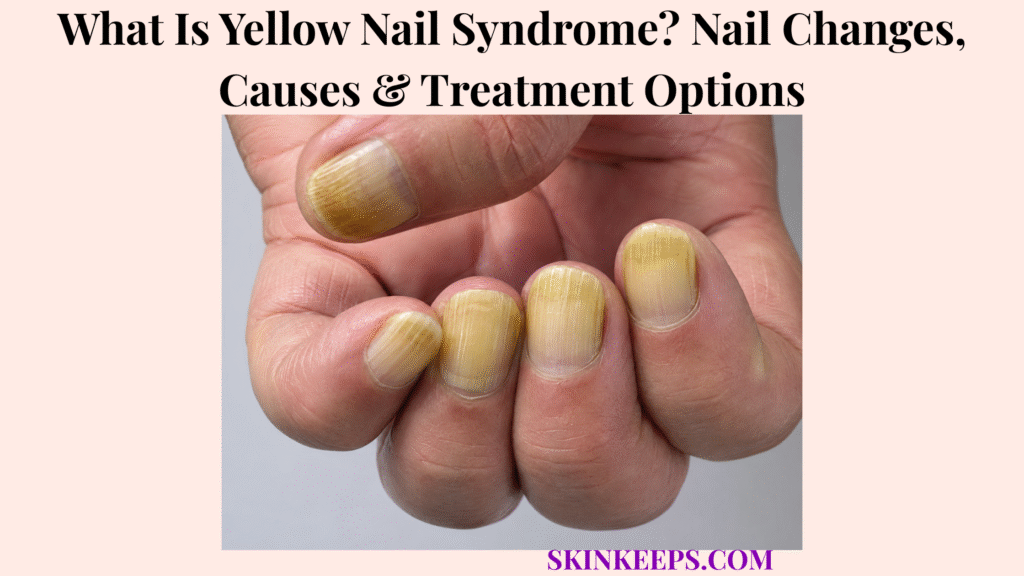
Yellow Nail Syndrome is a rare multisystem condition in which characteristic slow-growing yellow dystrophic nails occur together with lymphedema and/or respiratory disease such as chronic cough, sinus disease, bronchiectasis or pleural effusion. The nail, lymphatic and respiratory features can appear at different times, so yellow nails alone do not establish the diagnosis.
The exact cause remains unknown, although impaired lymphatic drainage is a leading proposed mechanism rather than a proven single cause. Diagnosis is clinical and should exclude common nail mimics such as onychomycosis, while treatment is directed separately at the nails, lymphedema, respiratory manifestations and any associated condition.
Medical note: This article is for educational purposes only. Yellow nail changes accompanied by unexplained leg swelling, recurrent respiratory infections, breathlessness, chest pain or pleural effusion should be medically evaluated.
What Is Yellow Nail Syndrome and What Symptoms Can It Cause?
Yellow Nail Syndrome is a rare multisystem syndrome involving characteristic slow-growing yellow dystrophic nails together with lymphedema and respiratory disease, although all three features do not have to appear at the same time.
What Are the Three Classic Features of Yellow Nail Syndrome?
The classic YNS triad consists of yellow dystrophic nails, lymphedema and respiratory disease. These three systems form the diagnostic framework even though the full triad may not be present during the same visit.
Does Someone Need All Three Features to Have YNS?
No; the major manifestations often develop at different times, and commonly used clinical criteria recognize YNS when at least two characteristic components are present. This matters because isolated nail disease may precede swelling or respiratory symptoms, and the reverse can also occur.
What Do YNS Nails Look Like?
YNS nails are typically yellow to yellow-green, thickened, hard or dystrophic, abnormally curved and unusually slow-growing or nearly growth-arrested. Transverse ridging, reduced or absent cuticles and onycholysis can also occur.
Are All Fingernails and Toenails Always Affected?
No; many nails may be involved, but complete involvement of all twenty fingernails and toenails is not required. The more useful clue is the combination of discoloration with striking growth slowing, thickening and curvature.
What Does YNS-Related Lymphedema Look Like?
YNS-related lymphedema most often causes persistent lower-leg swelling, with heaviness, tightness and later tissue thickening possible. Early swelling can pit, while longstanding lymphedema may become firmer as tissue changes accumulate.
Which Respiratory Problems Can Occur?
YNS can cause chronic cough, recurrent sinus or chest infections, bronchiectasis, pleural effusion and breathlessness. Respiratory disease can become more clinically important than the nail appearance and needs its own evaluation and treatment pathway.
Can Respiratory Disease Appear Before the Nail Changes?
Yes; nail, lymphatic and respiratory features can appear months or years apart, so lung or sinus disease may precede obvious nail findings. That asynchronous pattern is a major reason YNS can be overlooked.
What Causes Yellow Nail Syndrome and Which Conditions Are Associated With It?
The exact cause of Yellow Nail Syndrome is unknown, although abnormal lymphatic function is one leading proposed mechanism and the syndrome has been reported alongside several systemic diseases.
Is the Exact Cause of Yellow Nail Syndrome Known?
No; the pathogenesis of YNS remains incompletely understood. The syndrome should therefore not be explained as if one proven obstruction, exposure or biochemical defect accounts for every case.
How Could Lymphatic Dysfunction Contribute?
One proposed model is that impaired lymphatic drainage disrupts tissue-fluid clearance, contributing to limb swelling, altered nail growth and pleural or respiratory fluid abnormalities. This model is biologically plausible and supported by abnormal lymphatic studies in some patients, but it remains a proposed mechanism rather than a definitive single cause.
Is Yellow Nail Syndrome Genetic?
Most YNS is considered acquired rather than a clearly inherited single-gene disorder, although rare familial and congenital cases have been reported. Typical YNS should not be presented as a straightforward Mendelian syndrome.
Which Conditions Have Been Reported With Yellow Nail Syndrome?
YNS has been reported alongside autoimmune disorders, immunodeficiency, selected malignancies and other diseases affecting lymphatic or respiratory function. These are associations rather than diagnostic requirements and should be investigated according to the individual clinical picture.
Does Yellow Nail Syndrome Mean Someone Has Cancer?
No; malignancy has been reported in association with some YNS cases, but the syndrome itself is not a cancer diagnosis. Broader malignant-skin disease belongs to the separate Skin Cancer pathway and should not be inferred from yellow nails.
How Is Yellow Nail Syndrome Diagnosed and Distinguished From Fungal Nail Disease?
YNS is primarily a clinical diagnosis based on characteristic nail dystrophy together with lymphedema and/or respiratory disease, while fungal nail infection and other causes of yellow nails should be excluded when appropriate.
How Is Yellow Nail Syndrome Diagnosed?
Clinicians diagnose YNS from the combined pattern of characteristic slow-growing dystrophic nails plus evidence or history of lymphatic and/or respiratory involvement. There is no single blood test or laboratory marker that confirms the syndrome.
Why Should Fungal Nail Infection Be Ruled Out?
Onychomycosis can also cause yellow, thickened, distorted or detached nails and can closely resemble the nail component of YNS. The 2025 international expert cohort specifically suggested mycologic examination when YNS is suspected.
How Is YNS Different From Onychomycosis?
YNS is suggested by unusually slow nail growth plus multisystem lymphatic or respiratory clues, whereas Nail Fungus / Onychomycosis is a fungal nail infection supported by appropriate fungal testing. Fungal infection can also coexist, so appearance alone is not enough.
How Is Yellow Nail Syndrome Different From Nail Psoriasis?
Nail Psoriasis can cause dystrophy, discoloration and onycholysis but does not define the characteristic YNS combination of severe nail-growth slowing with lymphatic or respiratory disease.
Which Respiratory Tests May Be Needed?
Respiratory evaluation depends on symptoms and can include chest imaging, pulmonary assessment, CT when bronchiectasis is suspected, sinus evaluation or pleural-fluid investigation. The 2025 expert cohort recommended pulmonology referral in suspected YNS rather than one identical test panel for every patient.
How Is Lymphedema Evaluated?
Lymphedema is usually recognized clinically, while selected patients may undergo additional testing such as lymphoscintigraphy to assess lymphatic drainage or help distinguish other causes of swelling. Specialized lymphatic testing is supportive rather than a universal diagnostic requirement.
What Other Causes of Yellow Nails Should Be Considered?
Medication or chemical staining, smoking-related discoloration, psoriasis and other nail dystrophies should be considered when the multisystem YNS pattern is absent. The diagnostic goal is to avoid converting every yellow nail into either fungus or YNS without the necessary context.
How Is Yellow Nail Syndrome Treated?
Yellow Nail Syndrome has no single established curative treatment, so management targets the nail changes, lymphedema, respiratory disease and associated conditions separately.
Is There One Treatment That Cures Yellow Nail Syndrome?
No; treatment is individualized because the underlying cause remains uncertain and each manifestation may require a different management pathway. Improvement of one component, especially the nails, does not prove that the whole syndrome has resolved.
How Are the Yellow Nail Changes Treated?
Nail treatment is specialist-directed, and evidence remains limited because YNS is rare. A 2025 international retrospective cohort of 111 cases found the highest complete nail-response rate with oral vitamin E combined with an oral azole antifungal, but the study was nonrandomized and the authors acknowledged incomplete clinical data and limited evidence for some therapies.
Why Are Azole Antifungals Sometimes Used if YNS Is Not Fungal?
Azole antifungals have sometimes improved YNS nail growth or appearance even when fungal infection is absent, so response to an azole does not mean fungus caused the syndrome. This treatment distinction is essential because YNS and onychomycosis are different conditions.
How Is YNS-Related Lymphedema Treated?
Lymphedema treatment focuses on reducing chronic swelling through compression and other lymphatic-care measures rather than treating the nail abnormality itself. Management can include compression garments or bandaging, exercise, skin care and selected manual lymphatic drainage under appropriate clinical or therapist guidance.
How Are Respiratory Problems Treated?
Respiratory treatment depends on the specific manifestation, with infection management, bronchiectasis care, sinus treatment or pleural-effusion management used as clinically appropriate. A cough, recurrent infection and a significant pleural effusion do not share one identical treatment.
How Is Bronchiectasis Managed Within YNS?
Bronchiectasis in YNS requires pulmonology-directed management rather than treatment aimed only at the nails. Airway-clearance, infection and other bronchiectasis decisions should follow the patient’s pulmonary findings rather than a generic YNS nail regimen.
Should Associated Diseases Be Treated Separately?
Yes; autoimmune, immunologic, malignant or other associated conditions require their own diagnosis and treatment rather than being assumed to resolve when YNS nail changes improve. YNS management coordinates these problems but does not replace disease-specific care.
How Is Yellow Nail Syndrome Monitored, and When Does It Need Prompt Medical Care?
YNS requires long-term monitoring of the nails, limb swelling and respiratory system because individual manifestations can improve, recur or appear at different times.
Can Yellow Nail Syndrome Improve or Return?
Yes; nail and systemic manifestations can improve spontaneously or with treatment, but persistence and recurrence are possible. The course is variable, so one period of improvement should not be treated as a permanent cure.
Why Should Respiratory Symptoms Be Monitored Even if the Nails Are the Main Complaint?
The nail changes can be the visible clue to respiratory disease, so new cough, breathlessness, recurrent sinus symptoms or repeated chest infections should not be ignored. Respiratory complications can drive functional risk even when the nails are cosmetically the most obvious feature.
Why Should Persistent Lymphedema Be Treated?
Poorly controlled lymphedema can lead to greater swelling, tissue thickening, discomfort, reduced mobility and higher susceptibility to skin infection. Long-term lymphatic care therefore remains important even if the nail color improves.
When Can Cellulitis Complicate YNS-Related Lymphedema?
Red, hot, painful swelling in a chronically edematous limb can suggest Cellulitis and requires prompt medical assessment rather than routine lymphedema care alone.
When Should Yellow Nails Be Medically Evaluated?
Yellow nail changes warrant assessment when they are accompanied by markedly slow nail growth, nail thickening or curvature, unexplained leg swelling or chronic respiratory symptoms. That combination is more informative than color by itself.
Which Respiratory Symptoms Need Prompt Assessment?
New or worsening shortness of breath, chest pain, fever with respiratory infection or symptoms suggesting a significant pleural effusion require prompt medical evaluation. These findings should not be normalized as routine nail-syndrome progression.
When Does Rapidly Worsening Leg Swelling Need Reassessment?
Rapidly worsening limb swelling should be reassessed because acute change can indicate infection or another cause beyond stable chronic YNS-related lymphedema. Sudden worsening deserves a broader clinical evaluation rather than simply stronger compression at home.
What Should You Remember About Yellow Nail Syndrome?
Yellow Nail Syndrome is a rare multisystem disorder defined by characteristic slow-growing dystrophic yellow nails together with lymphatic and/or respiratory disease, so evaluation and treatment must extend far beyond nail color.
- Yellow nails alone do not diagnose Yellow Nail Syndrome.
- The core triad is nail dystrophy, lymphedema and respiratory disease.
- All three features do not need to appear at the same time.
- YNS nails are often yellow or yellow-green, thickened, curved and strikingly slow-growing.
- Growth may nearly stop, cuticles may be reduced and onycholysis can occur.
- Multiple nails are often affected, but all twenty nails are not required.
- Lymphedema usually affects the lower limbs and can become chronic and thickened.
- Chronic cough, sinusitis, bronchiectasis, recurrent infection and pleural effusion can occur.
- The exact cause remains unknown.
- Lymphatic dysfunction is a proposed mechanism, not a proven sole cause.
- Most cases are acquired rather than a defined single-gene inherited syndrome.
- Autoimmune disease, immunodeficiency and malignancy have been reported as associations, but YNS itself is not cancer.
- Diagnosis is clinical and no single laboratory test confirms YNS.
- Mycologic testing is useful because onychomycosis can closely mimic the nail changes.
- YNS is not caused by fungus, and azole response does not prove fungal causation.
- Nail psoriasis is another important nail-dystrophy differential.
- Pulmonary assessment and sometimes lymphatic testing may be needed according to symptoms.
- No single treatment cures the entire syndrome.
- Vitamin E plus oral azole therapy has limited retrospective support for nail disease and should remain specialist-directed.
- Lymphedema, respiratory disease and associated conditions each need their own treatment pathway.
- Symptoms can improve, persist or recur over time.
- Nail improvement does not equal systemic resolution.
- Hot painful swelling can signal cellulitis, while new breathlessness or chest pain needs prompt respiratory assessment.
Frequently Asked Questions About Yellow Nail Syndrome
The main YNS questions concern whether yellow nails alone diagnose the syndrome, fungal infection, leg swelling, respiratory disease and whether treatment can improve the condition.
Does Having Yellow Nails Mean You Have Yellow Nail Syndrome?
No; Yellow Nail Syndrome is a multisystem condition involving characteristic nail dystrophy together with lymphatic and/or respiratory manifestations, not nail color alone.
Is Yellow Nail Syndrome Caused by Nail Fungus?
No; YNS is not a fungal disease, although onychomycosis can closely resemble its nail changes and should often be excluded with appropriate testing.
Can Yellow Nail Syndrome Cause Swollen Legs?
Yes; lymphedema, most often affecting the lower limbs, is one of the three classic manifestations of YNS.
What Lung Problems Are Associated With Yellow Nail Syndrome?
Respiratory manifestations can include chronic cough, recurrent respiratory infections, bronchiectasis, chronic sinusitis and pleural effusion.
Can Yellow Nail Syndrome Improve With Treatment?
Yes; nail, lymphatic and respiratory manifestations can improve, but the course is variable and no single treatment guarantees permanent resolution of the syndrome.
Journal of the American Academy of Dermatology / PubMed — International expert cohort of 111 YNS cases (2025): characteristic nail findings, asynchronous triad, mycologic examination, pulmonology referral and limited retrospective treatment evidence for oral vitamin E plus an oral azole.
DermNet — Yellow Nail Syndrome: nail morphology, lower-limb lymphedema, respiratory manifestations, unknown cause, associated diseases and antifungal-use context despite non-fungal etiology.
NCBI Bookshelf / StatPearls — Yellow Nail Syndrome: clinical diagnostic framework, lack of a single confirmatory test, differential testing, lymphoscintigraphy, manifestation-directed management and complications.
Orphanet Journal of Rare Diseases / PubMed — Yellow Nail Syndrome: a review: uncertain pathogenesis, lymphatic-dysfunction hypothesis, acquired versus rare familial disease and multisystem associations.