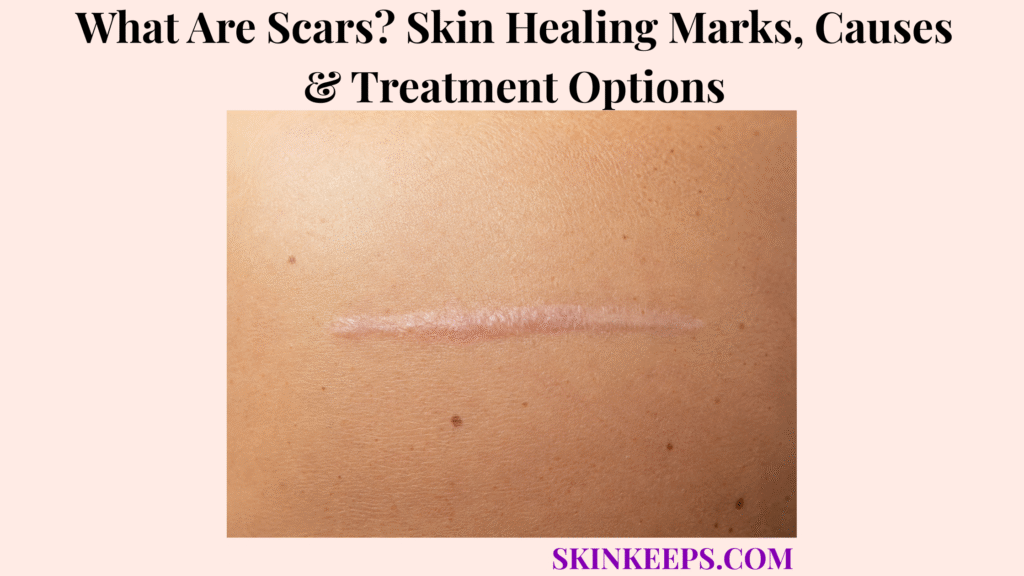
A scar is collagen-rich fibrous tissue that forms when the skin repairs an injury deep enough to disrupt its normal structure. Scar tissue closes and strengthens the injured area, but the repaired tissue can differ from normal skin in collagen arrangement, texture, flexibility, color and skin structures.
Scars can become flat, raised, depressed or contractile, and they continue to mature for many months. The most useful treatment choice therefore starts with scar structure, maturity, symptoms and function rather than with a single product or procedure for every scar.
This article is for educational purposes only. Painful, growing, ulcerated, restrictive or unexplained scar-like lesions should be professionally evaluated.
What Are Scars and What Types of Scar Tissue Can Form?
Scars are structural areas of fibrous repair tissue that form after deeper skin injury and can mature into flat, raised, depressed or tightening patterns depending on how healing occurs.
How Does Normal Wound Healing Create a Scar?
Scar tissue forms as an injured area moves through inflammation, new collagen formation, wound closure and long-term collagen remodeling.
The basic pathway is skin injury → inflammation → collagen-rich repair tissue → closure → remodeling → mature scar. During remodeling, collagen is reorganized and the scar may gradually become flatter, softer, paler or more flexible.
Why Is Scar Tissue Different From Normal Skin?
Scar tissue repairs the damaged area but does not perfectly recreate normal skin, so it can differ in texture, thickness, flexibility, pigmentation and normal skin structures.
Hair follicles and glands may be reduced or absent in some scars, and the collagen architecture is different from uninjured skin. This is why a scar can feel firmer, tighter, less mobile or visually different even after the wound has fully closed.
What Is the Difference Between Flat, Hypertrophic and Keloid Scars?
Flat scars remain level with surrounding skin, hypertrophic scars rise within the original wound boundaries, and keloids extend beyond those boundaries.
A hypertrophic scar may be firm, itchy or painful and can flatten with time. A keloid is more likely to persist or enlarge beyond the original injury and can recur after treatment, making the wound-border distinction clinically important.
What Are Atrophic and Contracture Scars?
Atrophic scars sit below the surrounding skin because supporting tissue is lost, while contracture scars tighten tissue and can restrict movement.
Depressed scars can follow conditions such as acne, chickenpox or trauma. Contractures are especially associated with deeper injuries such as burns and become clinically important when they limit a joint, facial feature or other normal movement.
Figure 1. Scar structure is the first treatment fork: flat, hypertrophic, keloid, atrophic and contracture scars behave differently and need different management.
What Causes Scars and Why Do Some People Develop More Noticeable Scarring?
Scars form after deeper skin injury, while wound depth, size, location, tension, infection and individual susceptibility influence how noticeable or abnormal the final scar becomes.
Which Skin Injuries Commonly Cause Scars?
Cuts, surgery, burns, acne, infections, ulcers and other deeper inflammatory injuries can leave scars when damage extends into skin layers that require fibrous repair.
Superficial injuries may heal with little structural change, while deeper dermal injury usually requires more collagen-rich reconstruction and therefore has a greater chance of leaving a lasting scar.
How Do Wound Depth, Size and Location Affect Scarring?
Deeper or larger wounds generally require more tissue reconstruction and are therefore more likely to leave visible scars.
Location also matters because areas exposed to greater skin tension can form wider or more raised scars. These factors influence probability and appearance; they do not mean every deep or high-tension wound will heal in the same way.
Why Are Some People More Likely to Develop Keloids?
Keloid susceptibility varies with personal and family history, age, anatomical site and skin characteristics, with keloids occurring more frequently in darker skin but not being determined by skin color alone.
The association should be treated as susceptibility rather than causation. A previous keloid is an especially useful practical clue when considering future elective skin injury such as piercing or tattooing.
Can Infection, Scratching or Repeated Trauma Worsen Scarring?
Infection, repeated trauma, scratching and delayed wound healing can disrupt repair and increase the chance of a more noticeable or symptomatic scar.
These are healing modifiers rather than the definition of scarring itself. Protecting a healing wound from repeated reopening or inflammation can reduce preventable worsening without guaranteeing scar-free healing.
Figure 2. The original injury starts scar formation, while wound mechanics, inflammation and individual susceptibility influence how the scar ultimately matures.
How Are Scars Assessed and Distinguished From Other Skin Marks?
Scar assessment focuses on tissue structure, thickness, depth, color, maturity, symptoms, wound boundaries and functional impact rather than appearance alone.
What Features Does a Dermatologist Assess in a Scar?
A dermatologist evaluates scar type, depth or thickness, color, age, location, symptoms, wound-border relationship and effects on movement or function.
Pain, itching, tightness, previous treatment and whether the lesion is stable, enlarging or changing help determine whether observation, scar-directed therapy or further investigation is appropriate.
Why Does Scar Age Matter Before Treatment?
New scars continue remodeling for months or years, so some naturally flatten, soften or change color before reaching a more stable mature appearance.
Many scars continue changing for up to roughly two years or longer. This is why an early scar should not automatically be treated as its final appearance, although symptomatic or abnormal scars may still need earlier professional care.
How Are Scars Different From Post-Inflammatory Dark Marks?
A scar involves structural tissue remodeling, while a post-inflammatory dark mark primarily reflects altered pigmentation without the same raised, depressed or fibrotic architecture.
After acne or another inflammatory lesion, a flat color change may persist without true tissue loss or excess collagen. Treatment decisions should therefore separate pigment contrast from structural scar depth or elevation.
When Does a Scar-Like Lesion Need Further Investigation?
A scar-like lesion should be medically reassessed if it develops unexplained growth, ulceration, recurrent bleeding, a persistent open area or a sudden major change.
Not every long-standing mark is automatically scar tissue. A changing focal lesion or unexplained “scar” without a convincing injury history deserves diagnostic assessment before cosmetic treatment.
Figure 3. A scar is a structural diagnosis. Classification, maturity, symptoms and function come before treatment, while unexplained change requires investigation.
How Are Different Types of Scars Treated?
Scar treatment is type-specific: raised scars need different strategies from depressed scars, while contractures and function-limiting scars may require rehabilitation or surgical correction.
How Do Silicone and Steroid Treatments Help Raised Scars?
Silicone gel or sheets may help soften and flatten selected hypertrophic or keloid scars, while intralesional corticosteroids can reduce raised scar volume, itching and discomfort.
Raised scars often need repeated or combined treatment, particularly keloids. Response varies, and recurrence remains possible, so treatment should be framed as improvement and control rather than guaranteed removal.
When Are Laser, Cryotherapy or Pressure Treatments Used?
Laser, cryotherapy, pressure therapy and related procedures may be used for selected raised or symptomatic scars depending on the scar’s structure and location.
Laser can reduce vascular color, thickness, hardness, itch or other scar features in selected cases, but it does not erase scar tissue. Cryotherapy and pressure methods are also selected according to scar type, site and treatment goals.
How Are Atrophic or Depressed Scars Treated?
Depressed scars may be treated with approaches such as microneedling, resurfacing, fillers, subcision or selected surgical techniques depending on scar depth and tethering.
Subcision is particularly relevant to selected tethered depressed scars because it releases fibrous attachments beneath the depression. Procedure choice depends on anatomy and scar pattern rather than on a universal “best” acne-scar treatment.
When Is Scar Revision Surgery Considered?
Scar revision may be considered when a mature scar significantly affects contour, position, movement or function or remains problematic despite less invasive treatment.
Revision replaces or reshapes one scar with another controlled healing process; it cannot create scar-free skin. Functional restriction, distortion and mature irregular scars are more useful indications than the expectation of complete disappearance.
Figure 4. Scar treatment follows architecture: raised, keloid, depressed, contractile and mature irregular scars have different treatment directions.
How Can Scarring Be Minimized, and When Should a Scar Be Evaluated?
Good wound care, reduced repeated trauma and sun protection can help optimize scar healing, while growing, painful, restrictive or unusually changing scars deserve professional assessment.
How Does Proper Wound Care Reduce Preventable Scarring?
Gentle cleaning, appropriate protection and avoiding repeated wound injury support normal healing and reduce preventable complications that can worsen scarring.
The useful principle is clean gently → protect the healing surface → support closure → avoid repeated trauma. Wound care can optimize healing conditions, but it cannot guarantee that a deep injury will leave no scar.
Why Should Healing Wounds or Scabs Not Be Picked?
Picking or scratching can reopen healing tissue, prolong inflammation and increase the risk of a more noticeable scar.
Repeated trauma can also increase crusting, bleeding or infection risk, which disrupts an otherwise orderly repair process.
How Does Sun Protection Help a Healing Scar?
Sun protection can reduce persistent pigment contrast in healing scars and is especially useful while new scar tissue is still changing.
Broad-spectrum photoprotection helps prevent a new scar from becoming more conspicuously darker or differently colored as it matures. Sun protection supports color maturation; it does not remove the structural scar.
When Should a Scar Be Evaluated by a Dermatologist or Scar Specialist?
Professional evaluation is appropriate when a scar continues growing, becomes increasingly raised or painful, restricts movement, forms a contracture, remains severely depressed or is being considered for procedural treatment.
Persistent itching, poor improvement, recurrent irritation or uncertainty about whether a lesion is actually a scar are also reasonable reasons for assessment. People prone to keloids may benefit from discussing risk before elective skin trauma such as piercing or tattooing. Good wound care can reduce preventable worsening, but no strategy can guarantee scar-free healing after every deep injury.
What Should You Remember About Skin Scars?
Skin scars are structural repair tissue, and the most important management step is identifying the scar type before choosing treatment.
- Scars form when deeper injury heals through collagen-rich fibrous repair.
- Scar tissue differs structurally from normal skin and may remain less flexible.
- Scars can continue maturing for many months and sometimes about two years or longer.
- Flat scars are level with surrounding skin; hypertrophic scars are raised but stay within the wound.
- Keloids extend beyond the original wound and have a greater tendency to persist or recur.
- Atrophic scars are depressed, while contractures tighten tissue and may restrict movement.
- A structural scar is not the same as a pigment-only dark mark.
- Wound depth, size, location, tension, infection and repeated trauma can influence scar outcome.
- Keloids occur more often in darker skin, but skin color alone does not cause them.
- Scar assessment should consider structure, maturity, symptoms and function.
- Silicone, steroid injections, laser, cryotherapy and pressure therapy are selected mainly according to scar type.
- Depressed scars may require microneedling, resurfacing, subcision, filler or other structure-specific treatment.
- Scar revision can improve contour or function but cannot create scar-free skin.
- Gentle wound protection, avoiding picking and sun protection can reduce preventable worsening.
- Growing, ulcerated, bleeding or function-limiting scar-like lesions warrant professional assessment.
Core pathway: Understand scar formation → classify scar type → assess maturity, symptoms and function → choose type-specific treatment → optimize healing → escalate functional or abnormal scars.
Frequently Asked Questions About Scars
The main scar questions concern whether scars disappear, how keloids differ from hypertrophic scars, why scars become raised or depressed, whether old scars can still be treated and whether scars can recur.
Do Scars Ever Go Away Completely?
Most scars do not disappear completely, although many flatten, soften, fade or become much less noticeable as they mature.
What Is the Difference Between a Keloid and a Hypertrophic Scar?
A hypertrophic scar remains within the boundaries of the original injury, while a keloid extends beyond the original wound.
Why Do Some Scars Become Raised While Others Become Sunken?
Raised scars result from excess fibrous tissue formation, while depressed scars form when insufficient supporting tissue remains beneath the repaired surface.
Can Old Scars Still Be Treated?
Yes; mature scars can still be treated, although the best approach depends on scar type, depth, symptoms, location and treatment goals.
Can a Scar Come Back After Treatment or Surgery?
Yes; recurrence is possible, particularly with keloids, and treatment may reduce or reshape scar tissue without eliminating the tendency to form it.
Which Sources Support This Scar Guidance?
MedlinePlus — Scar Revision — Used for scar formation after injury or surgery, wound size/depth/location influences, scar maturation, functional revision and recurrence principles.
American Academy of Dermatology — Scars: Diagnosis and Treatment — Used for raised-scar treatment including silicone/pressure context, corticosteroid injections, laser/light treatment, cryotherapy and surgery.
American Academy of Dermatology — Keloid Scars: Diagnosis and Treatment — Used for keloid assessment, combination treatment, silicone, injections, recurrence and prevention planning.
DermNet — Keloid and Hypertrophic Scar — Used for the wound-border distinction, skin-type susceptibility, symptoms, diagnosis and selected raised-scar therapies.
DermNet — Subcision — Used for subcision as a selected treatment for tethered or depressed scars.
NHS — Scars — Used for scar types, maturation over up to about two years or more, sun protection, treatment expectations and the principle that scars cannot be completely removed.