
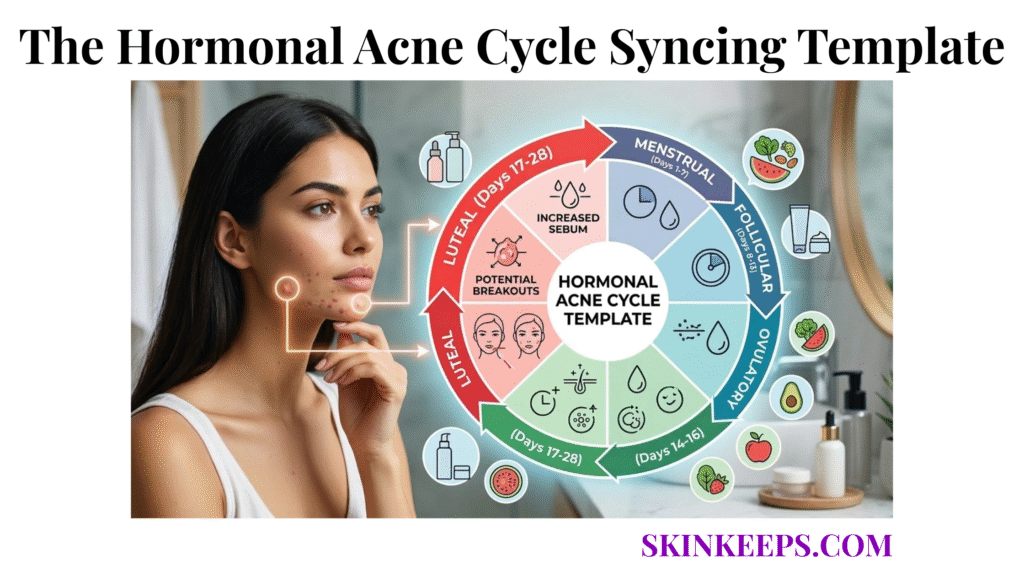
Most people treat hormonal breakouts after the pimple appears, which is biologically too late; however, by using a Hormonal Acne Cycle Syncing Template, you can track your cycle to identify your specific “Danger Window.”
Hormonal acne is highly predictable, yet most treatments fail because they are reactive rather than interceptive. When you wait for a bump to surface, the internal follicular blockage has often been festering for several days. This guide provides a clinical framework to map your biological acne timeline, calculate the lag between your sebum spike and the resulting cyst, and execute a targeted preventative protocol.
By maintaining a strong context vector through the Hormonal Acne Cycle Syncing Template, we shift from surface-level management to chronobiological control. The jawline and neck are specifically sensitive to these shifts due to high androgen receptor density.
What Does the Hormonal Acne Cycle Syncing Template Actually Measure?
The Hormonal Acne Cycle Syncing Template measures the distinct biological timeline between an internal endocrine shift and a physical breakout by quantifying daily sebum production against the days of your menstrual cycle. You cannot stop the hormone shift, but you can intercept the resulting oil spike.
A core parameter of this model is the Biological Lag Time. This term defines the mathematical delay between initial pore blockage (comedogenesis) and the visual eruption of an inflammatory cyst. Identifying this gap is required to ensure topical actives reach the follicle before secondary bacterial infection occurs.
The 5-Step Protocol Framework
- Identify your current menstrual phase via ovulation tracking.
- Track daily oil production to catch the invisible sebum spike.
- Record the exact timing and severity of new inflammatory cysts.
- Calculate the biological lag time between the oil spike and the breakout.
- Start preventative BHA treatment exactly 48 hours prior to the anticipated cyst.
Diagram Breakdown: The Lag Mechanic
This graph illustrates the biological delay between internal chemical shifts and clinical symptoms. As Estrogen falls after ovulation (Day 14), the skin’s sebum “brake” is removed. The red curve highlights the Luteal Phase spike, which precedes physical inflammation by 72–96 hours. Self-diagnosis of hormone levels based on skin alone is discouraged; clinical bloodwork is the gold standard.
Why Does the Hormonal Acne Cycle Syncing Template Focus on the Luteal Phase?
The Hormonal Acne Cycle Syncing Template focuses heavily on the Luteal Phase because this is when Estrogen drops and Progesterone rises, leaving Testosterone relatively dominant and triggering an overproduction of thick, pore-clogging sebum. According to the American Academy of Dermatology (AAD), hormonal fluctuations are the primary driver of adult female acne.
In the Follicular Phase (Days 1–14), Estrogen is the dominant hormone. Estrogen acts as a natural suppressor of sebum and a primary hydrator of the skin barrier. However, during the Luteal Phase (Days 15–28), the androgen imbalance overstimulates the Sebaceous Glands as detailed in the Journal of Investigative Dermatology (2004).
| Cycle Phase | Hormone Shift | Skin Effect |
|---|---|---|
| Follicular (Days 1-14) | Estrogen dominant | Sebum suppressed, barrier hydrated. |
| Luteal (Days 15-28) | Androgen dominance | Sebaceous glands overstimulated. |
Diagram Breakdown: The Cellular Overdrive
Clinical seborrhea isn’t just “oily skin.” As shown, DHT binding to intracellular receptors activates the mTORC1 protein complex, acting as a master switch commanding the sebaceous gland to enter a state of hyper-lipogenesis that overwhelms the pore wall Thiboutot (2004).
How Do You Isolate Triggers Before Starting the Hormonal Acne Cycle Syncing Template?
To ensure accuracy, isolate variables by eliminating environmental and dietary factors that mimic hormonal breakouts. Establish the Independent Variable: The Day of the Cycle (where Day 1 is the first day of bleeding).
- Dairy Intake: Dairy stimulates systemic IGF-1, which upregulates 5α-reductase activity, increasing localized DHT production Melnik (2015). Keep intake at zero during the trial month.
- Stress Levels: Cortisol directly spikes oil production and can mask cycle-dependent results. Note stress levels qualitatively in your log.
- Pillowcase Hygiene: Must be changed every 48 hours to definitively rule out external bacterial infections as a confounding factor.
How to Track Your Sebum Spike With the Hormonal Breakout Tracker
Evaluate your skin’s oiliness on a 1-10 scale at exactly 2:00 PM daily. Scientific observation by Raghunath et al. (2015) confirms that sebum secretion peaks significantly during the late Luteal phase.
| Date | Cycle Day | Phase | Oil (1-10) | New Cysts | Pain (1-10) |
|---|---|---|---|---|---|
| MM/DD | 1-14 | Follicular | 3-4 | 0 | 0 |
| MM/DD | 18 | Luteal | 8 (SPIKE) | 0 | 2 |
| MM/DD | 21 | Luteal | 7 | 2 (CYST) | 9 |
How Do You Calculate Breakout Lag Time Using the Template?
You calculate your breakout lag time by identifying the exact day your sebum production spiked and counting the days until the first deep cyst physically appeared on your skin. Waiting until the cyst appears guarantees treatment failure.
Find Sebum Spike
Example: Day 18 oil hits 8/10.
Find Breakout Point
Example: Day 21 deep cyst appears.
Calculate Lag Time
3 Days: The biological delay.
Diagram Breakdown: The Preventative Intercept
BHA (Salicylic Acid) is lipophilic, allowing it to travel transappendageally through sebum to reach the follicle wall, where it dissolves the cellular bonds holding the clog together before follicular rupture can occur Arif (2015).
How to Execute Preventative Skincare Using Your Data
Knowing your lag time allows you to execute a precise routine that focuses on barrier repair during the Follicular phase and targeted chemical exfoliation exactly 48 hours before a predicted cyst.
Phase 1: Pre-Spike Barrier Prep (The Follicular Window)
Direct your efforts toward hydration and Skin Barrier repair during Days 1-14. Avoid harsh active ingredients during this window so the skin is maximally resilient for upcoming chemical exfoliation.
Phase 2: The 3-Day Targeted BHA Intercept (The Danger Zone)
Hypothesis: “My skin enters the Danger Zone on Day 21. By introducing a Salicylic Acid (BHA) treatment on Day 19, I can clear oil congestion before it becomes a cyst.” Applying BHA only during this peak prevents damage to the barrier during the clear follicular window Arif (2015).
Hormonal Acne Prevention Timeline
- Day 18: Oil spike detected internally.
- Day 19: Start preventative BHA application.
- Day 20: BHA prevents follicular blockage.
- Day 21: Zero new cysts form.
Why Does the Cycle Syncing Acne Protocol Beat Reactive Spot Treatments?
The protocol clears the deep follicular clog before infection occurs. Spot treatments address surface inflammation after the damage is done. Treat the biological calendar, not the pimple.
| Method | Timing | Root-Cause Effectiveness |
|---|---|---|
| Spot Treatment | Reactive (Post-Cyst) | Low (Surface only) |
| Cycle Syncing Protocol | Preventative (Pre-Cyst) | High (Prevents blockage) |
What Are the 5 Rules for Mastering the Hormonal Acne Cycle Syncing Template?
Timing is Everything
Cysts form deep within the follicle days before they are visible on the surface.
The Luteal Shift
Breakouts are driven by the specific drop in estrogen and rising androgen dominance.
The Lag Time Rule
You must mathematically identify the gap between your oil spike and your breakout to intercept the process.
Targeted Exfoliation
BHA treatments are highly effective only when timed perfectly with the oil spike.
Barrier Protection
Avoid over-exfoliating during the Follicular phase to maintain skin resilience.
Frequently Asked Questions About Hormonal Acne Syncing
Tracking sebum production becomes even more critical for irregular cycles. While you cannot predict the date on a calendar, you can still monitor the leading biological indicator—your daily oil score—to identify the surge in real-time.
AHAs like Glycolic Acid are water-soluble and generally less effective at penetrating the dense, lipid-rich sebum plug. For hormonal clogs, the lipophilic nature of Salicylic Acid is the clinical preference as noted by Arif (2015).
At least one full cycle of tracking is required to calculate your initial lag time. However, tracking for three cycles provides a more robust average, accounting for variables like stress and seasonal shifts.
Conclusion: Commit to Preventative Care
Monthly hormonal breakouts are highly predictable events that can be intercepted by meticulously tracking your cycle, controlling variables, and treating the biological timeline rather than the symptom.
Use the template for one full month to find your specific biological “Danger Window.” Stop reacting to your skin, and start syncing with your cycle to prevent breakouts entirely.
Reference List
- Thiboutot D. Regulation of sebaceous gland size and sebum production. J Invest Dermatol. 2004;123(1):1-12. PubMed.
- Melnik BC. Linking diet to acne metabolomics, inflammation, and comedogenesis: an update. Clin Cosmet Investig Dermatol. 2015;8:371-88. DOI.
- Raghunath et al. Profile of acne vulgaris – A clinic-epidemiological study. J Eur Acad Dermatol Venereol. 2015. DOI.
- Arif T. Salicylic acid as a peeling agent: a comprehensive review. Clin Cosmet Investig Dermatol. 2015;8:455-61. DOI.
- American Academy of Dermatology. Adult acne. AAD.