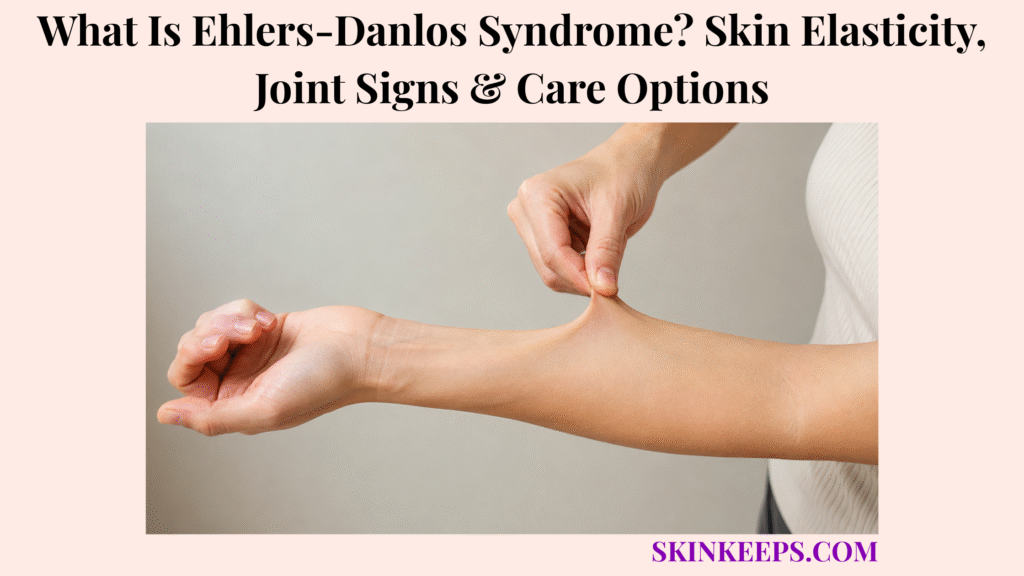
Ehlers-Danlos syndrome is a group of inherited connective-tissue disorders that can affect skin strength, skin elasticity, joint stability, blood vessels, organs, and wound healing.
Ehlers-Danlos syndrome, or EDS, is not diagnosed from stretchy skin alone. This page covers skin signs, joint signs, other symptoms, EDS types, causes, inheritance, similar conditions, diagnosis, care options, skin and wound care, joint protection, urgent vascular risks, mistakes, and doctor-warning signs.
What Is Ehlers-Danlos Syndrome and How Does It Affect Connective Tissue?
Ehlers-Danlos syndrome is a group of inherited connective-tissue disorders that can affect skin strength, skin elasticity, joint stability, blood vessels, organs, and wound healing.
Connective tissue helps support the skin, joints, blood vessels, organs, ligaments, tendons, and many internal structures.
EDS is not contagious and is not caused by poor hygiene, lack of exercise, or one simple lifestyle mistake.
Different EDS types have different main features. Some people have mostly joint symptoms, some have stronger skin signs, and some rare types have serious vascular or organ risks.
Practical rule: Stretchy skin alone does not diagnose EDS. The safer question is whether skin, scars, bruising, joints, family history, and subtype signs form a consistent pattern.
What Skin Elasticity Signs Can Ehlers-Danlos Syndrome Cause?
EDS can cause skin that stretches more than usual, feels soft or velvety, bruises easily, tears more easily, or heals with wide, thin, or sunken scars.
Skin signs vary by EDS type. Some people have obvious skin hyperextensibility and abnormal scars, while others have milder skin changes.
How Is EDS Skin Elasticity Different From Normal Stretchy Skin?
EDS skin elasticity is different from normal stretchy skin when the skin stretches beyond the expected range and occurs with other connective-tissue signs such as abnormal scars, bruising, or joint hypermobility.
Some skin stretch is normal, especially in certain body areas and younger skin.
Skin hyperextensibility becomes more meaningful when it appears with fragile skin, widened scars, easy bruising, frequent joint injuries, or family history.
Why Do Fragile Skin and Abnormal Scars Matter?
Fragile skin and abnormal scars matter because EDS can make skin easier to tear and wounds more likely to heal with wide, thin, or sunken scars.
Classical EDS is especially associated with skin hyperextensibility, atrophic scarring, abnormal wound healing, and generalized joint hypermobility.
Adhesives, friction, procedures, and surgery may need extra planning when skin tears easily or scars widen.
| Skin Sign | What User May Notice | Why It Matters |
|---|---|---|
| Hyperextensible skin | Skin stretches farther than expected. | EDS clue, not diagnosis alone. |
| Soft or velvety skin | Unusually smooth texture. | Supportive feature. |
| Fragile skin | Tears, cuts, or splits easily. | Wound-care issue. |
| Easy bruising | Bruises after minor bumps. | Needs subtype and bleeding-context review. |
| Atrophic scars | Wide, thin, sunken scars. | Classical EDS clue. |
| Poor wound healing | Slow or widened healing. | Surgery and closure planning. |
What Joint Signs Can Ehlers-Danlos Syndrome Cause?
EDS can cause joints to move beyond the usual range, and in some people this leads to pain, clicking, sprains, subluxations, dislocations, or fatigue with daily activity.
Hypermobility can be painless in some people and disabling in others.
Flexibility alone does not confirm EDS; function, injuries, pain, family history, skin signs, and subtype clues matter.
- Extra range of motion.
- Clicking or popping joints.
- Recurrent sprains.
- Subluxations or partial dislocations.
- Full dislocations.
- Joint pain.
- Fatigue from stabilizing loose joints.
- Back, hip, knee, shoulder, wrist, finger, ankle, or jaw involvement.
- Symptoms that affect school, work, walking, sleep, or daily tasks.
What Other Symptoms Can Ehlers-Danlos Syndrome Involve?
EDS can involve more than skin and joints, but symptoms vary widely by type and person.
Some people report chronic musculoskeletal pain, fatigue, headaches, neck pain, digestive symptoms, dizziness, dental or gum issues, hernias, pelvic-floor symptoms, or cardiovascular monitoring needs.
Not every EDS patient has every symptom, and severe arterial, bowel, or uterine rupture risk is mainly a vascular EDS concern.
| Area | Possible Issue | Why It Matters |
|---|---|---|
| Skin | Stretch, bruising, fragile skin, scars. | Diagnosis and wound care. |
| Joints | Hypermobility, sprains, dislocations. | Function and injury prevention. |
| Muscles | Fatigue, pain, stabilization strain. | Rehab and pacing. |
| Digestion | Variable GI symptoms. | Supportive care if present. |
| Heart / vessels | Type-specific risk. | Screening depends on subtype. |
| Pregnancy | Higher-risk in some types. | Specialist planning. |
| Teeth / gums | Type-specific features. | Dental monitoring if relevant. |
What Types of Ehlers-Danlos Syndrome Are Important to Know?
EDS is divided into different types, and the type matters because skin signs, joint signs, inheritance, genetic testing, and complication risks are not the same for every patient.
Current EDS classification uses 13 types, but this page focuses on the main safety patterns rather than turning into a full subtype atlas.
| EDS Type / Group | Main Clue | Why It Matters |
|---|---|---|
| Hypermobile EDS | Generalized joint hypermobility, pain, instability. | Clinical diagnosis; no routine single-gene confirmation currently. |
| Classical EDS | Stretchy skin, atrophic scars, generalized joint hypermobility. | Skin and wound care are important. |
| Vascular EDS | Thin translucent skin, easy bruising, arterial/organ fragility. | Emergency-risk subtype. |
| Kyphoscoliotic types | Scoliosis, hypotonia, joint laxity. | Specialist/genetic care. |
| Arthrochalasia type | Congenital hip dislocation, severe hypermobility. | Early orthopedic/genetic care. |
| Periodontal type | Severe gum/periodontal problems. | Dental/genetic care. |
| Other rare types | Eye, muscle, skin, heart, or skeletal features. | Subtype-specific testing and monitoring. |
What Causes Ehlers-Danlos Syndrome?
EDS is usually caused by inherited genetic changes that affect collagen or related connective-tissue structures, but the exact gene and inheritance pattern depend on the EDS type.
Many EDS types involve collagen or collagen-processing genes, while some affect other extracellular-matrix pathways.
Some types are autosomal dominant, some are autosomal recessive, and a person can also be the first recognized case in a family.
Genetic testing is most useful when the suspected subtype has known genes. Hypermobile EDS currently lacks a single routine diagnostic genetic marker, so a normal genetic test should not be used by itself to erase clinically relevant hEDS or HSD symptoms.
| Cause Pathway | Meaning | Care Implication |
|---|---|---|
| Collagen gene change | Connective tissue structure affected. | Genetic confirmation in many types. |
| Collagen-processing change | Tissue assembly affected. | Specialist testing. |
| Family inheritance | Similar signs in relatives. | Family history matters. |
| New variant | No known family history. | Genetics still possible. |
| hEDS unknown gene | Clinical diagnosis currently. | Criteria-based assessment. |
How Is Ehlers-Danlos Syndrome Different From Other Conditions?
EDS can resemble hypermobility spectrum disorder, Marfan syndrome, Loeys-Dietz syndrome, cutis laxa, fibromyalgia, benign flexibility, or other connective-tissue disorders, so diagnosis should match the full pattern.
Hypermobility spectrum disorder can cause symptomatic hypermobility without meeting EDS criteria.
Bruising alone can also come from many causes, including blood disorders, medications, trauma, or vascular conditions.
| Condition | Main Clue | Why Confusion Happens | Safer Next Step |
|---|---|---|---|
| EDS | Skin, joint, scar, bruising, family, and subtype pattern. | Broad symptoms. | Subtype assessment. |
| HSD | Symptomatic hypermobility without EDS criteria. | Joint overlap. | Hypermobility evaluation. |
| Marfan syndrome | Aortic, eye, and skeletal pattern. | Connective-tissue overlap. | Cardio/genetic review. |
| Loeys-Dietz syndrome | Arterial aneurysm/tortuosity and craniofacial clues. | Vascular overlap. | Genetic/vascular review. |
| Cutis laxa | Loose skin with poor recoil. | Skin laxity overlap. | Skin recoil and subtype review. |
| Fibromyalgia | Widespread pain and fatigue. | Pain overlap. | Do not ignore connective-tissue signs. |
| Benign flexibility | Flexible joints without injury/systemic signs. | Hypermobility overlap. | Monitor only if symptomatic. |
Loose skin that hangs and does not recoil may fit cutis laxa better than EDS skin hyperextensibility, which is often described as stretching and snapping back.
How Is Ehlers-Danlos Syndrome Diagnosed?
EDS is diagnosed by combining medical history, family history, physical examination, joint-hypermobility assessment, skin and scar findings, subtype criteria, and genetic testing when appropriate.
Diagnosis should be full-pattern and subtype-aware rather than based on one online flexibility test.
What Does a Clinician Check During EDS Evaluation?
A clinician checks whether skin, joint, scar, bruising, family history, and subtype-specific features fit an EDS pattern.
The evaluation may include joint range of motion, Beighton score or age-adjusted hypermobility assessment, skin stretch and recoil, skin fragility, bruising history, scar quality, dislocations, subluxations, chronic pain, fatigue, hernias, prolapse, dental or gum signs, eye or spine features, and vascular red flags.
Alternative diagnoses should also be considered when hypermobility, bruising, pain, or fatigue has another explanation.
When Is Genetic Testing Useful?
Genetic testing is useful when the suspected EDS type has known genes and the clinical pattern meets criteria for that subtype.
Many non-hypermobile EDS types can be genetically confirmed when the responsible gene is known.
Hypermobile EDS is currently diagnosed clinically because no single confirmed routine genetic test exists; genetic counseling helps interpret variants and family risk when testing is used.
What Should the Article Say About Updated Diagnostic Criteria?
EDS diagnostic wording should refer to the current criteria while noting that formal updates are scheduled.
As of July 20, 2026, the 2017 framework remains the current practical reference in many settings.
The Road to 2026 process is active, with monogenic EDS publications scheduled for December 2026 and hEDS/HSD diagnostic-pathway work scheduled for March 2027, so this page should be updated after those publications appear.
- Skin stretch, skin fragility, bruising, or abnormal scar photos.
- History of poor wound healing.
- Joint hypermobility areas.
- Sprains, subluxations, or dislocations.
- Chronic pain, fatigue, dizziness, digestive, dental, or pelvic-floor symptoms.
- Family history of EDS, hypermobility, aneurysm, arterial rupture, bowel rupture, uterine rupture, sudden unexplained death, or severe bruising.
- Pregnancy plans or pregnancy complications if relevant.
- Prior genetic testing or family genetic result.
- Surgeries, dental procedures, wound problems, or anesthesia notes.
- Current braces, splints, PT, OT, or pain plan.
- Sudden severe pain, collapse, chest or abdominal symptoms, neurologic signs, or major unexplained bleeding history.
What Care Options Help Ehlers-Danlos Syndrome?
EDS care focuses on protecting joints and skin, reducing injury, managing pain, treating symptoms, monitoring subtype-specific risks, and improving daily function.
There is no single cure for EDS, and care should be individualized by subtype, symptoms, age, function, and risk level.
Care may involve physical therapy, occupational therapy, pacing, pain management, wound planning, dental care, cardiovascular monitoring, vascular planning, gastrointestinal support, autonomic support, orthopedic care, pelvic-floor care, or genetics follow-up when needed.
| Care Need | Care Option | Goal |
|---|---|---|
| Joint instability | PT, strengthening, proprioception. | Fewer injuries. |
| Daily function | OT, pacing, adaptive tools. | Less strain. |
| Pain | Multimodal pain plan. | Better function. |
| Skin fragility | Wound-care planning. | Fewer tears and wide scars. |
| Vascular-risk type | Genetics/cardiology/vascular plan. | Prevent/respond to emergencies. |
| Foot/ankle instability | Supportive footwear/orthotics if needed. | Better alignment. |
| Dental/gum signs | Dental monitoring. | Type-specific prevention. |
How Should Skin and Wounds Be Cared for in EDS?
Skin care in EDS should reduce trauma, protect fragile areas, and plan wound closure carefully when cuts, surgery, or procedures are needed.
Fragile skin may need gentle handling, protective clothing, padding for friction-prone areas, careful adhesive use, and early care for cuts.
If skin is also dry or easily irritated, a gentle barrier-care routine similar to dry skin / xerosis care may help reduce extra friction and cracking, but it does not treat EDS itself.
- Protect fragile or friction-prone skin.
- Avoid unnecessary skin trauma.
- Treat cuts early and gently.
- Use adhesives cautiously if skin tears easily.
- Tell surgeons and dentists about EDS history.
- Plan wound closure carefully.
- Monitor scars and wound reopening.
- Check severe, sudden, or unexplained bruising.
Adhesive irritation, product reactions, or repeated skin inflammation may resemble dermatitis or eczema, so persistent red, itchy, oozing, or inflamed skin should be assessed rather than blamed automatically on EDS.
How Should Joints Be Protected in EDS?
Joint care in EDS should improve stability and function without pushing joints repeatedly into extreme ranges.
Focus on stability, safe movement, gradual strengthening, pacing, and function rather than maximum flexibility.
Braces, splints, supportive footwear, or orthotics may help selected people, but they should be guided clinically so they support function without unnecessary deconditioning.
- Build stability strength gradually.
- Avoid repeated end-range “party tricks.”
- Use safe movement patterns.
- Use pacing for daily tasks.
- Use braces or splints only when clinically appropriate.
- Avoid complete deconditioning.
- Seek PT when pain, subluxations, or injuries are frequent.
- Follow subtype-specific restrictions if vascular EDS is suspected or confirmed.
What Serious EDS Symptoms Need Urgent Care?
Urgent care is needed for sudden severe pain, stroke-like symptoms, chest pain, severe abdominal pain, fainting, major bleeding, sudden shortness of breath, or signs of arterial or organ rupture, especially when vascular EDS is known or suspected.
Vascular EDS is a serious subtype because arteries and hollow organs can be fragile.
Sudden severe symptoms should not be dismissed as ordinary hypermobility pain, chronic pain, anxiety, or “just EDS.”
Emergency red flags:
| Red Flag | Why It Matters |
|---|---|
| Sudden severe chest/back pain | Arterial emergency possible. |
| Severe abdominal pain | Bowel or arterial concern. |
| Stroke-like symptoms | Vascular event possible. |
| Fainting/collapse | Internal bleeding or vascular concern. |
| Sudden shortness of breath | Lung or vascular emergency. |
| Pregnancy severe pain/bleeding | Uterine/vascular risk in vEDS. |
| Major unexplained bruising | Fragility or bleeding concern. |
| Sudden eye swelling/pulsing in vEDS | Carotid-cavernous fistula concern. |
What EDS Care Mistakes Should You Avoid?
The biggest EDS mistake is treating it as either “just flexibility” or diagnosing it from one sign without checking the full skin, joint, family, and subtype pattern.
Do not repeatedly show extreme flexibility for fun if joints are unstable, and do not assume all hypermobility is EDS.
Do not ignore abnormal scars, frequent dislocations, strong family history, vascular red flags, or a normal genetic test that does not explain clinically relevant hypermobility symptoms.
| Mistake | Why It Is Risky | Better Action |
|---|---|---|
| “Stretchy skin = EDS” | Overdiagnosis. | Full criteria-based assessment. |
| “Flexible joints are harmless” | Misses injuries and pain. | Check symptoms and function. |
| Party-trick stretching | Can worsen instability. | Train stability. |
| Ignoring vEDS red flags | Emergency risk. | Genetic/vascular evaluation. |
| Stopping all activity | Deconditioning. | Guided strengthening. |
| Unplanned procedures | Wound/vascular risk. | Tell clinicians early. |
When Should Ehlers-Danlos Syndrome Signs Be Checked by a Doctor?
EDS signs should be checked when skin elasticity or fragile scars occur with joint hypermobility, recurrent dislocations, chronic pain, easy bruising, family history, poor wound healing, or vascular red flags.
Medical review is also appropriate for children with significant hypermobility, pain, injuries, developmental concerns, severe scoliosis, congenital hip dislocation, or early severe symptoms.
Seek medical review if there is:
- Skin hyperextensibility plus abnormal scars.
- Fragile skin or poor wound healing.
- Easy bruising with translucent or fragile skin.
- Generalized joint hypermobility with pain or injuries.
- Recurrent sprains, subluxations, or dislocations.
- Strong family history of EDS, aneurysm, arterial rupture, bowel rupture, uterine rupture, or sudden unexplained death.
- Severe scoliosis, congenital hip dislocation, or early severe symptoms.
- Gum or periodontal disease with suspected EDS features.
- Pregnancy planning with suspected high-risk EDS subtype.
- Sudden severe pain, collapse, chest or abdominal symptoms, neurologic signs, or major unexplained bleeding.
What Should You Remember About Ehlers-Danlos Syndrome?
Ehlers-Danlos syndrome is a group of inherited connective-tissue disorders, so the safest approach is to identify the subtype, protect skin and joints, and monitor serious risks when they apply.
EDS care should be individualized and multidisciplinary, not based on one flexibility sign or a single home test.
- EDS is a group condition, not one single presentation.
- Skin signs can include hyperextensibility, fragility, easy bruising, poor wound healing, and atrophic scars.
- Joint signs can include hypermobility, pain, instability, subluxations, and dislocations.
- Diagnosis should use clinical criteria, family history, subtype assessment, and genetic testing when appropriate.
- Hypermobile EDS is currently diagnosed clinically.
- Care focuses on joint stability, skin protection, pain/function support, and subtype-specific monitoring.
- Vascular EDS has serious arterial and organ risks.
- Urgent symptoms should not be dismissed as ordinary EDS pain.
- Long-term care is multidisciplinary and individualized.
Frequently Asked Questions About Ehlers-Danlos Syndrome
Is Ehlers-Danlos syndrome only stretchy skin?
No. Ehlers-Danlos syndrome is a group of inherited connective-tissue disorders that can affect skin, joints, blood vessels, organs, wound healing, pain, and daily function depending on type.
What skin signs suggest EDS?
Skin signs can include hyperextensible skin, soft or velvety skin, fragile skin, easy bruising, poor wound healing, and wide thin atrophic scars.
What joint signs suggest EDS?
Joint signs can include generalized hypermobility, joint pain, clicking, sprains, subluxations, dislocations, and fatigue from joint instability. Flexibility alone does not confirm EDS.
Is hypermobile EDS confirmed by genetic testing?
Not currently in routine diagnosis. Many EDS subtypes can be genetically confirmed when the responsible gene is known, but hypermobile EDS is currently diagnosed clinically because its genetic basis is still unknown in routine care.
What is the most dangerous type of EDS?
Vascular EDS is generally considered the highest emergency-risk type because of arterial, intestinal, and uterine fragility. That does not mean every person with EDS has vascular EDS.
What care options help EDS?
Care depends on subtype and symptoms, but may include physical therapy, joint protection, pacing, pain management, wound-care planning, cardiovascular or vascular monitoring, dental care, and specialist follow-up.
When should possible EDS be checked urgently?
Urgent care is needed for sudden severe chest, back, head, neck, or abdominal pain; fainting; stroke-like symptoms; sudden shortness of breath; major unexplained bruising or bleeding; severe injury after minor trauma; or pregnancy-related severe pain or bleeding, especially with known or suspected vascular EDS.
Are EDS diagnostic criteria changing?
Current care should follow existing clinical criteria, but formal updates are scheduled through the Road to 2026 process, with monogenic EDS publications planned for December 2026 and hEDS/HSD diagnostic-pathway work planned for March 2027.
Sources & Evidence About Ehlers-Danlos Syndrome
NHS — Ehlers-Danlos Syndromes was used for patient-friendly EDS definition, inherited connective-tissue framing, joint hypermobility, stretchy or fragile skin, bruising, pain, dislocations, and physiotherapy-support context.
DermNet — Ehlers-Danlos Syndrome was used for dermatology-facing skin signs including hyperextensible skin, skin fragility, easy bruising, and joint laxity.
GeneReviews — Classical Ehlers-Danlos Syndrome was used for classical EDS features including skin hyperextensibility, atrophic scarring, generalized joint hypermobility, fragile skin, easy bruising, and poor wound healing.
GeneReviews — Vascular Ehlers-Danlos Syndrome was used for vascular EDS features including arterial, intestinal, and uterine fragility; thin translucent skin; easy bruising; blood-pressure monitoring; and trauma/heavy-lifting caution context.
The Ehlers-Danlos Society — Diagnosis was used for 13 EDS types, diagnostic criteria, hEDS genetic-testing limits, and EDS/HSD framework context.
The Ehlers-Danlos Society — EDS Diagnostics 2017 was used for genetic confirmation framing for EDS subtypes except hEDS and hEDS clinical-diagnosis context.
The Ehlers-Danlos Society — VEDS Emergency Information was used for vascular EDS emergency awareness and arterial or organ rupture risk framing.
The Ehlers-Danlos Society — Road to 2026 FAQ was used for scheduled monogenic EDS publications in December 2026, hEDS/HSD diagnostic-pathway timing in March 2027, and active update-process caution.
Educational Disclaimer: This SkinKeeps article is for educational purposes only and does not diagnose or replace medical care. Stretchy skin, fragile skin, easy bruising, wide or sunken scars, poor wound healing, joint hypermobility, recurrent sprains, subluxations, dislocations, chronic pain, fatigue, family history of EDS, aneurysm, arterial rupture, bowel rupture, uterine rupture, sudden unexplained death, severe scoliosis, congenital hip dislocation, gum disease, suspected vascular EDS, pregnancy planning with suspected high-risk subtype, or symptoms in a child should be reviewed by a qualified healthcare professional. Seek urgent medical care for sudden severe chest, back, head, neck, or abdominal pain; fainting or collapse; stroke-like symptoms; sudden shortness of breath; severe bleeding; major unexplained bruising or swelling; severe injury after minor trauma; or pregnancy-related severe pain or bleeding. Do not self-diagnose EDS from one sign, perform extreme joint-stretching “tests,” stop movement completely, ignore vascular red flags, or start major exercise, bracing, pain-treatment, genetic-testing, surgical, pregnancy, or vascular-risk plans without appropriate medical guidance.