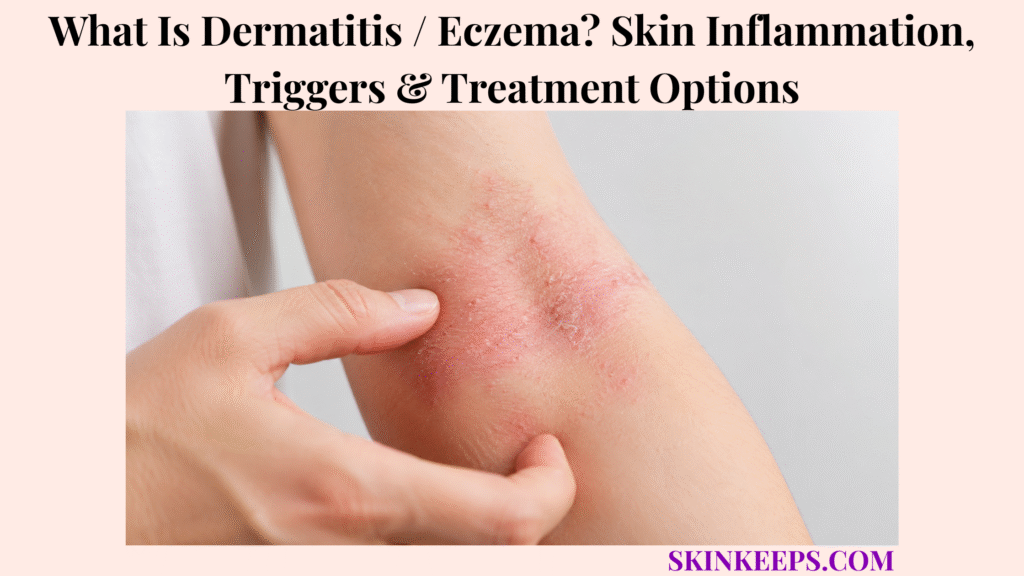
Dermatitis / eczema is a group of inflammatory skin conditions that can make the skin itchy, dry, red, darker, lighter, swollen, scaly, cracked, blistered, crusted, or irritated.
Dermatitis/eczema is not one single rash. This page covers symptoms, locations, types, causes, triggers, similar conditions, diagnosis, treatment options, daily care, flare prevention, mistakes, and doctor-warning signs.
What Is Dermatitis / Eczema and Why Does Skin Become Inflamed?
Dermatitis / eczema is a group of inflammatory skin conditions that can make the skin itchy, dry, red, darker, lighter, swollen, scaly, cracked, blistered, crusted, or irritated.
Dermatitis means skin inflammation, while eczema is commonly used for itchy inflammatory skin conditions. The terms often overlap, but subtype names still matter.
The safest care plan starts by identifying the pattern, body site, trigger, severity, age group, infection risk, and possible mimics.
Are Dermatitis and Eczema the Same Thing?
Dermatitis and eczema are often used together, but the safest way to understand them is as overlapping terms for inflammatory skin conditions with different subtypes.
Some people use dermatitis as the broader term and eczema as the common name for itchy inflammatory rashes.
Specific subtype names such as atopic dermatitis, contact dermatitis, seborrheic dermatitis, dyshidrotic eczema, nummular eczema, or stasis dermatitis guide treatment more safely than calling everything “eczema.”
Why Does the Skin Barrier Matter in Eczema?
The skin barrier matters in eczema because a weakened or inflamed barrier loses moisture more easily and lets irritants trigger more itch and inflammation.
Dryness and scratching can create a cycle: damaged barrier, itch, scratching, more barrier damage, and a stronger flare.
Moisturizer and gentle care are foundational, but active flares may also need anti-inflammatory medicine chosen for the body site, age, and severity.
Practical rule: Do not treat every itchy rash with the same cream. Identify the subtype, trigger pattern, location, severity, and infection signs first.
What Dermatitis / Eczema Symptoms Appear on Skin?
Dermatitis/eczema can cause itching, dryness, rough patches, scaling, redness, darker or lighter discoloration, swelling, cracks, blisters, crusting, or weeping depending on the type and severity.
Itch is common, but appearance varies widely. Some flares are dry and rough, while others are wet, crusted, blistered, thickened, or painful.
What Does Mild Eczema Look and Feel Like?
Mild eczema may look and feel like itchy, dry, rough, tight, sensitive, flaky, red, darker, lighter, or mildly scaly patches that flare and settle.
Skin may sting when products are applied because the barrier is irritated.
Mild flares may improve with gentle care, moisturizer, and trigger reduction, but recurrent patterns still need correct subtype thinking.
What Does Moderate or Severe Eczema Look Like?
Moderate or severe eczema may cause thickened plaques, cracks, oozing, crusting, bleeding from scratching, severe itch, sleep disruption, pain, burning, or widespread rash.
Repeated scratching can make skin thicker, darker, lighter, leathery, or more sensitive.
Oozing, pus, honey-colored crust, fever, spreading warmth, or painful blisters suggest infection or another urgent problem.
How Can Eczema Look on Darker Skin?
On darker skin, eczema inflammation may look purple, gray, brown, darker, lighter, or ashy rather than bright red.
Texture, itch, scaling, dryness, swelling, and thickening may be clearer clues than redness alone.
Post-inflammatory hyperpigmentation or hypopigmentation can remain after flares, especially when skin is scratched, inflamed, or irritated by harsh treatment.
| Symptom | What User May Notice | Why It Matters |
|---|---|---|
| Itch | Scratching, sleep disruption. | Common eczema driver. |
| Dryness | Tight, flaky, rough skin. | Barrier weakness. |
| Scaling | Fine flakes or plaques. | Eczema, psoriasis, or fungal mimic check. |
| Cracks | Painful splits. | Infection risk. |
| Weeping / crusting | Wet areas or yellow crust. | Possible infection or severe flare. |
| Color change | Darker, lighter, purple, gray, brown patches. | Common after inflammation. |
| Blisters | Tiny hand/foot blisters or painful clusters. | Subtype or infection check. |
Where Does Dermatitis / Eczema Usually Appear?
Dermatitis/eczema can appear anywhere, but the location often gives clues about the subtype, trigger, and mimic to rule out.
Babies may show facial or cheek involvement. Children and adults may show flexural, hand, eyelid, scalp, lower-leg, or exposure-site patterns.
A rash that matches jewelry, cosmetics, gloves, adhesives, work chemicals, detergents, masks, or hair products may suggest contact dermatitis.
| Area | Possible Pattern | Trigger or Mimic to Consider |
|---|---|---|
| Face / cheeks | Atopic, contact, or seborrheic dermatitis. | Cosmetics, fragrance, baby eczema, rosacea. |
| Eyelids | Contact dermatitis or atopic dermatitis. | Fragrance, nail products, preservatives, eye drops. |
| Neck | Contact dermatitis or atopic eczema. | Fragrance, jewelry, hair products, clothing. |
| Inner elbows / behind knees | Atopic dermatitis. | Sweat, friction, chronic itch. |
| Hands / fingers | Hand eczema, contact dermatitis, dyshidrotic eczema. | Wet work, detergents, gloves, metals. |
| Scalp / ears | Seborrheic dermatitis. | Dandruff, psoriasis, fungal mimic. |
| Lower legs / ankles | Stasis dermatitis. | Swelling, venous disease, cellulitis mimic. |
| Skin folds | Atopic, irritant, seborrheic, or fungal mimic. | Sweat, friction, yeast, inverse psoriasis. |
What Types of Dermatitis / Eczema Are Important to Know?
Dermatitis/eczema includes several different conditions, and identifying the type helps choose the right treatment and prevention plan.
The same word “eczema” can describe different patterns, so the best next step is often subtype recognition rather than stronger random cream.
What Is Atopic Dermatitis?
Atopic dermatitis is a chronic, relapsing eczema type that often causes dry, itchy, inflamed skin and may be linked with personal or family history of atopic disease.
It can affect babies, children, teens, and adults, with different body sites at different ages.
Care usually focuses on barrier repair, trigger control, anti-inflammatory treatment during flares, and maintenance planning between flares.
What Is Contact Dermatitis?
Contact dermatitis happens when skin reacts to an irritant or allergen that touches it.
Irritant contact dermatitis can follow soaps, detergents, cleaning chemicals, wet work, hand sanitizer overuse, friction, or repeated washing.
Allergic contact dermatitis can follow nickel, fragrance, preservatives, hair dye, rubber additives, adhesives, plants, or cosmetics, and patch testing may help identify delayed allergens.
What Is Seborrheic Dermatitis?
Seborrheic dermatitis is a chronic eczema pattern that affects oily areas such as the scalp, eyebrows, sides of the nose, ears, and chest.
Dandruff is a mild scalp form.
It is linked with an inflammatory response to Malassezia yeast on the skin, not poor hygiene, so care may include antifungal and anti-inflammatory treatment when appropriate.
What Is Dyshidrotic Eczema?
Dyshidrotic eczema causes small, deep, itchy blisters on the palms, sides of fingers, or soles.
It can burn or itch intensely and may crack or peel after blisters dry.
Sweating, metals, irritants, stress, atopic tendency, or work exposure can matter in some people.
What Is Nummular Eczema?
Nummular eczema causes coin-shaped itchy patches that can look like ringworm, especially on the arms, legs, trunk, or hands.
It may ooze or crust during flares.
Diagnosis matters because nummular eczema and ringworm can look similar but need different care.
What Is Stasis Dermatitis?
Stasis dermatitis is lower-leg eczema linked to poor venous circulation, swelling, and skin changes around the ankles or shins.
It may come with leg heaviness, swelling, varicose veins, brown discoloration, fragile skin, scaling, or ulcers.
Fever, warmth, rapid spread, pain, or one-sided swelling should raise concern for infection or circulation-related emergencies.
| Type | Main Clue | Common Location | Treatment Direction |
|---|---|---|---|
| Atopic dermatitis | Chronic itchy dry eczema. | Flexures, face, hands, widespread areas. | Barrier + anti-inflammatory care. |
| Contact dermatitis | Product, work, irritant, or allergen trigger. | Exposure site. | Avoid trigger ± patch testing. |
| Seborrheic dermatitis | Greasy scale or flakes. | Scalp, face, ears, chest. | Antifungal + anti-inflammatory care. |
| Dyshidrotic eczema | Tiny itchy blisters. | Hands and feet. | Trigger control + flare therapy. |
| Nummular eczema | Coin-shaped patches. | Arms, legs, trunk, hands. | Moisturize + rule out ringworm. |
| Stasis dermatitis | Lower-leg rash with swelling. | Ankles, shins. | Venous/edema care + skin treatment. |
What Causes Dermatitis / Eczema?
Dermatitis/eczema happens when skin inflammation develops from a mix of barrier weakness, immune response, irritants, allergens, microbes, genetics, circulation problems, and environmental triggers.
The cause is subtype-specific. A hand rash from wet work has a different pathway from stasis dermatitis around swollen ankles or seborrheic dermatitis on the scalp.
How Does Barrier Weakness Cause Eczema Flares?
Barrier weakness can cause eczema flares by allowing moisture to escape and irritants to enter more easily.
The skin becomes dry, itchy, and easier to inflame.
Scratching creates tiny breaks and worsens inflammation, so barrier repair and itch control support each other.
How Do Irritants and Allergens Cause Dermatitis?
Irritants can directly damage the skin barrier, while allergens trigger immune reactions after a person becomes sensitized.
Fragrance, nickel, preservatives, rubber additives, hair dye, adhesives, soaps, detergents, gloves, cosmetics, and work chemicals are common exposure categories.
The rash pattern often follows the contact site, such as eyelids, neck, hands, wrists, or areas under gear and clothing.
How Do Microbes Affect Some Eczema Types?
Microbes can affect some eczema types by worsening inflammation, causing infection, or contributing to specific patterns such as seborrheic dermatitis.
Staph bacteria can infect broken eczema skin, while Malassezia yeast contributes to seborrheic dermatitis patterns.
Fungal infection can also mimic eczema, so antifungal treatment should match the diagnosis rather than be used for every itchy rash.
How Do Circulation Problems Cause Stasis Dermatitis?
Circulation problems can cause stasis dermatitis when poor venous return leads to lower-leg swelling and chronic skin inflammation.
The skin may become itchy, brown, scaly, fragile, swollen, or ulcer-prone.
Stasis dermatitis needs edema and venous management under clinician guidance, not only steroid cream.
| Cause Pathway | Example | Care Implication |
|---|---|---|
| Barrier weakness | Dry, sensitive, eczema-prone skin. | Moisturize and avoid harsh products. |
| Immune inflammation | Atopic dermatitis. | Anti-inflammatory treatment when needed. |
| Irritant exposure | Soap, detergent, wet work. | Reduce exposure and protect hands. |
| Allergic exposure | Nickel, fragrance, preservatives. | Patch testing and avoidance. |
| Microbial factor | Seborrheic dermatitis, infected eczema. | Antifungal or antimicrobial care if indicated. |
| Circulation issue | Stasis dermatitis. | Edema/venous management. |
What Triggers Dermatitis / Eczema Flares?
Eczema triggers differ from person to person, and many flares happen from several triggers acting together rather than one single cause.
Tracking is often more useful than guessing. The trigger pattern should match the body site, timing, work exposure, product use, weather, sweat, or swelling history.
Which Environmental Triggers Commonly Worsen Eczema?
Environmental triggers that may worsen eczema include cold dry weather, heat, sweating, low humidity, hot showers, rough fabrics, wool, friction, and airborne irritants in some people.
Sweat and heat can worsen itch, while cold dry weather can increase dryness.
Friction from clothing, masks, sports gear, or repeated rubbing can worsen barrier damage.
Which Product Triggers Commonly Worsen Dermatitis?
Product triggers that can worsen dermatitis include fragrance, harsh soaps, detergents, preservatives, cosmetics, hair dye, sanitizer overuse, cleaning chemicals, adhesives, and glove materials.
Nickel jewelry, rubber additives, nail products, eye drops, hair products, and workplace chemicals may matter when the rash pattern matches exposure.
Fragrance-free, low-irritant routines are safer than switching many products during a flare.
Which Body or Health Triggers Can Worsen Eczema?
Body and health triggers can include stress, sleep loss from itch, hormonal shifts in some people, skin infection, sweating, occupational exposure, scratching, and leg swelling in stasis dermatitis.
Food should be considered cautiously only when a clear individual pattern exists or clinician guidance supports testing or dietary changes.
Default elimination diets can be restrictive and may miss more direct triggers such as soap, fragrance, gloves, sweat, or infection.
| Trigger Group | Examples | Tracking Question |
|---|---|---|
| Weather | Cold, heat, humidity changes. | Did the flare follow climate change? |
| Products | Fragrance, soaps, cosmetics. | Did a new product touch the rash site? |
| Work | Wet work, gloves, chemicals. | Does rash improve on days off? |
| Clothing | Wool, tight fabric, friction. | Does fabric contact match rash location? |
| Body factors | Sweat, stress, infection. | Did itch or flare follow sweating or illness? |
| Circulation | Leg swelling. | Is rash on ankles or shins with edema? |
How Is Dermatitis / Eczema Different From Other Skin Conditions?
Dermatitis/eczema can look like psoriasis, fungal infection, scabies, cellulitis, rosacea, acne, drug rash, or cutaneous T-cell lymphoma, so pattern, symptoms, triggers, and treatment response matter.
This section prevents two mistakes: treating a mimic as eczema, and treating eczema like infection or fungus without evidence.
How Is Eczema Different From Psoriasis?
Eczema often has itch, dryness, and barrier sensitivity, while psoriasis often forms thicker, more sharply defined plaques with scale.
Both can affect hands, scalp, folds, elbows, knees, or nails.
Persistent thick plaques, nail changes, or unclear scaling may need dermatology diagnosis.
How Is Eczema Different From Fungal Rash?
Fungal rash may be ring-shaped with a scaly edge, while eczema can form irregular or coin-shaped patches that may mimic ringworm.
Steroid cream can worsen or hide fungal infection.
Foot scale between toes, peeling, itching, and fissures may suggest athlete’s foot rather than eczema-only care.
How Is Eczema Different From Scabies?
Scabies often causes intense itch that is worse at night and may affect close contacts, while eczema is not spread by skin-to-skin infestation.
Burrows may appear in finger webs, wrists, waistline, or genitals.
Scabies needs mite-specific treatment, not eczema cream alone.
How Is Eczema Different From Cellulitis?
Eczema is inflammatory and often itchy, while cellulitis is a bacterial infection that is usually painful, warm, swollen, spreading, and may include fever.
Infected eczema can occur when scratching breaks the barrier.
Fever, spreading warmth, swelling, worsening pain, pus, or a person feeling ill needs prompt medical care.
How Is Eczema Different From Cutaneous T-Cell Lymphoma?
Cutaneous T-cell lymphoma can mimic chronic eczema or psoriasis, so persistent, progressive, treatment-resistant patches need reassessment.
Concern rises with patches that keep enlarging, thick plaques, tumors, swollen lymph nodes, unexplained weight loss, night sweats, or unusual chronic rash behavior.
This does not mean every eczema-like rash is lymphoma, but long-lasting unexplained rash should not be dismissed forever.
| Condition | Main Clue | Why Confusion Happens | Safer Next Step |
|---|---|---|---|
| Dermatitis / eczema | Itchy dry inflamed rash. | Many patterns and body sites. | Subtype diagnosis. |
| Psoriasis | Thick defined plaques. | Scale overlap. | Dermatology if unclear. |
| Fungal rash | Ring or scaly edge. | Coin eczema mimic. | Scraping/antifungal if confirmed. |
| Scabies | Night itch + close contacts. | Itch overlap. | Mite-specific treatment if diagnosed. |
| Cellulitis | Warm painful spreading infection. | Red inflamed skin. | Urgent medical care. |
| Rosacea / acne | Face redness or bumps. | Facial irritation overlap. | Pattern-specific diagnosis. |
| Drug rash | New medicine timing. | Widespread rash overlap. | Medication review. |
| CTCL | Persistent treatment-resistant patches. | Mimics chronic eczema. | Biopsy if suspicious. |
How Is Dermatitis / Eczema Diagnosed?
Dermatitis/eczema is usually diagnosed by skin examination and history, but tests may be needed when the rash is persistent, recurrent, unusual, infected-looking, or not responding to treatment.
Diagnosis should connect the rash pattern with age, location, exposures, triggers, symptoms, product history, work history, medications, infection signs, and treatment response.
What Does a Clinician Check?
A clinician checks rash location, itch severity, skin changes, age of onset, family history, exposures, triggers, infection signs, leg swelling, and response to previous treatments.
The visit may review dryness, scale, blisters, cracks, crusting, weeping, new medicines, weather, sweat, work exposure, gloves, cosmetics, soaps, detergents, and household itching.
Bring photos from flare and calmer days because eczema can change before the appointment.
When Is Patch Testing Useful?
Patch testing is useful when allergic contact dermatitis is suspected, especially with chronic, recurrent, exposure-pattern, occupational, eyelid, face, hand, or neck dermatitis.
Patch testing checks delayed contact allergens, not every food allergy or every airborne allergy.
It is especially useful when a rash keeps returning despite good eczema care or when the pattern matches products, metals, gloves, adhesives, hair dye, or workplace exposure.
When Might Scraping, Swab, or Biopsy Be Needed?
Scraping, swab, or biopsy may be needed when eczema mimics are possible, infection is suspected, or a chronic rash behaves unusually.
A scraping may help when fungus is possible. A swab may help when bacterial or viral infection is suspected.
A biopsy may be used when psoriasis, CTCL, drug eruption, autoimmune disease, or unclear chronic rash remains possible.
- Photos of the rash during flare and calm periods.
- Date rash started.
- Body locations involved.
- Itch severity and sleep impact.
- Products used: soaps, fragrance, cosmetics, hair dye, detergents, gloves.
- Work or school exposures.
- Weather, heat, sweat, or clothing triggers.
- New medicines.
- Prior treatments and response.
- Oozing, crusting, pus, fever, pain, or swelling.
- Household itching or scabies concern.
- Ring-shaped pattern or fungal concern.
- Leg swelling, varicose veins, or lower-leg discoloration.
What Treatment Options Help Dermatitis / Eczema?
Dermatitis/eczema treatment usually combines gentle skin care, moisturizer, trigger control, and anti-inflammatory medication when flares need active treatment.
Treatment depends on type, severity, body site, age, trigger, infection risk, and response. Do not use strong steroid creams, antibiotics, antifungals, food elimination, or systemic medicines randomly.
Why Is Moisturizer a Foundation Treatment?
Moisturizer is a foundation treatment because eczema-prone skin often loses moisture easily and needs barrier support even between flares.
Creams and ointments are often better than thin lotions for very dry skin.
Apply moisturizer soon after bathing and reapply to dry areas as needed, using fragrance-free low-irritant products when possible.
When Are Topical Corticosteroids Used?
Topical corticosteroids are commonly used for active inflamed eczema flares when inflammation needs faster control.
Strength, body site, age, duration, and severity matter.
Face, eyelids, folds, genitals, and children need extra caution; overuse can cause side effects, while undertreated inflammation can keep the flare active.
When Are Non-Steroid Anti-Inflammatory Creams Used?
Non-steroid anti-inflammatory creams may be used when sensitive sites, steroid-sparing plans, long-term maintenance, or side-effect concerns matter.
Options may include topical calcineurin inhibitors, crisaborole, or topical JAK inhibitors in selected patients.
They should follow clinician guidance because not every option fits every age, site, severity, pregnancy status, or medical history.
When Are Antifungal, Antibiotic, or Antiviral Treatments Needed?
Antifungal, antibiotic, or antiviral treatments are only used when the pattern or testing supports yeast, fungus, bacterial infection, or viral infection.
Antifungal care may fit seborrheic dermatitis or confirmed fungal mimics. Antibiotics fit confirmed bacterial infection, not ordinary non-infected eczema.
Painful blisters, fever, swollen lymph nodes, or eye-area involvement can suggest serious infection such as eczema herpeticum and needs urgent medical review.
When Are Phototherapy or Systemic Medicines Considered?
Phototherapy or systemic medicines may be considered for moderate-to-severe, widespread, sleep-disrupting, or treatment-resistant eczema under specialist care.
Options may include phototherapy, biologics, oral JAK inhibitors, or other immunomodulatory medicines depending on diagnosis and patient risk.
These are specialist-led decisions, not self-treatment plans.
| Situation | Treatment Direction | Key Caution |
|---|---|---|
| Mild dry eczema | Moisturizer + trigger control. | Avoid harsh cleansing. |
| Active itchy flare | Topical anti-inflammatory treatment. | Use correct strength/site/duration. |
| Face / eyelid / fold eczema | Steroid-sparing options may fit. | Extra side-effect caution. |
| Seborrheic dermatitis | Antifungal + anti-inflammatory care. | Not a hygiene issue. |
| Infected eczema | Treat infection if confirmed. | Fever/spreading pain needs care. |
| Moderate-to-severe eczema | Phototherapy/systemic options. | Dermatologist-led. |
| Contact dermatitis | Identify and avoid trigger. | Patch testing may be needed. |
| Stasis dermatitis | Skin treatment + edema/venous management. | Check ulcers/cellulitis mimic. |
How Should Daily Skin Care Support Dermatitis / Eczema?
Daily eczema care should protect the skin barrier even when the rash looks calm, because barrier weakness can make future flares easier to trigger.
Use lukewarm water, mild fragrance-free cleanser, gentle drying, and moisturizer soon after bathing. Avoid fragranced lotions, harsh scrubs, and alcohol-heavy products on irritated skin.
Soft breathable fabrics, gloves for wet work, short nails, and early clinician-directed flare treatment can reduce scratch damage and repeated irritation.
- Wash with lukewarm water.
- Use mild fragrance-free cleanser.
- Pat dry instead of rubbing.
- Apply moisturizer soon after bathing.
- Reapply moisturizer to dry areas.
- Avoid fragrance and harsh scrubs.
- Wear soft breathable fabrics.
- Use gloves for wet work or cleaning chemicals.
- Keep nails short.
- Use prescribed flare treatment early when directed.
How Can Dermatitis / Eczema Flares Be Prevented?
Eczema flares cannot always be prevented, but many people can reduce flare frequency by protecting the skin barrier and identifying personal triggers.
A flare diary can help connect rash location with products, weather, sweat, stress, work exposure, clothing, and treatment response.
Track foods only when there is a clear individual pattern or clinician guidance supports it. Do not use food elimination as a default eczema plan.
| Date | Rash Location | Possible Trigger | Products Used | Weather / Sweat / Stress | Treatment Response |
|---|---|---|---|---|---|
- Avoid known irritants and allergens.
- Patch-test new products cautiously on a small area if sensitive.
- Manage sweat and heat when they trigger itch.
- Moisturize before dry weather exposure.
- Protect hands during wet work.
- Treat early signs of flare as directed.
- Review persistent flares with a dermatologist instead of adding more products.
What Dermatitis / Eczema Mistakes Should You Avoid?
The biggest dermatitis/eczema mistake is treating every itchy rash with the same cream without identifying the eczema type, trigger, infection risk, or mimic.
Do not use strong steroid creams on face, eyelids, groin, or children without guidance, and do not stop moisturizer once the flare improves.
Do not scrub active eczema, use fragranced products on irritated skin, repeatedly use antibiotic creams without infection diagnosis, treat every ring-shaped rash as eczema, or rely only on food elimination without clinician guidance.
| Mistake | Why It Fails | Better Action |
|---|---|---|
| Generic rash cream | Wrong subtype or mimic risk. | Diagnose the pattern. |
| No moisturizer | Barrier remains weak. | Daily barrier care. |
| Harsh scrubbing | Worsens inflammation. | Gentle cleansing. |
| Steroid misuse | Side effects or undertreatment. | Correct site/strength/duration. |
| Ignoring infection | Can worsen quickly. | Medical review. |
| Food elimination by default | May not match cause and can restrict diet. | Use clinician-guided testing/history. |
| Treating ring rash as eczema | Steroid can worsen fungal infection. | Check for fungus if pattern fits. |
When Should Dermatitis / Eczema Be Checked by a Doctor?
Dermatitis/eczema should be checked when it is severe, widespread, infected-looking, painful, bleeding, sleep-disrupting, treatment-resistant, recurrent in the same unusual area, or affecting the eyes, face, genitals, hands, infants, or high-risk patients.
Medical review is safer than stronger self-treatment when the rash is changing, spreading, infected-looking, blistered, or not behaving like a known eczema pattern.
Which Eczema Signs Need Medical Review?
Medical review is needed when eczema causes severe itch, sleep loss, pain, burning, oozing, weeping, honey-colored crust, pus, fever, spreading warmth, swelling, cracks, widespread rash, painful blisters, swollen lymph nodes, or treatment failure.
Thick plaques, ring-shaped rash, new rash after medication, or chronic patches that keep returning in one unusual area also need diagnosis.
Blisters near the eyes, painful widespread blisters, fever, fatigue, or swollen lymph nodes can signal serious infection and should not wait.
Which Patients Should Be More Cautious?
Babies, young children, pregnant people, immunosuppressed people, people with diabetes or poor wound healing, and people with eye, hand, occupational, recurrent, or treatment-resistant eczema should be more cautious.
People with suspected allergic contact dermatitis may need patch testing rather than repeated creams.
Long-lasting “eczema” that changes or fails appropriate treatment needs reassessment, especially if plaques, tumors, swollen lymph nodes, systemic symptoms, or unusual distribution appears.
Seek medical review if dermatitis/eczema is:
- Severe or widespread.
- Sleep-disrupting.
- Painful or burning.
- Oozing, weeping, pus-filled, or honey-crusted.
- Associated with fever.
- Rapidly spreading, warm, swollen, or increasingly painful.
- Bleeding or deeply cracked.
- Near the eyes, face, genitals, or hands.
- Blistering near the eyes or painful and widespread.
- Ring-shaped or thick-plaque-like.
- Associated with swollen lymph nodes.
- New after medication.
- Not improving with appropriate care.
- In an infant, pregnant person, immunosuppressed person, or person with diabetes.
- Linked to work exposure, gloves, chemicals, or recurrent hand disability.
What Should You Remember About Dermatitis / Eczema?
Dermatitis/eczema is a group of inflammatory skin conditions, so safe care means matching the plan to subtype, trigger pattern, body site, severity, and infection risk.
Moisturizer and gentle skin care support the barrier, but active flares may need correct anti-inflammatory treatment and persistent or unusual rashes may need testing.
- Dermatitis/eczema is a group, not one exact rash.
- Itch, dryness, scale, cracks, blisters, crusting, and color changes can occur.
- Darker skin may show purple, gray, brown, darker, lighter, or ashy inflammation.
- Subtype matters: atopic, contact, seborrheic, dyshidrotic, nummular, and stasis patterns differ.
- Triggers vary by person and can include products, weather, sweat, friction, work, microbes, and swelling.
- Patch testing can help allergic contact dermatitis.
- Scraping, swab, or biopsy may be needed when the rash is unclear or resistant.
- Treatment often combines moisturizer, trigger control, and anti-inflammatory care.
- Antibiotics, antifungals, antivirals, phototherapy, biologics, and systemic medicines are for selected diagnosed situations.
- Infection signs, eye involvement, severe itch, sleep loss, ring-shaped rash, thick plaques, or treatment failure need medical review.
Frequently Asked Questions About Dermatitis / Eczema
Are dermatitis and eczema the same thing?
They are often used together, but the safest way to understand them is as overlapping terms for inflammatory skin conditions with different subtypes. The subtype still matters.
Is eczema contagious?
No. Eczema itself is not contagious. Infected eczema can contain bacteria or viruses that need medical care, but eczema is not spread like scabies or fungal infection.
What does dermatitis / eczema look like?
It may cause itching, dryness, rough patches, scaling, redness, darker or lighter discoloration, swelling, cracks, blisters, crusting, weeping, pain, burning, or thickened skin depending on type and severity.
What causes eczema flares?
Flares can be triggered by barrier weakness, irritants, allergens, soaps, detergents, fragrance, preservatives, sweat, heat, cold dry weather, friction, stress, infection, work exposure, or circulation problems depending on subtype.
What is the best treatment for dermatitis / eczema?
There is no one best treatment for every case. Treatment depends on subtype, severity, body site, age, trigger, infection risk, and response. Moisturizer, trigger control, and anti-inflammatory treatment are common parts of care.
When is patch testing useful for eczema?
Patch testing is useful when allergic contact dermatitis is suspected, especially with chronic, recurrent, exposure-pattern, occupational, eyelid, face, hand, or neck dermatitis.
Can food cause eczema?
Food is not the main trigger for everyone. Food should be considered cautiously only when a clear individual pattern exists or clinician guidance supports testing or dietary changes.
When should eczema be checked by a doctor?
Medical review is needed for severe itch, sleep loss, pain, burning, oozing, honey-colored crust, pus, fever, spreading warmth, swelling, cracks, widespread rash, painful blisters, eye involvement, ring-shaped rash, thick plaques, swollen lymph nodes, medication-related rash, or treatment failure.
Sources & Evidence About Dermatitis / Eczema
American Academy of Dermatology — Eczema Types and Treatment was used for eczema as a multi-type framework and for atopic, contact, dyshidrotic, nummular, hand, seborrheic, and stasis dermatitis subtype context.
American Academy of Dermatology — Atopic Dermatitis Overview was used for atopic dermatitis as one eczema type, early diagnosis, proper treatment, skin care, medication use, and trigger avoidance framing.
American Academy of Dermatology — Atopic Dermatitis Symptoms was used for itch, rash-like skin changes, dry skin, oozing/crusting, yellow crust as infection concern, and eczema herpeticum warning context.
American Academy of Dermatology — Atopic Dermatitis Diagnosis and Treatment was used for skin care, trigger management, topical corticosteroids, antimicrobial treatment when infection is present, phototherapy, and selected systemic options under dermatologist care.
DermNet — Dermatitis was used for dermatitis as a group of itchy inflammatory skin diseases, common types, darker-skin post-inflammatory hypo- and hyperpigmentation, and treatment categories.
DermNet — Allergic Contact Dermatitis was used for allergen exposure patterns, occupational relevance, contact-site logic, and darker-skin contact dermatitis color changes.
DermNet — Irritant Contact Dermatitis was used for irritant dermatitis as barrier damage from chemical or physical agents, site-of-contact pattern, and patch testing distinction from allergic contact dermatitis.
DermNet — Patch Tests was used for patch testing as contact-allergy testing and for its value in determining allergic contact dermatitis causes.
American Academy of Dermatology — Dyshidrotic Eczema Overview was used for tiny intensely itchy blisters on hands or feet and subtype identification.
American Academy of Dermatology — Nummular Eczema Overview was used for itchy round patches and overlap with other eczema patterns.
National Eczema Association — Eczema Overview was used for trigger variability, diagnosis by medical history, current symptoms and visual skin assessment, and individualized treatment planning.
MedlinePlus — Eczema was used for eczema as a term covering several types of skin swelling and for patient-friendly long-course context.
Educational Disclaimer: This SkinKeeps article is for educational purposes only and does not diagnose or replace medical care. Dermatitis/eczema-like rashes that are severe, widespread, painful, burning, bleeding, blistering, infected-looking, oozing, pus-filled, honey-crusted, fever-associated, rapidly spreading, warm, swollen, eye-related, face-related, genital-related, hand-disabling, infant-related, pregnancy-related, immune-suppression-related, diabetes-related, treatment-resistant, ring-shaped, thick-plaque-like, medication-related, lymph-node-associated, or unclear should be checked by a qualified healthcare professional. Do not use strong steroid creams, antibiotics, antifungals, food elimination, bleaching products, harsh scrubs, or systemic eczema medicines without appropriate medical guidance.