
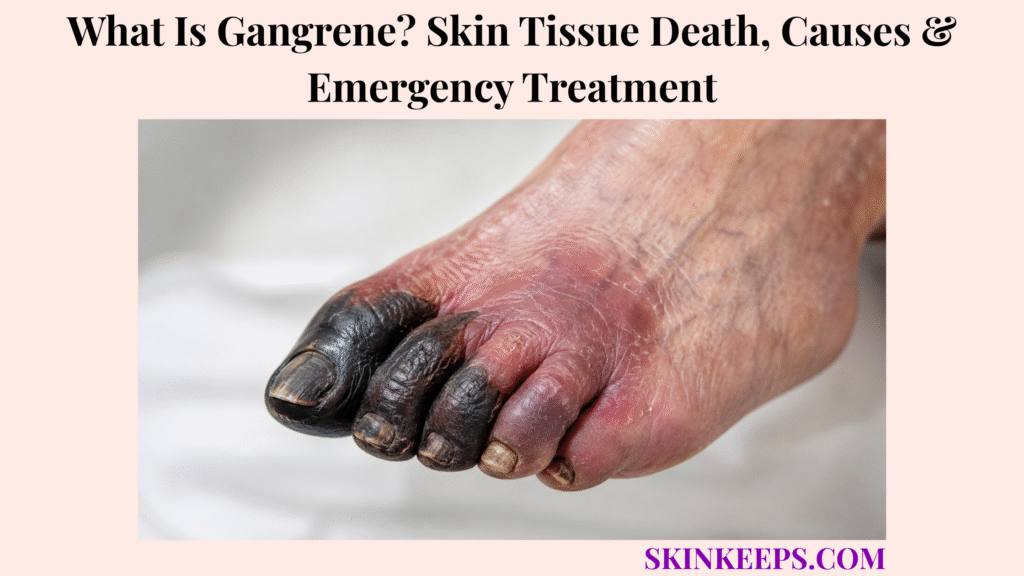
Gangrene is the death of body tissue caused by critically reduced blood flow, a serious infection, or both. It often affects toes, feet, fingers, and limbs, but it can also damage muscle, internal organs, or genital and perineal tissue.
Dead tissue cannot return to normal. Untreated gangrene can spread, cause sepsis, lead to limb loss, or become fatal, and warning signs may begin with severe pain, coldness, swelling, blisters, numbness, discharge, or a non-healing wound before skin turns black.
How Can You Recognize Gangrene in Skin and Soft Tissue?
Gangrene can cause colour change, severe pain, numbness, swelling, blisters, non-healing wounds, discharge, or cold tissue that no longer feels normal.
Local changes may include pale, red, brown, blue, purple, green, grey, or black skin; a thin, shiny, dry, hairless, or shrivelled surface; and a clear boundary between living and dead tissue in some dry cases.
Early infected gangrene may look red, moist, swollen, and blistered rather than black. Sudden severe pain followed by reduced sensation, foul-smelling drainage, pus, or a crackling feeling under the skin is dangerous.
Fever, chills, weakness, confusion, fast breathing, a rapid heart rate, dizziness, fainting, or low blood pressure can signal sepsis or shock even when the visible wound seems small.
| Skin Change | Sensation | Wound Finding | Possible Pattern | Urgency |
|---|---|---|---|---|
| Pale, blue, purple, grey, green, or black | Severe pain then numbness | Non-healing sore | Gangrene possible | Emergency assessment |
| Dry, shrivelled, dark boundary | Cold or numb | Little drainage | Dry gangrene pattern | Urgent vascular and surgical review |
| Red, swollen, moist, or blistered | Severe pain | Pus or foul odour | Wet gangrene pattern | Emergency care |
| Bronze, dark, or rapidly changing | Pain out of proportion | Gas or crackling | Gas gangrene concern | Emergency surgery |
| Genital or groin redness and swelling | Severe pain | Odour or darkening | Fournier concern | Emergency care |
| Any wound with fever or confusion | Variable | May appear limited | Sepsis risk | Emergency response |
Figure 1. Gangrene may begin with severe pain, colour or temperature change, swelling, numbness, or a non-healing wound before dark tissue appears; infection or sepsis signs require emergency care.
What Should You Do Immediately if Gangrene Is Suspected?
Suspected gangrene needs emergency or urgent hospital care because dead or infected tissue can spread and become life-threatening.
- Seek emergency or urgent hospital care immediately.
- Do not wait for the tissue to become black.
- Keep pressure and weight off the affected toe, foot, finger, hand, limb, or wound.
- Cover an open area loosely with a clean, dry dressing.
- Do not cut, squeeze, drain, scrape, peel, puncture, or remove discoloured tissue.
- Do not apply acids, chemical removers, herbal substances, harsh antiseptics, heat, or soaking treatments.
- Do not delay hospital care while trying antibiotics or wound products at home.
- Tell clinicians about diabetes, circulation disease, neuropathy, recent surgery, trauma, burns, frostbite, ulcers, medicines, and immune suppression.
- Call emergency services for severe pain, rapid swelling, fever, confusion, fast breathing, faintness, a cold pulseless limb, or genital/perineal pain and swelling.
Antibiotics alone may not be enough: dead tissue usually requires surgical source control, and ischemic tissue may also require urgent restoration of blood flow.
How Does Gangrene Cause Body Tissue to Die?
Gangrene develops when tissue loses oxygen through failed circulation, destructive infection, or both, causing irreversible cell death and weakening local defence against bacteria.
Blocked or severely narrowed arteries prevent blood from delivering oxygen, nutrients, immune cells, and medicines. Cells die when circulation cannot meet their needs.
Dead or poorly perfused tissue is vulnerable to infection. Some bacteria release toxins or gas that destroy skin, fat, fascia, and muscle, while swelling further compresses blood vessels.
Gangrene is therefore an outcome of necrosis rather than one disease with one universal cause. Dry ischemic tissue can become infected and convert into a faster, wetter emergency.
Figure 2. Critically reduced blood flow deprives tissue of oxygen, while destructive infection adds toxins, gas, and swelling; both pathways can converge on irreversible necrosis and systemic illness.
How Do Dry, Wet, Gas, Internal, and Fournier’s Gangrene Differ?
Gangrene types differ by whether the main driver is blood-flow failure, infected dead tissue, gas-forming bacteria, loss of circulation to an organ, or a necrotizing infection of the genital and perineal region.
What Happens During Dry Gangrene?
Dry gangrene usually develops when circulation to a finger, toe, foot, or limb is gradually reduced or completely blocked.
Tissue may become cold, numb, dry, shrivelled, brown, blue-purple, or black, with a clearer boundary between living and dead tissue. It can progress more slowly than infected gangrene, but “dry” does not mean harmless or suitable for home observation.
What Happens During Wet Gangrene?
Wet gangrene occurs when dead tissue becomes infected or when infection and poor circulation develop together.
The tissue may be swollen, moist, blistered, very painful, and foul-smelling, with pus or cloudy fluid and no clean boundary. It can spread into the bloodstream and needs emergency antibiotics, debridement, and circulation treatment.
What Happens During Gas Gangrene?
Gas gangrene is a rapidly destructive bacterial infection of muscle and soft tissue that can produce gas under the skin.
Severe pain, rapid swelling, dark or bronze discoloration, large blisters, foul discharge, crackling, shock, and organ failure may develop after trauma, surgery, or injury to poorly perfused tissue. Surgical exploration must not wait for every test when suspicion is high.
How Does Internal Gangrene Affect Organs?
Internal gangrene develops when blood flow to an organ such as the intestines, gallbladder, or appendix is blocked, so external skin changes may be absent.
Sudden severe abdominal pain, vomiting, fever, low blood pressure, or sepsis signs require emergency surgical evaluation.
What Is Fournier’s Gangrene?
Fournier’s gangrene is a rapidly spreading necrotizing infection of the genital, perineal, or anal region.
Severe pain, tenderness, swelling, redness, foul odour, skin darkening, fever, weakness, or systemic illness requires immediate broad-spectrum antibiotics and urgent repeated debridement.
| Type | Dominant Cause | Typical Appearance | Speed | Emergency Treatment |
|---|---|---|---|---|
| Dry gangrene | Blood-flow failure | Dry, shrivelled, cold, dark tissue | Often slower | Urgent vascular and surgical assessment |
| Wet gangrene | Dead tissue plus infection | Moist, swollen, blistered, foul drainage | Fast | IV antibiotics, debridement, circulation care |
| Gas gangrene | Toxin and gas-forming infection | Severe pain, swelling, dark tissue, gas | Very fast | Immediate surgery, antibiotics, resuscitation |
| Internal gangrene | Organ blood-flow loss | May have no external skin sign | Urgent | Emergency surgery |
| Fournier’s gangrene | Necrotizing genital/perineal infection | Severe pain, swelling, odour, darkening | Fast | Antibiotics and repeated debridement |
What Causes Gangrene to Develop?
Gangrene develops when tissue is starved of blood, destroyed by infection, or injured in a way that allows both circulation failure and infection to accelerate.
Which Blood-Flow Problems Can Cause Gangrene?
Peripheral artery disease, atherosclerosis, sudden arterial clots, chronic limb-threatening ischemia, diabetes-related vascular disease, trauma, surgery, tight casts or bandages, prolonged compression, shock, vasculitis, burns, and severe cold injury can critically reduce perfusion.
Severe frostbite can kill tissue directly and may later allow infection to develop.
Which Infections Can Cause Gangrene?
Deep wound infection, contaminated crush injury or open fracture, an infected diabetic foot ulcer, postsurgical infection, necrotizing soft-tissue infection, clostridial muscle infection, and genital or perineal infection can destroy tissue.
Poor circulation makes infection harder to control because immune cells and antibiotics reach the site less effectively.
Which Injuries Can Lead to Gangrenous Tissue?
Deep cuts, punctures, crush injuries, open fractures, burns, bites, contaminated wounds, surgery, injections, frostbite, and pressure injury can damage vessels, kill tissue, or provide an entry point for bacteria.
A neglected skin fissure is not gangrene, but an open crack can provide an infection route in a high-risk foot with poor circulation.
| Cause | Blood-Flow Effect | Infection Risk | Possible Pattern |
|---|---|---|---|
| PAD or atherosclerosis | Gradual arterial narrowing | Secondary infection possible | Dry, then wet if infected |
| Sudden arterial clot | Abrupt oxygen loss | Tissue breakdown risk | Rapid ischemic gangrene |
| Diabetic foot wound | Poor healing and neuropathy | High when untreated | Wet or ischemic gangrene |
| Crush injury or open fracture | Direct tissue and vessel damage | Heavy contamination | Wet or gas gangrene |
| Deep surgical wound | Local tissue injury | Postsurgical infection | Wet or gas pattern |
| Frostbite or burn | Direct tissue death | Later infection possible | Dry or infected tissue loss |
| Tight cast or prolonged pressure | Reduced perfusion | Wound breakdown | Ischemic necrosis |
Which Factors Increase the Risk of Gangrene?
Gangrene risk rises when circulation is poor, wounds go unnoticed, infection resistance is reduced, or damaged tissue is not treated early.
Diabetes can combine neuropathy, blood-vessel disease, delayed healing, and infection risk. Gangrene is not inevitable: early foot care and vascular assessment can interrupt this pathway.
- Diabetes and peripheral neuropathy.
- Peripheral artery disease or advanced atherosclerosis.
- Smoking or nicotine exposure.
- High cholesterol, hypertension, and obesity.
- Kidney disease or immune suppression.
- Older age and reduced mobility.
- Previous vascular surgery or amputation.
- History of foot ulcers or poor wound healing.
- Severe trauma, surgery, burns, or frostbite.
- Delayed treatment of infected wounds.
- Poorly fitting footwear that damages numb feet.
- Prolonged pressure or immobility.
| Risk Factor | How It Raises Risk | Warning to Monitor | Prevention Direction |
|---|---|---|---|
| Diabetes | Neuropathy, vascular disease, and poor healing | Unnoticed foot wound | Daily inspection and early treatment |
| Peripheral artery disease | Critically reduced circulation | Cold, painful, discoloured toe | Urgent vascular care |
| Smoking or nicotine | Vessel narrowing and damage | Slow-healing wound | Cessation support |
| Neuropathy | Injury may not be felt | Shoe pressure or burn | Protective footwear |
| Immune suppression | Infection spreads more easily | Fever, pus, swelling | Early hospital care |
| Prior ulcer or amputation | Higher recurrence and pressure risk | New callus, crack, or sore | Podiatry and vascular follow-up |
| Frostbite, burn, or trauma | Tissue and vessel damage | Numbness or colour change | Urgent assessment |
How Is Gangrene Different From Necrosis and Other Serious Skin Conditions?
Gangrene is a clinical pattern of tissue death linked to failed blood flow, serious infection, or both, while several conditions can look similar or use related terminology.
How Is Gangrene Different From General Tissue Necrosis?
Necrosis is the broad term for irreversible cell or tissue death, while gangrene describes clinically important necrosis, commonly with ischemic, wet infected, or gas-forming patterns.
How Is Gangrene Different From Necrotizing Fasciitis?
Necrotizing fasciitis is a rapidly spreading infection of deeper soft tissue that can produce gangrene as tissue dies.
Pain out of proportion, rapidly expanding swelling, fever, confusion, blisters, or dusky skin requires emergency surgery even before black tissue develops.
How Is Gangrene Different From Cellulitis?
A spreading infection such as cellulitis usually causes warm, red, tender, swollen skin, while gangrene means tissue is dead or dying.
Coldness, numbness, gas, foul discharge, a pulseless limb, or dead-looking tissue suggests more advanced circulation failure or necrotizing damage.
How Is Gangrene Different From Pyoderma Gangrenosum?
Pyoderma gangrenosum is not true gangrene despite its name; it is an inflammatory condition that causes painful ulcers.
It is not primarily caused by blocked arteries or destructive bacterial infection, and cutting can worsen some cases, which makes accurate diagnosis essential.
How Is Gangrene Different From a Diabetic Foot Ulcer?
A diabetic foot ulcer is an open wound that may still contain viable tissue, while gangrene means tissue death has occurred.
An ulcer can progress to gangrene when ischemia or infection is not controlled.
| Condition | Blood Flow | Infection | Tissue Death | Pain Pattern | Emergency Level |
|---|---|---|---|---|---|
| Gangrene | Often critically reduced | May be present | Yes | Severe pain then numbness possible | Emergency |
| General necrosis | Variable | Variable | Yes | Variable | Depends on extent and cause |
| Necrotizing fasciitis | May worsen with swelling | Deep and rapidly spreading | Can develop quickly | Pain out of proportion/systemic illness | Emergency surgery |
| Cellulitis | Usually preserved early | Yes | Not by definition | Warm, tender swelling | Urgent if severe or spreading |
| Pyoderma gangrenosum | Not primarily ischemic | Not primarily infectious | Ulceration rather than true gangrene | Painful ulcer | Specialist diagnosis |
| Diabetic foot ulcer | May be reduced | May occur | Not always | May be painless with neuropathy | Urgent if infected or ischemic |
How Do Clinicians Diagnose Gangrene and Determine Its Extent?
Clinicians urgently assess the tissue, look for infection or sepsis, and determine whether enough blood is reaching the affected area.
Examination includes colour, temperature, swelling, sensation, movement, pulses, blisters, drainage, odour, wound depth, and crepitus or gas beneath the skin.
Blood tests evaluate infection, inflammation, kidney function, organ stress, and clotting. Blood, wound-fluid, or tissue cultures help identify organisms without delaying source control.
X-ray may show soft-tissue gas; ultrasound, ankle-brachial pressure testing, arterial studies, CT, MRI, or angiography may map deeper infection or blocked vessels.
When necrotizing infection is strongly suspected, surgical exploration and debridement should proceed without waiting for every scan or laboratory result.
- When colour change, pain, numbness, blister, discharge, or non-healing began.
- Whether symptoms are spreading quickly.
- Exact location, including toe, foot, finger, limb, genital/perineal area, or abdomen.
- Skin colour, coldness, dryness, shine, swelling, and hair loss.
- Severe pain, pain out of proportion, or numbness.
- Pus, odour, gas, crackling, blisters, or drainage.
- Fever, chills, weakness, confusion, faintness, fast breathing, or fast heart rate.
- Diabetes, PAD, nicotine use, neuropathy, kidney disease, or immune suppression.
- Recent trauma, surgery, burn, frostbite, puncture, fracture, or animal bite.
- Previous ulcer, vascular surgery, amputation, or poor healing.
- Medicines, allergies, blood thinners, and antibiotics already taken.
- Whether the hand or foot is cold, pulseless, weak, or difficult to move.
Which Emergency Treatments Stop Gangrene From Spreading?
Emergency treatment removes dead or infected tissue, controls infection, restores circulation when possible, and supports the body if sepsis or shock develops.
How Is Dead or Infected Tissue Removed?
Surgical debridement removes nonviable and infected tissue so necrosis and bacterial spread cannot continue through a poorly perfused wound.
More than one operation may be needed as tissue boundaries evolve. Drainage and negative-pressure wound therapy may be used between procedures in selected wounds.
How Is Infection Treated in Wet or Gas Gangrene?
Infected gangrene needs immediate hospital-level broad-spectrum IV antibiotics, cultures, repeated surgery, IV fluids, oxygen, and organ support when sepsis or shock is present.
Antibiotic choice is adjusted to cultures and clinical response; medicine cannot substitute for removal of dead tissue.
How Is Blood Flow Restored in Ischemic Gangrene?
Angioplasty, vascular stenting, bypass surgery, clot removal, and treatment of underlying arterial disease may restore circulation to tissue that can still survive.
Debridement without correcting severe ischemia can leave the remaining wound unable to heal.
When Is Hyperbaric Oxygen Used for Gangrene?
Hyperbaric oxygen may be an adjunct in selected infections or difficult wounds, but it does not replace urgent surgery, antibiotics, revascularization, or sepsis care.
| Treatment Goal | Intervention | Problem Addressed | What It Cannot Do Alone |
|---|---|---|---|
| Remove dead tissue | Urgent or repeated debridement | Necrosis and infected source | Cannot restore circulation |
| Control infection | IV antibiotics and cultures | Wet/gas gangrene and sepsis risk | Cannot revive dead tissue |
| Support shock | Fluids, oxygen, organ support | Systemic instability | Cannot remove the source |
| Restore circulation | Angioplasty, stent, bypass, or clot treatment | Ischemic gangrene | Cannot remove existing necrosis |
| Support selected wounds | Hyperbaric oxygen | Adjunctive oxygenation | Cannot replace surgery or vascular care |
| Preserve function | Reconstruction and rehabilitation | Recovery after control | Begins after emergency control |
Figure 3. Gangrene treatment combines emergency assessment, source control, infection treatment, circulation restoration, and reconstruction; amputation is based on viability, spread, blood flow, and systemic safety—not colour alone.
When Does Gangrene Require Amputation?
Amputation may be required when tissue is irreversibly dead, infection is spreading, circulation cannot support healing, or the limb threatens the person’s life.
The level can involve a toe, finger, foot, hand, or larger part of a limb and depends on viable tissue, arterial supply, infection extent, function, and systemic stability.
Emergency amputation may be necessary during uncontrollable infection or sepsis. In stable dry gangrene, clinicians may first map circulation and define the dead-tissue boundary.
Black tissue does not automatically mean immediate major amputation. Early revascularization and limited debridement may preserve more tissue in selected cases, but limb salvage cannot be guaranteed.
Decision logic: viable tissue with restorable blood flow → limb-salvage treatment; localised dead tissue → limited removal; spreading infection, sepsis, or nonviable limb → urgent amputation may be required.
How Is the Wound Repaired After Gangrenous Tissue Is Removed?
Wound repair begins after infection is controlled and blood supply is adequate enough to support healing.
Care may include repeated cleaning and reassessment, negative-pressure wound therapy, delayed closure, skin grafting, local or free-tissue flaps, and protection of weight-bearing or pressure areas.
Physiotherapy, occupational therapy, prosthetic assessment, pain and neuropathic-pain care, glucose and nutritional support, and psychological support may be needed after major tissue or limb loss.
Recovery sequence: emergency control → repeat debridement → infection controlled → blood flow optimised → clean viable wound → graft, flap, or closure → rehabilitation and recurrence prevention.
What Complications Can Gangrene Cause?
Gangrene can spread from local tissue death to bloodstream infection, organ failure, amputation, or death when treatment is delayed.
Complications include wet or gas spread, sepsis, septic shock, kidney, lung, or heart failure, clotting abnormalities, extensive tissue loss, chronic wounds, recurrent infection, reduced mobility, and neuropathic or phantom-limb pain.
| Complication | Warning Sign | Why It Matters |
|---|---|---|
| Wet or gas spread | Rapid swelling, extreme pain, foul discharge, gas | Emergency source control |
| Sepsis | Fever, fast breathing, confusion, low blood pressure | Life-threatening systemic infection |
| Tissue loss | Dusky, black, cold, nonviable tissue | May require debridement or amputation |
| Cellulitis or deeper infection | Spreading warmth, redness, tenderness, pus | Infection expanding beyond wound |
| Organ failure | Confusion, low pressure, breathing difficulty, low urine output | Intensive-care support |
| Chronic wound | Failure to heal after source control | Needs circulation and reconstruction review |
| Mobility loss | Foot or limb tissue loss | Rehabilitation and prosthetic planning |
| Psychological distress | Fear, grief, body-image or limb-loss impact | Mental-health and rehabilitation support |
How Can Gangrene Risk Be Reduced?
Gangrene risk falls when circulation is protected, wounds are treated early, infection is controlled, and high-risk feet or limbs are checked before tissue dies.
- Control blood glucose, blood pressure, and cholesterol with clinical care.
- Stop smoking and avoid nicotine exposure.
- Follow treatment and surveillance for peripheral artery disease.
- Inspect feet, toes, and between-toe spaces daily when sensation or circulation is reduced.
- Use a mirror or help from another person to check the soles.
- Wash gently and dry carefully, especially between toes.
- Wear properly fitted footwear and clean socks.
- Avoid barefoot walking when neuropathy is present.
- Treat cuts, blisters, pressure points, and ulcers promptly.
- Do not use chemical corn removers on high-risk feet without professional advice.
- Seek early care for a wound that is not healing.
- Protect skin from burns, severe cold, and pressure injury.
- Follow postsurgical wound instructions.
- Keep podiatry, diabetes, vascular, and wound-care appointments.
When Is Gangrene an Immediate Medical Emergency?
Gangrene is an immediate emergency when tissue is rapidly changing, severely painful, cold, numb, pulseless, blistered, foul-smelling, gas-forming, or associated with systemic illness.
Call emergency services for severe pain followed by numbness, rapidly spreading redness or swelling, gas or crackling, a cold or pulseless hand or foot, large or blood-filled blisters, foul discharge, genital or perineal pain and swelling, fever, confusion, faintness, fast breathing, fast heart rate, or low blood pressure signs.
- Black, blue, purple, green, grey, or rapidly changing tissue.
- Sudden severe pain followed by reduced sensation.
- Rapidly spreading redness or swelling.
- Large, cloudy, or blood-filled blisters.
- Foul-smelling pus or drainage.
- Gas or crackling beneath the skin.
- Cold, numb, weak, or pulseless hand or foot.
- Non-healing wound with new discoloration.
- Severe genital, groin, perineal, or anal pain and swelling.
- Fever, chills, weakness, or confusion.
- Fast breathing, rapid heart rate, dizziness, fainting, or low blood pressure.
- Deterioration after trauma, surgery, frostbite, burn, or diabetic foot injury.
What Should You Remember About Gangrene?
Gangrene means tissue has died from failed blood flow, severe infection, or both, so suspected cases need emergency assessment rather than home treatment.
- Do not wait for skin to become black.
- Severe pain followed by numbness is a dangerous pattern.
- Dry gangrene is still urgent because circulation has failed.
- Wet, gas, and Fournier gangrene can spread rapidly.
- Dead tissue cannot return to normal.
- Antibiotics treat infection but cannot revive dead tissue or reopen an artery.
- Treatment may require debridement, antibiotics, sepsis support, and revascularization.
- Amputation is based on viability and safety, not colour alone.
- Pyoderma gangrenosum is a separate inflammatory ulcer condition.
- Diabetes raises risk but daily foot care and early wound treatment can reduce it.
- A cold pulseless limb, gas, severe swelling, foul discharge, or systemic illness requires emergency care.
What Questions Do People Ask About Gangrene?
Can gangrene begin without black skin?
Yes. Gangrene may begin with severe pain, coldness, swelling, redness, blistering, numbness, discharge, or a non-healing wound before tissue becomes dark or black.
Is gangrene always caused by an infection?
No. Dry gangrene is mainly linked to critically reduced blood flow, while wet and gas gangrene involve infection. Many severe cases involve both circulation failure and infection.
How quickly can gangrene spread?
Spread depends on the type, circulation, infection severity, immune status, and treatment delay. Gas gangrene and necrotizing soft-tissue infections can progress rapidly and require immediate hospital and surgical care.
Is dry gangrene less dangerous than wet gangrene?
Dry gangrene may progress more slowly and may not be infected at first, but it still represents dead tissue and severe circulation failure. It needs urgent vascular and surgical assessment because it can extend or become infected.
Can gangrene heal without surgery?
Dead tissue cannot return to normal. Many cases require debridement, revascularization, drainage, or amputation. A specialist may manage a limited stable area differently, but suspected gangrene should never be observed or treated at home.
Can antibiotics cure gangrene on their own?
Antibiotics treat susceptible infection but cannot revive dead tissue or reopen a blocked artery. Wet or gas gangrene usually needs urgent surgery, and ischemic gangrene may need a blood-flow procedure.
Does every case of gangrene require amputation?
No. The decision depends on tissue viability, infection spread, circulation, systemic stability, and whether blood flow can be restored. Some cases use limited debridement or limb-salvage procedures; others require amputation to save life or function.
Can a person feel pain in dead gangrenous tissue?
Early gangrene can be extremely painful. As nerves die, pain may decrease and the tissue may become numb. Severe pain followed by loss of sensation is a dangerous warning pattern.
Can diabetes cause gangrene in the feet?
Diabetes increases risk through reduced sensation, blood-vessel disease, slow healing, and infection. Gangrene is not inevitable: daily foot checks, proper footwear, glucose and circulation care, and early wound treatment reduce risk.
Is gangrene contagious?
Gangrene is tissue death and is not itself contagious. Some bacteria involved in infected wounds require hospital infection-control precautions, but suspected gangrene should be handled by medical teams rather than home caregivers.
How is gas gangrene different from ordinary gangrene?
Gas gangrene is a rapidly destructive infection of muscle and soft tissue that may produce severe pain, swelling, dark discoloration, blisters, foul discharge, gas beneath the skin, shock, and organ failure. It requires emergency surgery and antibiotics.
Can gangrene return after treatment?
Recurrence is possible when poor circulation, diabetes-related injury, smoking, pressure, infection, or delayed wound care persists. Prevention depends on vascular follow-up, daily inspection, protective footwear, and early treatment of new wounds.
Which Sources Support This Gangrene Guidance?
Mayo Clinic — Gangrene Symptoms and Causes — Definition, local and systemic warning signs, dry/wet/gas/internal/Fournier patterns, risks, complications, and emergency framing.
Mayo Clinic — Gangrene Diagnosis and Treatment — Blood and culture testing, imaging, surgical assessment, antibiotics, debridement, vascular surgery, amputation, grafting, and adjunct oxygen therapy.
Cleveland Clinic — Gangrene — Medical-emergency framing, tissue death, symptoms, circulation and infection pathways, tissue removal, and reconstruction.
StatPearls / NCBI Bookshelf — Gangrene — Pathophysiology, dry/wet/gas classification, ischemic and infectious pathways, diagnosis, and surgical principles.
Cleveland Clinic — Gas Gangrene — Rapid destructive infection, trauma and surgery context, gas-gangrene symptoms, emergency hospital treatment, and surgery.
Cleveland Clinic — Fournier’s Gangrene — Genital and perineal recognition, rapid spread, sepsis risk, emergency antibiotics, and surgical treatment.
MSD Manual Professional — Necrotizing Soft-Tissue Infection — Pain out of proportion, rapid necrotizing spread, IV fluids and antibiotics, and surgery without delay for testing.
NHS — Gangrene — Causes, symptoms, risk factors, urgent treatment, dead-tissue removal, circulation procedures, reconstruction, and prevention.
NHS — Necrotising Fasciitis — Rapid deep infection, early severe pain, later blisters or dark blotches, emergency antibiotics, surgery, and recovery effects.
NHS — Pyoderma Gangrenosum — Painful inflammatory ulcer disorder and its separation from true gangrene.
This SkinKeeps article is for educational purposes only and does not diagnose or replace emergency, vascular, surgical, infectious-disease, wound-care, podiatry, or hospital treatment. Suspected gangrene requires urgent medical evaluation. Black, blue, purple, green, grey, pale, cold, shiny, dry, hairless, blistered, swollen, foul-smelling, pus-producing, gas-crackling, non-healing, severely painful, numb, pulseless, rapidly spreading, genital/perineal, diabetic-foot-related, trauma-related, surgery-related, frostbite-related, burn-related, or infection-related tissue changes should be checked immediately. Seek emergency care for sudden severe pain followed by numbness, rapidly spreading redness or swelling, blood-filled or large blisters, foul-smelling discharge, gas beneath the skin, cold or pulseless hands or feet, fever, chills, confusion, fast breathing, fast heart rate, dizziness, fainting, very low blood pressure, severe genital or perineal pain and swelling, or any non-healing wound with new discoloration. Do not wait for skin to become black, cut or remove tissue at home, squeeze or drain wounds, apply harsh chemicals, use herbal treatments, heat or soak the tissue, delay hospital care, rely on antibiotics alone, or confuse gangrene with pyoderma gangrenosum.