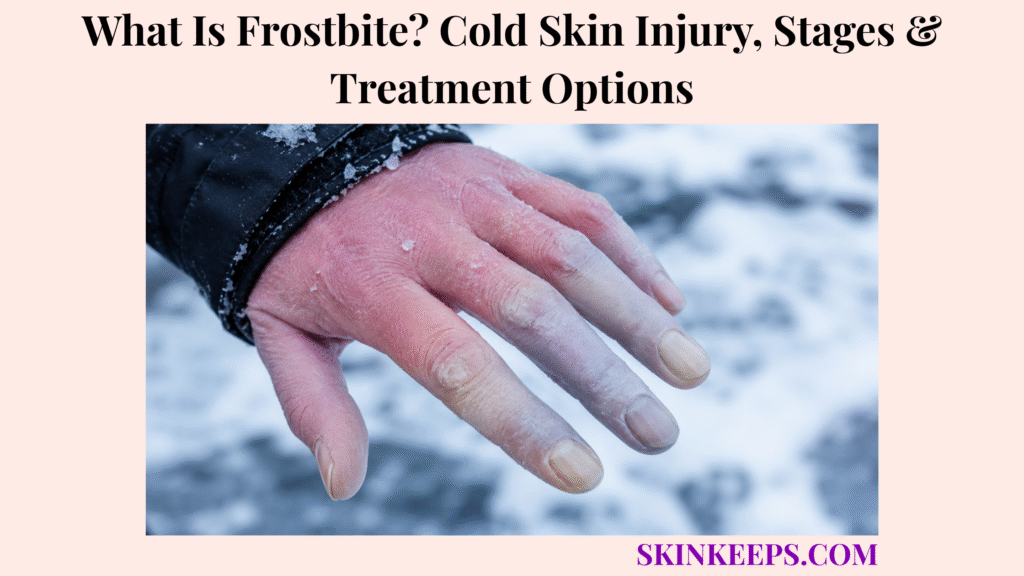
Frostbite is an injury that happens when skin and underlying tissues freeze after severe cold exposure, most often affecting the fingers, toes, ears, nose, cheeks, and chin.
Numbness can hide worsening damage. Frostnip may resolve without permanent injury, but suspected superficial or deep frostbite needs medical assessment because severe freezing can damage nerves, blood vessels, muscle, bone, and tissue viability.
How Can You Recognize Frostbite Before the Injury Deepens?
Frostbite may begin with intense coldness, tingling, stinging, burning, aching, numbness, or skin that looks pale, red, waxy, unusually firm, or different from the surrounding area.
Reduced sensation can prevent a person from noticing that the injury is progressing. Poor finger or toe movement, increasing firmness, or complete numbness after cold exposure should not be dismissed because the area no longer hurts.
Worsening injury may cause white, blue, grey, purple, brown, black, or blotchy tissue; marked swelling after thawing; clear, milky, or blood-filled blisters; and hard dead-looking tissue. Colour change may be harder to recognise on brown or Black skin, so temperature, texture, swelling, pain, sensation, and movement also matter.
| Early Warning Sign | Worsening Sign | Likely Urgency |
|---|---|---|
| Cold, tingling, stinging, or aching skin | Persistent numbness or reduced movement | Leave the cold and protect the area. |
| Red, pale, or unusual colour change | White, blue, grey, purple, brown, or blotchy tissue | Prompt medical assessment. |
| Firm or waxy texture | Hard frozen skin | Emergency care. |
| Mild swelling | Severe swelling after thawing | Medical care. |
| No blistering | Clear, milky, or blood-filled blisters | Emergency or specialist assessment. |
| Pain returns with warming | Severe pain during or after rewarming | Emergency care. |
| Sensation returns quickly | Persistent numbness | Medical review. |
| Colour and softness return | Black, hard, or dead-looking tissue | Emergency specialist care. |
Figure 1. Early pain or tingling can progress to numb, waxy, hard tissue; blisters, severe swelling, black tissue, loss of movement, or hypothermia signs require emergency care.
What Should You Do Immediately When Frostbite Is Suspected?
When frostbite is suspected, leave the cold, check for hypothermia, protect the frozen tissue, and prevent it from refreezing.
- Move indoors or into a warm, sheltered location.
- Check for intense shivering, confusion, fumbling hands, slurred speech, drowsiness, slow breathing, trouble walking, trauma, or altered consciousness.
- Remove wet clothing, rings, jewellery, tight boots, and other constricting items carefully before swelling increases.
- Protect the frozen area from rubbing, pressure, and additional cold.
- Seek medical care for suspected frostbite beyond rapidly improving frostnip.
- Rewarm only when the tissue can remain thawed and refreezing is no longer possible.
- Use circulating warm—not hot—water when controlled rewarming is appropriate.
- After thawing, dry gently and use loose, clean, dry dressings.
- Avoid unnecessary walking on frostbitten feet or toes.
Hypothermia takes priority: confusion, slurred speech, drowsiness, severe shivering, slow breathing, fumbling hands, or trouble walking requires emergency care because core body cooling can be life-threatening.
Mild frostnip may respond to protection and careful warming, but true tissue-freezing injury is difficult to stage before and immediately after thawing.
How Should Frozen Skin Be Rewarmed Safely?
Frozen tissue should be rewarmed only when a sustained thaw can be maintained and the area will not freeze again.
When proper rewarming is appropriate, immerse the affected part in circulating water maintained at about 37–39°C / 98.6–102.2°F. Warm—not hot—water reduces burn risk in numb tissue.
Continue until the tissue becomes soft and pliable and its colour begins to change toward red or purple. Rewarming can be intensely painful. If a controlled water bath is unavailable, adjacent body heat may support the area while medical help is arranged, but direct heat must not be used.
After thawing, air-dry or gently blot the area, separate affected fingers or toes with loose dressings when advised, protect it from pressure, and arrange medical assessment.
- Rewarm only when refreezing can be prevented.
- Use warm—not hot—water.
- Maintain about 37–39°C / 98.6–102.2°F.
- Keep the water temperature controlled and circulating.
- Continue until tissue is soft and pliable.
- Expect significant pain during rewarming.
- Dry gently; never rub.
- Cover loosely and seek medical care.
Figure 2. Safe frostbite care starts with shelter and hypothermia screening, delays thawing when refreezing is possible, and uses controlled warm-water rewarming only when a sustained thaw can be maintained.
Which Frostbite First-Aid Mistakes Can Worsen Tissue Damage?
Frozen or numb tissue can be damaged further by rubbing, overheating, refreezing, compression, unnecessary walking, or opening blisters.
| Unsafe Action | Why It Causes Harm | Safer Response |
|---|---|---|
| Rubbing or massage | Mechanically injures fragile frozen tissue. | Protect the area and rewarm correctly. |
| Rubbing with snow | Adds cold exposure and abrasion. | Move to shelter. |
| Ice or cold packs | Extends cold injury. | Prevent further heat loss. |
| Heating pad, fire, stove, dryer, or radiator | Numb tissue can burn without warning. | Use monitored warm water when safe. |
| Hot bath or hot water | Temperature may be uncontrolled and cause burns. | Use 37–39°C warm water. |
| Walking on frostbitten toes or feet | Adds pressure and tissue trauma. | Avoid walking unless evacuation requires it. |
| Popping or cutting blisters | Increases wound and infection risk. | Leave blister care to clinicians. |
| Tight bandage | May reduce circulation as swelling develops. | Use loose, bulky protection. |
| Alcohol for warmth | Impairs judgement and heat regulation. | Use a warm nonalcoholic drink if fully alert. |
| Thawing before refreezing risk ends | A second freeze–thaw cycle worsens damage. | Delay active thawing until sustained warmth is possible. |
Do not delay help because a frozen area stops hurting. Loss of pain may reflect deeper numbness rather than recovery.
How Does Frostbite Damage the Skin and Deeper Tissues?
Frostbite damages tissue through reduced circulation, ice-crystal formation, cell and blood-vessel injury, and post-thaw inflammation and clotting.
Cold causes intense blood-vessel narrowing to preserve core heat. As local blood flow falls and tissue freezes, ice crystals disrupt cells and small vessels.
During thawing, swelling, inflammation, blood stagnation, and small-vessel clotting can further reduce oxygen delivery. This freeze–thaw and late ischemic injury explains why tissue damage can continue after the skin is warm again.
Lower temperatures, longer exposure, wind, wetness, compression, and poor circulation increase the risk that superficial injury will extend into fat, muscle, tendon, nerve, or bone.
Mechanism: cold vasoconstriction → reduced blood flow → tissue freezing → ice-crystal injury → thaw-related swelling and inflammation → microvascular clotting → recovery or tissue death.
How Do Frostnip, Superficial Frostbite, and Deep Frostbite Differ?
Frostnip is a reversible nonfreezing warning injury, while superficial and deep frostbite involve actual tissue freezing.
How Does Frostnip Warn That Frostbite May Be Developing?
Frostnip causes cold, pale, tingling, painful, or numb skin that improves with protection and warming and does not usually cause permanent tissue loss.
It signals that the environment can cause true frostbite if exposure continues. The area should be warmed promptly and protected from further cold.
What Happens During Superficial Frostbite?
Superficial frostbite affects the skin and superficial tissues, causing frozen or numb skin before thawing and redness, swelling, stinging, burning, or clear or milky blisters after rewarming.
The tissue-loss risk is usually lower than with deep injury, but a clinician still needs to assess true frostbite and monitor blister and circulation changes.
What Happens During Deep Frostbite?
Deep frostbite extends below the skin and can damage fat, muscle, tendon, nerve, blood vessels, and bone.
Profound numbness, hard waxy tissue, reduced movement, blood-filled blisters, blue-grey or black tissue, and severe swelling indicate greater risk of infection, permanent dysfunction, tissue loss, and amputation.
| Injury Level | Sensation | Appearance | Blister Pattern | Depth and Risk |
|---|---|---|---|---|
| Frostnip | Pain, tingling, or numbness that improves. | Cold, pale, or red. | None. | Nonfreezing warning injury; usually reversible. |
| Superficial frostbite | Numb before thaw; pain after rewarming. | Firm/pale, then red, purple, or swollen. | Clear or milky. | Skin and superficial tissue; medical assessment needed. |
| Deep frostbite | Profound numbness and poor movement. | Hard, waxy, blue, grey, purple, or black. | Blood-filled or absent in the deepest injury. | Skin plus deeper tissue; tissue-loss and amputation risk. |
Figure 3. Frostnip is a reversible nonfreezing warning injury; superficial and deep frostbite involve actual tissue freezing, with deeper injury carrying greater tissue-loss and functional risk.
How Do Clinicians Classify the Four Degrees of Frostbite?
Clinicians may describe frostbite in four degrees, but the final degree may not be clear until after thawing, blister evolution, and repeated assessment.
| Degree | Tissue Depth | Typical Post-Thaw Pattern | Tissue-Loss Risk | Clinical Direction |
|---|---|---|---|---|
| First degree | Surface skin. | Redness, numbness, mild swelling, firm pale plaque, little blistering. | Low. | Assess if true frostbite is suspected. |
| Second degree | Superficial skin. | Clear or milky blisters with redness and swelling. | Lower than deep injury. | Wound care and monitoring. |
| Third degree | Deeper skin and vascular tissue. | Blood-filled blisters and cyanotic change. | Higher. | Urgent specialist assessment. |
| Fourth degree | Subcutaneous tissue, muscle, tendon, or bone. | Deep necrosis, poor circulation, or gangrene. | Highest. | Tissue-salvage and surgical planning. |
Superficial frostbite generally corresponds to first- and second-degree injury, while deep frostbite generally corresponds to third- and fourth-degree injury. One hand or foot can contain areas of different depth.
Which Body Areas Are Most Vulnerable to Frostbite?
Frostbite most often affects fingers, toes, ears, nose, cheeks, and chin because they are exposed, farther from the warm core, or supplied by smaller vessels.
Wet or compressed clothing can allow frostbite beneath covered skin. Tight boots and gloves reduce circulation, while wet socks or gloves increase heat loss.
| Common Site | Exposure Pattern | Protective Strategy |
|---|---|---|
| Fingers | Wind, wet gloves, tool contact, or poor circulation. | Insulated mittens or properly fitted gloves. |
| Toes | Tight boots, wet socks, cold ground, or reduced sensation. | Dry socks and insulated non-compressive footwear. |
| Ears | Direct wind exposure. | Hat or headband fully covering the ears. |
| Nose | Exposed cold air and wind. | Scarf, mask, or face covering. |
| Cheeks | Wind and uncovered skin. | Windproof face protection. |
| Chin | Exposed lower face. | Scarf or balaclava. |
| Covered skin | Wet, tight, or insufficient clothing. | Dry, loose insulating layers. |
Which Conditions and Behaviours Increase Frostbite Risk?
Frostbite risk rises when cold exposure is severe, wet, windy, prolonged, or combined with poor circulation, reduced sensation, impaired judgement, or limited movement.
Which Environmental Conditions Raise Frostbite Risk?
Subfreezing temperature, wind chill, wet clothing, prolonged exposure, high altitude, direct contact with cold metal or liquid, inadequate shelter, and tight equipment can accelerate tissue cooling.
Which Personal and Medical Factors Raise Frostbite Risk?
Diabetes, peripheral vascular disease, Raynaud-type circulation problems, dehydration, malnutrition, nicotine use, previous frostbite, reduced mobility, fatigue, age extremes, alcohol, and medicines or illnesses affecting circulation or temperature regulation increase vulnerability.
| Environmental Exposure | Personal Vulnerability | Combined Risk | Prevention Action |
|---|---|---|---|
| Wind chill | Poor circulation. | Faster cooling of digits. | Windproof layers and early exit. |
| Wet socks or boots | Diabetes or numb feet. | Injury may be missed. | Dry footwear and frequent checks. |
| High altitude | Dehydration or fatigue. | Lower heat reserve. | Eat, hydrate, and rest. |
| Tight gloves or boots | Vascular disease or Raynaud pattern. | Reduced blood flow. | Use properly fitted gear. |
| Alcohol or substances | Impaired judgement. | Delayed recognition and shelter. | Avoid use before cold exposure. |
| Previous frostbite | Cold sensitivity and altered circulation. | Higher reinjury risk. | Extra insulation and buddy checks. |
How Is Frostbite Different From Other Cold-Related Conditions?
Frostbite is local tissue freezing, while hypothermia, chilblains, and trench foot involve different cold-injury mechanisms and priorities.
How Does Frostbite Differ From Hypothermia?
Frostbite affects a local body part, while hypothermia is a dangerous fall in core body temperature that affects the whole body.
Intense shivering, confusion, fumbling hands, slurred speech, drowsiness, slow breathing, and trouble walking suggest hypothermia. Moderate or severe hypothermia takes priority, although both conditions can occur together.
How Does Frostbite Differ From Chilblains?
Frostbite involves frozen tissue, while chilblains usually follow cold, damp, nonfreezing exposure and cause itchy, painful, inflamed patches as the skin warms.
How Does Frostbite Differ From Trench Foot?
Trench foot, or immersion foot, is a nonfreezing injury caused by prolonged wet and cold exposure, mainly affecting the feet.
The feet may become numb, swollen, painful, heavy, or discoloured. Its drying and passive-warming pathway differs from rapid water rewarming for frozen tissue.
| Condition | Freezing Present? | Body Pattern | Key Symptoms | Immediate Priority |
|---|---|---|---|---|
| Frostbite | Yes. | Fingers, toes, nose, ears, cheeks, or chin. | Numb hard/waxy tissue, blisters, discolouration. | Prevent refreezing and obtain medical assessment. |
| Frostnip | No true tissue freezing. | Exposed skin. | Tingling, pain, numbness that resolves. | Warm and protect. |
| Hypothermia | Core cooling rather than local freezing. | Whole body. | Shivering, confusion, slurred speech, drowsiness. | Emergency core-warming care. |
| Chilblains | No. | Fingers, toes, ears, or exposed skin. | Itchy or painful inflamed patches. | Protect from cold/damp; assess severe cases. |
| Trench foot | No. | Feet after prolonged wet cold. | Numbness, swelling, pain, discolouration. | Dry, protect, and obtain medical review. |
How Do Clinicians Diagnose Frostbite and Determine Its Severity?
Clinicians combine the cold-exposure history with repeated examination of colour, texture, temperature, sensation, movement, circulation, and blisters after rewarming.
They ask about temperature, wind, wetness, altitude, exposure duration, direct cold contact, thawing and refreezing, first aid, hypothermia symptoms, trauma, medical risks, and the time of rewarming.
Examination includes pulses, capillary circulation, joint movement, sensation, swelling, blister type, anatomical extent, and signs of infection or compartment syndrome. Because tissue viability changes after thawing, repeat examinations are often more informative than one early photograph.
Selected severe injuries may need angiography, bone scanning, magnetic resonance angiography, or other imaging to estimate blood flow and tissue viability. Imaging is not required for every mild cold injury.
- Start and end time of cold exposure.
- Temperature, wind, wet clothing, altitude, and shelter.
- Whether tissue thawed and then refroze.
- Affected fingers, toes, ears, nose, cheeks, chin, hands, or feet.
- Pain, tingling, burning, aching, numbness, or poor movement.
- Hard or waxy skin, swelling, blisters, or dark tissue.
- Rubbing, snow, direct heat, warm water, walking, or dressings already used.
- Shivering, confusion, slurred speech, drowsiness, or trouble walking.
- Diabetes, poor circulation, Raynaud pattern, nicotine use, or previous frostbite.
- Medicines, alcohol or substance use, dehydration, fatigue, trauma, or unconsciousness.
- Time of rewarming and whether sensation or pain returned.
- Drainage, fever, spreading redness, or other infection signs.
Which Treatments Are Used After Frostbite Has Been Rewarmed?
Post-thaw treatment depends on depth, circulation, blister pattern, tissue-loss risk, infection, and whether the injury is superficial or deep.
How Is Superficial Frostbite Treated?
Superficial frostbite care may include controlled rewarming if still frozen, strong pain control, elevation, loose bulky dressings, finger or toe separation, blister and wound management, tetanus review, and follow-up.
Antibiotics are not automatically used for every frostbite injury. They are reserved for infection, cellulitis, sepsis, or another clinical indication.
How Is Deep Frostbite Treated?
Deep frostbite is a time-sensitive tissue-salvage problem that may require admission, urgent specialist transfer, advanced imaging, circulation monitoring, wound care, and burn, vascular, surgical, or emergency consultation.
Rehabilitation and protection of an injured hand or foot may begin early because loss of sensation, stiffness, weakness, and altered load can persist.
When Are Iloprost or Thrombolytic Treatments Considered?
Iloprost or tissue plasminogen activator may be considered only for selected severe deep frostbite when major tissue loss is threatened.
These specialist medicines aim to improve blood flow or address small-vessel clotting. The 2024 Wilderness Medical Society guideline supports tPA for selected severe frostbite within about 24 hours and recommends iloprost as soon as possible, ideally within 48 hours after thawing, with selected consideration up to 72 hours.
They have bleeding, blood-pressure, contraindication, monitoring, imaging, and facility requirements and are not routine treatment for frostnip or mild superficial injury.
| Injury Level | Treatment Direction | Main Caution |
|---|---|---|
| Frostnip | Supportive warming and protection. | Prevent progression and re-exposure. |
| Superficial frostbite | Controlled rewarming, pain care, dressings, elevation, and monitoring. | True frostbite still needs assessment. |
| Deep frostbite | Urgent specialist care, imaging, and tissue-salvage evaluation. | Time-sensitive. |
| Selected severe deep injury | Iloprost or tPA may be considered in expert settings. | Strict time windows, risks, and contraindications. |
| Infected tissue | Antibiotics and surgical care when indicated. | Watch for sepsis. |
| Nonviable tissue | Delayed surgery planning unless infection demands earlier action. | Avoid premature tissue removal. |
When Does Frostbite Require Surgery or Amputation?
Frostbite surgery is usually delayed until clinicians can distinguish tissue that may recover from tissue that is irreversibly dead, unless infection or sepsis creates an urgent threat.
Repeated examinations and vascular or nuclear imaging may help estimate tissue viability. Complete demarcation can take 1–3 months, so black tissue does not automatically mean immediate amputation.
Urgent surgery may be required for sepsis from infected frostbitten tissue, compartment syndrome, or another limb-threatening complication. Otherwise, debridement or amputation is planned after the boundary is clearer.
Reconstruction, footwear and orthotic changes, occupational therapy, physical rehabilitation, and psychological support may be needed after major tissue loss.
Recovery sequence: rewarming → swelling and blister evolution → repeated tissue assessment → imaging when severe → demarcation → rehabilitation, debridement, reconstruction, or delayed amputation when needed.
What Complications Can Frostbite Cause During and After Recovery?
Frostbite can cause acute tissue loss and long-term nerve, circulation, movement, sweating, nail, and cold-sensitivity problems even after the surface closes.
Which Immediate Complications Can Occur?
Immediate complications include tissue death, gangrene, infection, sepsis, compartment syndrome, damage to muscle, tendon, nerve, or bone, and loss of fingers, toes, or a larger part of a limb.
Spreading warmth, redness, swelling, pus, fever, or worsening pain can indicate a deeper skin infection and needs urgent assessment.
Which Long-Term Effects Can Remain?
Long-term effects may include numbness, neuropathic pain, cold sensitivity, stiffness, weakness, reduced dexterity, altered skin colour, nail changes, chronic wounds, abnormal sweating, and greater risk during future cold exposure.
Some people develop persistent sweating changes similar to hyperhidrosis in the affected area, although frostbite-related sweating change has a different cause.
| Complication | Warning Sign | Possible Long-Term Effect | Follow-Up Need |
|---|---|---|---|
| Infection or cellulitis | Spreading redness, warmth, pus, or fever. | Tissue loss or sepsis. | Urgent care. |
| Gangrene | Black hard tissue and absent viability signs. | Amputation risk. | Specialist care. |
| Nerve injury | Persistent numbness or burning pain. | Cold sensitivity and neuropathic pain. | Neurologic and rehabilitation follow-up. |
| Joint or tendon injury | Stiffness and reduced movement. | Reduced dexterity or gait problems. | Therapy and rehabilitation. |
| Nail damage | Altered nail growth. | Chronic nail change. | Monitoring. |
| Compartment syndrome | Tense swelling, worsening pain, poor movement. | Limb threat. | Emergency surgical evaluation. |
| Psychological distress | Fear, grief, or body-image impact. | Reduced wellbeing. | Rehabilitation and support. |
How Can Frostbite Be Prevented in Cold and Windy Conditions?
Frostbite prevention depends on insulation, dryness, wind protection, unrestricted circulation, exposure planning, and immediate action when numbness or pain begins.
- Check temperature, wind chill, and planned exposure time.
- Wear several loose insulating layers.
- Use a windproof and waterproof outer shell.
- Cover ears, nose, cheeks, chin, and neck.
- Use insulated mittens or properly fitted gloves.
- Wear dry socks and non-compressive insulated boots.
- Avoid tight clothing, footwear, or equipment.
- Replace wet clothing promptly and avoid excessive sweating.
- Carry spare dry layers and emergency shelter.
- Eat regularly, hydrate, and rest.
- Check fingers, toes, and exposed skin frequently.
- Use a buddy system for colour, movement, and behaviour checks.
- Avoid alcohol and substances that impair judgement.
- Leave the cold at the first numbness, pain, or texture change.
Ordinary moisturisers and heavy emollients are not reliable frostbite protection. The 2024 Wilderness Medical Society guideline notes that emollients do not prevent frostbite and may increase risk.
When Is Frostbite a Medical Emergency?
Frostbite is an emergency when skin is hard or frozen, numbness persists, blisters appear, movement is lost, tissue becomes deeply discoloured or black, or hypothermia symptoms are present.
Call emergency services for suspected hypothermia, deep frostbite, hard frozen skin, blood-filled blisters, severe swelling, black tissue, several affected digits, loss of movement, severe post-thaw pain, spreading infection, or a large affected area.
- Hard or frozen skin.
- Persistent numbness after warming.
- White, blue, grey, purple, brown, blotchy, or black tissue.
- Clear, milky, or blood-filled blisters.
- Severe swelling.
- Loss of movement.
- Severe pain during or after rewarming.
- Suspected deep frostbite.
- Large affected area or several fingers or toes involved.
- Pus, fever, spreading redness, or other infection signs.
- Diabetes, poor circulation, or immune suppression.
- Intense shivering, confusion, slurred speech, drowsiness, slow breathing, or trouble walking.
- Any situation in which thawed tissue may refreeze.
What Should You Remember About Frostbite?
Frostbite is local tissue freezing, so safe care requires rapid shelter, hypothermia screening, refreezing prevention, controlled rewarming, and medical assessment.
- Frostbite freezes skin and sometimes deeper tissue.
- Numbness can hide worsening injury.
- Fingers, toes, ears, nose, cheeks, and chin are common sites.
- Frostnip is a reversible nonfreezing warning injury.
- Superficial and deep frostbite involve actual tissue freezing.
- Leave the cold and check for hypothermia first.
- Do not rub, use snow, apply direct heat, drink alcohol, or walk unnecessarily on frostbitten feet.
- Rewarm only when refreezing can be prevented.
- Controlled rewarming uses warm—not hot—water at about 37–39°C.
- Deep frostbite needs urgent specialist care.
- Black tissue does not automatically mean immediate amputation.
- Prevention depends on dry insulation, wind protection, circulation, buddy checks, and early action.
What Questions Do People Ask About Frostbite?
At what temperature can frostbite occur?
Frostbite can occur when skin is exposed to freezing conditions. Risk rises as temperature and wind chill fall and when exposure is wet, prolonged, at altitude, or involves direct contact with freezing metal or liquid.
How quickly can frostbite develop?
There is no single safe timeline. Speed depends on temperature, wind chill, moisture, clothing, circulation, altitude, direct cold contact, and exposure duration. Numbness or colour and texture change should trigger immediate shelter.
Is frostnip the first stage of frostbite?
Frostnip is often described as an early stage, but it is more accurately a reversible nonfreezing warning injury that can precede true tissue-freezing frostbite.
Can mild frostbite heal without permanent damage?
Frostnip usually resolves without permanent damage. Suspected frostbite beyond frostnip should be medically assessed because depth and tissue-loss risk may not be clear before and immediately after rewarming.
Why does frostbite become painful during rewarming?
Rewarming restores circulation and sensation to injured tissue while swelling and inflammation develop. This can be intensely painful and does not prove that the injury is minor.
Should you rub frostbitten skin to warm it?
No. Rubbing, massage, and snow rubbing can mechanically damage fragile frozen tissue. Protect the area and use controlled rewarming only when refreezing can be prevented.
Can you use hot water to treat frostbite?
No. When rewarming is appropriate, use controlled warm—not hot—water maintained at about 37–39°C or 98.6–102.2°F. Direct heat and unmonitored hot water can burn numb tissue.
Why should frostbite not be thawed if it may refreeze?
A freeze–thaw–refreeze cycle can substantially worsen blood-vessel and cell injury. Protect the frozen part and delay active thawing until a sustained thaw can be maintained.
Can frostbite cause permanent numbness?
Yes. Nerve and blood-vessel injury may cause lasting numbness, burning pain, cold sensitivity, stiffness, sweating changes, weakness, or altered nail growth.
When do frostbite blisters appear?
Blisters develop after rewarming as the injury evolves. Clear or milky blisters generally fit more superficial injury, while blood-filled blisters suggest deeper vascular damage. Clinicians should assess their meaning.
Can black frostbitten skin recover?
Black, hard tissue can indicate severe damage or tissue death, but the final boundary between surviving and nonviable tissue may take time to declare. It requires urgent specialist assessment rather than an automatic immediate-amputation conclusion.
Does every severe frostbite injury require amputation?
No. Severe frostbite may receive tissue-salvage treatment and repeated viability assessment. Unless infection or sepsis requires urgent surgery, amputation planning is commonly delayed until tissue demarcation is clearer.
Which Sources Support This Frostbite Guidance?
CDC — Preventing Frostbite — Definition, common sites, numbness, medical-care priority, hypothermia screening, safe warming, and first-aid warnings.
NHS — Frostbite — Early and worsening symptoms, darker-skin visibility, urgent signs, hospital treatment, complications, and clothing prevention.
Mayo Clinic — Frostbite First Aid — Shelter, refreezing prevention, rewarming, ring removal, no rubbing, no direct heat, no alcohol, and hypothermia symptoms.
Mayo Clinic — Frostbite Symptoms and Causes — Symptoms, frostnip/superficial/deep stages, affected sites, risk factors, complications, and prevention.
Mayo Clinic — Frostbite Diagnosis and Treatment — Exposure-based diagnosis, imaging, rewarming, pain control, dressings, antibiotics when infected, and surgical treatment boundaries.
Wilderness Medical Society — Frostbite Clinical Practice Guideline, 2024 Update — 37–39°C rewarming, refreezing injury, deep-frostbite tPA/iloprost windows, imaging, delayed demarcation, surgery timing, and emollient warning.
NHS — Chilblains — Nonfreezing cold-damp differential, itching, pain, colour change, prevention, and care thresholds.
CDC Yellow Book — Heat and Cold Illness in Travelers — Trench foot as a nonfreezing wet-cold injury, frostbite pathophysiology, degrees, rapid rewarming, and sustained-thaw principle.
This SkinKeeps article is for educational purposes only and does not diagnose or replace emergency, medical, surgical, wilderness-medicine, vascular, or burn-specialist care. Suspected frostbite is time-sensitive. Hard or frozen skin, persistent numbness, white, blue, grey, purple, brown, blotchy, or black tissue, clear, milky, or blood-filled blisters, severe swelling, severe pain during or after rewarming, loss of movement, large affected areas, multiple fingers or toes involved, signs of infection, diabetes, poor circulation, immune suppression, possible hypothermia, confusion, slurred speech, drowsiness, slow breathing, trouble walking, or risk of refreezing needs urgent medical assessment. Seek emergency care for suspected hypothermia, deep frostbite, black tissue, severe swelling, blood-filled blisters, infection signs, or any frostbite injury beyond mild frostnip. Do not diagnose frostbite depth from photos, rub or massage frostbitten skin, rub with snow, use direct heat, use hot water, drink alcohol for warmth, pop blisters, apply tight bandages, walk unnecessarily on frostbitten feet, thaw tissue that may refreeze, delay help because numb tissue no longer hurts, or use ordinary moisturisers as frostbite protection.