
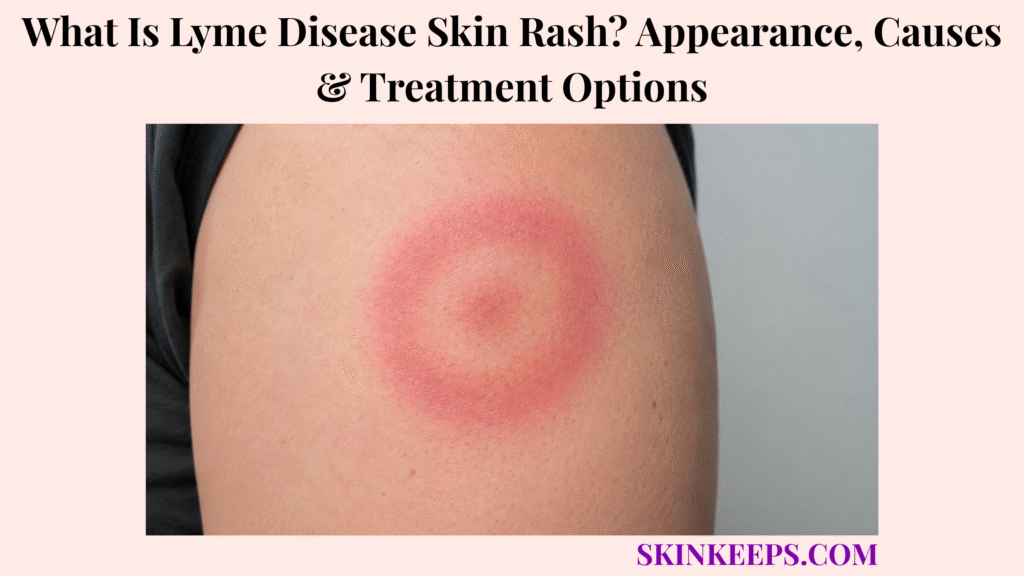
Erythema migrans is the characteristic early Lyme disease skin rash and usually appears as a gradually enlarging round or oval lesion after infection from an Ixodes tick. Borrelia bacteria are deposited into the skin at the transmission site, where the lesion begins and then expands outward over several days.
A Lyme disease skin rash does not need to form a textbook bull’s-eye. Typical erythema migrans in the right exposure setting can establish the diagnosis clinically even while early blood tests remain negative, and prompt treatment helps reduce the risk of later neurological, cardiac or joint disease.
An expanding rash after plausible tick exposure deserves medical assessment. Earlier or urgent evaluation is particularly important with severe headache, neck stiffness, facial weakness, nerve pain, numbness, palpitations, fainting, breathlessness, chest symptoms, marked joint swelling or severe systemic illness because these findings may indicate Lyme disease beyond the skin.
How Can You Recognize a Lyme Disease Skin Rash?
A Lyme disease skin rash usually appears as an erythema migrans lesion that progressively expands outward over several days and does not need to form a classic bull’s-eye.
What Does Erythema Migrans Usually Look Like?
Erythema migrans usually begins as a small discoloured spot or bump and enlarges into a round or oval patch over several days.
The lesion may be uniformly coloured, partly clearing in the centre, darker centrally, centrally crusted, round, oval, dusky or bluish-red. No single colour or ring pattern defines every case.
Does a Lyme Rash Always Look Like a Bull’s-Eye?
No; the classic bull’s-eye is only one erythema migrans pattern, and many lesions have little or no central clearing.
Some lesions are solid in colour, some are oval and others develop a darker or crusted centre. Progressive enlargement over time is more useful than asking whether the rash forms three perfect rings.
When Does Erythema Migrans Usually Appear?
Erythema migrans typically appears about 3–30 days after a tick bite and then gradually expands over several days.
CDC guidance places average onset at roughly seven days after exposure. This delayed appearance helps distinguish EM from the small immediate redness that can occur at a tick-bite site.
Is Erythema Migrans Usually Itchy or Painful?
Erythema migrans is usually not markedly itchy or painful, although the lesion may feel warm.
Mild itch or discomfort does not exclude Lyme disease, but intense itch, strong tenderness or pronounced pain can make another diagnosis more likely and should broaden the differential.
How Can a Lyme Rash Look on Darker Skin?
Erythema migrans may appear dusky, bluish-red, red-brown or subtly discoloured on darker skin rather than bright red.
Border contrast, lesion dimensions, shape and progressive enlargement are therefore more useful than relying on redness alone.
Can More Than One Lyme Disease Rash Appear?
Yes; multiple expanding erythema migrans lesions can appear when Lyme infection has disseminated beyond the original bite site.
Distant EM lesions suggest early disseminated infection and should not automatically be explained as multiple separate tick bites.
Figure 1. Erythema migrans can be uniform, oval, centrally crusted or partially clearing; progressive enlargement over time is the stronger recognition clue.
Why Does Lyme Disease Cause Erythema Migrans, and What Happens if Infection Spreads?
Erythema migrans develops when tick-transmitted Borrelia bacteria multiply in the skin and spread outward from the site of inoculation.
What Causes the Lyme Disease Skin Rash?
The Lyme disease skin rash is caused by Borrelia infection transmitted through the bite of an infected Ixodes tick.
In the United States, Borrelia burgdorferi causes most Lyme disease. The bacteria multiply locally in the skin and trigger outwardly expanding inflammation that produces erythema migrans.
Do You Need to Remember a Tick Bite to Have Erythema Migrans?
No; Lyme disease can occur even when a person does not remember being bitten by a tick.
Ticks can be small and attach in hidden body sites, so outdoor activity, geography and plausible exposure remain relevant even when no bite was noticed.
Which Symptoms Can Occur With an Early Lyme Disease Rash?
Early Lyme disease can cause fever, chills, fatigue, headache, muscle or joint aches and swollen lymph nodes alongside erythema migrans.
These symptoms can accompany EM or occur when the rash is unnoticed, but nonspecific flu-like symptoms by themselves do not diagnose Lyme disease.
What Do Multiple Erythema Migrans Lesions Mean?
Multiple erythema migrans lesions suggest that Borrelia infection has disseminated beyond the original skin site.
Multiple distant lesions represent an early disseminated pattern and can change the assessment even when no neurological or cardiac symptoms are yet present.
Which Problems Can Develop if Lyme Disease Is Untreated?
Untreated Lyme disease can spread beyond the skin and affect the nervous system, heart and joints.
Neurological disease can cause facial palsy, meningitis-like symptoms or shooting nerve pain. Lyme carditis can produce palpitations or rhythm and conduction abnormalities. Lyme arthritis commonly causes episodic swelling of a large joint, particularly a knee.
Figure 2. Borrelia enters through an infected Ixodes tick bite, expands locally as erythema migrans and can disseminate to other skin sites, the nervous system, heart or joints if infection spreads.
How Is Erythema Migrans Different From Other Tick-Bite or Ring-Shaped Rashes?
Erythema migrans is distinguished most reliably by delayed progressive expansion over several days rather than by a perfect ring or bull’s-eye shape.
How Is Erythema Migrans Different From a Normal Tick-Bite Reaction?
A normal tick-bite reaction usually appears immediately, remains relatively small and fades within a day or two, whereas erythema migrans appears later and progressively expands.
A simple bite reaction can also be hotter, itchier or more uncomfortable than typical EM. Timing and behaviour over the next several days are among the most useful differentiators.
How Is Erythema Migrans Different From Ringworm?
Ringworm or tinea corporis usually has a scaly, itchy and more raised active border, while erythema migrans is generally smoother and progressively expands after relevant tick exposure.
Ringworm is a fungal infection and commonly shows scale at its active edge. EM is more strongly defined by exposure, timing and outward enlargement than by a raised scaly border.
How Is a Lyme Disease Rash Different From Cellulitis?
Cellulitis is usually hotter, more tender, painful and swollen than erythema migrans, although both can produce expanding skin discoloration.
EM may feel mildly warm but is usually less painful. Cellulitis more often produces tenderness, swelling and diffuse spreading inflammation rather than a minimally symptomatic expanding EM pattern.
What Is STARI?
Southern Tick-Associated Rash Illness can produce an erythema-migrans-like rash after a lone star tick bite but is not Lyme disease.
Its geographic and tick-exposure context differs from Lyme borreliosis, and an EM-like appearance alone does not establish Borrelia infection.
Which Feature Is Most Useful When Comparing These Rashes?
Progressive outward enlargement over several days after plausible exposure is more useful for recognizing erythema migrans than asking whether the lesion forms a perfect bull’s-eye.
The most practical comparison sequence is timing → expansion → surface → symptoms → exposure.
| Feature | Erythema Migrans | Simple Bite Reaction | Ringworm | Cellulitis |
|---|---|---|---|---|
| Onset | Delayed after exposure | Immediate or soon after bite | Variable | Variable |
| Expansion | Progressive over days | Usually limited | Slowly enlarges | Spreading redness |
| Scale | Usually absent | Absent | Common | Absent |
| Itch | Usually minimal | Can itch | Often itchy | Not usually the main symptom |
| Pain / tenderness | Usually mild or absent | Possible | Usually mild | Often prominent |
How Is a Lyme Disease Skin Rash Diagnosed?
Typical erythema migrans with plausible Lyme exposure is diagnosed clinically and does not require a positive blood test before treatment begins.
Can Typical Erythema Migrans Be Diagnosed Without a Blood Test?
Yes; a characteristic erythema migrans lesion in the appropriate exposure setting can be diagnosed clinically without laboratory confirmation.
IDSA/AAN/ACR guidance recommends clinical diagnosis rather than laboratory testing for compatible EM in an appropriate epidemiologic setting, and NICE similarly advises diagnosis and treatment without laboratory testing when erythema migrans is present.
Why Can Lyme Blood Tests Be Negative When the Rash First Appears?
Early Lyme blood tests can be negative because antibodies may not yet have reached detectable levels when erythema migrans first develops.
Serology detects the immune response rather than the rash itself. CDC notes that antibody tests may be falsely negative during the first few weeks of infection, so a negative early test should not automatically override convincing typical EM.
When Are Lyme Blood Tests More Useful?
Lyme serology becomes more useful when the rash is atypical, erythema migrans is absent or later neurological, cardiac or joint manifestations are being evaluated.
CDC recommends a two-step serologic testing process when laboratory testing is indicated. Testing becomes more sensitive after the early antibody window has passed.
Can Antibody Testing Show Whether Lyme Disease Has Been Cured?
No; Lyme antibodies can remain detectable long after successful treatment and should not be used as a test of cure.
Persistent antibody positivity can last for months or years and does not automatically mean active infection. Recovery is assessed clinically rather than by waiting for antibodies to disappear.
What Should Be Documented When an Erythema Migrans Rash Is Changing?
Documenting the rash’s size, location and progression over time can help demonstrate the characteristic expansion of erythema migrans.
Recording the date, body site and lesion dimensions can be useful, and sequential photographs can help show enlargement when practical. Photographs support documentation but do not replace medical assessment.
Figure 3. A characteristic expanding erythema migrans lesion in an appropriate exposure setting can be diagnosed clinically, while atypical or later presentations rely more on appropriate serology.
How Is a Lyme Disease Skin Rash Treated, and When Is More Urgent Care Needed?
Uncomplicated erythema migrans is treated promptly with appropriate antibiotics, while neurological, cardiac or significant joint manifestations require a different Lyme disease treatment pathway.
Which Antibiotics Treat Erythema Migrans?
Doxycycline, amoxicillin and cefuroxime axetil are among the main oral antibiotics used for uncomplicated erythema migrans.
The choice depends on age, pregnancy, allergy history, other medical factors and whether other Lyme manifestations are present. These drugs are not interchangeable for every patient and patient-specific dosing belongs to clinical care.
How Long Is Early Lyme Disease Treated?
Uncomplicated early Lyme disease is commonly treated for about 10–14 days, with the exact duration depending on the antibiotic and applicable clinical guideline.
That timeframe applies to uncomplicated early EM and should not be generalized to neurological, cardiac or arthritis presentations, which can require different regimens and durations.
Why Should Treatment Not Wait for a Positive Blood Test?
Treatment of convincing erythema migrans should not be delayed for blood-test confirmation because serology can still be negative during early infection.
Typical EM plus plausible exposure is a clinical-diagnosis pathway. Laboratory confirmation becomes more useful when the rash is atypical or later manifestations are being evaluated.
What Happens to the Rash After Antibiotics Begin?
Erythema migrans usually improves after appropriate antibiotic treatment, although visible discoloration may take time to disappear completely.
The lesion should gradually fade rather than vanish immediately after the first dose. Overall symptoms and new dissemination signs remain important during follow-up.
Can Symptoms Temporarily Worsen After Lyme Treatment Starts?
Yes; a temporary Jarisch–Herxheimer reaction can briefly worsen symptoms after antibiotic treatment begins.
This is an inflammatory reaction and differs from a true antibiotic allergy. New breathing difficulty, facial swelling, widespread hives or other severe drug-reaction symptoms require medical assessment rather than being dismissed as a Jarisch–Herxheimer reaction.
Which Symptoms Suggest Lyme Disease Has Spread Beyond the Skin?
Facial weakness, severe headache, neck stiffness, nerve symptoms, palpitations, fainting, breathlessness or major joint swelling can indicate Lyme disease beyond the skin.
Neurological manifestations include facial palsy, meningitis-like symptoms, shooting nerve pain or numbness. Cardiac disease can cause palpitations, syncope or breathlessness, while joint dissemination can cause significant swelling.
When Does Lyme Disease Need Urgent Assessment?
Urgent assessment is warranted for syncope, significant palpitations or chest symptoms, marked breathlessness or severe neurological symptoms because Lyme carditis or neurological Lyme disease may be present.
These are not routine features of isolated EM and can indicate cardiac conduction involvement or neurological dissemination that needs a different treatment pathway.
Figure 4. Uncomplicated erythema migrans is treated promptly with an oral-antibiotic pathway, while neurological, cardiac or major joint manifestations require a different Lyme disease treatment and urgency pathway.
What Should You Remember About a Lyme Disease Skin Rash?
The key sign of erythema migrans is progressive expansion after plausible tick exposure, not the presence of a perfect bull’s-eye pattern.
- Erythema migrans is the characteristic early Lyme disease skin rash.
- It usually appears after a delay rather than immediately after the bite.
- It progressively enlarges over several days.
- A bull’s-eye appearance is optional.
- EM is usually not markedly itchy or painful.
- Colour and contrast vary across skin tones.
- Multiple EM lesions suggest early dissemination.
- Simple bite-site redness usually behaves differently.
- Typical EM can be diagnosed clinically.
- Early serology can be falsely negative.
- Antibodies are not a test of cure.
- Prompt antibiotics treat early infection.
- Neurological, cardiac or significant joint symptoms change the treatment pathway.
Exposure → delayed expanding rash → recognize EM → diagnose clinically when typical → treat promptly → monitor dissemination.
Frequently Asked Questions About Lyme Disease Skin Rash
The most important Lyme rash questions concern bull’s-eye appearance, timing, itching or pain, blood testing and antibiotic treatment.
Does a Lyme Disease Rash Always Look Like a Bull’s-Eye?
No; erythema migrans can be uniformly coloured, oval, dusky or centrally crusted and may have little or no central clearing. Progressive enlargement is the more useful recognition feature.
How Soon After a Tick Bite Can Erythema Migrans Appear?
Erythema migrans usually begins about 3–30 days after a tick bite, with onset commonly occurring around one week after exposure. Immediate small bite-site redness is a different pattern.
Is a Lyme Disease Rash Usually Itchy or Painful?
Erythema migrans is usually not significantly itchy or painful, although it may feel mildly warm. Pronounced itch or pain can broaden the differential diagnosis.
Do You Need a Positive Blood Test if You Have Typical Erythema Migrans?
No; typical erythema migrans with appropriate exposure can be diagnosed clinically because early serology may still be negative. Antibody production can lag behind rash appearance.
Which Antibiotics Are Used to Treat Erythema Migrans?
Doxycycline, amoxicillin and cefuroxime axetil are commonly used oral treatments for uncomplicated erythema migrans. Selection and duration depend on the individual’s clinical context.
Which Sources Support This Lyme Disease Skin Rash Guidance?
CDC — Lyme Disease Rashes — Used for erythema migrans morphology, non-bull’s-eye appearances, central crusting, skin-tone examples and visual differential context.
CDC — Signs and Symptoms of Untreated Lyme Disease — Used for 3–30 day timing, average onset near seven days, gradual expansion, limited itch or pain, immediate bite-site reactions, multiple EM lesions and later neurological, cardiac and joint symptoms.
CDC — About Lyme Disease — Used for infected blacklegged-tick transmission, Borrelia burgdorferi and dissemination to joints, heart and nervous system.
IDSA/AAN/ACR — 2020 Guidelines for Prevention, Diagnosis and Treatment of Lyme Disease — Used for clinical diagnosis of characteristic erythema migrans in the appropriate epidemiologic setting without requiring laboratory testing.
CDC — Testing and Diagnosis for Lyme Disease — Used for early false-negative serology, two-step antibody testing and persistence of antibodies after successful treatment.
CDC — Clinical Treatment of Erythema Migrans Rash — Used for prompt treatment, doxycycline, amoxicillin, cefuroxime axetil, 10–14 day early-treatment context and individual treatment-selection factors.
NICE — Lyme Disease: Recommendations — Used for the simple bite-reaction distinction, diagnosis and treatment of erythema migrans without laboratory testing, emergency referral context and Jarisch–Herxheimer guidance.