
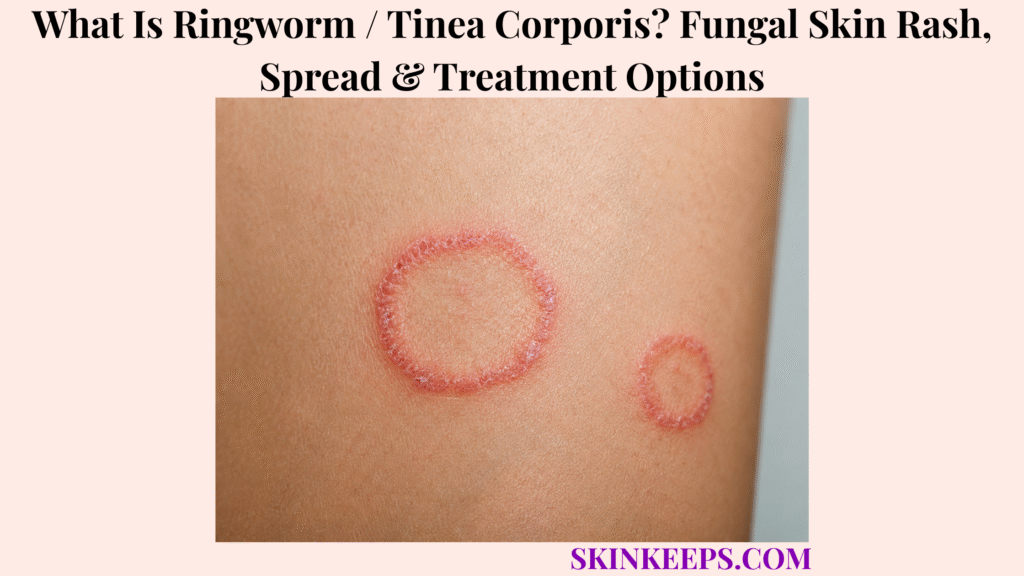
Tinea corporis, commonly called ringworm of the body, is a superficial fungal infection caused by dermatophytes that often produces an expanding scaly rash with a more active outer border. Ringworm is not caused by a worm; the name comes from the circular or ring-like appearance that some lesions develop as the fungus grows through superficial keratinized skin.
Tinea corporis can spread from infected people, animals, contaminated items or another fungal body site, and atypical rashes sometimes require fungal testing for confirmation. Localized disease is usually treated with topical antifungal therapy, while prevention depends on completing treatment and breaking the transmission or reinfection cycle.
This article is for educational purposes only. Widespread, recurrent, treatment-resistant or uncertain fungal-looking rashes should be medically evaluated.
What Is Tinea Corporis and What Does Ringworm Look and Feel Like?
Tinea corporis is a superficial dermatophyte infection of body skin that commonly produces expanding scaly patches with a raised or more active border and variable central clearing.
Which Fungi Cause Tinea Corporis?
Tinea corporis is caused by dermatophyte fungi that colonize keratin-containing tissue in the superficial outer skin.
The useful mechanism is dermatophyte reaches body skin → colonizes superficial keratin → triggers local inflammation → lesion expands outward. The infection remains mainly within the outer keratinized layer in otherwise healthy skin rather than behaving like a deep invasive infection.
Why Is It Called Ringworm if No Worm Is Involved?
Ringworm is a fungal infection, and its name refers to the circular appearance that some lesions develop rather than to any worm or parasite.
The word “ring” describes a visual pattern, not the cause. A lesion may become annular as the outer border remains more active while the center becomes relatively less inflamed.
What Does a Typical Tinea Corporis Rash Look Like?
Typical tinea corporis forms one or more circular or oval scaly patches with an expanding active border, while the center may become relatively clearer.
The border may be slightly raised, flaky, papular or occasionally pustular, and multiple lesions can overlap into more complex shapes. A perfect ring is not required, so incomplete rings, broad scaly patches or lesions with little central clearing can still fit tinea corporis.
How Can Tinea Corporis Look and Feel Different Across Skin Tones?
Tinea corporis can appear red, purple-brown, gray or darker than surrounding skin, so the expanding scaly border is often more useful diagnostically than color alone.
Itching is common but variable, and color changes may be subtle compared with textbook images. Shape, scale, active border and outward expansion are more dependable recognition clues than requiring bright redness.
Figure 1. Tinea corporis is best recognized by an expanding scaly active border; central clearing, itch and textbook ring shape are helpful when present but are not mandatory.
How Does Tinea Corporis Spread and Who Is More Likely to Get It?
Tinea corporis spreads when dermatophyte material passes from infected people, animals, body sites or contaminated objects onto susceptible skin.
Can Ringworm Spread From Person to Person?
Yes; direct skin-to-skin contact with an infected person can transmit dermatophytes and produce a new tinea corporis infection.
Transmission is more likely in close-contact settings, households and contact sports where exposed skin repeatedly touches infected skin or contaminated shared environments.
Can Pets or Other Animals Spread Ringworm?
Yes; infected animals, including household pets, can transmit dermatophytes to people through direct contact.
Animal exposure is an established route of infection, so recurrent household ringworm should prompt consideration of an untreated animal source rather than assuming repeated infections are random.
Can Towels, Clothing, Bedding or Surfaces Spread Tinea Corporis?
Yes; fungal material can persist on contaminated personal items and surfaces, making shared towels, clothing or bedding potential transmission routes.
The transmission sequence is infected skin or animal → shed fungal material → textile or surface → susceptible skin. This is why prevention needs to address shared items as well as the visible rash.
Which Conditions Make Ringworm Easier to Spread?
Warm humid environments, close skin contact, shared personal items, infected household members or animals and untreated tinea elsewhere on the body can increase transmission or reinfection risk.
A persistent foot infection such as athlete’s foot can act as a fungal reservoir that repeatedly seeds other skin sites. Warmth, sweating, occlusive clothing and crowded contact environments can further favor dermatophyte persistence.
Figure 2. Ringworm recurrence often makes more sense when you map the transmission source: people, animals, contaminated textiles and untreated fungal infection elsewhere can all re-expose body skin.
How Is Tinea Corporis Diagnosed and Distinguished From Similar Rashes?
Tinea corporis is often suspected from its expanding scaly border and exposure history, but fungal testing is useful when the rash is atypical, recurrent or fails appropriate treatment.
How Does a Clinician Diagnose Tinea Corporis?
A clinician combines lesion appearance, distribution, exposure history and skin examination, with fungal testing added when diagnostic certainty is needed.
The practical sequence is appearance → distribution → exposure → examination → testing where needed. Shape alone is not enough because several inflammatory conditions can also form round or scaly patches.
How Do Skin Scrapings Confirm Ringworm?
Scale from the active edge can be collected for fungal microscopy, culture or other mycologic testing to demonstrate dermatophyte infection.
Testing is especially useful when the rash is atypical, has been altered by treatment, keeps recurring or fails a reasonable antifungal approach. It can also help avoid treating an inflammatory mimic as fungus—or fungus as eczema.
What Skin Conditions Can Be Mistaken for Tinea Corporis?
Nummular eczema, psoriasis, pityriasis rosea and contact dermatitis can resemble tinea corporis, especially when lesions are round or scaly.
Coin-shaped inflammatory patches can resemble nummular eczema, while thicker scaling can overlap visually with psoriasis. An oval scaly eruption may also require comparison with pityriasis rosea. The active advancing fungal border and mycologic testing help resolve uncertainty.
What Is Tinea Incognito and Why Can Steroid Creams Hide Ringworm?
Tinea incognito is dermatophyte infection whose appearance has been altered by corticosteroid treatment, allowing the fungus to continue spreading while inflammation becomes less typical.
The sequence is misdiagnosed tinea → steroid applied → inflammation suppressed → fungus persists → rash becomes less classic or spreads. Steroid monotherapy does not eradicate dermatophytes, so a rash that changes without truly clearing should trigger diagnostic reassessment.
Figure 3. A steroid-modified rash that becomes less inflamed without truly clearing should raise concern for tinea incognito; fungal testing is more useful than repeatedly escalating anti-inflammatory treatment.
How Is Tinea Corporis Treated?
Localized uncomplicated tinea corporis is usually treated with topical antifungal therapy, while extensive, recurrent, hair-bearing or treatment-resistant disease may require clinician-directed oral treatment.
Which Topical Antifungals Are Used for Localized Tinea Corporis?
Localized tinea corporis is commonly treated with topical antifungal medicines such as terbinafine-type or azole agents.
Exact duration depends on the medicine and clinical setting, so treatment should follow the product or clinician instructions rather than one universal schedule. The important point is that therapy targets the fungus itself rather than merely reducing visible inflammation.
Why Should Treatment Continue as Directed After the Rash Improves?
Visible improvement does not necessarily mean all dermatophytes have been eradicated, so antifungal treatment should be completed for the directed duration.
A rash can look less scaly or less inflamed before the infection has fully cleared. Stopping early can leave viable fungus behind and increase the chance of persistence or recurrence.
When Are Oral Antifungals Needed?
Oral antifungal treatment may be needed when tinea corporis is extensive, recurrent, involving certain hair-bearing areas or not responding appropriately to topical therapy.
Systemic treatment is selected by a clinician when disease extent, deeper follicular involvement or treatment failure makes topical therapy inadequate. Different anatomical tinea sites can require different treatment strategies, so body ringworm should not be merged into one protocol with scalp or nail disease.
What Should Be Checked When Ringworm Does Not Respond to Treatment?
Treatment failure should prompt reassessment of the diagnosis, treatment completion, fungal reservoirs, infected contacts or animals and the possibility of unusually persistent or resistant dermatophytes.
The disciplined pathway is: was the diagnosis correct → was the antifungal appropriate → was treatment completed → is another tinea site acting as a reservoir → is a person or animal causing re-exposure → does persistent or resistant disease need specialist evaluation? Indefinite switching between creams is not a substitute for reassessment.
Figure 4. Localized tinea corporis often responds to topical antifungal therapy, but persistent or recurrent disease should trigger confirmation of diagnosis and a search for fungal reservoirs or re-exposure before treatment is escalated.
How Can Tinea Corporis Be Prevented From Spreading or Coming Back?
Preventing recurrent tinea corporis requires completing antifungal treatment, reducing direct transmission, avoiding shared contaminated items and treating fungal reservoirs in people, animals or other body sites.
How Can Personal Care Reduce Ringworm Transmission?
Keeping affected skin clean and dry, washing hands after touching lesions and avoiding shared personal items can reduce dermatophyte spread.
Changing sweaty clothing, reducing scratching and avoiding shared towels or clothing can lower opportunities for fungal material to move to other skin or other people. Ringworm is contagious, but infection should not be framed as evidence of poor personal cleanliness.
Should Towels, Clothing and Bedding Be Shared During Ringworm?
No; shared textiles can carry dermatophyte material and contribute to transmission between household members.
Using separate personal items while infection is active helps reduce repeated exposure, especially in close households where the same towels, clothing or bedding may otherwise circulate fungal material.
What Should Be Done if a Pet May Have Ringworm?
A pet suspected of having ringworm should be professionally evaluated because untreated animal infection can repeatedly expose people in the household.
The practical principle is animal evaluation + appropriate treatment + household environmental hygiene. Human treatment can fail repeatedly when the reservoir remains active outside the person’s skin.
When Should Tinea Corporis Be Medically Reassessed?
Medical evaluation is appropriate when the diagnosis is uncertain, the rash is widespread or recurrent, treatment fails, steroid use has changed its appearance or scalp, beard or nail involvement is suspected.
A persistent nail infection such as nail fungus can act as a dermatophyte reservoir that contributes to reinfection. Reassessment is also reasonable when lesions spread rapidly, involve several body areas, occur in a vulnerable patient, become painful or swollen, develop pus, or appear unusually resistant to treatment.
Failure to improve should trigger diagnostic reassessment—not indefinite switching between steroid and antifungal creams.
What Should You Remember About Ringworm / Tinea Corporis?
Tinea corporis is a contagious superficial dermatophyte infection of body skin that is best controlled by accurate diagnosis, complete antifungal treatment and elimination of transmission or reinfection sources.
- Ringworm is a fungal infection, not a worm infestation.
- Tinea corporis specifically affects ordinary body skin.
- Dermatophytes colonize superficial keratin.
- Lesions often expand outward from an active scaly border.
- Central clearing may occur but is not mandatory.
- A perfect ring is not required.
- Color varies across skin tones.
- Itch is common but not diagnostic by itself.
- Person-to-person transmission occurs.
- Animal-to-human transmission occurs.
- Contaminated towels, clothing, bedding and surfaces can contribute to spread.
- Warm and humid environments can support transmission.
- Another tinea site can act as a fungal reservoir.
- Diagnosis is often clinical but may need fungal confirmation.
- Skin scrapings can be examined by microscopy or culture.
- Nummular eczema can mimic tinea corporis.
- Psoriasis can mimic tinea corporis.
- Pityriasis rosea can mimic tinea corporis.
- Steroid treatment can produce tinea incognito.
- Steroid monotherapy does not eradicate dermatophytes.
- Topical antifungals commonly treat localized disease.
- Antifungal treatment should be completed as directed.
- Oral therapy is reserved for selected extensive or refractory disease.
- Treatment failure requires reassessment rather than random product switching.
- Household contacts or pets can contribute to reinfection.
- Persistent or recurrent disease deserves medical evaluation.
Recognize pattern → identify transmission → confirm when uncertain → treat fungus → complete therapy → eliminate reservoirs → reassess failure.
Frequently Asked Questions About Ringworm / Tinea Corporis
The main tinea corporis questions concern terminology, fungal cause, transmission, whether treatment is necessary and why infection can recur.
Is Tinea Corporis the Same as Ringworm?
Yes; tinea corporis is the medical term for dermatophyte ringworm affecting ordinary body skin.
Is Ringworm Caused by a Worm?
No; ringworm is caused by dermatophyte fungi, and the name refers only to the ring-like shape of some lesions.
How Does Tinea Corporis Spread From One Person to Another?
Tinea corporis can spread through direct skin contact or indirectly through contaminated clothing, towels, bedding and other shared items.
Can Tinea Corporis Go Away Without Antifungal Treatment?
Some limited infections may fluctuate, but relying on spontaneous clearance can allow continued spread, so appropriate antifungal treatment is generally used to eradicate the infection.
Can Tinea Corporis Come Back After Treatment?
Yes; recurrence can occur if treatment is incomplete or if an untreated person, animal or fungal infection elsewhere on the body continues to cause re-exposure.
Which Sources Support This Tinea Corporis Guidance?
DermNet — Tinea Corporis — Used for body-skin scope, dermatophyte mechanism, active scaly border, transmission, fungal reservoirs, skin scraping/culture, tinea incognito and topical-versus-systemic treatment principles.
CDC — Ringworm Basics — Used for fungal-not-worm terminology, body-site distinctions and reader-facing recognition.
CDC — Symptoms of Ringworm — Used for ring morphology, overlapping lesions and skin-tone variation.
CDC — Treatment of Ringworm — Used for antifungal treatment categories, course completion and steroid-warning guidance.
World Health Organization — Ringworm (Tinea) — Used for dermatophyte cause, transmission context and broad antifungal-treatment framing.
Mayo Clinic — Ringworm (Body): Symptoms & Causes — Used for reader-facing symptom pattern, outward expansion, itch and direct human/animal transmission.
Mayo Clinic — Ringworm (Body): Diagnosis & Treatment — Used for clinical diagnosis, skin scraping context and escalation to prescription treatment when disease is severe or extensive.