
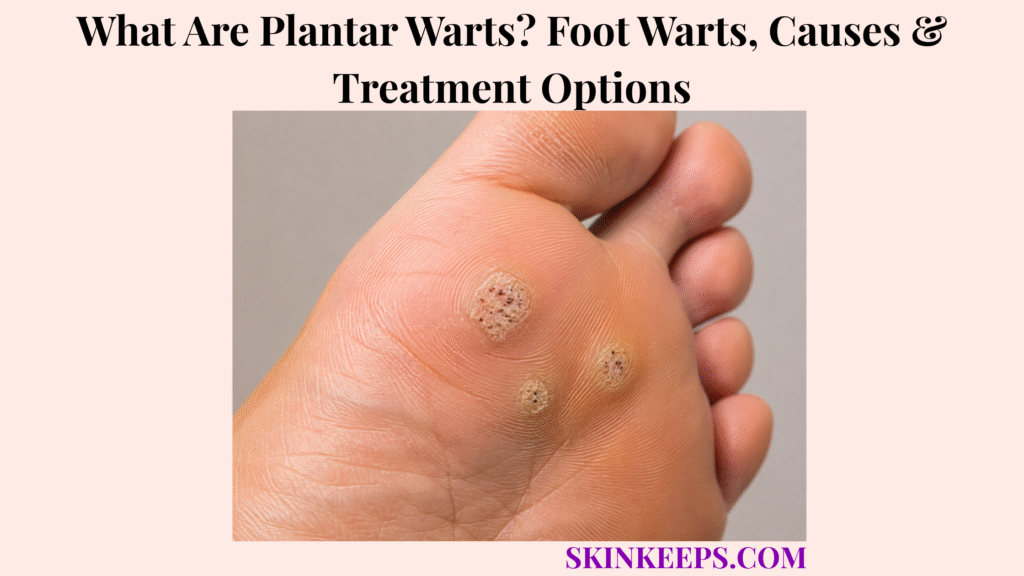
Plantar warts are benign cutaneous HPV growths on the sole that often become rough, thick and inward-growing because standing and walking compress them into weight-bearing skin. Also called verruca plantaris, they commonly interrupt normal skin lines and may show pinpoint red or black capillary dots within the keratinized surface.
Some plantar warts are painless and can be observed, while others become painful, cluster or interfere with walking and sport. Salicylic acid and clinician-administered cryotherapy are established treatments, but no method clears every wart permanently and persistent or atypical lesions should be reassessed before more destructive treatment is used.
This article is for educational purposes only and does not constitute medical advice, diagnosis, or treatment. A foot lesion that is very painful, rapidly changing, repeatedly bleeding, unusually large, diagnostically uncertain or resistant to appropriate treatment should be evaluated by a licensed dermatologist or qualified healthcare professional. People with diabetes, neuropathy, poor circulation or significant immune suppression should seek professional advice before using destructive wart treatments on the feet because treatment-related wounds can be harder to manage safely.
How Can You Recognize Plantar Warts?
Plantar warts usually appear as rough thickened sole lesions that interrupt normal skin lines and contain tiny red or black capillary dots.
What Does a Plantar Wart Look Like, and Why Can It Grow Inward?
A plantar wart is usually a rough callus-like growth that can be pushed inward by weight-bearing pressure instead of forming a prominent outward bump.
Thick keratin can build above the lesion and make it resemble ordinary callused skin. Deeper myrmecial warts are particularly prone to inward compression, while the inward direction itself is a mechanical consequence of standing and walking rather than a sign of malignancy.
What Happens to Skin Lines, and What Are the Black Dots?
Normal skin lines typically stop at or become disrupted by a plantar wart, while the tiny red or black dots are papillary capillaries within the lesion.
Some capillaries thrombose and appear black; others can bleed at pinpoint sites when a clinician carefully pares overlying keratin. These dots are not seeds, roots or dirt, and home cutting should not be used just to expose them.
Do Plantar Warts Hurt?
Plantar warts can become painful when inward pressure, overlying callus or their location on a weight-bearing area compresses sensitive tissue beneath them.
Pain can interfere with standing, walking or sport, but pain is not required for diagnosis. Side-to-side compression can be suggestive, whereas direct vertical pressure more often aggravates a corn or callus; neither pressure test is definitive alone.
What Are Mosaic Plantar Warts?
Mosaic plantar warts are clusters of multiple adjoining warts that merge into a broader affected area of the sole.
They are often more superficial than a single deep myrmecial wart but can cover more surface area and be harder to treat because several lesions coexist.
Figure 1. The highest-value morphology pair is interrupted skin lines plus pinpoint capillaries, while pressure can compress the lesion inward.
What Causes Plantar Warts, and How Do They Spread?
Plantar warts develop when cutaneous HPV enters sole skin through small breaks and infects epidermal cells, with spread occurring through direct contact, contaminated surfaces or self-inoculation.
How Does HPV Cause a Plantar Wart?
Cutaneous HPV enters through tiny skin breaks and stimulates infected keratinocytes to proliferate, producing the thickened wart.
Visible cuts are not required; microscopic trauma, small cracks and softened or macerated sole skin can provide entry points. The infection remains in epidermal tissue and may take months to become visibly apparent.
Why Are Public Showers and Pool Areas Associated With Plantar Warts?
Warm wet communal environments can soften foot skin and increase opportunities for HPV exposure and entry through microscopic breaks.
Locker rooms, pool decks and public showers are common exposure settings, but not every contact causes infection. Wearing pool shoes or flip-flops reduces bare-skin contact with these surfaces.
Who Is More Likely to Develop Plantar Warts?
Children and teenagers commonly develop cutaneous warts, while impaired skin barriers or weakened immunity can increase persistence and wart burden.
Anyone can develop plantar warts. Significant immune suppression can make lesions more numerous, larger or resistant, and the incubation period can be prolonged enough that the exact exposure is often impossible to identify.
Are Plantar Warts Contagious or Sexually Transmitted?
Plantar warts can spread through cutaneous HPV contact, but they are not genital warts and should not be interpreted as evidence of a sexually transmitted infection.
Transmission can occur through direct skin contact, contaminated surfaces and autoinoculation from picking or trauma. The cutaneous HPV types involved in ordinary plantar warts are clinically distinct from the mucosal HPV group associated with genital infection and HPV-related cancers.
For broader information about body-site variants, see warts.
Figure 2. Cutaneous HPV enters through microscopic breaks, and wart appearance can be delayed; trauma or contaminated surfaces can enable additional spread.
How Are Plantar Warts Distinguished and Diagnosed?
Plantar warts are usually diagnosed clinically by rough texture, interrupted skin lines and pinpoint capillaries, while corns and calluses usually preserve skin markings and lack wart-type vascular dots.
How Is a Plantar Wart Different From a Corn or Callus?
A plantar wart interrupts normal skin lines and contains papillary capillaries, while corns and calluses generally preserve skin markings and are driven mainly by pressure or friction.
Thickness alone is not enough to diagnose a wart. Mechanical lesions tend to follow pressure and friction patterns, while wart capillaries and interrupted dermatoglyphics are more specific clues to cutaneous HPV infection.
Do Location and Pressure Help Distinguish Them?
Yes; corns and calluses cluster at predictable friction or pressure points, while plantar warts can occur beyond maximal pressure sites and may hurt more with side-to-side compression.
Direct-pressure tenderness can be more typical of corns and calluses, but overlap is common. Location and pain direction should support—not replace—the stronger morphology clues.
Can Plantar Warts Usually Be Diagnosed Without Tests?
Yes; most plantar warts are diagnosed clinically, and dermoscopy can strengthen the diagnosis by showing characteristic vascular dots more clearly.
Routine blood tests and routine HPV typing are unnecessary for ordinary plantar warts. Dermoscopy can reveal papillary capillaries and structural detail without destructive manipulation.
When Is Biopsy or Professional Reassessment Needed?
Biopsy or specialist assessment is reserved for atypical, changing, bleeding, treatment-resistant or diagnostically uncertain lesions where another condition cannot be confidently excluded.
This is especially relevant with significant immune suppression, unusual morphology, persistent bleeding or repeated nonresponse. Most plantar warts do not need biopsy, and atypical change does not automatically mean cancer.
| Feature | Plantar Wart | Corn / Callus |
|---|---|---|
| Cause | Cutaneous HPV | Pressure or friction |
| Skin lines | Interrupted or displaced | Usually preserved |
| Red/black dots | Papillary or thrombosed capillaries | Classic wart capillary pattern absent |
| Pressure clue | Lateral squeeze may hurt | Direct pressure often hurts more |
| Location | Any plantar site, including pressure areas | Predictable pressure/friction points |
| Uncertain or changing lesion | Professional reassessment before destructive treatment | |
How Are Plantar Warts Treated?
Small painless plantar warts can be observed, while salicylic acid is a standard first-line treatment and clinician-administered cryotherapy or specialist procedures are used for selected persistent or painful disease.
Does Every Plantar Wart Need Treatment?
No; observation is reasonable for a small painless plantar wart that is not spreading or interfering with walking, sport or daily activity.
Many warts eventually clear through immune recognition, particularly in children. Treatment becomes more worthwhile when lesions are painful, spreading, persistent, clustered or functionally troublesome.
How Does Salicylic Acid Treat Plantar Warts, and Who Should Avoid Unsupervised Use?
Salicylic acid gradually removes wart-containing keratinized skin, but people with diabetes, neuropathy or poor circulation should obtain professional advice before using it on the foot.
Salicylic acid works over repeated applications rather than instantly, and the chosen product should be used exactly as directed while avoiding excessive irritation of normal skin. No single concentration or schedule fits every product or patient.
How Does Cryotherapy Compare With Salicylic Acid?
Cryotherapy freezes the wart with liquid nitrogen and is an established clinician-directed option, but it can be painful and often requires repeated sessions rather than one treatment.
Salicylic acid is a common home first-line option for appropriately identified uncomplicated warts, while cryotherapy is a common professional treatment. Choice depends on lesion size, pain, age, previous treatment and tolerance.
What Treatments Are Used for Resistant Plantar Warts?
Persistent plantar warts may be treated by a dermatologist with selected options such as cantharidin-based therapy, curettage or electrosurgery, laser, bleomycin or immunotherapy.
These are specialist options because pain, evidence and scarring risk vary. Cutting or excision is not routinely first choice on weight-bearing skin because a painful scar can become a long-term functional problem.
Figure 4. Treatment intensity rises with pain and persistence, while high-risk feet need professional guidance before destructive therapy.
How Long Do Plantar Warts Last, and How Can Spread or Recurrence Be Reduced?
Plantar warts can persist for months or years before immune clearance, and preventing picking, sharing contaminated items and barefoot exposure in communal wet areas can reduce additional spread.
Can Plantar Warts Disappear Without Treatment, and Why Can Treatment Take Months?
Yes; many plantar warts eventually clear through the immune response, while salicylic-acid and other treatments work gradually rather than eliminating HPV-infected tissue immediately.
Children often clear warts faster than adults, but no exact timetable can be guaranteed. Pharmacy treatments can take up to about three months and may still fail.
Can Plantar Warts Return After Treatment?
Yes; plantar warts can recur after apparent clearance because no current treatment guarantees permanent eradication in every patient.
Persistent viral infection, reinoculation and impaired immunity can contribute to recurrence. Repeated recurrence can justify reassessment.
How Can Someone Reduce Self-Spread and Community Spread?
Avoid picking or scratching the wart, wash hands after treatment, keep wart-care tools away from normal skin and wear protective footwear in communal showers, locker rooms and pool areas.
Do not share socks, towels, pumice stones, files or sanding tools. Tools used on the wart should not be reused on unaffected skin.
Does HPV Vaccination Prevent Plantar Warts, and When Should Persistent Disease Be Reassessed?
Routine HPV vaccines are not established prevention for ordinary plantar-wart HPV types, and persistent, changing, bleeding, very painful or repeatedly recurrent lesions should be professionally reassessed.
This limitation does not reduce the importance of HPV vaccination for its approved prevention targets. Reassessment is especially appropriate with diagnostic uncertainty, repeated treatment failure, significant immune suppression or changing morphology.
What Should You Remember About Plantar Warts?
Plantar warts are benign cutaneous HPV lesions of the sole that are best recognized by rough keratin, interrupted skin lines and pinpoint capillaries and can become painful because body weight pushes them inward.
- Plantar wart and verruca plantaris refer to the same lesion.
- Plantar warts are caused by cutaneous HPV.
- They occur on the sole and can be compressed inward by body weight.
- Lesions are rough and often thickened.
- Normal skin lines are usually interrupted.
- Red or black dots are papillary capillaries, not seeds.
- Plantar warts may be painful but pain is not mandatory.
- Mosaic warts are clusters of adjoining lesions.
- HPV can enter through microscopic skin breaks.
- Wet communal areas increase exposure opportunity.
- Picking and trauma can promote autoinoculation.
- Plantar warts are not genital warts and are not evidence of an STI.
- Corns and calluses usually preserve skin lines and lack wart-type vascular dots.
- Diagnosis is usually clinical and dermoscopy can help.
- Biopsy is selective rather than routine.
- Small painless warts can be observed.
- Salicylic acid is a standard first-line home option for appropriately identified lesions.
- Diabetes, neuropathy and poor circulation require professional guidance before destructive foot treatment.
- Cryotherapy is a clinician-directed option and may require repeat sessions.
- Resistant warts may need specialist therapies.
- Weight-bearing scars can remain painful.
- Natural clearance and treatment response can take months.
- Recurrence remains possible.
- Avoid picking and sharing wart-care tools.
- Protective footwear reduces communal wet-surface exposure.
- Routine HPV vaccination does not specifically prevent most ordinary plantar warts.
- Changing or persistent lesions should be reassessed.
Recognize wart-specific morphology → Distinguish corn/callus → Decide whether treatment is needed → Use safe first-line therapy → Escalate persistent disease → Prevent spread → Reassess atypical lesions.
Frequently Asked Questions About Plantar Warts
The most important plantar-wart questions concern how HPV causes the lesion, how to distinguish it from a corn or callus, whether it can resolve naturally, which treatments are used and how spread or recurrence can be reduced.
What Causes Plantar Warts on the Bottom of the Foot?
Plantar warts form when cutaneous HPV enters through microscopic breaks in sole skin and infects epidermal keratinocytes. Softened or macerated skin can increase entry opportunities, and visible warts may appear only after a delayed incubation.
How Can You Tell a Plantar Wart From a Corn or Callus?
A plantar wart usually interrupts normal skin lines and contains pinpoint vascular dots, while a corn or callus generally preserves skin markings and reflects repeated pressure or friction. Professional assessment is sensible when the lesion is uncertain before destructive treatment is attempted.
Can Plantar Warts Disappear Without Treatment?
Yes; many plantar warts eventually disappear through the immune response, especially in children, although spontaneous clearance can take months or longer. Observation is reasonable when the lesion is painless and not functionally troublesome.
Which Treatment Works Best for Painful or Persistent Plantar Warts?
Salicylic acid and clinician-administered cryotherapy are established options, while stubborn warts may need dermatologist-directed treatment because no single therapy works for everyone. People with diabetes, neuropathy or poor circulation should seek professional advice before destructive foot treatment.
How Can You Stop Plantar Warts From Spreading or Coming Back?
Avoid picking, use separate foot-care tools, do not share personal items and wear protective footwear in communal wet areas to reduce HPV spread and reinoculation. Recurrence can still occur, and repeatedly persistent lesions should be reassessed.
Which Sources Support This Plantar Warts Guidance?
DermNet — Viral Warts — Primary source for cutaneous HPV, plantar-wart morphology, papillary capillaries, inward myrmecial growth, mosaic warts, pain, clinical diagnosis, corn differential, natural history and recurrence.
American Academy of Dermatology — Warts: Diagnosis and Treatment — Used for salicylic acid, cryotherapy, repeated-treatment expectations, cantharidin and specialist wart therapies.
NHS — Warts and Verrucas — Used for patient-facing treatment duration, recurrence, large/painful/changing-lesion reassessment and repeated cryotherapy expectations.
RDaSH NHS Podiatry — Verrucas — Used narrowly for foot-treatment safety, avoiding sharp self-cutting and the practical reality that acid treatment can injure surrounding skin.