Common warts, or verruca vulgaris, are benign rough skin growths caused when cutaneous human papillomavirus infects epidermal cells and stimulates localized thickening of the skin.
They can spread by contact and by self-inoculation through picking, scratching, shaving or nail biting, can sometimes resemble other rough growths, and may either clear spontaneously or be managed with salicylic acid, cryotherapy or clinician-directed care when persistent, symptomatic or uncertain.
This article is for educational purposes only. A rapidly changing, ulcerated, persistently bleeding, destructive or diagnostically uncertain wart-like growth should be evaluated by a qualified healthcare professional.
What Are Verruca Vulgaris / Common Warts and What Do They Look Like?
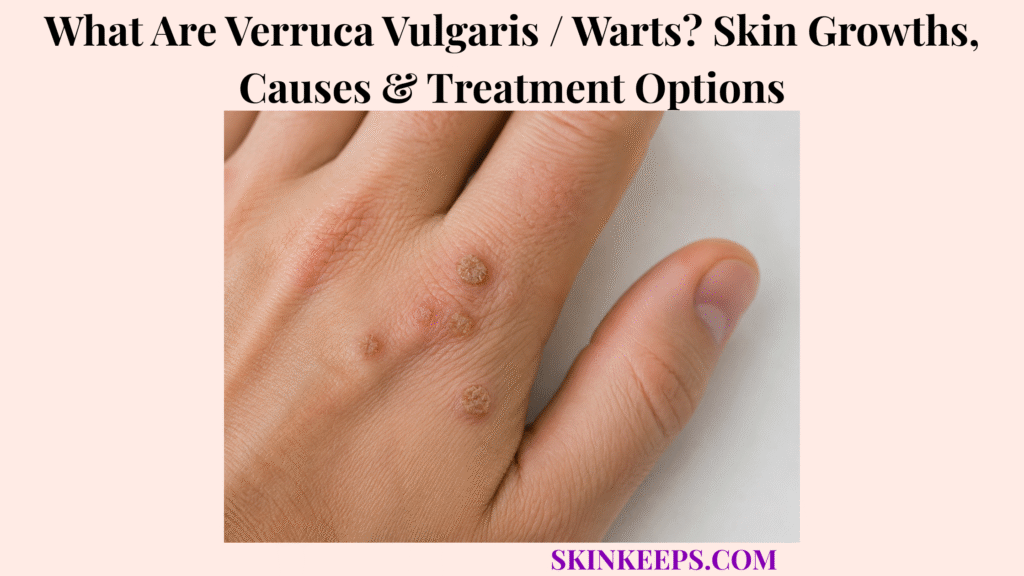
Common warts are benign cutaneous HPV growths that usually appear as firm, rough, hyperkeratotic papules, especially on the hands and fingers.
How Does HPV Create a Common Wart?
A common wart develops when cutaneous HPV enters through a small skin-barrier disruption, infects basal epidermal cells and stimulates keratinocyte proliferation and hyperkeratosis. The result is a localized thickened papule with a rough or grainy surface rather than a diffuse rash.
Which HPV Types Can Cause Common Warts?
Several cutaneous HPV types can cause common warts, with HPV types 2 and 4 among recognized associations. The practical point is not memorizing a long genotype list, but understanding that these are ordinary cutaneous HPV infections affecting keratinized skin rather than the separate mucosal HPV pathway.
Are Common Warts Cancerous?
No; ordinary verruca vulgaris is a benign cutaneous HPV lesion and should not be confused with the high-risk mucosal HPV infections associated with several cancers. A wart-like appearance also does not prove that every rough lesion is a wart, which is why atypical lesions still need reassessment.
What Does a Typical Common Wart Look Like?
A typical common wart is firm, raised, rough or grainy and hyperkeratotic, with a dome-shaped or irregular surface. It may be skin-colored, gray, brown or darker depending on skin tone and most often appears on fingers, hands, knees and other sites repeatedly exposed to minor trauma.
What Are the Red or Black Dots Inside a Wart?
The red or black dots are small papillary blood vessels, often thrombosed, rather than roots growing beneath the wart. They are a useful recognition clue and help explain why a traumatized wart may bleed in pinpoint spots.
Can Common Warts Hurt, Itch or Bleed?
Many common warts are symptom-free, but repeated trauma can make them painful, tender, itchy, irritated or prone to bleeding. Symptoms often reflect friction, pressure or picking rather than aggressive disease.
What Other Cutaneous Wart Patterns Can Occur?
Cutaneous HPV can also cause plantar, flat, filiform and periungual warts, each with a different characteristic morphology or location. Keeping these related patterns subordinate helps preserve the main focus on verruca vulgaris while still improving recognition.
What Causes Common Warts and How Do They Spread?
Common warts are caused by cutaneous HPV, which can spread through direct contact, contaminated items or self-inoculation when infected material reaches disrupted skin.
How Does HPV Spread Between People?
Cutaneous HPV can pass through direct skin contact or contaminated objects and is more likely to establish infection when the receiving skin is damaged or softened. This is why small barrier breaks matter more than dramatic injuries.
Can Picking or Scratching a Wart Spread It?
Yes; picking or scratching can transfer HPV from an existing wart into nearby damaged skin and produce additional lesions. That self-inoculation pathway is one reason clustered or linearly arranged warts can appear over time.
Can Shaving Spread Common Warts?
Yes; shaving can create microtrauma and mechanically transfer HPV to nearby skin, particularly when warts occur in shaved areas. Shaving directly over lesions increases the chance of local spread rather than accelerating healing.
Can Nail Biting Spread Warts Around the Nails?
Yes; nail biting and repeated injury around nail folds can facilitate periungual HPV infection and spread existing warts. The same principle applies to cuticle chewing and other repetitive periungual trauma.
Why Can Warts Appear Long After HPV Exposure?
The incubation period for cutaneous warts can be prolonged for many months, so the exact exposure that caused a wart is often impossible to identify. A wart appearing now does not necessarily mean a very recent exposure.
How Are Common Warts Diagnosed and Distinguished From Other Skin Growths?
Most common warts are diagnosed clinically from their rough keratotic surface, characteristic capillary dots, disrupted skin lines and typical distribution, while atypical lesions may require dermoscopy or biopsy.
How Is Verruca Vulgaris Usually Diagnosed?
Diagnosis is usually clinical and relies on morphology, location, interruption of normal skin markings and characteristic vascular dots. Dermoscopy can support recognition by helping visualize the papillary vessels and surface pattern.
How Is a Wart Different From a Corn or Callus?
A wart commonly interrupts normal skin lines and contains characteristic capillary dots, while skin markings generally continue through a corn or callus. This difference is especially useful when a thick hyperkeratotic lesion appears on a pressure-prone site.
How Is Verruca Vulgaris Different From Molluscum Contagiosum?
Common warts are rough hyperkeratotic HPV growths, while Molluscum Contagiosum usually forms smoother dome-shaped papules with central umbilication.
How Is a Common Wart Different From Seborrheic Keratosis?
Seborrheic Keratosis is a benign keratinocytic growth rather than an HPV infection and can sometimes mimic the rough or verrucous surface of a wart.
When Can a Wart-Like Growth Actually Be Squamous Cell Carcinoma?
A persistently enlarging, ulcerated, bleeding, painful or destructive lesion that does not behave like an ordinary wart should be reassessed because Squamous Cell Carcinoma can occasionally mimic a wart.
Is Routine HPV Testing Needed for a Common Wart?
No; ordinary common warts are usually diagnosed clinically and do not require routine HPV typing. Testing the virus type rarely changes day-to-day management of a typical stable lesion.
How Are Verruca Vulgaris / Common Warts Treated?
Common warts can often be observed because spontaneous immune clearance occurs, while persistent or bothersome lesions may be treated with salicylic acid, cryotherapy or dermatologist-directed therapies.
Do All Common Warts Need Treatment?
No; many common warts eventually disappear without treatment, although spontaneous clearance may take months or years. Treatment becomes more reasonable when lesions are painful, spreading, repeatedly traumatized, cosmetically troublesome or simply persist longer than the person wants to tolerate.
How Does Salicylic Acid Treat Common Warts?
Salicylic acid gradually removes layers of HPV-infected hyperkeratotic skin and requires consistent repeated application rather than a single treatment. People with diabetes, neuropathy or poor circulation should obtain medical advice before self-treatment on affected areas because tissue injury may be harder to detect or heal.
How Does Cryotherapy Treat Common Warts?
Cryotherapy uses controlled intense cold to damage wart tissue and stimulate clearance, but repeated treatment sessions may be required. Pain, blistering, crusting, pigment change and occasional scarring are possible, so it should not be framed as a guaranteed one-session cure.
What Other Treatments Can Dermatologists Use?
Persistent or resistant warts may be treated with selected specialist therapies such as cantharidin, curettage or electrosurgery, laser or immunotherapy depending on the lesion and patient. Choice depends on location, number, age, prior treatment, immune status and the need to limit functional problems or scarring.
Why Can a Wart Return After Treatment?
A wart can recur because treatment removes visible wart tissue without guaranteeing complete elimination of local HPV activity or future susceptibility. Visible clearance therefore does not equal permanent virologic eradication.
Does the HPV Vaccine Treat Existing Common Warts?
Routine HPV vaccination should not be presented as established treatment for existing verruca vulgaris because licensed vaccines primarily target important mucosal HPV types rather than the main cutaneous types causing common warts. Vaccination remains valuable in its own preventive pathway, but it should not be promised as therapy for an ordinary hand wart.
How Can Common Warts Be Prevented From Spreading, and When Should They Be Evaluated?
Spread can be reduced by avoiding picking, scratching and shared personal tools and by protecting surrounding skin from trauma, while atypical, destructive, numerous or treatment-resistant wart-like lesions deserve clinical reassessment.
Why Should Warts Not Be Picked or Scratched?
Picking or scratching can transfer HPV to nearby damaged skin and increase self-inoculation while also causing bleeding and irritation. Avoiding repeated trauma is therefore part of both treatment and prevention.
Should Razors, Nail Tools or Personal Items Be Shared?
No; avoiding shared tools or personal items that contact wart-affected skin can reduce opportunities for cutaneous HPV transmission. Razors and nail tools are especially relevant because they can also create microtrauma.
Why Should Skin Around a Wart Be Protected From Trauma?
Cuts, shaving, scratching and nail biting disrupt the skin barrier and create new entry points where HPV can establish infection. Preventing repeated trauma is often more practical than trying to identify the exact original exposure.
Can Common Warts Be Completely Prevented?
Not always; HPV exposure is common and warts may appear long after infection, so prevention focuses on reducing viral transfer and self-inoculation rather than promising complete protection. Even careful people may still develop occasional warts.
Why Can Immunosuppression Make Warts More Persistent?
Impaired cell-mediated immunity can make HPV harder to clear, leading to more numerous, recurrent or treatment-resistant warts. That pattern is a reason for clinical reassessment rather than a reason to assume severe immune disease on your own.
When Should a Wart Be Evaluated by a Dermatologist?
A wart should be professionally assessed when its diagnosis is uncertain, it changes or bleeds, causes persistent symptoms, occurs in large numbers or fails appropriate treatment. Face lesions, genital-area lesions and situations where diabetes makes self-treatment unsafe also deserve more caution.
When Should a Wart-Like Growth Be Biopsied?
Biopsy may be needed when a wart-like lesion is rapidly enlarging, ulcerated, persistently bleeding, unusually hard, destructive or otherwise suspicious for SCC or another diagnosis. Nail destruction, recurrence after repeated therapy and significant immunosuppression lower the threshold for reconsidering the diagnosis.
Why Should Genital Warts Follow a Separate Pathway?
Genital Warts usually involve different mucosal HPV types and require separate counseling, examination and treatment from ordinary common cutaneous warts.
Typical stable common wart patterns can often be observed or routinely treated, spreading or persistent warts call for treatment plus transmission control, numerous or refractory disease deserves clinician assessment, and changing, destructive or bleeding wart-like lesions require diagnostic reassessment with biopsy when needed.
What Should You Remember About Verruca Vulgaris / Common Warts?
Common warts are benign cutaneous HPV growths that often resolve naturally but can spread through self-inoculation, recur after treatment and occasionally resemble other skin lesions that require reassessment.
- Verruca vulgaris means common wart, and cutaneous HPV is the cause.
- HPV enters through disrupted skin, reaches basal epidermal cells and drives keratinocyte proliferation with hyperkeratosis.
- The resulting wart is usually firm, rough, raised and often found on hands or fingers, though other traumatized sites can also be involved.
- Common warts are benign and should not be confused with high-risk mucosal HPV disease.
- Children commonly develop warts, and immunosuppression can make them more persistent, numerous or resistant.
- Red or black dots are papillary blood vessels, sometimes thrombosed, and are not wart roots.
- Warts may be painless, but trauma can make them tender, itchy or prone to bleeding.
- Related cutaneous-wart patterns include plantar, flat, filiform and periungual warts.
- HPV can spread directly, indirectly and by autoinoculation.
- Picking, scratching, shaving and nail biting all increase the risk of spreading warts to nearby skin.
- The incubation period can be prolonged, so a new wart does not prove a recent exposure.
- Diagnosis is usually clinical, and dermoscopy can help when the morphology needs clarification.
- Common warts often interrupt skin lines, unlike corns or calluses.
- Molluscum contagiosum, seborrheic keratosis and SCC are among the important mimics.
- Routine HPV typing is not needed for an ordinary common wart.
- Not every wart needs treatment because spontaneous clearance can occur over months or years.
- Salicylic acid and cryotherapy are common treatments, but repeated use or repeated sessions may be required.
- Dermatologists can also use specialist therapies for persistent, numerous or refractory lesions.
- Recurrence can occur after visible clearance, and HPV vaccination should not be presented as routine treatment for an existing common wart.
- Avoid picking and sharing tools, protect surrounding skin from trauma, and seek reassessment for numerous refractory warts or any wart-like lesion that changes, bleeds, ulcerates or behaves atypically.
Frequently Asked Questions About Verruca Vulgaris / Common Warts
The main common-wart questions concern contagiousness, black dots, spontaneous clearance, recurrence and the possibility of a wart-like lesion being another diagnosis.
Are Common Warts Contagious?
Yes; cutaneous HPV can spread through direct contact, contaminated items and self-inoculation into damaged skin.
Why Do Common Warts Have Black Dots?
The black or red dots are tiny papillary blood vessels, some of which have thrombosed; they are not wart roots.
Can Common Warts Disappear Without Treatment?
Yes; many common warts eventually clear through the immune response, although this can take months or years.
Why Do Warts Come Back After Freezing or Salicylic Acid Treatment?
Recurrence can occur because clearing the visible wart does not guarantee that local HPV activity or susceptibility has completely disappeared.
Can a Wart-Like Growth Actually Be Skin Cancer?
Yes; although ordinary common warts are benign, an atypical, destructive, ulcerated, bleeding or persistently changing wart-like lesion can require biopsy to exclude SCC or another condition.
DermNet — Viral warts: common-wart morphology, papillary capillaries, interruption of skin lines, dermoscopy, differential diagnosis and biopsy when SCC cannot be excluded.
DermNet — Non-sexually acquired human papillomavirus infection: cutaneous HPV context, verruca vulgaris features, periungual and filiform patterns, autoinoculation and shaving-related spread.
American Academy of Dermatology — Warts: Diagnosis and treatment: observation, salicylic acid, cryosurgery, cantharidin, electrosurgery, excision and immunotherapy options, including expectations and side effects.
American Academy of Dermatology — Warts: Dermatologists’ tips for at-home treatment: repeated salicylic-acid use and the caution to seek medical advice before self-treatment when diabetes, neuropathy or poor circulation is present.
American Academy of Dermatology — 8 dermatologists’ tips for preventing warts: trauma reduction, avoiding shared personal items, and lowering the chance of HPV reaching damaged skin.
NHS — Warts and verrucas: prolonged natural history, over-the-counter treatment expectations, recurrence concerns, cryotherapy needing several sessions and the separate pathway for genital warts.
National Cancer Institute — HPV vaccine fact sheet: vaccine targets, especially HPV 6 and 11 for genital warts and high-risk mucosal types for HPV-related cancers, supporting the boundary between common cutaneous warts and the vaccine’s main preventive role.