Polymorphic light eruption is a recurrent photosensitivity disorder that causes itchy or burning skin lesions several hours to one or two days after ultraviolet exposure. Also called polymorphous light eruption, PMLE or PLE, it most often appears in spring or early summer on skin that has recently become exposed after being covered through winter.
Both UVA and UVB can trigger PMLE, and the same person usually develops a broadly similar rash pattern each time even though different people can show papules, plaques, eczema-like areas or small blisters. Many attacks settle without scarring and may become less frequent as summer progresses through natural hardening, but immediate hives, persistent atypical lesions, systemic symptoms or a new medication require a broader photosensitivity differential.
This article is for educational purposes only and does not constitute medical advice, diagnosis, or treatment. A new or unusually severe photosensitive rash should be evaluated by a licensed dermatologist or qualified healthcare professional when the diagnosis is uncertain, lesions persist despite sun avoidance, or the eruption occurs with joint or muscle pain, extreme fatigue, marked swelling or other systemic symptoms because lupus and other photosensitivity disorders can resemble polymorphic light eruption.
How Can You Recognize Polymorphic Light Eruption?
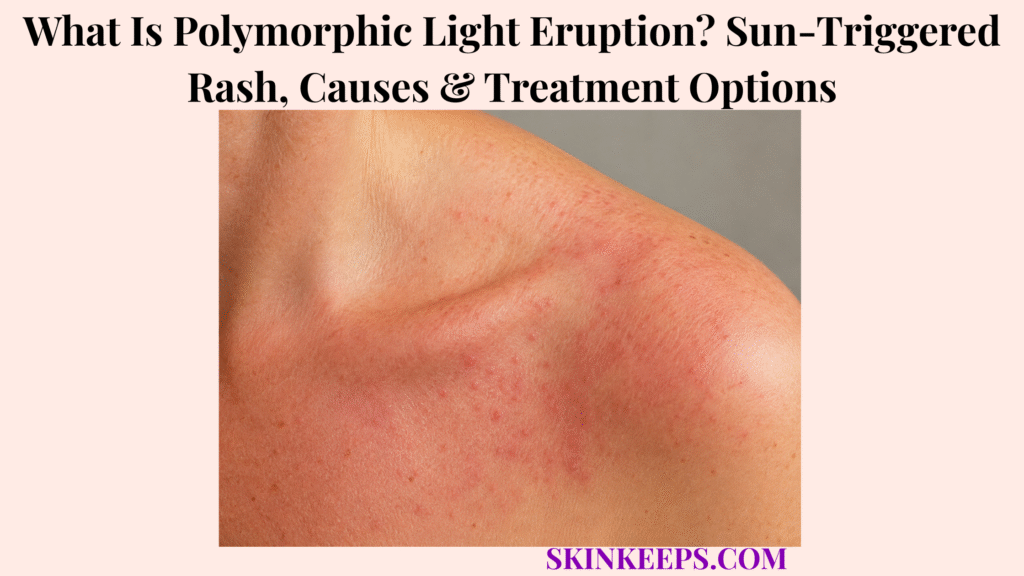
PMLE usually appears several hours to one or two days after strong sunlight as an itchy or burning eruption on skin that has recently become sun-exposed after being covered.
How Soon Does PMLE Appear, and What Does the Rash Look Like?
PMLE usually develops within several hours to one or two days after UV exposure and can appear as papules, plaques, eczema-like patches, tiny blisters or occasional hive-like lesions.
The lesions usually persist for days rather than disappearing immediately, and further UV exposure can intensify or prolong the episode. “Polymorphic” describes the range seen across patients; one person’s attacks generally look broadly similar from episode to episode.
Where Does PMLE Usually Appear?
PMLE most often affects symmetrically exposed areas such as the arms, upper chest, V-neck region, lower legs and upper thighs.
Intermittently exposed skin is especially susceptible after sudden seasonal sun exposure. Not every patient develops lesions at every exposed site.
Why Are the Face and Hands Sometimes Spared?
The face and backs of the hands can be relatively spared because regular year-round light exposure may create a natural hardening effect that increases UV tolerance.
Hardening may involve increased pigmentation, a thicker stratum corneum and altered inflammatory responsiveness. This relative tolerance is incomplete and does not mean chronically exposed skin becomes immune to PMLE.
How Can PMLE Look on Darker Skin, and What Is Juvenile Spring Eruption?
In darker skin, redness may be subtle and grouped small papules can be prominent, while juvenile spring eruption is a localized PMLE variant that mainly affects the ears of children, particularly boys, in spring.
Burning, itching and lesion texture can be more useful than redness alone on deeply pigmented skin. Juvenile spring eruption should remain a brief variant context rather than being assumed whenever the ears become itchy after sunlight.
Figure 1. PMLE is fundamentally delayed: strong UV exposure is followed hours to one or two days later by a recurrent itchy or burning eruption on intermittently exposed skin.
Why Does Polymorphic Light Eruption Develop, and Who Is More Likely to Get It?
PMLE appears to result from an abnormal delayed inflammatory response to UV-induced substances in susceptible skin, although the exact triggering antigen remains unknown.
What Causes PMLE?
The precise cause of PMLE is unknown, but current evidence supports a delayed immune response to UV-induced changes within the skin.
Ultraviolet radiation appears to create or modify skin molecules that provoke an abnormal inflammatory response in susceptible people. The specific photo-antigen has not been identified, so PMLE should not be described as a proven ordinary IgE-mediated allergy.
Do UVA and UVB Both Trigger PMLE?
Yes; both UVA and UVB can provoke PMLE, with UVA contributing substantially in many patients.
Visible light is a much less common trigger, and individual action spectra vary. Prevention therefore needs broad UVA and UVB protection rather than an SPF number alone.
Can PMLE Occur Through Window Glass, and Why Is Spring a Common Trigger?
Yes; UVA can penetrate ordinary window glass, and PMLE often appears in spring when winter-covered skin suddenly receives a larger ultraviolet dose.
A sunny window, the first warm spring days, an outdoor holiday or travel to a sunnier climate can provide enough sudden exposure to provoke symptoms in a susceptible person.
Who Is More Likely to Develop PMLE, and Is It Contagious?
PMLE can affect any skin tone or age but commonly begins in younger adulthood and is reported more often in women; it is not contagious, although familial susceptibility occurs in some people.
Children can also develop PMLE. A family history has been reported in a minority of patients, but PMLE is not a simple single-gene disorder and is not an infection or a form of skin cancer.
Figure 2. PMLE is best understood as an incompletely defined delayed inflammatory reaction to UV-induced skin changes rather than infection or a conventional immediate allergy.
How Is Polymorphic Light Eruption Distinguished and Diagnosed?
PMLE is usually diagnosed clinically from its recurrent delayed relationship to sunlight, but solar urticaria, lupus and drug- or product-related photosensitivity should be excluded when timing or symptoms are atypical.
How Is PMLE Different From Solar Urticaria?
Solar urticaria produces hives and swelling within minutes of light exposure, while PMLE generally develops hours to days later and persists for several days.
Immediate wheals strongly favor solar urticaria. PMLE can occasionally look hive-like, but the delayed onset remains a much stronger discriminator than morphology alone.
How Is PMLE Different From Cutaneous Lupus?
PMLE usually causes recurrent seasonal eruptions without systemic disease, while persistent photosensitive lesions or joint, muscle, fatigue or other systemic symptoms can justify investigation for lupus erythematosus.
When lupus is a realistic possibility, clinical examination and selected blood tests such as ANA or ENA can be appropriate, with biopsy used when needed. Those tests are not routine for every classic seasonal PMLE presentation.
How Do Drug-Induced Photosensitivity and Photocontact Dermatitis Differ?
Drug photosensitivity requires a photosensitizing medicine plus UV exposure, while photocontact dermatitis results from light interacting with a substance applied to or contacting the skin.
A newly started or changed medicine can create a new photosensitivity pattern, while photocontact dermatitis may match sites exposed to fragrances, selected plant chemicals or topical products. Medication and product history therefore matter when a previously familiar PMLE pattern suddenly changes.
When Are Skin Biopsy or Phototesting Needed?
Biopsy and specialist phototesting are reserved for atypical or diagnostically difficult photosensitivity rather than required for every typical PMLE case.
Biopsy findings in PMLE are variable and nonspecific but can help exclude alternatives; direct immunofluorescence is typically negative. Phototesting or photoprovocation uses controlled light wavelengths to reproduce a reaction and is a specialist diagnostic tool.
Figure 3. Timing separates immediate solar urticaria from delayed PMLE, while systemic symptoms and new medicine or product exposures shift attention toward lupus or secondary photosensitivity.
How Is an Active Polymorphic Light Eruption Treated?
An active PMLE flare is treated first by preventing further ultraviolet exposure and then controlling itch and inflammation with supportive or anti-inflammatory therapy when needed.
What Should Be Done When a PMLE Flare Appears?
The most important immediate step is to protect affected skin from additional UV exposure because continued sunlight can intensify or prolong the eruption.
Many episodes settle in roughly a week when further exposure stops, although duration varies. Shade, covering exposed skin and moving away from strong window exposure can help prevent continued provocation.
How Do Emollients, Cooling Measures and Topical Corticosteroids Help?
Emollients and cooling measures can reduce irritation, while an appropriately selected topical corticosteroid can reduce inflammation and itching during a significant PMLE flare.
Moisturizers and cooling preparations are supportive rather than curative. Topical corticosteroid strength depends on body site and severity, with extra caution on the face.
Can Antihistamines Help PMLE?
Yes; oral antihistamines can reduce itching, although they do not correct the underlying photosensitivity.
They are symptom-relief medicines, not a way to block the UV-triggered inflammatory mechanism or prevent the next attack.
When Are Systemic Treatments Considered?
Short systemic corticosteroid treatment, hydroxychloroquine or other specialist therapies are reserved for selected severe, extensive or repeatedly disabling PMLE rather than ordinary mild seasonal flares.
Systemic corticosteroids may be used selectively for major flares. Hydroxychloroquine can be considered for troublesome recurrent disease despite strong photoprotection, while rarely resistant disease may require specialist immunosuppressive therapy.
Figure 4. Active treatment focuses on stopping UV and reducing symptoms, while prevention focuses on broad-spectrum protection and, for disabling recurrent disease, supervised preseason phototherapy hardening.
How Can Future PMLE Flares Be Prevented?
Future PMLE flares are reduced by broad-spectrum UVA/UVB protection, protective clothing and lower UV exposure, while recurrent disabling disease may benefit from dermatologist-supervised phototherapy hardening before the sunny season.
Which Sunscreen and Physical Protection Matter Most?
PMLE prevention requires high-protection broad-spectrum sunscreen covering both UVA and UVB together with clothing, shade and reduced strong-sun exposure.
DermNet recommends broad-spectrum SPF 50+ protection, but sunscreen is not complete protection. Long sleeves, protective clothing, hats, shade and reducing intense midday exposure all reduce total UV dose.
Does Window Glass Fully Protect Against PMLE?
No; ordinary window glass can transmit significant UVA, so strongly UVA-sensitive people may still react during prolonged exposure beside sunny windows.
This does not mean brief routine indoor exposure is dangerous for everyone. The practical point is that UVA protection can matter even behind glass for people with clearly window-triggered disease.
What Is Natural PMLE Hardening?
Natural hardening is the seasonal increase in UV tolerance that can make PMLE attacks less frequent or severe as summer progresses.
Increased pigmentation, a thicker stratum corneum and altered immune responsiveness may contribute. The effect is temporary and can be lost after winter or another low-exposure period.
What Is Phototherapy Hardening, and Does It Cure PMLE Permanently?
Phototherapy hardening uses controlled dermatologist-supervised UVA or UVB exposure before the sunny season to increase tolerance, but its protective effect can fade and does not permanently cure PMLE.
It is generally considered for recurrent disabling disease and should not be confused with uncontrolled deliberate tanning. People who practise strict long-term UV avoidance may also need a clinician discussion about vitamin-D status rather than automatically taking supplements.
What Should You Remember About Polymorphic Light Eruption?
Polymorphic light eruption is a recurrent UV-triggered photodermatosis that typically produces an itchy or burning rash several hours to two days after strong spring or summer sunlight reaches previously covered skin.
- PMLE and PLE refer to polymorphic or polymorphous light eruption.
- It is a primary photodermatosis, not an infection or skin cancer.
- “Sun allergy” is informal shorthand rather than proof of ordinary IgE allergy.
- Onset is delayed by hours to one or two days after UV exposure.
- Papules, plaques, vesicles and eczema-like lesions can occur.
- One person’s morphology usually repeats across attacks.
- Arms, upper chest, V-neck and legs are common sites.
- The face and hands can be relatively spared through natural hardening.
- Redness can be subtle on darker skin.
- Juvenile spring eruption is a localized ear variant.
- The exact photo-antigen remains unknown.
- Both UVA and UVB can trigger PMLE.
- UVA can penetrate ordinary window glass.
- Spring and early summer are classic seasons.
- Some patients report a family history, but inheritance is not simple.
- PMLE is not contagious.
- Solar urticaria is usually immediate.
- Systemic symptoms or persistent lesions raise concern for lupus or another disorder.
- New medicines or topical products can cause secondary photosensitivity.
- Diagnosis is usually clinical.
- Biopsy and phototesting are selective.
- Stopping additional UV is the first flare-management step.
- Emollients, topical corticosteroids and antihistamines can reduce symptoms.
- Systemic therapy is reserved for selected severe or recurrent disease.
- Broad-spectrum UVA/UVB protection is central.
- Protective clothing and shade matter alongside sunscreen.
- Natural hardening can occur as summer progresses.
- Phototherapy hardening is controlled specialist treatment, not tanning.
- Phototherapy does not permanently cure PMLE.
- Individual attacks usually resolve without scarring.
- The seasonal tendency may become less severe over time, but recurrence remains possible.
Recognize delayed UV relationship → Exclude important mimics → Stop additional UV → Control symptoms → Strengthen UVA/UVB protection → Consider supervised hardening for recurrent disabling disease.
Frequently Asked Questions About Polymorphic Light Eruption
The most important PMLE questions concern how quickly the rash appears, how it differs from solar urticaria or lupus, whether UVA through windows can trigger it, how active attacks are treated and how future episodes can be prevented.
How Soon After Sunlight Does Polymorphic Light Eruption Appear?
PMLE usually develops several hours to one or two days after significant UV exposure rather than immediately. Lesions can persist for days, and continued sunlight can prolong the eruption.
How Can You Tell PMLE From Solar Urticaria or Lupus?
Solar urticaria usually causes hives within minutes, while PMLE is delayed; persistent photosensitivity with systemic symptoms raises greater concern for lupus or another disorder. Atypical cases should be clinically evaluated rather than diagnosed from sunlight exposure alone.
Can PMLE Occur Through Window Glass?
Yes; UVA can penetrate ordinary window glass, so substantial exposure beside a sunny window can trigger PMLE in susceptible people. Individual UVA sensitivity varies.
Which Treatments Help an Active PMLE Rash?
Avoiding further UV is the first step, while emollients, topical corticosteroids and antihistamines can help control inflammation, dryness and itching. Systemic treatment is reserved for selected severe disease.
Can Sunscreen and Phototherapy Prevent PMLE From Returning?
Broad-spectrum UVA/UVB sunscreen and protective clothing can reduce flares, while supervised preseason phototherapy can increase UV tolerance in people with recurrent disabling PMLE. Sunscreen is not complete protection, and phototherapy does not provide a permanent cure.
Which Sources Support This Polymorphic Light Eruption Guidance?
DermNet — Polymorphic Light Eruption — Primary source for seasonal timing, delayed onset, morphology, recurrent individual pattern, distribution, hardening, darker-skin presentation, UVA/UVB triggers, window-glass exposure, diagnosis, lupus exclusion, phototesting, treatment, photoprotection and long-term course.
British Association of Dermatologists — Polymorphic Light Eruption — Used for the delayed-hours-to-days pattern, spring seasonality, non-contagious framing, broad-spectrum UVA/UVB protection, antihistamines, controlled phototherapy desensitisation and vitamin-D caution.
NHS — Polymorphic Light Eruption — Used for hours-to-days onset, burning/itching, darker-skin visibility and juvenile spring eruption.
British Association of Dermatologists — Solar Urticaria — Used only for the immediate-light urticaria comparison that distinguishes solar urticaria from delayed PMLE.