
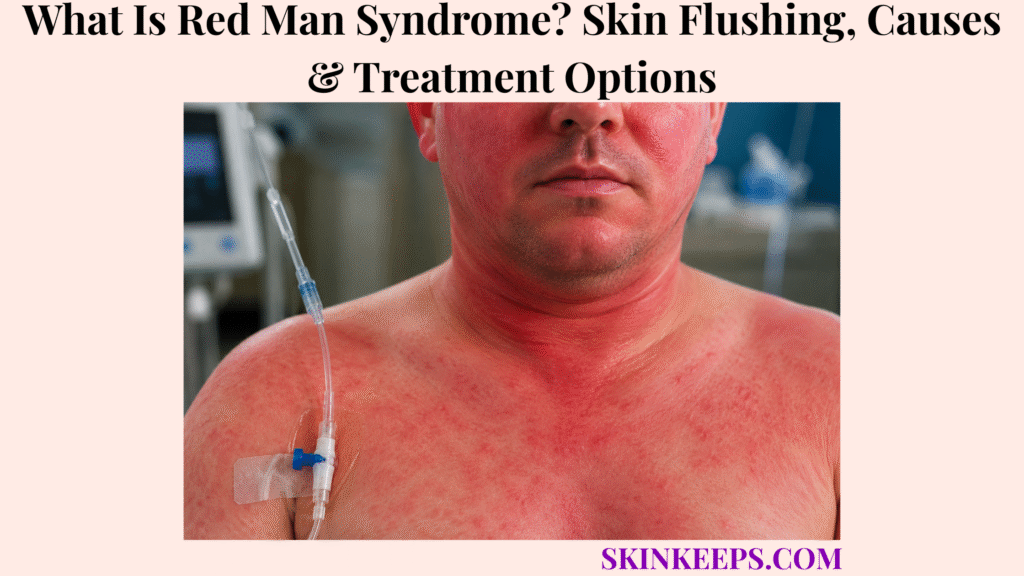
Vancomycin infusion reaction is a rate-related, non-IgE mast-cell reaction that can cause sudden flushing, itching and other symptoms during intravenous vancomycin administration. The reaction was historically called “Red Man Syndrome,” but Vancomycin Infusion Reaction, or VIR, is now the more accurate term because it describes the medication-and-infusion mechanism rather than a visual stereotype.
VIR is different from true vancomycin allergy or anaphylaxis, even though some symptoms can overlap and severe reactions require careful assessment. Management depends on reaction severity, and uncomplicated VIR may still allow future vancomycin use with slower monitored administration, selected premedication and accurate documentation.
This article is for educational purposes only. Breathing difficulty, airway swelling, severe hypotension or collapse during vancomycin treatment requires immediate medical attention.
What Is Vancomycin Infusion Reaction and What Does It Look and Feel Like?
Vancomycin infusion reaction is a non-IgE mast-cell reaction that usually develops during intravenous vancomycin and causes flushing, itching and warmth, especially over the upper body.
How Does Vancomycin Trigger Mast-Cell Activation?
Vancomycin can directly activate mast cells, releasing inflammatory mediators that dilate blood vessels and produce flushing, warmth and itching.
The mechanism is vancomycin exposure → mast-cell activation → mediator release → superficial vasodilation → flushing and pruritus. This differs from a classic IgE-mediated allergy pathway, which is why VIR should not automatically be labeled as permanent vancomycin allergy.
Why Is “Red Man Syndrome” No Longer the Preferred Name?
Vancomycin infusion reaction is the preferred term because it describes the medication-associated infusion mechanism rather than defining the reaction only by visible redness.
The older term remains recognizable in search and clinical history, but it is less precise and can obscure the fact that the reaction is driven by infusion-related mast-cell activation rather than skin color alone.
Where Does VIR Flushing Usually Appear?
VIR flushing and erythema commonly affect the face, neck, upper chest or trunk and sometimes the upper extremities.
Itching and warmth often accompany the flushing, and the eruption may look maculopapular in some patients. Redness alone is not enough to diagnose VIR because timing, infusion relationship and reaction severity all matter.
What Symptoms Can Occur Besides Flushing?
VIR can also cause itching, dizziness, weakness, chest or back discomfort, muscle symptoms and, in more substantial reactions, reduced blood pressure.
Symptoms often begin during or near the infusion and may improve after the infusion is interrupted and the reaction is treated. More severe cardiopulmonary symptoms require a different level of assessment because anaphylaxis or another serious reaction may be present.
Figure 1. VIR recognition begins with infusion-associated flushing and itching, but the decisive next step is severity assessment so airway compromise or major hypotension is not mislabeled as a routine infusion reaction.
What Causes Vancomycin Infusion Reaction and Which Factors Increase the Risk?
VIR is primarily promoted by vancomycin administration rate, with faster infusion increasing mast-cell activation and reaction risk, although dose and other mast-cell-activating exposures can also influence susceptibility.
How Does Infusion Rate Affect VIR Risk?
Faster vancomycin administration increases the likelihood and potential severity of VIR by producing stronger mast-cell activation.
Infusion rate is the major modifiable factor because rapid delivery can provoke greater mediator release from mast cells. This article does not provide individualized infusion instructions; the rate should be managed by the healthcare team using appropriate institutional protocols.
Does Vancomycin Dose Affect the Reaction?
Dose can influence VIR risk because larger doses may require longer administration to avoid excessive delivery rate.
The important concept is the dose-rate relationship rather than dose alone: a larger amount given over insufficient time can increase the infusion burden and mast-cell response.
Can Other Medicines or Agents Increase Susceptibility?
Other agents capable of promoting mast-cell mediator release may increase susceptibility to VIR when given around the same time as vancomycin.
Examples include selected opioids, neuromuscular-blocking agents and radiocontrast media. These are risk-context categories rather than a patient-directed list of medicines to stop or avoid independently.
Can VIR Occur Even With Slow Vancomycin Infusion?
Yes; slower administration substantially lowers VIR risk but does not reduce the possibility to zero.
That distinction matters because an appropriately slow infusion can still be followed by symptoms in a susceptible patient. Slower delivery is a risk-reduction strategy, not a guarantee that a reaction cannot occur.
Figure 2. The clearest modifiable VIR risk factor is infusion rate, while dose context and other mast-cell-activating exposures can contribute to the amount of mast-cell activation and symptom burden.
How Is Vancomycin Infusion Reaction Distinguished From Anaphylaxis or Other Drug Reactions?
VIR is usually recognized by infusion-associated flushing and itching with a strong rate relationship, while airway symptoms, severe hypotension or other hypersensitivity features raise concern for anaphylaxis or another serious drug reaction.
Which Features Suggest Typical VIR?
Typical VIR is suggested by symptoms developing during or near vancomycin infusion, especially upper-body flushing, erythema and itching that correlate with administration rate.
Diagnosis is largely clinical and no single laboratory test proves VIR. The healthcare team interprets timing, symptom pattern, hemodynamic stability and whether the reaction changes when the infusion is interrupted.
Which Symptoms Raise Concern for Anaphylaxis?
Breathing difficulty, wheezing, stridor, major airway swelling, severe hypotension or collapse require urgent assessment for anaphylaxis rather than assumption of uncomplicated VIR.
Widespread hives can also occur in immediate hypersensitivity and should be interpreted together with airway, cardiovascular and timing features rather than treated as a stand-alone diagnosis.
Can Other Vancomycin Skin Reactions Be Mistaken for VIR?
Yes; delayed drug eruptions, DRESS, linear IgA bullous dermatosis and severe epidermal reactions are different adverse drug reactions with different implications for future vancomycin exposure.
A delayed blistering eruption is not typical VIR. Vancomycin-associated linear IgA dermatosis belongs to a different autoimmune blistering pathway and should not be grouped with a rate-related infusion reaction.
Figure 3. VIR and anaphylaxis can overlap visually, but mechanism, infusion-rate relationship, airway findings and future-drug implications make the distinction clinically important.
How Is Vancomycin Infusion Reaction Treated?
When VIR develops, clinicians interrupt the infusion, assess severity and vital signs, treat symptoms as needed and determine whether vancomycin can later be resumed more slowly.
What Happens When a VIR Begins?
The immediate clinical response is to stop or interrupt vancomycin administration and assess the patient’s airway, breathing, circulation and overall reaction severity.
This is a healthcare-team response rather than a home-treatment problem. The first task is to determine whether the reaction fits uncomplicated VIR or whether anaphylaxis, severe hypotension or another dangerous adverse reaction needs emergency management.
How Are Antihistamines Used?
Clinicians may use antihistamines to reduce flushing and itching because mast-cell mediator release contributes to VIR symptoms.
Antihistamines are part of clinician-directed treatment rather than a complete stand-alone response. The infusion relationship, reaction severity and vital signs still need to be assessed.
Can Vancomycin Be Restarted After VIR?
Yes, uncomplicated VIR may sometimes allow vancomycin to be restarted more slowly after symptoms resolve and anaphylaxis or another severe reaction has been excluded.
The decision depends on reaction severity, response to treatment, clinical need for vancomycin and whether the original event was truly VIR rather than an immune-mediated hypersensitivity reaction.
How Is a Severe Reaction Managed Differently?
If airway symptoms, severe hypotension or other signs suggest anaphylaxis, the reaction must be treated as a medical emergency rather than managed as routine VIR.
Emergency management follows the severe-hypersensitivity pathway, not the slower-infusion pathway used for uncomplicated VIR.
Figure 4. VIR management should move in a safety-first sequence: interrupt the infusion, assess severity, separate uncomplicated VIR from severe hypersensitivity, then decide whether and how vancomycin can be used again.
How Can Future Vancomycin Infusion Reactions Be Prevented and Documented Safely?
Future VIR risk can often be reduced through slower vancomycin administration, selected premedication when appropriate and accurate documentation of the previous reaction rather than automatically labeling the patient as permanently allergic.
How Does Slower Vancomycin Administration Reduce Risk?
Slower administration reduces the intensity of mast-cell activation and is the most important modifiable strategy for lowering VIR risk.
Healthcare protocols commonly limit the administration rate and extend infusion time according to dose and prior reaction history. Those are clinician-facing decisions rather than patient-directed dosing instructions.
When Is Antihistamine Premedication Considered?
Premedication may be considered for selected patients with previous VIR or when clinically necessary, but it is not automatically required for every vancomycin infusion.
The decision should reflect prior reaction severity, planned infusion conditions and the treating team’s protocol rather than a universal rule.
How Should a Previous VIR Be Documented?
Medical documentation should record the symptoms, timing, severity, infusion relationship and precautions that allowed vancomycin to be tolerated safely.
Useful documentation can include what symptoms occurred, when they appeared, whether hypotension or airway symptoms were present, the infusion conditions and any premedication used. Precise documentation helps avoid inaccurate permanent allergy labeling and supports safer future prescribing.
When Does a Reaction Need Emergency Treatment?
Emergency assessment is required for breathing difficulty, wheezing or stridor, major facial or airway swelling, severe persistent hypotension, collapse or a rapidly worsening systemic reaction.
Healthcare staff should be notified immediately whenever suspected VIR develops during an infusion. Uncomplicated VIR may not prohibit future vancomycin, but severe immune-mediated reactions require a separate risk assessment.
What Should You Remember About Vancomycin Infusion Reaction?
Vancomycin infusion reaction is usually a rate-related non-IgE mast-cell reaction that can cause flushing and itching during vancomycin administration but should not automatically be treated as permanent vancomycin allergy.
- VIR is the preferred name.
- Red Man Syndrome is legacy terminology.
- VIR is commonly rate related.
- Direct mast-cell activation is central.
- VIR is generally non-IgE mediated.
- Flushing commonly affects the upper body.
- Itching and warmth are common.
- Hypotension can occur in more substantial reactions.
- Symptoms often arise during or near infusion.
- Faster infusion increases risk.
- Dose can influence administration needs.
- Slower infusion lowers but does not eliminate risk.
- VIR is not automatically vancomycin allergy.
- Anaphylaxis is a different and potentially life-threatening reaction.
- Airway symptoms are major warning signs.
- Other vancomycin skin reactions exist.
- Diagnosis is mainly clinical.
- The infusion is interrupted when VIR begins.
- Severity is assessed immediately.
- Antihistamines may be used by clinicians.
- Vancomycin may sometimes be restarted after uncomplicated VIR.
- Future administration may be slower and monitored.
- Premedication is selected rather than universal.
- Documentation should be precise.
- Severe reactions require emergency treatment.
Infusion → recognize reaction → assess severity → distinguish VIR from anaphylaxis → manage → document → plan safer future vancomycin.
Frequently Asked Questions About Vancomycin Infusion Reaction
The main VIR questions concern whether it represents allergy, why flushing occurs, recurrence, future vancomycin use and how it differs from anaphylaxis.
Is Red Man Syndrome the Same as a Vancomycin Allergy?
No; what is now called vancomycin infusion reaction is usually a non-IgE rate-related reaction and should not automatically be documented as true vancomycin allergy.
Why Does Vancomycin Cause Skin Flushing?
Vancomycin can directly activate mast cells, releasing mediators that dilate superficial blood vessels and cause flushing and warmth.
Can Vancomycin Infusion Reaction Happen Again?
Yes; VIR can recur with future vancomycin exposure, especially if relevant infusion-related risk factors are not addressed.
Can Someone Receive Vancomycin Again After VIR?
Often yes; uncomplicated VIR does not automatically prohibit future vancomycin, although subsequent administration should be planned by the treating medical team.
What Is the Difference Between VIR and Anaphylaxis?
VIR is usually a rate-related non-IgE mast-cell reaction, while anaphylaxis is a potentially life-threatening hypersensitivity reaction in which airway or severe cardiovascular symptoms are major warning signs.
Which Sources Support This Vancomycin Infusion Reaction Guidance?
UCSF Infectious Diseases Management Program — Vancomycin Infusion Reaction — Used for VIR terminology, rate-related mast-cell mechanism, allergy distinction, risk factors, immediate management, future vancomycin precautions, premedication context and documentation principles.
NCBI Bookshelf / StatPearls — Vancomycin Infusion Reaction — Used for symptom spectrum, upper-body distribution, timing, dose-rate relationship, clinical diagnosis, infusion interruption, antihistamine use and future slower administration.
New England Journal of Medicine — Vancomycin Infusion Reaction: Moving Beyond “Red Man Syndrome” — Used for terminology modernization and the rationale for preferring “Vancomycin Infusion Reaction.”