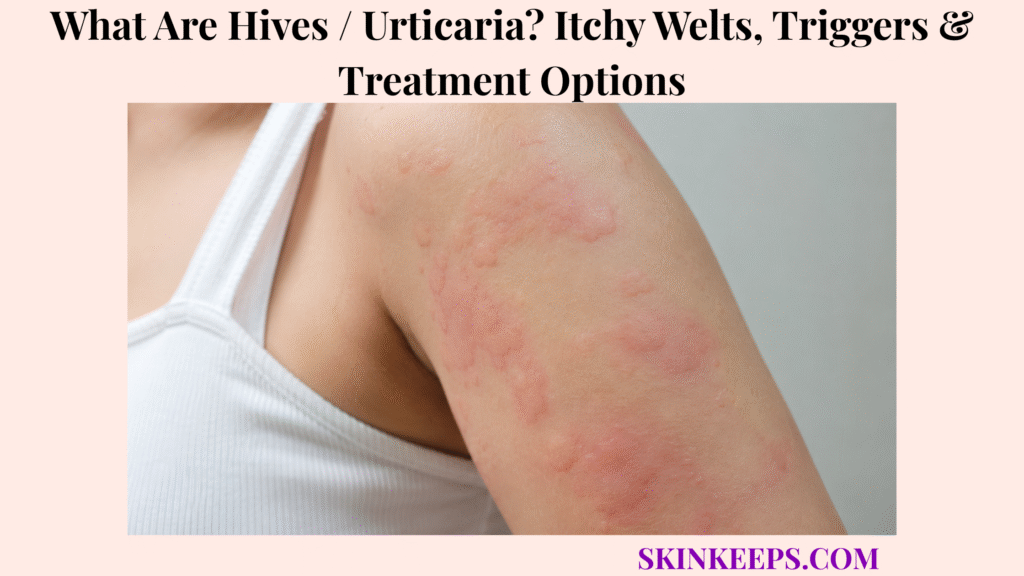
Hives, also called urticaria, are raised, usually itchy areas of temporary skin swelling called wheals or welts. They can change shape, merge, disappear and reappear elsewhere, and each ordinary hive usually clears from one spot within 24 hours.
Deeper swelling is called angioedema. Hives are not always an allergy, but breathing difficulty, tongue or throat swelling, faintness or severe multisystem symptoms may indicate anaphylaxis and require epinephrine and emergency care.
How Can You Recognize Hives on the Skin?
Hives usually appear as raised, smooth, itchy welts that change shape, migrate and resolve from each spot within 24 hours.
- Raised smooth wheals or merged plaques.
- Pale, pink, red, brown-red, purple-brown or skin-coloured swelling.
- Round, oval, ring-shaped, irregular or map-like borders.
- Intense itch; burning or stinging in some cases.
- Blanching or a lighter swollen centre.
- Rapid change in size and shape.
- Welts disappearing from one area while new ones form elsewhere.
- Skin returning to normal after an ordinary lesion resolves.
A fixed painful lesion lasting longer than 24 hours, blistering or bruising needs reconsideration.
Figure 1. Ordinary hives are raised, smooth, itchy wheals that change shape and location; each spot usually clears within 24 hours, while deeper angioedema can last longer.
Where Can Hives Appear?
Hives can appear on almost any external skin surface, either randomly or in the area exposed to a trigger.
| Distribution | Possible Sites | Pattern Clue |
|---|---|---|
| Widespread spontaneous | Face, trunk, arms and legs | Random changing areas |
| Scratching/rubbing | Any stroked skin | Linear welts |
| Pressure | Waist, shoulders, palms, soles or buttocks | Matches sustained pressure |
| Cold/heat/contact | Exposed surface | Stimulus-shaped |
| Clothing/occlusion | Beneath tight or warm clothing | Pressure or heat link |
How Can Hives Look Different Across Skin Tones?
Hives do not always look bright red; raised texture, itching, movement and short duration may be more reliable than colour.
- Welts may be pink, red-brown, purple-brown, greyish or skin-coloured.
- The centre may look lighter than surrounding skin.
- Elevation can be easier to see from the side.
- Blanching can be subtle in deeply pigmented skin.
- Persistent dark or light marks are not typical of an untouched ordinary wheal.
How Long Does an Individual Hive Last?
One ordinary hive usually lasts minutes to several hours and should resolve within 24 hours.
New welts can continue appearing as older ones disappear, so the whole episode may last days, weeks or longer.
Angioedema is deeper and can take up to about 72 hours to resolve.
| Skin Event | Typical Duration | When to Reconsider |
|---|---|---|
| Ordinary wheal | Minutes to under 24 hours | Same lesion fixed beyond 24 hours |
| Angioedema | Hours to about 72 hours | Airway symptoms or recurrent isolated swelling |
| Whole urticaria episode | Days to years depending on type | Six weeks or more becomes chronic |
How Are Acute and Chronic Urticaria Different?
What Is Acute Urticaria?
Acute urticaria means wheals, angioedema or both lasting less than six weeks.
It often resolves within hours or days and is more likely to follow infection, food, medicine, sting or another recent exposure.
What Is Chronic Urticaria?
Chronic urticaria means recurrent or continuous wheals, angioedema or both for six weeks or longer.
Symptoms may be daily or episodic and can affect sleep, concentration, school, work and quality of life.
| Feature | Acute | Chronic |
|---|---|---|
| Duration | Less than six weeks | Six weeks or longer |
| Trigger | Recent trigger more likely | Often no single external trigger |
| Course | Hours to days common | Months or years possible |
| Subtypes | Usually spontaneous acute episode | Spontaneous or inducible |
How Are Spontaneous and Inducible Urticaria Different?
Spontaneous urticaria occurs without one consistently reproducible external stimulus, while inducible urticaria follows a repeatable trigger.
| Type | Trigger Pattern | Lesion Distribution | Examples |
|---|---|---|---|
| Spontaneous | No definite reproducible stimulus | Random | Acute spontaneous or CSU |
| Inducible | Predictable stimulus-response | Matches exposure | Scratching, cold, heat or pressure |
| Coexisting forms | Both patterns present | Mixed | CSU plus dermographism |
Spontaneous does not mean imaginary.
How Do Mast Cells Produce Itchy Welts?
Mast cells produce hives by releasing histamine and other mediators that make small blood vessels temporarily leaky.
Fluid enters the superficial dermis and creates a wheal, while histamine activates sensory nerves and causes itching. Deeper leakage produces angioedema.
This mechanism explains why H1 antihistamines are first-line treatment for most urticaria.
Figure 2. Mast-cell mediators temporarily increase superficial vessel leakage and stimulate itch nerves; urticaria is then classified by duration and by whether a reproducible trigger exists.
What Commonly Causes Acute Hives?
Acute hives can follow infection, food, medicine, insect stings, latex or another recent exposure, but many episodes have no identified cause.
| Exposure | Timing/Context | Allergy Likelihood | Next Direction |
|---|---|---|---|
| Viral illness | During or after infection | Often non-allergic | Supportive care |
| Food | Minutes to about two hours | Higher when reproducible | Targeted allergy assessment |
| Medicine | After a dose or course | Depends on pattern | Prescriber review |
| Sting or latex | Immediate exposure | Higher when reproducible | Allergy and emergency plan |
| Physical trigger | Repeatable cold, heat or pressure | Inducible urticaria | Supervised assessment |
Infections are common acute causes in children.
When Do Foods Cause Hives?
Food allergy is more likely when hives begin quickly after the same food and recur with repeated exposure.
- Symptoms begin within minutes to about two hours.
- The same food repeatedly causes the same reaction.
- Hives occur with lip swelling, vomiting, wheezing or faintness.
- A targeted allergy assessment supports the history.
Daily random hives for months, reactions to many unrelated foods or symptoms long after eating argue against one food allergy. Broad panels can create irrelevant positives and unnecessary restriction.
Which Medicines Can Trigger or Worsen Hives?
Medicines can trigger acute hives, worsen chronic urticaria or cause a separate drug eruption, so timing and lesion duration matter.
A medicine may cause immediate hives, aggravate CSU or produce a different drug rash.
| Medicine Group | Possible Pattern | Action |
|---|---|---|
| Antibiotics | Acute hives or separate eruption | Document timing and review |
| NSAIDs/aspirin | Can worsen CSU | Discuss alternatives |
| Opioids/contrast | Mediator-related hives possible | Risk assessment |
| Biologics/infusions | Immediate reaction possible | Supervised treatment plan |
| Vaccines | Immediate hives uncommon | Evaluate reaction phenotype |
An infection being treated by an antibiotic may itself be the cause. Essential medicines should not be stopped abruptly without guidance.
What Causes Chronic Spontaneous Urticaria?
Chronic spontaneous urticaria usually reflects ongoing mast-cell activation rather than one hidden external allergen.
- Autoantibodies that activate mast-cell pathways in some patients.
- Other internal immune dysregulation.
- Association with autoimmune thyroid disease.
- Unknown mechanism in many people.
- Heat, alcohol, stress or NSAIDs acting as aggravators rather than root causes.
Chronic spontaneous urticaria is generally not one-food disease.
Is Chronic Urticaria an Autoimmune Disease?
Some chronic spontaneous urticaria is autoimmune, but not every patient has a separate systemic autoimmune disease.
Autoantibodies can activate IgE-related mast-cell pathways in some cases. Thyroid autoimmunity is associated with CSU, but a positive thyroid antibody does not prove it causes each hive.
Testing is selected according to history and clinical findings.
What Is Symptomatic Dermographism?
Symptomatic dermographism causes raised itchy linear welts after scratching, stroking or firm rubbing.
- Lines appear within minutes.
- Clothing seams or scratching may reproduce them.
- Welts often fade within about an hour.
- Warmth, stress or irritation may increase activity.
- Controlled skin stroking can confirm the pattern.
What Is Cholinergic Urticaria?
Cholinergic urticaria causes many tiny itchy wheals after body temperature rises and sweating begins.
Exercise, hot showers, fever, emotional stress or spicy food can trigger rapid short-lived lesions.
Cholinergic wheals appear quickly and fade rapidly, while heat rash / miliaria produces more persistent sweat-duct bumps.
Wheezing or systemic symptoms need urgent assessment.
What Is Cold Urticaria?
Cold urticaria causes welts or swelling after cold air, water, objects or drinks.
- Local wheals after cold contact.
- Hand swelling while holding cold items.
- Lip swelling after cold drinks.
- Symptoms during rewarming.
- Dizziness, fainting or shock after extensive cold-water exposure.
Suspected cold urticaria should avoid unsupervised cold-water swimming and home immersion challenges until medically assessed.
What Is Delayed-Pressure Urticaria?
Delayed-pressure urticaria causes deeper painful swelling several hours after sustained pressure.
It may affect soles, palms, shoulders, buttocks or the waist after tight straps, carrying loads, sitting or prolonged walking.
Swelling can last longer than an ordinary superficial wheal and may limit activity.
Which Other Forms of Inducible Urticaria Can Occur?
Other inducible forms are classified by the specific stimulus that reproducibly creates wheals or swelling.
| Subtype | Trigger | Typical Pattern | Systemic Risk |
|---|---|---|---|
| Heat urticaria | Local heat | Rapid contact-site wheal | Usually local |
| Solar urticaria | Light exposure | Exposed skin | Possible |
| Aquagenic urticaria | Water contact | Contact-site wheals | Usually local |
| Vibratory angioedema | Vibration | Local swelling | Possible |
| Contact urticaria | Substance contact | Immediate contact area | Possible |
| Exercise-related | Exertion | Variable/widespread | Possible anaphylaxis |
What Is Angioedema—and How Is It Related to Hives?
Angioedema is deeper swelling that can occur with hives or occasionally without visible wheals.
Deeper swelling is called angioedema, and it may affect the lips, eyelids, hands, feet, genitals, tongue or throat.
It may feel tight, painful, burning or tingling and can take up to about 72 hours to resolve.
Recurrent swelling without hives, abdominal attacks or poor antihistamine response needs a separate bradykinin-mediated evaluation.
How Are Hives Different From Anaphylaxis?
Isolated hives affect the skin, while anaphylaxis involves airway, breathing, circulation or severe multisystem symptoms.
| Pattern | Skin-Only Hives | Possible Anaphylaxis |
|---|---|---|
| Skin | Itchy welts | Hives may or may not occur |
| Airway | No throat/tongue problem | Throat tightness, tongue swelling or hoarseness |
| Breathing | Normal | Wheeze or breathing difficulty |
| Circulation | Stable | Faintness, confusion, low BP or collapse |
| GI | Mild or absent | Repeated vomiting or severe symptoms after likely allergen |
| First action | Antihistamine and monitoring | Epinephrine and emergency services |
Antihistamines can reduce itching but do not reverse airway obstruction or shock.
How Are Hives Different From Hereditary Angioedema?
Hives are itchy mast-cell wheals, while hereditary angioedema usually causes deeper swelling without hives or itching.
Recurrent swelling without itchy welts, especially with abdominal attacks or poor antihistamine response, should be assessed through a separate hereditary angioedema pathway.
| Feature | Hives / Urticaria | Hereditary Angioedema |
|---|---|---|
| Itch | Common | Usually absent |
| Wheals | Present | Usually absent |
| Abdominal attacks | Not typical | Common |
| Mediator | Histamine/mast cell | Bradykinin |
| Antihistamine response | Often helps | Poor control |
How Are Hives Different From Insect Bites?
Hives move and resolve quickly, while insect-bite reactions usually stay fixed for days and may have a puncture mark.
| Feature | Hives | Insect Bites |
|---|---|---|
| Duration at one spot | Under 24 hours | Days |
| Movement | Migratory | Fixed |
| Central punctum | Absent | May be present |
| Residual mark | Usually none | Scab or pigment can remain |
| Distribution | Random or trigger-shaped | Exposed clustered areas |
How Are Hives Different From Contact Dermatitis?
Hives are transient smooth wheals, while contact dermatitis produces longer-lasting inflamed, dry, scaly, blistered or cracked patches.
Delayed allergic contact dermatitis commonly persists for days or weeks, unlike ordinary hives that move and resolve quickly.
| Feature | Hives | Contact Dermatitis |
|---|---|---|
| Surface | Smooth wheal | Scale, dryness, vesicles or cracks |
| Onset | Rapid | Often delayed |
| Duration | Each lesion under 24 hours | Days or weeks |
| After resolution | Normal skin | Ongoing inflammation possible |
How Are Hives Different From Urticarial Vasculitis?
Urticarial vasculitis can resemble hives, but lesions often stay fixed longer, burn or hurt and leave bruising or pigment.
| Feature | Ordinary Hives | Urticarial Vasculitis |
|---|---|---|
| Lesion duration | Under 24 hours | Often over 24 hours |
| Sensation | Itch | Burning or pain |
| Residual mark | None | Bruise or pigment |
| Systemic signs | Usually absent | Fever, joints or organ symptoms possible |
| Biopsy | Usually unnecessary | Often considered |
Which Other Conditions Can Resemble Urticaria?
Several rashes resemble hives, but duration, migration, scale, bruising, blistering and systemic symptoms help separate them.
Target-like lesions from erythema multiforme usually remain fixed longer than ring-shaped hives.
General viral exanthems may spread widely but usually do not behave like migratory wheals.
| Mimic | Clue Against Ordinary Hives |
|---|---|
| Bullous pemphigoid | Persistent lesions followed by blisters |
| Mastocytosis | Fixed lesions and mast-cell symptoms |
| Autoinflammatory syndrome | Fever and systemic inflammation |
| Scabies | Persistent burrows and night itch |
| Drug eruption | Fixed widespread eruption and medicine timeline |
| Cellulitis | Painful expanding warmth and fever |
| Serum sickness-like reaction | Fever, joints and persistent lesions |
How Do Clinicians Diagnose Hives?
Clinicians diagnose hives mainly from the history and appearance of true transient wheals.
- Appearance, itch and shape of each welt.
- Duration at one exact spot.
- Migration and complete resolution.
- Presence and duration of angioedema.
- Total condition duration.
- Food, medicine, sting, infection and physical-trigger timing.
- Family history and systemic warning signs.
- Photographs during active episodes.
The first task is to confirm a true wheal before searching for causes.
Which Tests Are Needed for Acute Hives?
Most uncomplicated acute hives do not need routine laboratory testing.
| Clinical Pattern | Testing Direction |
|---|---|
| Clear immediate food, medicine, latex or sting reaction | Targeted allergy evaluation |
| Compatible infection symptoms | Targeted infection testing |
| Systemic illness | CBC or inflammatory tests as indicated |
| Isolated resolving hives | Usually no laboratory test |
| Possible anaphylaxis | Emergency assessment first |
Broad allergy panels are unlikely to help without a convincing exposure history.
Which Tests Are Used for Chronic Spontaneous Urticaria?
CSU usually needs limited baseline assessment, with expanded testing only when history, examination or initial results suggest another condition.
| Level | Possible Assessment | Purpose |
|---|---|---|
| Baseline | CBC with differential and CRP or ESR | Screen for inflammation or blood clues |
| Clinical | Medication review and examination | Identify aggravators and mimics |
| Selected | TSH and thyroid antibodies | Evaluate thyroid association |
| Selected | Liver, kidney, complement or protein studies | Investigate specific clues |
| Selected | Tryptase, autoimmune tests or biopsy | Atypical or systemic pattern |
How Are Inducible Hives Confirmed?
Inducible hives are confirmed by safely reproducing the suspected trigger under controlled conditions.
| Suspected Type | Controlled Test |
|---|---|
| Dermographism | Skin stroking or dermographometer |
| Cold urticaria | Cold-contact and threshold testing |
| Cholinergic urticaria | Controlled warming or exercise |
| Delayed pressure | Weighted pressure challenge |
| Solar/heat/aquagenic/vibratory | Stimulus-specific provocation |
Cold-water immersion and strenuous exercise challenges should not be attempted casually at home.
When Is a Skin Biopsy Needed for Hive-Like Lesions?
A skin biopsy may be needed when hive-like lesions stop behaving like ordinary transient wheals.
- One lesion lasts longer than 24 hours.
- Pain or burning is greater than itching.
- Bruising or pigment remains.
- Blisters form.
- Fever, joint pain or organ symptoms occur.
- Vasculitis, bullous pemphigoid or another inflammatory disease is possible.
Does Acute Urticaria Require Treatment?
Mild acute hives may resolve without prescription treatment, but troublesome itching can be treated and anaphylaxis requires immediate emergency care.
- Remove a strongly suspected trigger when safe.
- Use a second-generation H1 antihistamine for skin-only symptoms when appropriate.
- Treat an underlying illness when indicated.
- Monitor for angioedema or systemic symptoms.
- Use epinephrine immediately for suspected anaphylaxis.
- Reassess persistent or recurrent disease.
Which Antihistamines Are Preferred for Hives?
Second-generation H1 antihistamines are preferred because they provide longer control with less sedation than older options.
| Medicine | General Role | Sedation Consideration |
|---|---|---|
| Cetirizine/levocetirizine | Common first-line options | Can still cause drowsiness |
| Loratadine/desloratadine | Long-acting options | Usually less sedating |
| Fexofenadine | Long-acting option | Minimal sedation for many people |
| Bilastine/rupatadine | Available in some countries | Follow local labeling |
Age, pregnancy, kidney or liver function, occupation and other medicines affect selection.
Why Are Older Sedating Antihistamines Not Preferred for Routine Treatment?
Older sedating antihistamines are not preferred for routine chronic treatment because they can impair alertness, memory, driving and coordination.
| Risk | Possible Consequence |
|---|---|
| Daytime sleepiness | Work or school impairment |
| Driving impairment | Accident risk |
| Cognitive effects | Reduced concentration and memory |
| Anticholinergic effects | Dry mouth, urinary or vision problems |
| Falls/overdose | Greater risk in vulnerable patients |
What Happens When a Standard Antihistamine Dose Does Not Control Chronic Hives?
When a standard dose fails, clinicians first confirm diagnosis, regular use, aggravators and adherence before escalating treatment.
One second-generation H1 antihistamine may be increased up to fourfold under clinical direction. Patients should not improvise multi-drug or high-dose combinations.
Persistent uncontrolled CSU can then move to advanced treatment.
How Does Omalizumab Treat Chronic Spontaneous Urticaria?
Omalizumab is an anti-IgE biologic used when CSU remains uncontrolled despite clinician-directed high-dose second-generation H1 antihistamines.
It reduces IgE-related mast-cell activation and is commonly administered every four weeks. Current U.S. labeling covers adults and adolescents aged 12 years and older.
It is not an emergency treatment and is not automatically used for every inducible subtype.
How Does Dupilumab Treat Chronic Spontaneous Urticaria?
Dupilumab blocks interleukin-4 and interleukin-13 signalling and is an approved CSU option after H1-antihistamine treatment remains inadequate.
The current U.S. label includes adults and children aged two years and older and specifically excludes other forms of urticaria from this indication.
Selection depends on age, previous treatment, comorbid disease, safety and access.
How Does Remibrutinib Treat Chronic Spontaneous Urticaria?
Remibrutinib is an oral Bruton tyrosine kinase inhibitor that reduces signalling involved in mast-cell activation.
The FDA approved it on September 30, 2025 for adults with CSU who remain symptomatic despite H1-antihistamine treatment.
It is taken orally and requires label-based safety review, interaction assessment and monitoring.
When Is Ciclosporin Used for Chronic Hives?
Ciclosporin is reserved for selected refractory CSU after antihistamines and preferred advanced therapy have not provided adequate control.
It suppresses immune activation but can affect blood pressure, kidney function and infection risk.
Specialist monitoring and interaction review are required.
Are Corticosteroids Appropriate for Hives?
A short systemic corticosteroid rescue course may be considered for selected severe acute exacerbations, but long-term use is not appropriate maintenance treatment.
Repeated or prolonged courses can cause glucose, blood pressure, bone, eye, mood, infection and adrenal complications.
Topical corticosteroids generally provide little benefit for ordinary wheals because the swelling is temporary and deeper than surface eczema.
Do Montelukast, H2 Blockers or Other Add-On Medicines Help Hives?
Selected add-on medicines may help individual patients, but evidence and risk differ and they should not replace the core treatment ladder.
| Add-On | Possible Role | Boundary |
|---|---|---|
| Montelukast | Selected NSAID-sensitive or refractory disease | Variable evidence |
| H2 blocker | Occasional adjunct | Not core modern treatment |
| Doxepin | Strong antihistamine effect | Sedating and anticholinergic |
| Dapsone/sulfasalazine | Selected specialist cases | Laboratory monitoring |
| Other immunomodulators | Rare refractory disease | Specialist-only |
How Are Chronic Inducible Hives Treated?
Chronic inducible hives are treated by identifying the reproducible trigger, reducing exposure below the reaction threshold and using antihistamines when needed.
- Define and, when safe, measure the exact trigger threshold.
- Use a daily second-generation H1 antihistamine when appropriate.
- Escalate only under clinical direction.
- Carry emergency medicine when systemic reactions are possible.
- Avoid unsupervised cold-water swimming in cold urticaria.
- Reduce sustained pressure in delayed-pressure urticaria.
- Modify warming or activity in cholinergic urticaria.
- Use photoprotection in solar urticaria.
How Can Itching From Hives Be Relieved at Home?
Home care can reduce itching and irritation but does not replace prescribed medicine or emergency treatment.
- Take the prescribed non-sedating antihistamine consistently.
- Use cool compresses.
- Choose lukewarm rather than hot bathing.
- Wear loose clothing.
- Keep the sleeping environment cool.
- Use fragrance-free products.
- Keep nails short and reduce scratching.
- Avoid alcohol, overheating or NSAIDs when they repeatedly worsen symptoms.
Which Hive Treatment Mistakes Should Be Avoided?
Unsafe hive care can delay epinephrine, create medication harm or miss a different disease.
| Mistake | Why It Is Unsafe | Safer Direction |
|---|---|---|
| Treat breathing difficulty with antihistamine alone | Does not reverse shock or airway obstruction | Use epinephrine and emergency care |
| Delay epinephrine | Anaphylaxis can progress quickly | Follow emergency plan immediately |
| Assume all chronic hives are food allergy | CSU often has no single allergen | Use history-based testing |
| Start broad elimination diets | Nutrition harm and false attribution | Avoid only confirmed triggers |
| Mix sedating antihistamines unpredictably | Impairment and overdose risk | Use clinician plan |
| Increase doses without direction | Safety and dosing errors | Clinician-directed maximum |
| Use repeated steroids for ongoing control | Cumulative serious harm | Follow chronic ladder |
| Attempt cold-water or exercise provocation outside supervised care | Systemic reaction risk | Supervised testing |
| Ignore fixed bruising lesions | May be vasculitis or mimic | Clinical review/biopsy |
How Is Urticaria Activity and Treatment Control Measured?
Urticaria control can be tracked with symptom scores, photographs, sleep impact, rescue-medicine use and daily function.
| Tool | What It Measures | Use |
|---|---|---|
| UAS7 | Seven-day wheal number and itch | Disease activity |
| UCT | Recent urticaria control | Treatment adequacy |
| AAS | Angioedema activity | Swelling burden |
| AECT | Angioedema control | Control and escalation |
| Photos/diary | Lesion behaviour and triggers | Diagnostic support |
| Sleep/work impact | Functional burden | Patient-important outcome |
How Are Hives Managed During Pregnancy?
Hives during pregnancy require individualized control that balances disease severity with medicine safety.
- Review urticaria activity and previous anaphylaxis.
- Use an antihistamine with established pregnancy experience when indicated.
- Use the lowest effective clinician-directed treatment.
- Review high-dose or advanced therapy with obstetric and allergy specialists.
- Avoid long-term systemic corticosteroids.
- Maintain an epinephrine plan when anaphylaxis risk exists.
- Do not stop effective treatment abruptly without advice.
How Are Hives Evaluated and Treated in Children?
Acute hives in children commonly occur during infections, while reproducible immediate reactions need targeted allergy assessment.
- Assess infection, food, medicine, sting and physical-trigger timing.
- Separate skin-only hives from anaphylaxis.
- Avoid broad food panels without a compatible history.
- Use age- and weight-appropriate second-generation antihistamines.
- Avoid routine sedating antihistamines.
- Refer chronic, recurrent, atypical or angioedema-associated disease.
Current U.S. dupilumab labeling includes eligible CSU patients aged two years and older; medicine selection remains specialist-directed.
How Long Does Chronic Urticaria Last?
Chronic urticaria can last months or years and may follow a relapsing-remitting course.
Control can improve before the disease enters remission, so effective treatment should be continued and periodically reassessed.
Step-down is considered after sustained control rather than according to one fixed cure date.
Can Hives Be Prevented?
Some hives can be reduced by avoiding a confirmed trigger, but CSU is not usually preventable with one elimination diet.
| Type | Prevention Direction |
|---|---|
| Confirmed food/medicine/sting allergy | Avoid confirmed trigger and maintain emergency plan |
| Inducible urticaria | Stay below threshold and use preventive antihistamine plan |
| Cold urticaria | Avoid sudden full-body cold exposure |
| CSU | Control disease and known aggravators rather than broad restriction |
| Unknown acute episode | Document timing and watch for recurrence |
When Should Hives Be Checked by a Clinician?
Hives should be checked when they recur, last six weeks, include angioedema, resist treatment or behave atypically.
- First severe or uncertain episode.
- Symptoms continue for six weeks or longer.
- Recurrent lip, eyelid, hand or genital swelling.
- Possible food, medicine, latex or sting allergy.
- Cold, exercise or pressure reactions.
- Standard antihistamine does not control symptoms.
- One lesion stays fixed beyond 24 hours.
- Bruising, blistering, fever or joint pain occurs.
- Recurrent swelling occurs without hives.
When Are Hives a Medical Emergency?
Hives are a medical emergency when airway, breathing, circulation or severe multisystem symptoms suggest anaphylaxis.
- Difficulty breathing or wheezing.
- Tongue swelling or throat tightness.
- Hoarse voice, swallowing difficulty or drooling.
- Rapidly worsening facial or neck swelling.
- Faintness, confusion, blue or grey lips or collapse.
- Low blood pressure.
- Repeated vomiting after a likely allergen.
- Severe systemic reaction after cold water, exercise, food, medicine or a sting.
Emergency route: use prescribed epinephrine immediately according to the emergency plan and call emergency services. Do not wait for an antihistamine to stop airway or circulation symptoms.
Figure 3. Hives care starts by confirming transient wheals and excluding anaphylaxis; chronic treatment progresses from a second-generation H1 antihistamine to clinician-directed escalation and specialist advanced therapy.
What Should You Remember About Hives / Urticaria?
Hives / urticaria are transient raised welts caused by mast-cell activation.
- Each ordinary wheal resolves within 24 hours.
- Angioedema is deeper swelling and may last longer.
- Acute disease lasts less than six weeks; chronic disease lasts six weeks or longer.
- Chronic urticaria can be spontaneous or inducible.
- Infection is a common acute cause, especially in children.
- CSU is usually not one concealed food trigger.
- Breathing, throat or circulation symptoms require epinephrine and emergency care.
- Second-generation H1 antihistamines are first-line.
- Clinician-directed dosing can rise up to fourfold when needed.
- Omalizumab is an established advanced add-on.
- Dupilumab and remibrutinib are current approved CSU options for eligible patients.
- Long-term systemic corticosteroids should be avoided.
- Fixed painful bruising lesions need assessment for a mimic.
Frequently Asked Questions About Hives / Urticaria?
Are hives and urticaria the same condition?
Yes. Urticaria is the medical term for hives, which are transient raised welts caused by mast-cell mediator release.
What does a typical hive look and feel like?
A typical hive is raised, smooth and itchy and may look pale, pink, red, brown-red, purple-brown or skin-coloured. Welts can change shape or merge.
How long should one hive remain in the same place?
One ordinary hive should resolve within 24 hours. A fixed lesion lasting longer needs reconsideration for vasculitis or another mimic.
Why do hives disappear and develop somewhere else?
Individual wheals settle as fluid leakage stops, while new mast-cell activation can create fresh welts elsewhere.
Are all hives caused by an allergy?
No. Acute hives may be allergic, infection-associated, medicine-related or unexplained, while chronic spontaneous urticaria often has no single external allergen.
Can an infection cause acute hives?
Yes. Viral and other infections commonly accompany acute hives, especially in children.
What is the difference between acute and chronic urticaria?
Acute urticaria lasts less than six weeks, while chronic urticaria lasts six weeks or longer.
What is chronic spontaneous urticaria?
It is recurrent or persistent hives, angioedema or both for six weeks or longer without one consistently reproducible external trigger.
Which physical triggers can cause inducible hives?
Possible triggers include scratching, pressure, cold, heat, sunlight, water, vibration, exercise and direct contact exposures.
How are hives different from heat rash?
Cholinergic hives appear quickly after body heating and fade quickly, while heat rash produces more persistent sweat-duct bumps.
How are hives different from insect bites?
Hives migrate and each lesion resolves within 24 hours, while bites usually stay fixed for days and may show a puncture mark.
Can hives cause swelling of the lips and eyelids?
Yes. Deeper swelling called angioedema may affect the lips, eyelids, hands, feet, genitals, tongue or throat.
How is urticaria-related angioedema different from hereditary angioedema?
Urticaria-related swelling often occurs with itchy hives and responds to antihistamines, while hereditary angioedema usually lacks hives and may cause abdominal attacks.
When do hives indicate anaphylaxis?
Breathing difficulty, wheezing, throat tightness, tongue swelling, hoarse voice, faintness, confusion, low blood pressure or repeated vomiting after a likely allergen can indicate anaphylaxis.
Does chronic urticaria require food-allergy testing?
Not routinely. Food testing is most useful when a specific food repeatedly causes an immediate compatible reaction.
Which antihistamines are preferred for hives?
Second-generation H1 antihistamines such as cetirizine, levocetirizine, loratadine, desloratadine or fexofenadine are preferred first-line options.
Can an antihistamine dose be increased for chronic hives?
Yes, but only under clinical direction. One second-generation H1 antihistamine may be increased up to fourfold when chronic disease remains uncontrolled.
When is omalizumab used for chronic spontaneous urticaria?
Omalizumab is used when CSU remains uncontrolled despite a clinician-directed high-dose second-generation H1 antihistamine.
Can dupilumab treat chronic hives?
Yes. The current U.S. label includes eligible adults and children aged two years and older with CSU who remain symptomatic despite H1-antihistamine treatment.
What is remibrutinib—and who can use it?
Remibrutinib is an oral BTK inhibitor approved in the United States for adults with CSU who remain symptomatic despite H1-antihistamine treatment.
Why should oral steroids not be used long term for hives?
Long-term systemic corticosteroids can cause serious cumulative harm and should not replace antihistamine or advanced CSU treatment.
Can chronic urticaria last for years?
Yes. Chronic urticaria may last months or years, with periods of improvement, relapse or remission.
Which hive symptoms require emergency medical care?
Emergency care is needed for breathing difficulty, tongue or throat swelling, wheezing, fainting, confusion, blue or grey lips, collapse, or a severe systemic reaction after cold water, exercise, food, medicine or a sting.
Which Sources Support This Hives / Urticaria Guidance?
2026 International Urticaria Guideline — PubMed — Current international definition, classification, diagnostic framework and evidence-based treatment approach.
2026 International Urticaria Guideline — Wiley — Wheal and angioedema definitions, 24-hour and 72-hour timing, acute/chronic and spontaneous/inducible classification.
American Academy of Dermatology — Urticaria Guideline Key Messages — Limited workup, second-generation H1 antihistamines, fourfold escalation, omalizumab, ciclosporin and steroid limits.
DermNet — Urticaria Overview — Clinical morphology, acute causes, inducible forms, lesion timing and chronic testing restraint.
AAAAI — Facts and Myths About Hives — Food-testing caution, chronic spontaneous urticaria myths and angioedema without hives.
DailyMed — XOLAIR Prescribing Information — Current omalizumab CSU indication and four-week dosing framework.
DailyMed — DUPIXENT Prescribing Information — Current U.S. CSU indication for patients aged two years and older who remain symptomatic despite H1 antihistamines.
FDA — RHAPSIDO Drug Trials Snapshot — September 30, 2025 approval of oral remibrutinib for adults with antihistamine-refractory CSU.
This SkinKeeps article is educational and does not diagnose or replace medical care. Use prescribed epinephrine and seek emergency help for breathing difficulty, wheezing, tongue or throat swelling, faintness, confusion, collapse, repeated vomiting after a likely allergen, or a systemic cold-water or exercise reaction. Do not rely on antihistamines for anaphylaxis, increase doses without clinical direction, perform unsafe trigger challenges, use repeated systemic steroids for ongoing control, start broad elimination diets, or ignore fixed painful bruising lesions or recurrent swelling without hives.