
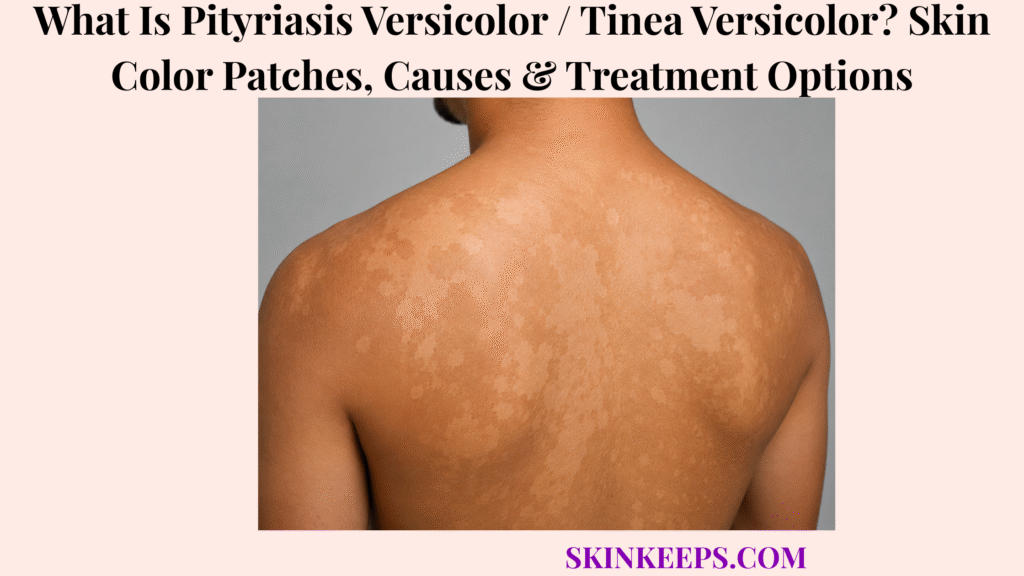
Pityriasis versicolor, also called tinea versicolor, is a common superficial yeast disorder caused by overgrowth of Malassezia that produces finely scaly lighter, darker or pink patches, especially on the upper trunk. The yeast remains within the stratum corneum, and patches commonly involve the chest, upper back, neck, shoulders or upper arms.
The condition is especially common in warm, humid settings and often affects teenagers and young adults, but most people are otherwise healthy. Topical antifungals are usually first-line, active scale can clear before skin colour normalizes, and recurrence is common because treatment suppresses overgrowth rather than permanently removing normal resident Malassezia.
This article is for educational purposes only and does not constitute medical advice, diagnosis, or treatment. Skin-colour patches should be assessed by a licensed dermatologist or qualified healthcare professional when the diagnosis is uncertain, they continue expanding despite appropriate antifungal treatment, occur in an unusual distribution, become markedly inflamed or symptomatic, recur unusually often, cover a large body area or occur in someone who is significantly immunocompromised.
How Can You Recognize Pityriasis Versicolor?
Pityriasis versicolor usually causes flat, finely scaly patches that are lighter, darker, pink, tan or brown and cluster on the chest, upper back, neck or upper arms.
What Do Pityriasis Versicolor Patches Look Like, and Where Do They Appear?
Pityriasis versicolor forms small flat pigment-changing spots that can enlarge and merge into irregular patches, most often across the chest, upper back, neck, shoulders and upper arms.
The patches can be white or pale, pink or salmon, tan, copper-brown or darker brown. The abdomen can be involved, but an unusual distribution should make the diagnosis less automatic.
Why Does Pityriasis Versicolor Have Fine Scale, and Does It Itch?
Malassezia grows within the superficial stratum corneum, producing fine flaky scale that may be subtle, while itching is usually absent or mild.
The scale may become easier to see with gentle stretching or scraping. Intense pain, marked inflammation or major tenderness is atypical and should prompt reassessment.
Why Can Pityriasis Versicolor Look White or More Obvious After Tanning?
Affected skin may not tan normally, so surrounding skin darkens with sun exposure while the involved patches remain lighter and become more visible.
Hypopigmented lesions can therefore stand out strongly on darker or recently tanned skin. Greater contrast after sun exposure does not automatically mean that the superficial yeast burden suddenly increased.
Can One Person Have Light and Dark Patches at the Same Time?
Yes; hypopigmented, hyperpigmented and pink variants are all recognized, and mixed colour patterns can occasionally occur in the same person.
The term “versicolor” reflects this variable colour expression. Colour alone is less useful than the combined pattern of pigment change, fine scale and typical upper-body distribution.
Figure 1. The recognition triad is fine scale, variable pigment and an upper-trunk distribution; colour alone is not enough.
What Causes Pityriasis Versicolor, and Why Does It Recur in Warm Weather?
Pityriasis versicolor develops when normally harmless Malassezia yeast overgrows on superficial skin, especially when warmth, humidity, sweating, oily skin or individual susceptibility favour proliferation.
What Causes Pityriasis Versicolor?
The condition results from excessive superficial growth and filamentous transformation of Malassezia that normally lives harmlessly on human skin.
This is an overgrowth of resident microbiota rather than acquisition of a new dermatophyte infection from another person. The terminology “pityriasis versicolor” is therefore technically more precise than “tinea versicolor,” although both names refer to the same condition.
Why Do Heat, Humidity and Sweating Increase Risk?
Warm, humid and sweaty conditions favor Malassezia proliferation, which helps explain why pityriasis versicolor is common and recurrent in tropical climates.
Oily skin also favors growth, and teenagers and young adults are commonly affected partly because sebaceous activity is higher. Seasonal recurrence during warm months is common.
Does Immune Suppression Increase Risk?
Yes; immune suppression can increase susceptibility to excessive Malassezia growth, although most people with pityriasis versicolor are otherwise healthy.
Extensive, unusual or repeatedly treatment-resistant disease in a significantly immunocompromised person deserves clinical assessment, but ordinary pityriasis versicolor does not imply that an immune disorder is present.
Is Pityriasis Versicolor Caused by Poor Hygiene or Spread Between People?
No; pityriasis versicolor is not caused by inadequate washing and is not considered contagious because Malassezia already forms part of the normal skin microbiota.
Routine isolation, avoiding family contact or disinfecting clothing as though this were a dermatophyte outbreak is unnecessary unless another transmissible infection has been diagnosed.
Figure 2. Malassezia normally lives on skin; disease occurs when it overgrows under favourable conditions, so recurrence can happen without a new external infection.
How Is Pityriasis Versicolor Distinguished and Diagnosed?
Pityriasis versicolor is usually diagnosed from its fine scale, variable pigment and upper-trunk distribution, while KOH microscopy can confirm Malassezia when the diagnosis is uncertain.
How Is Pityriasis Versicolor Different From Vitiligo?
Pityriasis versicolor usually has fine surface scale and upper-trunk distribution, while vitiligo causes more complete depigmentation without the characteristic superficial scale.
Vitiligo reflects melanocyte loss rather than superficial yeast overgrowth. A smooth sharply depigmented patch without scale therefore makes a fungal diagnosis less convincing.
How Is Pityriasis Versicolor Different From Pityriasis Alba and Other Pale Trunk Patches?
Pityriasis alba favors poorly defined pale facial patches in children, while pityriasis versicolor more often affects the upper trunk and can be confirmed by demonstrable Malassezia organisms.
Progressive macular hypomelanosis can produce non-scaly pale trunk patches, while pityriasis rosea follows an acute herald-patch and secondary papulosquamous sequence. The broader category of hypopigmentation includes many non-fungal causes, so a white patch should not automatically be treated as pityriasis versicolor.
What Does a KOH Skin Scraping Show?
KOH microscopy typically shows clusters of Malassezia yeast cells mixed with short hyphae—the classic “spaghetti and meatballs” appearance.
Superficial scale is collected, potassium hydroxide clears keratin, and the remaining yeast cells plus short hyphal elements support the diagnosis. Culture is not a better routine test because Malassezia is difficult to grow under ordinary laboratory conditions.
What Roles Do Wood’s Lamp, Culture and Biopsy Have?
Wood’s lamp can provide supportive yellow-green fluorescence, while fungal culture and skin biopsy are rarely needed for ordinary pityriasis versicolor.
Wood’s lamp fluorescence may be absent, so it is supportive rather than mandatory. Biopsy is reserved for atypical difficult cases and can show fungal elements in the stratum corneum.
Figure 3. Typical disease is often diagnosed clinically; KOH confirms uncertain cases, Wood’s lamp is supportive, and a mismatch should reopen the pigment differential.
How Is Pityriasis Versicolor Treated?
Most pityriasis versicolor is treated with topical antifungals, while oral itraconazole or fluconazole is reserved for selected extensive, recurrent or topical-treatment-resistant disease.
What Is the Main Goal of Treatment?
The immediate treatment goal is to eliminate active Malassezia overgrowth and fine scale, not to restore normal skin colour instantly.
Microbiologic and clinical clearance of active disease occurs before complete pigment recovery. A smooth residual light or dark patch can therefore remain even when active superficial infection has been controlled.
Which Topical Antifungal Treatments Are Used?
Topical treatment is first line and commonly includes selenium sulfide, ketoconazole and other topical antifungal creams, lotions, shampoos or washes.
Clotrimazole, miconazole and topical terbinafine are additional options used in appropriate cases. Creams are practical for small localized areas, while shampoos, washes or lotions can be easier for broad chest and back involvement.
When Are Oral Antifungals Considered?
Oral antifungals are reserved for selected extensive, thick, frequently recurrent or topical-treatment-resistant pityriasis versicolor.
Itraconazole and fluconazole are established systemic options when a clinician decides oral therapy is appropriate. Drug interactions, liver risk and other safety considerations make clinician selection important, so no universal oral regimen is appropriate here.
Does Oral Terbinafine Work, and Should Treatment Continue Until Colour Is Normal?
Oral terbinafine is not effective for pityriasis versicolor, and antifungal treatment should not be repeatedly escalated solely because residual light or dark colour remains after scale has cleared.
Topical terbinafine can work, but the oral form does not achieve effective treatment for this superficial Malassezia disorder. Once fine scale is gone and the patch is smooth, pigment should be allowed time to recover unless other evidence suggests active recurrence.
Figure 4. Treatment success is judged first by control of active scale and yeast; pigment may lag behind for weeks or months and should not trigger automatic repeat therapy.
Why Can Skin Colour Stay Uneven After Treatment, and How Is Recurrence Reduced?
Skin colour can remain uneven for weeks or months after Malassezia has been cleared because pigment production recovers more slowly than the superficial infection, while recurrence remains common because the yeast normally stays on the skin.
Why Can Light or Dark Patches Remain After Successful Treatment?
Malassezia-related pigment disruption can persist after the yeast is gone, so melanogenesis and visible skin-tone normalization may take weeks or months to recover.
This is particularly noticeable in hypopigmented disease. Residual smooth colour change alone should not be used as proof that active yeast remains.
How Can You Tell Active Pityriasis Versicolor From Residual Pigment Change?
Fine surface scale and expanding lesions favour active or recurrent pityriasis versicolor, while a stable smooth patch without scale is more consistent with residual pigment change.
Scale is therefore a stronger activity clue than colour alone. If the distinction remains uncertain, clinical examination or repeat KOH microscopy can help avoid unnecessary antifungal retreatment.
Why Does Pityriasis Versicolor Come Back?
Recurrence is common because antifungal treatment controls abnormal Malassezia overgrowth but does not permanently remove this normal resident yeast from the skin.
Heat, humidity, sweating, oily skin and seasonal conditions can again favour overgrowth. Recurrence months later therefore does not mean the previous treatment failed.
Can Preventive Treatment Reduce Recurrence?
Yes; people with frequent seasonal recurrence may benefit from periodic medicated antifungal cleansing during warm or humid periods under appropriate product or clinician guidance.
AAD describes medicated cleanser use once or twice monthly as one preventive strategy for recurrent disease, while DermNet also supports periodic topical maintenance. The exact product and schedule should be individualized rather than treated as universal.
What Should You Remember About Pityriasis Versicolor?
Pityriasis versicolor is a common superficial Malassezia yeast overgrowth that causes finely scaly lighter, darker or pink patches on the upper body and often recurs in warm, humid conditions.
- Pityriasis versicolor and tinea versicolor are the same condition.
- Malassezia is a yeast rather than a dermatophyte.
- The yeast normally lives on human skin.
- Disease reflects excessive superficial growth.
- Fine scale is an important activity clue.
- Patches can be lighter, darker, pink, tan or brown.
- Mixed colour patterns can occur.
- The chest, upper back, neck and upper arms are classic sites.
- Tanning can increase visual contrast.
- Heat, humidity, sweat and oily skin favor recurrence.
- Teenagers and young adults are commonly affected.
- Immune suppression can increase susceptibility, but most patients are otherwise healthy.
- Poor hygiene is not the cause.
- Pityriasis versicolor is not ordinarily contagious.
- Vitiligo lacks the characteristic superficial scale.
- Pityriasis alba has a different age and site pattern.
- Diagnosis is often clinical.
- KOH microscopy confirms uncertain cases.
- Wood’s lamp is supportive rather than mandatory.
- Fungal culture is usually unnecessary.
- Biopsy is rarely needed.
- Topical antifungals are first line.
- Oral itraconazole or fluconazole is reserved for selected cases.
- Oral terbinafine is ineffective for pityriasis versicolor.
- Active yeast can clear before skin colour returns.
- Smooth residual pigment does not automatically mean treatment failure.
- Recurrence is common because normal resident yeast remains.
- Periodic topical prevention can help frequent recurrence.
Recognize colour + scale + site → Understand Malassezia overgrowth → Distinguish non-fungal pigment disorders → Confirm with KOH if uncertain → Treat active yeast → Allow pigment to recover → Prevent recurrent overgrowth.
Frequently Asked Questions About Pityriasis Versicolor
The most important pityriasis-versicolor questions concern why patches change colour, how the condition differs from vitiligo, whether it is contagious, which antifungals are used and why pigment can remain abnormal after treatment.
What Causes Pityriasis Versicolor Patches to Become Lighter or Darker?
Malassezia overgrowth alters normal skin pigmentation while producing superficial scale, so affected areas can become lighter, darker, pink, tan or brown. Sun tanning can make hypopigmented patches stand out more strongly.
How Can You Tell Pityriasis Versicolor From Vitiligo?
Pityriasis versicolor usually has fine scale and favors the upper trunk, while vitiligo causes more complete depigmentation without the characteristic fungal scale. KOH microscopy can confirm uncertain pityriasis versicolor.
Is Pityriasis Versicolor Contagious or Caused by Poor Hygiene?
No; pityriasis versicolor is neither caused by poor washing nor considered contagious because Malassezia normally lives on human skin. Disease reflects overgrowth of resident yeast under favorable conditions.
Which Antifungal Treatments Are Used for Pityriasis Versicolor?
Most cases are treated with topical antifungal creams, washes, lotions or medicated shampoos, while oral itraconazole or fluconazole may be considered for selected extensive or refractory disease. Oral terbinafine is not effective for this condition.
Why Does Skin Colour Remain Uneven After the Fungal Infection Has Cleared?
Pigment production recovers more slowly than the superficial yeast infection, so smooth light or dark patches can remain for weeks or months after successful antifungal treatment. Persistent colour alone does not equal treatment failure.
Which Sources Support This Pityriasis Versicolor Guidance?
DermNet — Pityriasis Versicolor — Primary source for terminology, normal-skin Malassezia, colour variants, distribution, KOH findings, Wood’s lamp support, topical/oral treatment, oral-terbinafine limitation, residual pigment and recurrence.
American Academy of Dermatology — Tinea Versicolor Overview — Used for normal resident yeast and common tropical/subtropical occurrence.
American Academy of Dermatology — Tinea Versicolor: Signs and Symptoms — Used for colour range, scale, itch, tanning contrast and seasonal recurrence.
American Academy of Dermatology — Tinea Versicolor: Diagnosis and Treatment — Used for clinical diagnosis, scraping/Wood’s lamp, topical-first therapy, selected oral treatment, preventive cleanser use and delayed colour recovery.
NHS — Pityriasis Versicolor — Used for non-contagious framing, poor-hygiene myth correction, body-wash/cream practicality and delayed colour recovery.
Mayo Clinic — Tinea Versicolor — Used for extensive/recurrent/nonresponsive reassessment, common sites and recurrence in warm humid weather.