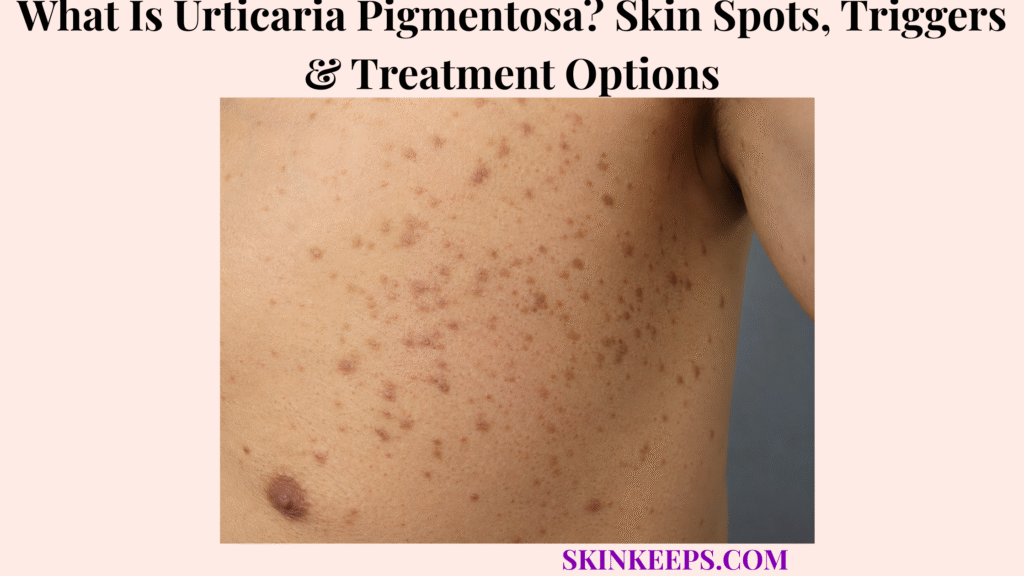
Urticaria pigmentosa, now commonly classified as maculopapular cutaneous mastocytosis (MPCM), is a form of cutaneous mastocytosis in which excess mast cells collect in the skin and form persistent tan, brown, red-brown or reddish spots and small bumps. These lesions are not simply leftover pigment from ordinary hives.
The spots may temporarily become itchy, red or swollen when mast cells release histamine and other mediators, especially after friction or another personal trigger. Childhood disease is often limited to the skin and may improve with age, whereas mastocytosis skin lesions beginning in adulthood deserve stronger consideration of systemic involvement.
Medical disclaimer: This article is for educational purposes only. Fainting, severe breathing difficulty, throat or tongue swelling, collapse or other signs of a severe systemic mast-cell reaction require emergency medical care.
What Is Urticaria Pigmentosa and What Do Its Skin Spots Look and Feel Like?
Urticaria pigmentosa is maculopapular cutaneous mastocytosis in which abnormal mast-cell accumulation creates persistent brown-red skin lesions that can temporarily itch, redden or swell when mast cells are activated.
What Happens in the Skin During Urticaria Pigmentosa?
Mast cells accumulate abnormally within the skin, forming persistent macules or papules that can release histamine and other inflammatory mediators when activated. The permanent-looking spot and the temporary hive-like reaction are therefore different parts of the same mast-cell disorder.
What Role Does KIT Play?
KIT is a receptor that helps regulate mast-cell growth and survival, and activating KIT changes contribute to clonal mast-cell accumulation in many cases of mastocytosis. The exact mutation pattern varies, especially between children and adults, so a particular KIT mutation should not be assumed in every patient or tested routinely without a clinical reason.
Is Urticaria Pigmentosa Inherited?
Usually not; most mastocytosis is sporadic rather than passed directly from parent to child. Rare familial cases have been reported, but the presence of urticaria pigmentosa does not by itself imply a predictable inherited pattern.
Why Is Maculopapular Cutaneous Mastocytosis the More Current Name?
The modern term emphasizes that persistent macules and papules are produced by cutaneous mast-cell accumulation rather than ordinary urticaria. The broader Mastocytosis page covers the wider family of mast-cell accumulation disorders, including disease that extends beyond the skin.
What Do Urticaria Pigmentosa Spots Look Like?
Typical lesions are persistent tan, brown, red-brown or reddish macules and small papules, often involving the trunk and limbs. Their number and size vary, and color can differ with skin tone and age; persistence is more diagnostically useful than expecting one exact shade.
What Is Darier’s Sign?
Darier’s sign is a temporary wheal-like reaction caused when mechanical stimulation activates mast cells within a lesion, producing localized redness, swelling and itching. It is a useful clinical clue, but repeatedly rubbing lesions at home to provoke a reaction is unnecessary and can worsen symptoms.
Can Urticaria Pigmentosa Blister?
Yes; blistering can occur, particularly in infants and young children with reactive cutaneous disease. A blistered lesion still reflects mast-cell activation in the setting of mastocytosis rather than an ordinary blistering disorder.
Is Urticaria Pigmentosa the Same as Ordinary Hives?
No; Hives / Urticaria are transient wheals that typically appear and fade, while urticaria pigmentosa consists of persistent mast-cell-rich lesions that may temporarily become hive-like after activation.
Figure 1. Urticaria pigmentosa recognition strip. Persistent mast-cell-rich lesions are distinct from the temporary swelling and itching that can appear after activation.
What Triggers Urticaria Pigmentosa Symptoms and Mast-Cell Release?
Urticaria pigmentosa symptoms can flare when physical, mechanical, emotional, medication-related, allergic or biologic triggers activate mast cells, but the relevant triggers differ considerably from one person to another.
Why Can Heat or Temperature Changes Trigger Symptoms?
Heat, cold and rapid temperature changes can provoke mediator release in susceptible people and lead to itching, flushing or lesion swelling. Hot baths or showers are a problem for some patients, but temperature avoidance should be based on a reproducible personal pattern rather than a universal rule.
Why Can Rubbing or Scratching Trigger a Flare?
Mechanical irritation can activate the mast cells concentrated within lesions, which explains why scratching, rubbing, pressure, vigorous toweling or similar friction may cause temporary swelling and itch. Reducing repeated friction is more useful than deliberately provoking Darier’s sign.
Can Exercise, Stress or Alcohol Trigger Symptoms?
Yes; exercise, emotional stress, fatigue and alcohol can trigger mediator symptoms in some people. A possible trigger should be treated as an individual observation—not as a reason for every person with MPCM to avoid the same activity or exposure.
Can Medicines Trigger Mast-Cell Reactions?
Selected medicines can provoke mast-cell mediator release in susceptible patients, but reactions are individualized. A mastocytosis diagnosis should be shared with prescribing and procedural clinicians so medication choices can reflect the person’s prior reactions and medical needs rather than a blanket list of prohibited drugs.
Why Are Bee or Wasp Stings Important?
Insect venom can provoke severe systemic reactions, including anaphylaxis, in susceptible people with mastocytosis. A previous severe venom reaction changes risk assessment and may affect emergency planning, but one reported trigger does not mean every patient will react in the same way.
Figure 2. Mast-cell trigger framework. Trigger management works best when it focuses on reproducible individual reactions rather than blanket avoidance.
How Is Urticaria Pigmentosa Diagnosed and When Is Systemic Mastocytosis Investigated?
Urticaria pigmentosa is often recognized from persistent characteristic lesions and a compatible Darier sign, while skin biopsy, serum tryptase, KIT testing and systemic evaluation are used selectively according to age, diagnostic uncertainty and findings beyond the skin.
How Is Urticaria Pigmentosa Diagnosed From the Skin?
Clinical suspicion is strongest when persistent brown-red macules or papules occur in a typical distribution and show compatible mast-cell reactivity. In many children with classic lesions, the clinical pattern is highly informative before more invasive testing is considered.
When Is a Skin Biopsy Needed?
Skin biopsy is useful when lesions are atypical, the diagnosis remains uncertain or another pigmented or inflammatory disorder is possible. Histology can demonstrate increased mast cells in lesional skin, with mast-cell markers such as tryptase or CD117 helping pathologists characterize the infiltrate.
What Is Serum Tryptase and Why Is It Checked?
Serum tryptase is a laboratory marker that can contribute information about mast-cell burden and activation and may support broader mastocytosis assessment. A single high value does not independently prove systemic mastocytosis, and a normal result does not replace the clinical assessment when concern remains.
Why Is Childhood Urticaria Pigmentosa Evaluated Differently?
Typical childhood MPCM is more often limited to the skin and commonly improves as the child grows, so every child does not automatically need invasive systemic testing. Evaluation is intensified when the presentation is atypical, severe or accompanied by concerning systemic features.
Why Does Adult-Onset Urticaria Pigmentosa Need More Systemic Attention?
Adult-onset mastocytosis skin lesions are more likely to persist and have a stronger association with systemic mastocytosis. That age difference makes assessment for extracutaneous disease more important in adults than in a child with otherwise typical skin-limited MPCM.
Which Findings Raise Concern for Systemic Mastocytosis?
Concern rises with adult onset, recurrent anaphylaxis, fainting or low blood pressure, persistent gastrointestinal symptoms, unexplained bone symptoms, abnormal blood counts, organ enlargement or other clinical and laboratory findings suggesting mast-cell disease beyond the skin.
When Are KIT or Bone-Marrow Tests Considered?
KIT testing and bone-marrow evaluation are considered when the combined picture of age, skin findings, systemic symptoms and laboratory results meaningfully raises concern for systemic mastocytosis. They are not automatic tests for every child with classic cutaneous lesions.
Figure 3. Cutaneous-to-systemic diagnostic path. Age, symptoms and clinical context determine how far evaluation should proceed.
How Is Urticaria Pigmentosa Treated?
Treatment is primarily symptom-driven and focuses on reducing mast-cell mediator effects, managing meaningful triggers and protecting higher-risk patients from severe reactions rather than permanently removing every visible spot.
Does Every Patient Need Treatment?
No; mild skin-limited disease may need little beyond education, gentle skin care, trigger awareness and treatment only when symptoms occur. This is particularly relevant in children whose cutaneous disease may become less active with age.
How Do H1 Antihistamines Help?
H1 antihistamines can reduce histamine-mediated itching, flushing, redness and temporary wheal-like reactions. The particular drug, schedule and need for ongoing treatment should be individualized rather than treated as a universal regimen.
When Are H2 Antihistamines or Other Mast-Cell–Directed Medicines Used?
Additional mediator-directed treatment may be considered when gastrointestinal symptoms or other mast-cell effects remain troublesome despite simpler measures. H2 antihistamines and mast-cell-directed medicines such as cromolyn are examples used selectively under clinician guidance.
Are Topical Steroids Needed for Every Lesion?
No; topical corticosteroids are not routine treatment for every lesion. They may be considered for selected symptomatic skin disease, but prolonged potent-steroid exposure has its own risks and should not become a default strategy for otherwise stable spots.
Can Phototherapy Help Extensive Skin Disease?
Phototherapy may reduce itching and visible skin disease in selected people with extensive symptomatic MPCM, particularly adults, but the effect may be temporary. It is a specialist-selected option rather than a permanent cure for mast-cell accumulation.
Can Treatment Permanently Remove All Urticaria Pigmentosa Spots?
No; there is no universal skin-directed therapy that guarantees permanent elimination of every lesion or the underlying mast-cell disorder. The practical goals are mediator-symptom control, individualized trigger management, appropriate systemic monitoring and protection against severe reactions.
Figure 4. Urticaria pigmentosa treatment hierarchy. Management is symptom- and risk-directed rather than an attempt to erase every visible lesion.
How Should Urticaria Pigmentosa Be Monitored, and When Is Emergency Care Needed?
Long-term care depends on age-specific follow-up, recognition of meaningful personal triggers, preparation for severe mast-cell reactions when risk is significant and prompt reassessment when symptoms suggest disease beyond the skin.
Does Childhood Urticaria Pigmentosa Usually Improve With Age?
Many childhood cases improve substantially as the child grows and lesions often fade toward adolescence, although resolution is not guaranteed. Persistent symptoms still deserve follow-up, especially when systemic or severe mediator reactions occur.
Does Adult Urticaria Pigmentosa Usually Persist?
Adult-onset mastocytosis skin disease is more likely to persist and is more strongly linked with systemic mastocytosis. Adults therefore need a different prognosis discussion and a lower threshold for systemic assessment when other clues are present.
How Should Personal Triggers Be Managed?
Trigger management should focus on reproducible individual reactions. Keeping track of patterns involving heat, friction, exercise, alcohol, infection or particular medicines can help avoid meaningful triggers without imposing broad restrictions that have never caused symptoms.
Who May Need an Epinephrine Auto-Injector?
Epinephrine preparedness may be recommended when anaphylaxis risk is clinically important, such as after a previous severe reaction or in other higher-risk mastocytosis settings. The decision is individualized; it should not be assumed that every child with skin-limited MPCM needs an auto-injector.
Why Should Doctors Know About Mastocytosis Before Procedures?
Informing surgeons, anesthetists and other healthcare teams allows procedure and medication planning to account for prior mast-cell reactions, temperature changes, stress and other possible triggers. Premedication or medication substitutions, when needed, are clinician-directed rather than standardized home instructions.
When Should New Systemic Symptoms Be Reassessed?
Recurrent fainting, severe flushing, persistent gastrointestinal symptoms, unexplained bone pain, worsening systemic reactions, abnormal blood counts or organ enlargement warrant reassessment for mast-cell disease beyond the skin, especially in adults.
Which Symptoms Can Signal Anaphylaxis?
Throat or tongue swelling, severe breathing difficulty, marked dizziness, low blood pressure, collapse or loss of consciousness can signal a potentially life-threatening systemic mast-cell reaction. These are not simply stronger versions of a locally itchy skin spot.
What Should Be Done During Suspected Anaphylaxis?
A person who has been prescribed epinephrine should follow their emergency plan and use it as directed, then obtain urgent emergency medical care. Antihistamines may help some skin symptoms but are not a substitute for epinephrine in suspected anaphylaxis.
What Should You Remember About Urticaria Pigmentosa?
Urticaria pigmentosa is a cutaneous mast-cell accumulation disorder whose persistent lesions can transiently swell or itch when mast cells release mediators, with prognosis and systemic-risk assessment differing importantly between children and adults.
- Urticaria pigmentosa is the traditional name for a maculopapular cutaneous mastocytosis pattern.
- The central problem is mast-cell accumulation in skin, not ordinary chronic hives or a simple pigment disorder.
- Persistent tan, brown or red-brown macules and papules may temporarily swell and itch after mast-cell activation.
- Darier’s sign reflects local mediator release after mechanical stimulation; repeated home rubbing is unnecessary.
- Heat, friction, exercise, stress, alcohol, medicines, infection and insect venom are possible—not universal—triggers.
- Medication and procedure planning should be individualized rather than based on a blanket avoidance list.
- Skin biopsy, serum tryptase, KIT testing and bone-marrow assessment are selective tools used in clinical context.
- Typical childhood MPCM is often skin-limited and may improve with age, while adult-onset disease warrants stronger systemic consideration.
- H1 antihistamines are commonly used for mediator symptoms; other therapies are selected according to the symptom pattern and severity.
- Phototherapy or topical treatment may improve selected skin symptoms but does not guarantee permanent disappearance of the mast-cell disorder.
- Epinephrine preparedness is risk-based, especially after severe systemic reactions.
- Airway, breathing or circulatory symptoms, severe dizziness or collapse require an emergency anaphylaxis pathway.
Frequently Asked Questions About Urticaria Pigmentosa
The main urticaria pigmentosa questions concern ordinary hives, Darier sign, childhood prognosis, systemic mastocytosis and anaphylaxis.
Is Urticaria Pigmentosa the Same as Ordinary Hives?
No; urticaria pigmentosa consists of persistent mast-cell-rich skin lesions, while ordinary hives are transient wheals that appear and disappear.
Why Do Urticaria Pigmentosa Spots Swell When Rubbed?
Rubbing can activate mast cells within a lesion, causing mediator release that temporarily produces redness, swelling and itching—known as Darier’s sign.
Does Childhood Urticaria Pigmentosa Usually Disappear With Age?
Many childhood cases improve substantially and lesions often fade toward adolescence, although this does not happen in every child.
Can Urticaria Pigmentosa Be Associated With Systemic Mastocytosis?
Yes; systemic involvement is particularly important to consider in adults and in people with systemic symptoms or otherwise concerning clinical findings.
Can Urticaria Pigmentosa Cause Anaphylaxis?
Yes; mast-cell mediator release can occasionally become systemic and severe enough to cause anaphylaxis, which requires emergency treatment.
DermNet — Maculopapular cutaneous mastocytosis. Supports the MPCM/urticaria pigmentosa terminology, persistent skin lesions, Darier-type reactivity, childhood versus adult natural history, triggers, selective biopsy and symptom-directed skin treatment.
British Association of Dermatologists — Urticaria pigmentosa. Supports mast-cell accumulation, lesion morphology, Darier sign, trigger awareness, antihistamines, procedure planning and age-related prognosis.
AAAAI — Systemic mastocytosis. Supports mediator symptoms, anaphylaxis, non-specific triggers and the distinction between cutaneous and systemic mastocytosis.
International consensus — Cutaneous manifestations in mastocytosis. Supports modern classification and the prognostic distinction between childhood and adult maculopapular cutaneous mastocytosis patterns.
Journal of the American Academy of Dermatology, 2025 — Mastocytosis diagnosis and management review. Supports the different diagnostic approach to mastocytosis in children and adults and the role of skin and systemic evaluation.