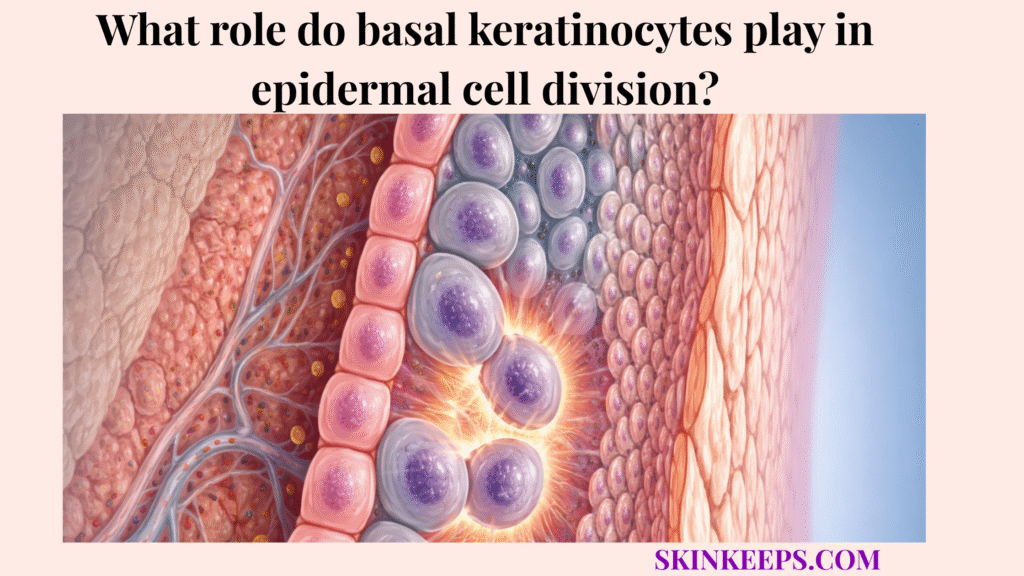
Basal keratinocytes play the central role in epidermal cell division because they are the living, mitotically active cells that generate the entire population of fresh keratinocytes at the base of the epidermis.
These vital cells function directly as the starting point of skin renewal, reliably supplying the fresh cells that eventually move upward and replace older, damaged surface cells.
Smoother, brighter skin does not actually begin at the surface. It begins with healthy basal keratinocytes dividing efficiently deep within the tissue, long before worn-out cells accumulate into visible dullness and roughness.
To understand the role basal keratinocytes play in epidermal cell division, you need to look at the cells themselves: where they live, why they divide, how they split into different cell fates, what happens when they slow down, and what actually helps support them.
When you evaluate your skin, remember that you are looking at the final result of a deep biological process. Protecting the integrity of that microscopic cellular factory allows you to achieve lasting radiance rather than temporary cosmetic improvement.
Who are the basal keratinocytes that play a role in epidermal cell division?
Basal keratinocytes are the living, cuboidal-shaped cells located in the deepest epidermal layer, anchored securely along the basement membrane to act as the epidermis’s primary cell-producing population.
These highly specialized cells form the critical physical interface between the epidermis and the underlying basement membrane, which is precisely why they are perfectly positioned to keep producing new epidermal cells supplied by deeper dermal nutrients.
The stratum basale is composed of a single row of cuboidal-to-columnar keratinocytes attached to the basement membrane [Medscape, 2025].
In practical terms, these are not just “bottom-layer cells”—they are the live, continuous biological generators actively feeding millions of new cells to the rest of the epidermis every single day.
- Cell type → Basal keratinocyte
- Location → Bottom of the epidermis / basement membrane interface
- Core function → Generate new epidermal cells
Why do basal keratinocytes play the central role in epidermal cell division?
Basal keratinocytes play the central role in epidermal cell division because they are the only cells in the epidermis that remain mitotically active, continuously generating replacement tissue while the cells above them have lost the ability to divide.
The upper epidermal layers depend entirely on replacement cells arriving steadily from below, rather than possessing the physiological machinery to divide continuously themselves.
This exclusive mitotic privilege is the fundamental biological characteristic that separates basal keratinocytes from the more mature, structurally differentiated keratinocytes residing directly above them.
When translating this cell biology into visible meaning, the consequence is clear: if these deep generator cells slow down, the skin surface immediately loses its freshness because the essential cellular supply slows directly at the source.
Functional Centrality Contrast
- Basal keratinocytes → living + mitotically active (The Factory)
- Suprabasal keratinocytes → differentiating + less proliferative
- Surface cells → terminally differentiated + shed rather than divide
How does asymmetric mitosis execute the role basal keratinocytes play in epidermal cell division?
Asymmetric mitosis executes the role basal keratinocytes play in epidermal cell division by allowing a single parent cell to divide into two distinct types of cells, ensuring continuous renewal without exhausting the source.
The biological logic behind asymmetric division is preservation combined with output: one daughter cell physically maintains the renewal source while the other contributes directly to upward epidermal production.
This fascinates because it centers on dictating distinct cell fate, not merely functioning as a simple factory for blind cell multiplication.
How does one division create two different outcomes?
One division creates two different outcomes through a biological split where one daughter cell stays anchored in the basal compartment to maintain the stem cell niche, while the second cell detaches to begin the upward differentiation pathway.
The anchored daughter cell expertly preserves the proliferative compartment, ensuring the factory remains open, while the departing daughter cell eagerly enters the transit-amplifying and differentiation pathway to build the barrier.
This dual-action fate is precisely why the epidermis can keep renewing itself seamlessly over the passage of decades rather than rapidly spending down its finite source cells.
Why is asymmetric division more important than simple division?
Asymmetric division is more important than simple division because it is the only mechanism that ensures the epidermis can produce billions of new cells over a lifetime without ever exhausting its own regenerative capacity.
If the skin relied on simple repeated division without an organized fate balance, the tissue would critically risk a complete stem-cell depletion or dangerous, disorganized cellular overgrowth.
Asymmetric Division Matrix
- Retained cell → remains basal / self-renewal
- Transit-amplifying cell → detaches, proliferates further, then differentiates
- Outcome → continuous regeneration without source exhaustion
How do basal keratinocytes feed the full epidermal renewal pathway after division?
Understanding how new epidermal cells are pushed toward the surface begins here: basal keratinocytes feed the full epidermal renewal pathway by initiating a highly coordinated sequence where newly formed cells migrate upward, transform their internal structure, and eventually populate the skin’s surface barrier.
Once a newly formed transit-amplifying cell leaves the basal compartment, it commits fully to differentiation, transforming its protein structure step by step as it steadily ascends through the tissue—a journey that also explains why keratinocytes lose their nuclei during epidermal maturation.
In humans, epidermal turnover is commonly estimated at roughly 40–56 days, with the pathway beginning in the basal compartment before cells migrate upward, undergo the precise process that converts keratinocytes into protective surface cells, and are ultimately shed [PMC, 2009].
Renewal Pathway Flow
- Basal division → New keratinocyte formed
- Early upward movement → Transit-amplifying output
- Suprabasal differentiation → Keratinization intensifies
- Surface arrival → Barrier participation
- Final stage → Desquamation
How does aging change the role basal keratinocytes play in epidermal cell division?
If you are wondering when epidermal cell turnover slows with age, you will find that aging changes the role basal keratinocytes play in epidermal cell division by significantly slowing the rate of mitosis, which results in a thinner epidermis and a longer turnover cycle.
A slower rate of mitosis directly means that older, structurally compromised cells remain on the surface for a longer duration, which heavily contributes to visible dullness, textural roughness, and a thicker-looking, less reflective surface.
The rate of epidermal cell turnover has been reported to reduce by about half between ages 30 and 70 [PMC, 2022].
| Skin state | Basal Activity | Turnover Speed | Visual Result |
|---|---|---|---|
| Youthful Skin | Faster Mitosis | 40–56 Days | Radiant & Responsive |
| Aging Skin | Slower Mitosis | 80+ Days | Dull & Thicker-Looking |
How can you tell when the role basal keratinocytes play in epidermal cell division is weakening?
You can tell when the role basal keratinocytes play in epidermal cell division is weakening by the emergence of persistent dullness, an uneven or rough tactile texture, and a noticeably slower recovery time for post-acne marks.
Cellular weakening inside the basal compartment usually manifests externally as a slow, gradual loss of skin refresh rather than presenting immediately as acute, painful barrier damage.
Self-Assessment: Signs of Sluggish Mitosis
When should you support basal keratinocytes more actively?
You should support basal keratinocytes more actively the moment you identify that your skin turnover has become sluggish, appearing as a built-up texture that no longer responds to simple moisturizers.
Deploying earlier cellular support is vastly more effective and comfortable than waiting for chronic dead-cell buildup and repeated frustration to set in.
Intervening at the correct stage prevents unnecessary, aggressive over-treatment of the surface barrier.
When do early signs suggest basal keratinocytes need support?
Early signs suggest basal keratinocytes need support when you notice mild dullness and a slight texture buildup that makes the skin look less fresh than it did in previous months.
Action: Begin renewal-supportive care early before sluggish turnover becomes more obvious.
When do moderate signs suggest basal keratinocyte activity is slowing too much?
Moderate signs suggest basal keratinocyte activity is slowing too much when marks take weeks to fade and you feel a repeated need to exfoliate just to achieve a temporary glow.
Action: Shift toward renewal-supportive ingredients like retinoids instead of relying only on surface removal.
When do advanced signs justify stronger support?
Advanced signs justify stronger support when chronic dullness and age-related slowdowns become highly visible, resulting in persistent frustration with surface-only routines.
Action: Use a more structured renewal-support plan centered on stimulation plus protection.
What factors weaken the role basal keratinocytes play in epidermal cell division?
Several external and internal factors weaken the role basal keratinocytes play in epidermal cell division, most notably chronic UV exposure and excessive barrier irritation that destabilize the deep cellular environment.
Unprotected UV exposure matters critically because basal keratinocytes sit in the exact part of the epidermis where cumulative DNA stress can aggressively interfere with healthy division.
Likewise, chronic barrier irritation matters deeply because an unstable, inflamed surface environment makes consistent, orderly cellular renewal biologically harder to maintain.
Weakening Factors Grid
- Chronic UV exposure → DNA stress and disrupted renewal quality
- Repeated irritation → unstable barrier environment
- Over-exfoliation → faster surface loss without solving deep slowdown
- Aging → lower proliferative efficiency
- Inconsistent routines → interrupted renewal support
What skincare ingredients support the role basal keratinocytes play in epidermal cell division?
Skincare ingredients support the role basal keratinocytes play in epidermal cell division by utilizing deep-penetrating actives that stimulate cellular turnover and protect the cells from environmental degradation.
The strongest strategy seamlessly combines the active stimulation of cellular turnover with rigorous defense against ongoing environmental damage.
Targeting the biological source requires highly specific, clinically proven ingredients that reach the deeper layers of the epidermis.
Problem: Sluggish renewal and dull-looking skin
Implication: Basal keratinocyte activity is slowing
Solution: Stimulate with retinoids, protect with SPF, and reduce unnecessary irritation
How do retinoids support basal keratinocyte activity?
Retinoids support basal keratinocyte activity by binding to nuclear receptors that directly stimulate cellular proliferation and normalize the entire turnover cycle from the deepest layers upward.
Retinoids are infinitely more relevant here than physical scrubs because they actively influence the deep biology of cellular turnover rather than merely removing old, dead cells from the top. In topical tretinoin studies for photoaged skin, some visible clinical improvements were reported after 4–6 weeks of therapy, with additional gains over longer use [PMC, 2022].
How do peptides and growth-supporting formulas support the role basal keratinocytes play in epidermal cell division?
Peptides and growth-supporting formulas support the role basal keratinocytes play in epidermal cell division by providing supportive signaling that helps maintain a healthier renewal environment.
How does sun protection preserve basal keratinocyte function?
Sun protection preserves basal keratinocyte function by providing a physical and chemical shield that prevents UV-induced DNA stress from interfering with healthy cell division.
How do supportive routines help basal keratinocytes function more consistently?
Supportive routines help basal keratinocytes function more consistently by maintaining a calm, un-irritated barrier that allows the epidermis to cycle efficiently without inflammatory stress.
What are the key takeaways about the role basal keratinocytes play in epidermal cell division?
The key takeaways center on their function as the primary drivers of continuous cell production and the necessity of targeted support to maintain their efficiency.
- ● Basal keratinocytes are the epidermis’s core dividing cells.
- ● Their role begins with asymmetric mitosis and continues through the full renewal pathway.
- ● Aging and stress can slow their division rate, making skin look duller and rougher.
- ● Support strategy centers on retinoids, SPF, and steady, non-irritating care.
What daily steps can you take to support the role basal keratinocytes play in epidermal cell division?
You can take daily steps to support the role basal keratinocytes play in epidermal cell division by prioritizing cellular stimulation at night and total environmental protection during the day.
An effective daily routine must carefully balance deliberate stimulation with robust protection, rather than pushing the delicate skin into a state of constant, counterproductive irritation.
Routine Check: Renewal Support Habits
The healthiest glow comes from supporting the cells that create fresh epidermis, not just stripping old cells away from the surface.
Build your routine around long-term renewal support if your goal is smoother texture, better radiance, and more efficient epidermal turnover.
Ultimately, when you support the engine of your skin, the surface takes care of itself.