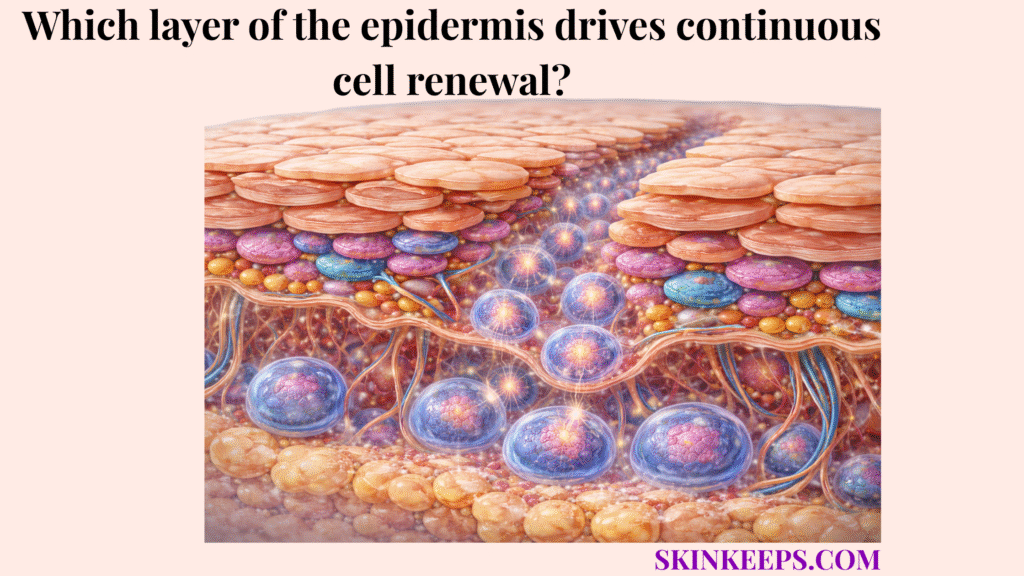
The layer of the epidermis that drives continuous cell renewal is the stratum basale, the deepest epidermal layer where basal cells divide to produce new keratinocytes.
This dynamic layer continuously supplies fresh cells that progressively move upward to replace older, damaged surface cells.
Although many people focus on manual exfoliation or surface texture, the real engine of skin renewal is situated much deeper within the tissue.
When the stratum basale slows down, the skin can begin to look duller, rougher, thicker, and considerably slower to recover from daily stress.
Understanding how the stratum basale drives continuous cell renewal makes it easier to explain why youthful skin looks fresher, why aging skin renews more slowly, and what actually helps support this process. The sections below break down its structure, its stem-cell activity, the turnover cycle, the warning signs of slowdown, and the best ways to support it.
What is the structural baseline that allows the stratum basale to drive continuous cell renewal?
The structural baseline that allows the stratum basale to drive continuous cell renewal is its position as the deepest layer of the epidermis, sitting directly above the dermis to serve as the foundational attachment site where new cells begin.
Its strategic position at the absolute base of the epidermis is precisely what allows it to function as the biological anchor for the skin’s regenerative capacity.
This critical interface is known as the dermal-epidermal junction, which helps stabilize the basal layer and supplies it with nutrients from below while renewal continues seamlessly above it.
This anatomy translates into a practical reality: new skin cells must begin at the base, completely nourished and structurally secure, before they can ever become visible at the surface.
- Surface → Stratum corneum
- Middle → Stratum spinosum and stratum granulosum
- Base → Stratum basale
Key Takeaway: The stratum basale drives continuous cell renewal because it sits at the foundation of the epidermis, where new skin cells can be generated before moving upward.
Why does the stratum basale drive continuous cell renewal?
The stratum basale drives continuous cell renewal because it contains the living basal cells and stem cells positioned at the dermal-epidermal junction, allowing it to remain anchored while generating fresh keratinocytes for the layers above.
If you consider what role basal keratinocytes play in epidermal cell division, it becomes clear why the upper epidermal layers depend entirely on the basal layer for replacement cells rather than possessing the biological capacity to produce them independently.
This specific cellular distribution makes the stratum basale the only epidermal layer truly built for continuous, long-term cellular production.
Visually, this mechanism dictates a clear reality: visible skin freshness depends entirely on uninterrupted cell production beginning deep below the surface.
Key Takeaway: The stratum basale drives continuous cell renewal because it is the only epidermal layer built to continuously generate new cells for the layers above.
How does the stratum basale drive continuous cell renewal?
The stratum basale drives continuous cell renewal through an ongoing cycle of cell division, migration, and differentiation that continuously feeds new keratinocytes into the epidermis.
During this precise division, one new cell remains safely behind to preserve the renewal source while another distinct cell begins moving upward through the epidermis.
Exploring how new epidermal cells are pushed toward the surface reveals that this upward movement is not random; it is part of a highly structured differentiation program where the cell changes shape and function to form the barrier.
Translating that biology into practical terms reveals that the surface only looks truly fresh when the deep production cycle stays robustly active.
Key Takeaway: The stratum basale drives continuous cell renewal by continuously producing new keratinocytes and feeding them into the epidermal turnover cycle.
How do keratinocyte stem cells ensure the stratum basale drives continuous cell renewal?
Keratinocyte stem cells ensure the stratum basale drives continuous cell renewal by continuously producing new cells without exhausting their own regenerative population.
Stem-cell renewal is the exact mechanism that allows epidermal regeneration to continue over long periods—spanning decades—rather than simply fading out after a few short cycles.
This incredible sustainability is achieved by breaking the mechanism into two distinct cellular functions: asymmetric division and long-term preservation.
Epidermal stem-cell biology relies on this asymmetric division to ensure one basal daughter is preserved while another daughter is dispatched to differentiate.
How does asymmetric cell division support continuous renewal?
Asymmetric cell division supports continuous renewal by splitting basal stem cells into two distinct daughter cells: one that remains anchored to preserve the stem-cell pool, and another that migrates upward.
The migrating daughter cell differentiates meticulously into a mature keratinocyte, while the anchored daughter cell stays firmly behind in the basal layer to divide again.
This exact functional split explains how the basal layer can keep renewing the tissue perpetually without ever running out of regenerative capacity.
Why does stem-cell preservation matter?
Stem-cell preservation matters because continuous renewal relies on maintaining a permanent source of new cells to prevent the basal layer from losing its regenerative capacity over time.
Without this self-renewal safety net, the skin would gradually lose its ability to heal properly, refine surface texture, and maintain a stable, waterproof barrier.
- Anchor cell → stays in the stratum basale
- Journey cell → migrates upward and differentiates
Key Takeaway: The stratum basale drives continuous cell renewal because it produces new cells without exhausting its own stem-cell pool.
How does the epidermal turnover cycle show that the stratum basale drives continuous cell renewal?
The epidermal turnover cycle shows that the stratum basale drives continuous cell renewal because every new surface cell begins its structural journey in this deep layer before migrating upward to shed.
As these generated cells are pushed upward, they eventually flatten, harden, become part of the stratum corneum, and are ultimately shed as dead surface cells.
While cosmetic literature often cites a rigid 28-day rule, complete epidermal turnover in adult humans is biologically longer. In humans, epidermal turnover is commonly estimated at roughly 40–56 days, with the cycle beginning in the stratum basale before cells migrate upward and are eventually shed [PMC, 2009].
- Day 1 → mitosis in the stratum basale
- Days 2–28 → migration and differentiation through the living epidermal layers
- Days 29–56 → surface arrival, stratum corneum residence, and shedding
Key Takeaway: The turnover cycle shows that all new surface cells begin in the stratum basale, confirming that this layer drives continuous cell renewal.
How can you tell when the stratum basale is not driving continuous cell renewal efficiently?
You can tell when the stratum basale is not driving continuous cell renewal efficiently by observing a duller skin tone, rougher texture, slower fading of post-inflammatory marks, and a generally tired appearance.
Sluggish basal activity does not usually present as dramatic or immediately painful; it more often looks slow, flat, and noticeably texturally uneven across the face.
This visual pattern is less about immediate barrier damage and much more about the delayed replacement of old, light-blocking surface cells.
- Dull skin tone
- Rougher or thicker texture
- Slower fading of post-inflammatory marks
- Less radiance
- Slower visible recovery after irritation
- Skin that looks tired or less fresh
Key Takeaway: When the stratum basale is not driving continuous cell renewal efficiently, the skin usually looks slower, duller, and less refined rather than immediately damaged.
When should you support the stratum basale if continuous cell renewal is slowing?
You should support the stratum basale when continuous cell renewal is slowing by identifying the earliest signs of dullness and acting before sluggish turnover causes chronic texture buildup.
Early support is far more practical and manageable than waiting for sluggish turnover to become a chronic condition requiring aggressive correction.
The timing tiers below serve as practical, cosmetic-function oriented guidelines to help you intervene appropriately, not as strict diagnostic categories.
When do early signs suggest the stratum basale needs support?
Early signs suggest the stratum basale needs support when the skin begins to exhibit mild dullness, a slight loss of glow, and a texture that feels noticeably less fresh than before.
These early structural shifts often appear well before more obvious skin thickening or stubbornly slow fading becomes highly visible.
Action: Begin renewal-supportive habits early before sluggish turnover becomes more obvious.
When do moderate signs suggest renewal is slowing too much?
Moderate signs suggest renewal is slowing too much when you experience persistent texture issues, noticeably slower fading of marks, and a repeated dependence on surface exfoliation.
Noticeable thickening or congestion is a hallmark here, heavily suggesting the surface is no longer being refreshed efficiently enough from the deeper layers below.
Action: Shift toward deeper renewal support instead of relying only on surface exfoliation.
When do more advanced signs justify stronger support?
More advanced signs justify stronger support when chronic dullness and aging-related slowdowns become highly visible and fail to improve with basic surface-focused care.
Ongoing frustration despite utilizing repeated surface-focused routines usually indicates that the core problem is deeper than simple surface roughness alone.
Action: Consider a more structured renewal-support plan.
Key Takeaway: It is better to support the stratum basale early than to wait until sluggish renewal becomes chronic and harder to improve.
How does youthful skin compare to aging skin in how the stratum basale drives continuous cell renewal?
Youthful skin drives continuous cell renewal much faster and more efficiently than aging skin, resulting in a shorter turnover cycle and a brighter, smoother appearance.
Aging skin naturally renews more slowly; consequently, old surface cells linger longer on the top layer, and the texture inevitably becomes rougher and duller. Understanding exactly when epidermal cell turnover slows with age provides crucial context, as the rate of epidermal cell turnover has been reported to reduce by about half between ages 30 and 70, which helps explain why aging skin often looks duller and slower to refresh [PMC, 2022].
| Skin state | Basal activity | Turnover speed | Visible appearance |
|---|---|---|---|
| Youthful skin | Faster and more efficient | Shorter cycle | Brighter, smoother, more radiant |
| Aging or sluggish skin | Slower and less efficient | Longer cycle | Duller, rougher, thicker-looking |
Key Takeaway: Youthful skin appears fresher because the stratum basale drives continuous cell renewal more efficiently, while aging skin often looks duller because this process slows down.
How can skincare ingredients support how the stratum basale drives continuous cell renewal?
Skincare ingredients support how the stratum basale drives continuous cell renewal by combining deep cellular stimulation with protective barrier support rather than relying solely on harsh surface exfoliation.
The strongest long-term support strategies work effectively by stimulating deep tissue renewal while carefully protecting the fragile surface barrier from unnecessary irritation.
This vital physiological requirement is exactly why retinoids and consistent SPF matter significantly more to this topic than repeated, aggressive physical scrubbing.
How do retinoids support how the stratum basale drives continuous cell renewal?
Retinoids support how the stratum basale drives continuous cell renewal by acting as the strongest targeted ingredient to normalize and stimulate epidermal turnover from the deepest layers.
Retinoids are far more relevant to this physiological topic than surface-only smoothing products because they actively influence keratinocyte turnover and differentiation directly at the cellular level. In topical tretinoin studies for photoaged skin, some visible clinical improvements were reported after 4–6 weeks of therapy, with additional gains over longer use [PMC, 2022].
The core clinical goal is to achieve consistent, sustainable renewal support, rather than triggering aggressive cycles of irritation and peeling.
How does sun protection protect how the stratum basale drives continuous cell renewal?
Sun protection protects how the stratum basale drives continuous cell renewal by shielding the delicate basal stem cells from cumulative UV damage that would otherwise disrupt healthy regeneration.
Daily application of broad-spectrum SPF essentially preserves the deep renewal system’s functional efficiency, preventing ultraviolet radiation from mutating or slowing the basal cells.
Deploying cellular stimulation—like retinoids—without accompanying UV protection thoroughly undermines any long-term structural renewal support you are trying to achieve.
How does supportive skincare help renewal stay consistent?
Supportive skincare helps renewal stay consistent by maintaining a stable, un-irritated barrier that allows the epidermis to cycle efficiently without the stress of constant inflammation.
Over-irritating the surface barrier can severely interfere with cellular progress and block visible improvements, even when the structurally correct active ingredients are present.
Consistent, gentle care fundamentally works better and yields faster results than aggressively stacking multiple harsh routines on top of each other.
Problem: Sluggish turnover and dull-looking skin
Implication: The basal layer may be renewing less efficiently
Solution: Support renewal with retinoids, sun protection, and stable skincare
Key Takeaway: The best way to support the stratum basale is to combine stimulation with protection rather than relying on exfoliation alone.
What are the key takeaways about how the stratum basale drives continuous cell renewal?
The key takeaways about how the stratum basale drives continuous cell renewal are that this deepest layer acts as the primary source of new keratinocytes, and its slowdown directly causes dull, rough skin.
- The stratum basale is the deepest epidermal layer and the source of new keratinocytes.
- It drives continuous cell renewal through ongoing stem-cell division and upward migration.
- When this process slows, the skin often looks duller, rougher, and less radiant.
- The strongest support strategy combines renewal stimulation with daily protection.
What daily steps can you take to support how the stratum basale drives continuous cell renewal?
You can take daily steps to support how the stratum basale drives continuous cell renewal by consistently using a retinoid, applying broad-spectrum SPF, and avoiding the trap of over-exfoliating the surface.
A successful daily routine must focus intently on protecting the delicate renewal layer from external damage while reliably supporting a healthy, long-term turnover cycle.
- Use a retinoid consistently if appropriate for your skin.
- Wear broad-spectrum SPF daily.
- Avoid depending only on harsh exfoliation for smoother-looking skin.
- Keep the routine stable and consistent.
- Support renewal without over-irritating the barrier.
The healthiest glow comes from supporting the layer that creates fresh skin cells, not just removing old ones from the surface.
Build your routine around long-term renewal support if you want to improve texture, radiance, and skin turnover more effectively.