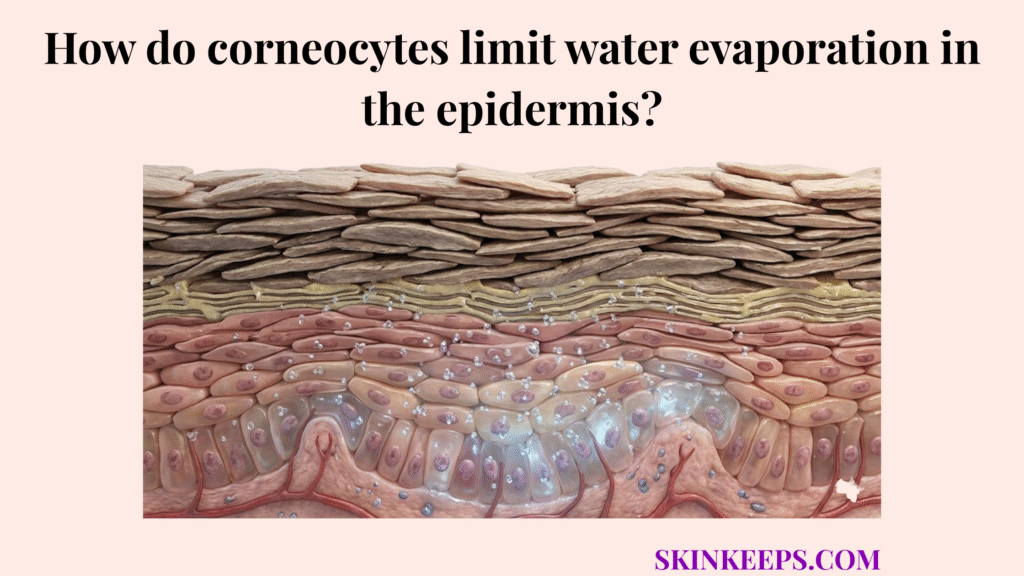
Corneocytes limit water evaporation in the epidermis by forming the tough outer cells of the stratum corneum that physically slow moisture loss and hold water-binding compounds inside the skin surface.
Their hardened protein structure reduces passive water escape, while their internal natural moisturizing factors help the outer barrier stay hydrated. This microscopic architecture functions as the ultimate line of defense for human skin.
When corneocytes fail to limit water evaporation, the skin becomes tighter, rougher, drier, and more reactive. The rapid escape of water triggers a cascade of inflammatory signals deep within the tissue.
This guide explains exactly how corneocytes limit water evaporation, what structures and compounds make that possible, how to recognize when the process is failing, and what skincare steps best support corneocyte barrier performance.
What is the structural baseline that allows corneocytes to limit water evaporation?
Building upon which layer of the epidermis drives continuous cell renewal, the structural baseline that allows corneocytes to limit water evaporation is the biological transformation of living keratinocytes into flattened, hardened, and highly specialized dead cells within the stratum corneum.
Driven by what role basal keratinocytes play in epidermal cell division, living keratinocytes migrate upward from the basal layer, flatten, harden, and lose their internal organelles to achieve a final form optimized for barrier defense. This cellular metamorphosis ensures the skin maintains tough outer skin cells capable of sealing the body from environmental extremes.
- Keratinocyte → living epidermal cell
- Transition → flattening, hardening, nucleus loss
- Corneocyte → tough outer barrier cell that helps limit water evaporation
How do tough protein structures help corneocytes limit water evaporation?
Tough protein structures help corneocytes limit water evaporation by transforming the outer epidermal cells into rigid, highly durable physical obstacles that resist moisture escape.
The cells use both a resilient external shell and an intricate internal scaffold to maintain their structural integrity. This physical architecture provides the foundational defense needed to support corneocyte barrier performance under daily friction and stress.
- Cornified envelope → outer shell protection
- Keratin matrix → internal structural reinforcement
- Result → lower water escape through the cell system
How does the cornified envelope help corneocytes limit water evaporation?
The cornified envelope helps corneocytes limit water evaporation by forming an ultra-tough, insoluble outer shell that makes the cell harder to penetrate and less prone to water loss.
This protective casing increases surface durability against friction and environmental stress. A specialized structural protein called loricrin cross-links to construct this barrier shell, heavily reinforcing the stratum corneum barrier cells against physical degradation. The mature cornified cell envelope has an average thickness of 15.3 ± 1.2 nm, and loricrin contributes from about 60% to >80% of its protein mass in different tissues [The Journal of Experimental Biology, 1998].
How does the keratin matrix help corneocytes limit water evaporation?
The keratin matrix helps corneocytes limit water evaporation by filling the inside of the cell with a dense filament network that creates a rigid scaffold and reduces collapse as the cell dehydrates.
Stronger, tightly packed cells resist structural dehydration far better than fragile cells lacking internal support. The cornified envelope and keratin matrix work together to guarantee optimal corneocyte water retention, with keratin-filled corneocytes constituting about 85% of the total weight of dry stratum corneum [PMC, 2017].
How do Natural Moisturizing Factors help corneocytes limit water evaporation?
Natural Moisturizing Factors help corneocytes limit water evaporation by chemically binding water inside the cellular matrix, helping the cells remain hydrated, flexible, and less brittle.
These natural moisturizing factors inside corneocytes act as microscopic water magnets. Lower NMF levels correlate directly with increased dryness, tightness, and surface flaking, severely compromising the tissue’s protective abilities.
- Amino acids → major water-binding components
- Urea → supports water retention
- Lactic acid → helps maintain hydration and softness
How do surrounding barrier lipids help corneocytes limit water evaporation more effectively?
Surrounding barrier lipids help corneocytes limit water evaporation more effectively by acting as the mortar that seals the microscopic spaces between the cellular bricks.
If the cells act as the structural bricks, the barrier lipids around corneocytes form the essential surrounding mortar. Corneocytes can only execute their function fully when the surrounding lipid seal remains intact to stop moisture from slipping through the intercellular gaps.
- Bricks: Corneocytes
- Mortar: Intercellular lipids
- Outcome: Lower water evaporation and stronger barrier function
What are the main mechanisms that help corneocytes limit water evaporation?
The main mechanisms that help corneocytes limit water evaporation are their hardened cornified envelope, dense internal keratin matrix, water-binding Natural Moisturizing Factors, and the surrounding lipid seal. These biological components operate simultaneously to stop dehydration and actively defend the skin.
- Cell hardening → corneocytes become flattened and durable
- Cornified envelope formation → outer shell reduces water escape
- Keratin packing → internal structure resists collapse
- Natural Moisturizing Factors → internal water retention
- Lipid sealing around corneocytes → less evaporation between cells
How do healthy corneocytes versus damaged corneocytes affect water evaporation?
Healthy corneocytes reduce water evaporation effectively because they remain cohesive and structurally sound, whereas damaged corneocytes shed too quickly and allow much more water to escape, which directly explains why barrier disruption increases TEWL in the epidermis.
The link between damaged corneocytes and water loss creates tight flaky reactive skin. Evaluating visual symptoms against cellular integrity reveals exactly why specific biological failures lead to severe surface irritation.
| Corneocyte status | Structure | NMF level | Water evaporation | Visible skin signs |
|---|---|---|---|---|
| Healthy corneocytes | Well-formed and cohesive | Adequate | Lower | Smooth, soft, comfortable skin |
| Damaged corneocytes | Fragile, dehydrated, fast-shedding | Reduced | Higher | Tightness, flaking, roughness, dullness |
What are the signs that corneocytes fail to limit water evaporation properly?
Signs that corneocytes fail to limit water evaporation properly include tightness after cleansing, persistent dryness despite moisturizing, and a visibly rough or flaky texture.
Recognizing these clinical indicators immediately allows for precise, targeted intervention before the barrier fully collapses.
- Tightness after cleansing
- Persistent dryness despite moisturizing
- Rough or flaky texture
- Dull or ashy appearance
- Stinging with basic skincare
- Low tolerance for weather, exfoliation, or harsh cleansers
When should you repair the skin barrier to help corneocytes limit water evaporation?
You should repair the skin barrier to help corneocytes limit water evaporation as soon as persistent dryness, flaking, or tightness appears, before the condition escalates into more severe irritation.
When do early signs mean corneocytes need support?
Early signs mean corneocytes need support when the skin shows mild tightness, slight flaking, reduced softness, and a generally dehydrated appearance.
Action: Simplify the routine and begin hydration plus barrier support early.
When do moderate signs mean corneocytes need active repair?
Moderate signs mean corneocytes need active repair when roughness, recurrent dryness, visible over-exfoliation, and stinging with routine products become more persistent.
Action: Pause aggressive actives and move into a repair-focused routine.
When do severe signs suggest professional help?
Severe signs suggest professional help is required when corneocyte failure leads to cracking, burning, repeated barrier collapse, or severe eczema-like irritation.
Action: Consider professional evaluation if the skin is not recovering.
What ingredients help corneocytes limit water evaporation?
Ingredients that help corneocytes limit water evaporation include humectants that bind water, alongside barrier-supportive moisturizers that reduce water escape from the surface.
Supporting the stratum corneum demands targeted formulas that directly address and replenish cellular hydration pathways.
| Ingredient or habit | Effect on corneocytes | Best use case or warning |
|---|---|---|
| Humectants | Increase water retention | Dehydrated, tight skin |
| Barrier moisturizers | Reduce water escape | Dry, reactive skin |
| Occlusives | Slow evaporation further | Very dry or impaired skin |
| Harsh exfoliation | Weakens corneocyte function | Avoid on compromised skin |
Which humectants help corneocytes limit water evaporation?
Humectants that help corneocytes limit water evaporation include glycerin, urea, and hyaluronic-acid-supportive formulas that help the cells retain more water.
These highly hygroscopic ingredients actively attract and hold moisture within the cellular framework, preventing the tissue from becoming brittle. For instance, hyaluronic acid is hygroscopic and has been described as capable of binding up to 1,000 times its own weight or volume in water [PMC, 2022].
Which moisturizers help corneocytes limit water evaporation?
Moisturizers that help corneocytes limit water evaporation include barrier-supportive creams, lipid-rich formulas, and heavier occlusive products that provide a secondary shield over very dry skin.
Applying a barrier-supportive moisturizer reduces transepidermal water loss by heavily reinforcing the microscopic environment surrounding the fragile cells.
Which habits make it harder for corneocytes to limit water evaporation?
Habits that make it harder for corneocytes to limit water evaporation include over-exfoliating, using stripping cleansers, and applying irritating actives to an already damaged barrier.
Over-exfoliation and barrier failure physically strip away these protective layers, leaving the underlying vulnerable tissue entirely exposed to rapid dehydration.
What are the best ways to help corneocytes limit water evaporation?
The best ways to help corneocytes limit water evaporation are to hydrate the outer cells, seal that hydration with supportive moisturizers, and avoid routines that strip or over-irritate the stratum corneum. Executing this straightforward approach ensures the epidermal surface remains protected and structurally cohesive.
- Use humectants that support water retention
- Seal hydration with a barrier-supportive moisturizer
- Reduce harsh exfoliation
- Avoid cleansers that leave the skin tight
- Switch to repair mode early when dryness becomes persistent
What are the key takeaways about how corneocytes limit water evaporation?
The key takeaways about how corneocytes limit water evaporation center on their tough physical protein defense, their internal chemical hydration, and their reliance on supportive surrounding barrier care.
- Corneocytes are the specialized outer cells that form the skin’s physical barrier.
- Corneocytes limit water evaporation through both tough protein structure and internal natural moisturizing factors.
- Corneocyte function weakens when the cells are dehydrated, damaged, or shed too quickly.
- Supporting corneocytes requires hydration, barrier protection, and fewer damaging habits.
What daily steps can you take to support how corneocytes limit water evaporation?
You can take daily steps to support how corneocytes limit water evaporation by eliminating stripping cleansers, applying targeted humectants, and sealing the skin with barrier-repair moisturizers.
The best dry-skin routine works by helping corneocytes stay intact, hydrated, and protected so they can keep limiting water evaporation every day.
- Stop using products that leave the skin tight or stripped
- Use humectants that help corneocytes hold more water
- Apply a barrier-supportive moisturizer after hydration
- Reduce over-exfoliation and unnecessary irritation
- Stay consistent long enough for the outer barrier to recover
Use this framework to choose products and habits that directly support how corneocytes limit water evaporation in the epidermis.
Understanding how your microscopic cells lock in moisture gives you the power to build lasting resilience against dry skin.
FAQs about how corneocytes limit water evaporation
Do corneocytes limit water evaporation by themselves?
Corneocytes limit water evaporation primarily through their own tough structure and internal hydration system, but they work best when sealed by the surrounding barrier lipids.
Why do corneocytes fail to limit water evaporation in dry skin?
Corneocytes fail to limit water evaporation in dry skin when they become structurally damaged, chronically dehydrated, poorly formed, or are forced to shed too quickly.
Do humectants help corneocytes limit water evaporation?
Yes, humectants help corneocytes limit water evaporation by helping the cells retain more water, especially when that hydration is sealed with a barrier-supportive moisturizer.
Can over-exfoliation stop corneocytes from limiting water evaporation?
Yes, over-exfoliation can stop corneocytes from limiting water evaporation by removing protective cells too quickly and increasing water loss from the surface.
What is the fastest way to help corneocytes limit water evaporation?
The fastest way to help corneocytes limit water evaporation is to stop stripping the skin with harsh products, add humectants to bind water, and seal the barrier with a supportive moisturizer.