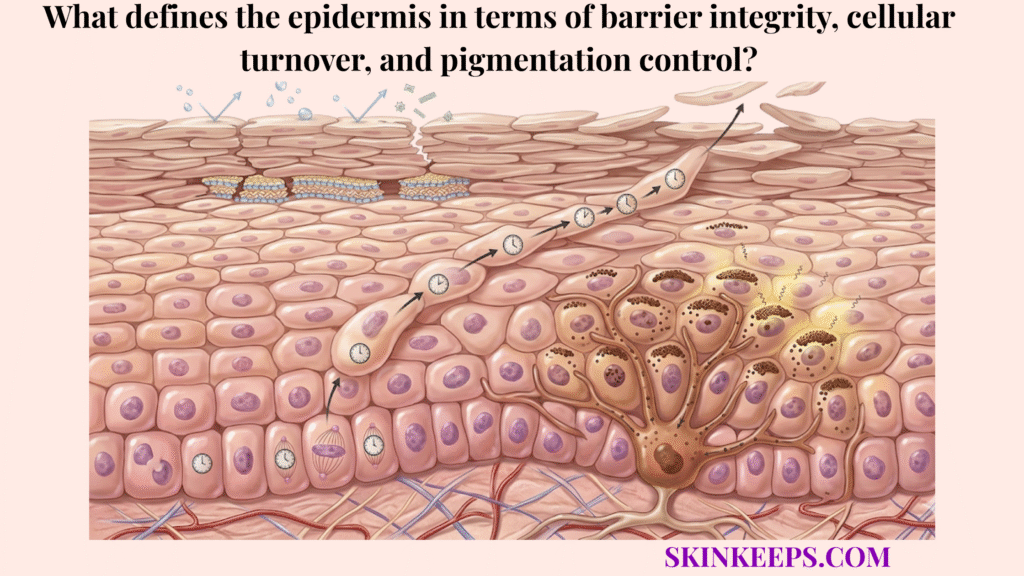
The epidermis is defined by three essential functions: barrier integrity, which protects the body and reduces water loss; cellular turnover, which renews the surface; and pigmentation control, which shapes visible skin tone through melanocyte activity and melanin distribution. It is not just a passive outer covering, but a living functional system that determines how the skin protects itself, renews itself, and regulates visible tone.
Moving from this biological definition to visible relevance, these processes dictate everyday skin health. Common concerns such as dryness, rough texture, dullness, sensitivity, and uneven pigmentation often reflect strain in one of these three defining epidermal functions.
This guide explains exactly what the epidermis is, how each of its three defining functions works, how to recognize when they are under strain, and how to support them with targeted skincare. To provide immediate clarity before moving into the deeper anatomy and function breakdown, the most common questions are answered first.
Quick Answers to Common Questions About the Epidermis
To provide immediate clarity, this section answers the most common questions about the epidermis using concise, clinically grounded explanations.
What is the epidermis?
The epidermis is the outermost layer of the skin and the part of the body that directly manages surface protection, visible texture, and pigmentation balance. It renews continuously and acts as the functional surface barrier you see, feel, and treat every single day.
What does the epidermis do?
The epidermis defines visible skin health through three core functions: barrier integrity, cellular turnover, and pigmentation control. When you experience dryness, dullness, roughness, sensitivity, or uneven tone, those symptoms often reflect structural or biological stress within one of those specific functions.
Which epidermal layer produces new skin cells?
The stratum basale is the deepest epidermal layer and the main site of new keratinocyte production. New keratinocytes begin their life cycle in the stratum basale and progressively migrate upward through the epidermis to eventually form the protective surface barrier.
Why does the epidermis matter in skincare?
The epidermis matters in skincare because most visible surface concerns begin where barrier function, renewal, and pigmentation control are managed. Connecting surface symptoms directly to underlying function provides a clinical baseline for making effective, long-term daily skincare decisions.
What causes epidermal barrier problems?
Epidermal barrier problems are often triggered when cleansing, exfoliation, irritation, or environmental stress overwhelm the skin’s surface defenses. Repeatedly stripping the natural lipid matrix or disrupting the acid mantle creates compounding stress that prevents the barrier from recovering efficiently.
How does the epidermis affect pigmentation?
The epidermis affects pigmentation through melanocyte activity and melanin transfer, which influence how evenly skin tone appears. Ultraviolet exposure, chronic inflammation, and harsh surface irritation can heavily disrupt this function, forcing melanocytes to overproduce pigment and making the tone less even.
Can skincare support epidermal function?
Skincare can support epidermal function when it is matched to the main function under strain and used with consistency rather than aggression. Routine hydration, careful renewal, and sun defense support recovery, though topical products should not replace medical care when symptoms are severe.
When should someone seek medical review?
Medical review is appropriate when skin symptoms are persistent, rapidly worsening, painful, unusual, or not improving with gentle evidence-based care. A licensed dermatologist can diagnose underlying conditions that mimic surface strain but require targeted clinical or prescription treatment.
Understand What the Epidermis Is and Why It Defines Visible Skin Health
To understand what the epidermis is and why it defines visible skin health, you must recognize it as the body’s dynamic first line of defense that directly influences moisture retention, surface texture, and pigmentation balance.
Define the Epidermis as the Outermost Protective Skin Layer
The epidermis is the outermost protective skin layer, and it renews itself continuously while separating the body from external chemical, microbial, and physical stress.
Unlike deeper tissues, the epidermis is entirely avascular, meaning it contains no direct blood supply. It depends fundamentally on the dermis situated below for the diffusion of essential nutrients, oxygen, and hydration to sustain its demanding cellular functions.
Therefore, the epidermis operates as a living, protective interface rather than a static, passive coating. Every environmental variable—from temperature shifts to topical acid application—forces this interface to adapt and react to maintain internal homeostasis.
Identify How the Layers of the Epidermis Support Barrier Function, Turnover, and Pigmentation
The epidermis contains specialized sublayers that work together to support barrier formation, continuous renewal, and visible pigment regulation.
These sublayers handle highly specific roles: the stratum corneum acts as the outer protective shield, the stratum granulosum handles waterproofing and barrier formation, the stratum spinosum supplies structural cohesion, and the stratum basale drives cell production and melanocyte activity. That outer shield depends heavily on the way corneocytes limit water evaporation in the epidermis, because those surface cells form the structural face of the barrier.
These individual layers function strictly as a coordinated biological system rather than isolated compartments. Stress in the basal layer inevitably disrupts the structural integrity of the upper layers days later.
- Stratum corneum → outer protective shield
- Stratum granulosum → waterproofing and barrier formation
- Stratum spinosum → structural cohesion
- Stratum basale → cell production and melanocyte activity
Discover How Barrier Integrity Defines the Epidermis as a Protective Surface
Barrier integrity is the defining protective function of the epidermis, because it helps keep water inside the body while limiting the entry of irritants, microbes, and environmental stressors.
When barrier integrity performs optimally, the result is visibly better tolerance and comfort. A well-functioning barrier directly translates to less skin tightness, fewer instances of flaking, and a significantly reduced reactivity to basic daily skincare products.
This robust defense system relies entirely on surface chemistry and the physical organization of the stratum corneum to prevent transepidermal water loss.
Explain How the Epidermis Helps Prevent Transepidermal Water Loss
The epidermis helps prevent transepidermal water loss by organizing corneocytes and intercellular lipids into a tightly regulated surface barrier.
This structure follows a precise brick-and-mortar model. Hardened corneocytes function as resilient bricks, while the lipid matrix—composed of ceramides, cholesterol, and free fatty acids—acts as the flexible, impermeable mortar that binds them together.
The stability of this mortar depends on the acid mantle, an invisible film of sebum and sweat. [PubMed, 2006]. Maintaining this acidic pH preserves lipid organization and keeps the surface chemically stable.
An acidic pH directly sustains barrier performance and optimizes skin-surface ecology. The next step is to explore how the epidermis prevents transepidermal water loss (TEWL) in more detail, because that process explains why a healthy surface barrier feels less dry, tight, and reactive.
Show How the Epidermal Barrier Helps Limit External Irritants and Microbes
An intact epidermal barrier helps limit irritants and microbes by maintaining both a physically continuous surface and a chemically unfavorable environment for invasion.
Pathogens and allergens struggle to penetrate the skin when the physical corneocyte structure is tightly bound and the acidic chemistry actively suppresses bacterial overgrowth. A major part of that defense depends on the lipids that form the epidermal barrier matrix, because those lipids help maintain cohesion, reduce irritant entry, and support barrier stability.
When barrier organization weakens, microscopic gaps form between the cells. These structural fractures allow environmental irritants to penetrate deeply, triggering an inflammatory cascade that rapidly compounds surface damage.
Recognize the Signs of Impaired Epidermal Barrier Integrity
When epidermal barrier integrity is under strain, the skin often shows dryness, flaking, tightness, diffuse redness, irritation, and reduced tolerance to basic skincare products.
These clinical signs map directly to common, frustrating daily experiences. The skin may feel uncomfortably tight immediately after cleansing, sting intensely when simple moisturizers are applied, and exhibit chronic dryness despite heavy product usage. If you are experiencing these compounding symptoms, evaluating them with a barrier health checker can help you accurately gauge your level of impairment.
The mechanism follows a predictable downward flow: an external stressor damages the lipid matrix, leading to a weakened surface defense, which subsequently accelerates water loss and allows irritants to enter, resulting in noticeably less comfortable skin.
Explore How Cellular Turnover Defines the Epidermis as a Renewing Layer
The epidermis is defined not only by surface protection, but also by continuous cellular turnover that renews the outer skin layer over time.
Cellular turnover is the complete biological cycle required for the epidermis to build new tissue and discard the old. This dynamic mechanism ensures the skin maintains its structural density and optical clarity.
Turnover relies on three distinct phases: the initial cellular production, the structural maturation, and the final shedding phase. This entire sequence is driven by the predictable formation and upward migration of keratinocytes.
Trace How New Epidermal Cells Form and Rise to the Surface
The renewal pathway begins in the basal layer, where new keratinocytes are generated and then migrate upward, mature, and ultimately contribute to the protective outer surface.
As keratinocytes migrate upward through the stratum spinosum and stratum granulosum, they synthesize essential proteins and lipids. During this journey, the cells gradually flatten, lose their nuclei, and prepare to form the barrier shield.
The cycle concludes with desquamation, the automated shedding phase where dead corneocytes invisibly detach from the surface to make room for the newly matured cells arriving from beneath.
Explain What Regulates Healthy Epidermal Turnover
Healthy epidermal turnover depends on balance: new cells must be produced, mature, and shed in an orderly sequence so the surface remains smooth and functional.
A balanced turnover rate ensures the skin does not become too thin and fragile or too thick and congested. The automated shedding phase matters just as much as rapid cell production.
When turnover remains perfectly balanced, the visible outcomes are immediate: the skin presents a smoother texture, significantly less roughness, minimal pore congestion, and a more even, healthy light reflection.
Identify the Signs of Disrupted Cellular Turnover in the Epidermis
Disrupted cellular turnover often appears as dullness, roughness, congestion, and uneven surface texture caused by slower or less orderly renewal.
When the desquamation phase slows down, dead cells accumulate unevenly. This dead-cell retention physically blocks light reflection and traps excess sebum within the pores.
Recognizing the root cause requires understanding the sequence that failed:
- Keratinocytes form in the basal layer.
- Cells move upward.
- Cells mature and flatten.
- Surface cells shed.
Learn How Pigmentation Control Defines the Epidermis as a Tone-Regulating Layer
Pigmentation control is the third defining function of the epidermis, because melanocytes and melanin distribution influence how the skin responds visibly to UV exposure, inflammation, and other triggers.
Pigmentation control is the specific biological mechanism the skin uses to manufacture, package, and deploy pigment throughout the surface layer. It represents a highly reactive defense system.
Melanin operates as protective biology first and visible tone second. Its primary mandate is to shield cellular DNA from radiation. To accomplish this, the epidermis utilizes melanocytes, the enzyme tyrosinase, and carefully regulated transfer networks to combat external stress.
Explain How Melanocytes Produce Pigment Within the Epidermis
Melanocytes in the basal layer produce melanin and distribute that pigment to surrounding keratinocytes, helping protect nuclear DNA while also shaping visible skin tone.
Tyrosinase serves as the critical, rate-limiting enzyme that initiates the chemical synthesis of melanin inside the melanocyte. When triggered, tyrosinase activity increases to produce more protective pigment.
Once manufactured, melanocytes distribute this pigment through their dendritic arms to dozens of neighboring keratinocytes. [ScienceDirect, 2007]. This functional partnership forms the epidermal melanin unit.
Show How UV Exposure and Inflammation Alter Epidermal Pigmentation
UV exposure and inflammation can alter epidermal pigmentation by increasing melanocyte activity and encouraging excess melanin production or transfer.
Ultraviolet radiation acts as an aggressive, direct trigger. When UV rays strike the skin, the epidermis immediately upregulates tyrosinase and pushes vast amounts of melanin upward to absorb the radiation.
Similarly, internal inflammation—such as the trauma from an acne breakout or harsh chemical irritation—sends distress signals that confuse melanocytes, causing them to dump disorganized pigment into the surrounding tissue. This disruption manifests visibly as patchy unevenness and stubborn post-inflammatory dark marks long after the initial trigger heals.
Recognize the Signs of Unbalanced Pigmentation Control in the Epidermis
Unbalanced pigmentation control often appears as uneven tone, persistent dark marks, or post-inflammatory hyperpigmentation after irritation or acne.
Unbalanced pigmentation usually presents either as a diffuse, mottled unevenness across large areas (often UV-induced) or as discrete, concentrated dark marks localized to areas of previous trauma.
Post-inflammatory hyperpigmentation (PIH) occurs simply because the skin deployed melanin to protect a wound, but the pigment remained trapped in the epidermal layers after the healing finished.
- UV exposure → increased melanin production
- Inflammation → post-inflammatory pigment change
- Repeated exposure → more visible unevenness
Compare a Healthy Epidermis with an Impaired Epidermis Across Barrier Integrity, Turnover, and Pigmentation
By evaluating barrier integrity, turnover, and pigmentation together, you can compare a more resilient epidermis with a more stressed one and identify which function is most likely under strain.
| Function | Healthy Epidermis | Impaired Epidermis | Visible Signs |
|---|---|---|---|
| Barrier Integrity | Retains water, resists irritants | Loses water rapidly, highly permeable | Dryness, tightness, redness, stinging |
| Cellular Turnover | Sheds smoothly and consistently | Retains dead cells, uneven shedding | Rough texture, dullness, congestion |
| Pigmentation Control | Distributes melanin evenly | Overproduces and traps pigment | Dark spots, patchiness, PIH |
Compare Healthy and Impaired Epidermal Barrier Integrity
A healthy epidermal barrier feels resilient and better hydrated, while an impaired barrier is more reactive, dehydrated, and easily irritated. Resilient skin comfortably tolerates daily cleansing and environmental shifts by locking moisture in. Conversely, an impaired barrier leaks hydration continuously, resulting in a fragile, tight surface that frequently reacts with stinging or diffuse redness when exposed to mild products.
Compare Balanced and Disrupted Epidermal Turnover
Balanced epidermal turnover supports a smoother, more refined surface, while disrupted turnover is more likely to leave the skin rough, dull, or congested. When shedding proceeds efficiently, the skin reflects light cleanly and feels soft. When turnover is disrupted, dead cells pile up, severely dulling the complexion, creating rough tactile patches, and contributing heavily to follicular congestion.
Compare Balanced and Unbalanced Epidermal Pigmentation Control
Balanced epidermal pigmentation control supports a more even skin tone, while unbalanced control is more likely to produce patchiness, dark marks, and visible discoloration. An even tone indicates that melanin transfer is steady and orderly. Unbalanced control reveals itself through scattered, persistent dark patches or severe post-inflammatory hyperpigmentation that lingers long after a breakout resolves.
Choose the Right Epidermis-Support Strategy Based on Whether Barrier Integrity, Turnover, or Pigmentation Is the Main Issue
To support the epidermis effectively, you must first identify whether barrier integrity, turnover, or pigmentation is the main function under strain, then match the routine to that problem.
| Primary concern | Likely epidermal issue | Best support category |
|---|---|---|
| Tightness, stinging, flaking | Compromised barrier integrity | Barrier-repair support |
| Rough texture, dullness, congestion | Disrupted cellular turnover | Controlled renewal |
| Dark spots, PIH, uneven tone | Unbalanced pigmentation control | Targeted brightening |
Choose Barrier-Repair Support When the Epidermis Feels Dry, Tight, or Sensitive
When the epidermis feels dry, tight, or sensitive, the most useful starting point is barrier-repair support.
The barrier-stress pattern indicates that the lipid matrix is severely depleted and transepidermal water loss is uncontrolled. In this state, ceramides, cholesterol, and fatty-acid support actively replace the missing mortar, while gentle cleansing ensures the delicate acid mantle remains intact. It is critical to avoid any stripping habits, stringent foaming washes, or abrasive scrubs that forcefully remove the remaining surface lipids.
Choose Turnover-Support Strategies When the Epidermis Looks Dull or Congested
When the epidermis looks dull or congested, turnover-support strategies can help improve renewal more effectively than simple surface scrubbing.
The dull or congested pattern suggests that dead corneocytes are trapped on the surface, requiring chemical ungluing rather than physical tearing. Controlled exfoliation with specific acids gently dissolves the bonds between dead cells, while consistent retinoid use supports cellular behavior from the deeper layers. Overuse of these strategies rapidly worsens tolerance, effectively trading a turnover problem for a severe barrier problem.
Choose Pigmentation-Control Strategies When the Epidermis Develops Dark Spots or Uneven Tone
When the epidermis develops dark spots or uneven tone, pigmentation-control strategies should begin with UV protection and then add targeted brightening support.
This pattern indicates that melanocytes are actively overproducing pigment due to external triggers or recent inflammation. Daily sunscreen serves as the foundational, non-negotiable shield that cuts off the primary UV trigger causing the enzyme cascade. Targeted brightening support—utilizing tyrosinase inhibitors—can subsequently help fade trapped pigment steadily, without promising rapid or overnight erasure.
Protect the Epidermis with Routines That Support Barrier Integrity, Cellular Turnover, and Pigmentation Control
Protecting the epidermis requires a routine that supports barrier integrity, renewal, and pigmentation control without overwhelming the skin.
Structuring your routine requires respecting the limits of epidermal biology. The most effective framework targets the root mechanisms:
- Barrier integrity → hydrate and repair
- Cellular turnover → renew carefully
- Pigmentation control → protect and brighten
Fortify Epidermal Barrier Integrity with Barrier-Repair Ingredients
Epidermal barrier integrity is best supported by routines that reinforce hydration, replenish surface lipids, and avoid stripping the acid mantle.
Topical hydration draws water into the stratum corneum, while heavy lipid support seals that moisture in by patching the structural mortar. Gentle, non-foaming cleansing respects the acid mantle by removing daily debris without altering the naturally acidic surface pH. It is vital to never strip the skin with hot water, harsh alcohols, or aggressive towel friction.
Regulate Epidermal Cellular Turnover with Controlled Renewal Strategies
Epidermal cellular turnover responds best to controlled renewal strategies that improve shedding without overwhelming the barrier.
Controlled exfoliation leverages chemical compounds to unglue retained dead cells evenly, encouraging a refined texture. Careful nighttime retinoid pacing influences the rate of cellular progression from the bottom up, supporting structural density over time. Always warn against overuse and irritation stacking; deploying acids and retinoids simultaneously guarantees compounding surface inflammation.
Control Epidermal Pigmentation with UV Protection and Targeted Brighteners
Epidermal pigmentation control depends first on reducing daily UV triggers and then on using targeted brightening support with consistency.
Sunscreen acts as the absolute baseline; without blocking radiation, melanocytes will continue to defend the nucleus with excess melanin. Brightening support remains strictly secondary, serving only to suppress the tyrosinase enzyme cascade once the skin is shielded. Consistency in applying these agents matters infinitely more than layering too many actives and risking inflammatory rebound pigmentation.
Avoid Mistakes That Weaken the Epidermis and Disrupt Its Defining Functions
Effective skincare requires avoiding the mistakes that repeatedly strain the epidermis and interfere with barrier integrity, renewal, and pigment balance.
Avoid Over-Exfoliating the Epidermis When Trying to Improve Texture
Over-exfoliating the epidermis in an effort to improve texture can weaken barrier integrity and make the skin more reactive.
The mistake involves using harsh physical scrubs or high-strength chemical exfoliants daily to chase an artificially smooth surface. The barrier consequence is severe transepidermal water loss and microscopic surface tears that invite chronic inflammation. The better alternative is controlled exfoliation utilizing gentle, well-formulated chemical exfoliants no more than a few times per week.
Avoid Skipping Sunscreen When Trying to Control Epidermal Pigmentation
Skipping sunscreen can continuously worsen epidermal pigmentation control and reduce the effectiveness of brightening strategies.
Unprotected UV exposure instantly re-triggers the pigment production pathways, commanding the melanocytes to flood the keratinocytes with fresh melanin. This constant defensive response thoroughly weakens and overrides any topical brightening efforts you apply. Making broad-spectrum sunscreen the non-negotiable daily baseline is the only way to stabilize pigment synthesis.
Avoid Layering Too Many Active Ingredients When the Epidermal Barrier Is Already Under Strain
Layering too many active ingredients onto an already strained epidermal barrier can trigger severe irritation and worsen barrier disruption.
Combining high-strength vitamin C, exfoliants, and retinoids onto a compromised surface guarantees that the multiple actives will aggressively compound the existing irritation. Total barrier recovery must always come before introducing aggressive corrective treatments. The better alternative is to simplify the routine entirely, stabilize the barrier with lipids, and then reintroduce actives slowly one by one.
Review the Key Ways Barrier Integrity, Cellular Turnover, and Pigmentation Control Define the Epidermis
The health and appearance of the skin depend heavily on how well the epidermis maintains barrier integrity, renewal, and pigmentation control together.
- The epidermis defines surface protection through barrier integrity.
- The epidermis defines visible renewal through cellular turnover.
- The epidermis defines tone regulation through pigmentation control.
- Healthy skin depends on supporting all three functions together.
- Skincare works best when matched to the epidermis’s main area of strain.
When you support the natural biology of the epidermis, healthier, more resilient skin becomes much more achievable over time.