Asteatotic eczema is dry-skin-driven eczema that causes itchy, rough, scaly, cracked, or fissured skin, often with a cracked-paving pattern. It is also called eczema craquelé, xerotic eczema, winter itch, or dry-skin eczema.
This page explains symptoms, body locations, causes, risk factors, diagnosis, treatment options, prevention, mistakes, and when to seek care. Asteatotic eczema is more than ordinary dryness because treatment must repair the skin barrier, reduce drying triggers, and calm inflammation when needed.
What Is Asteatotic Eczema and Why Does Dry Skin Crack?
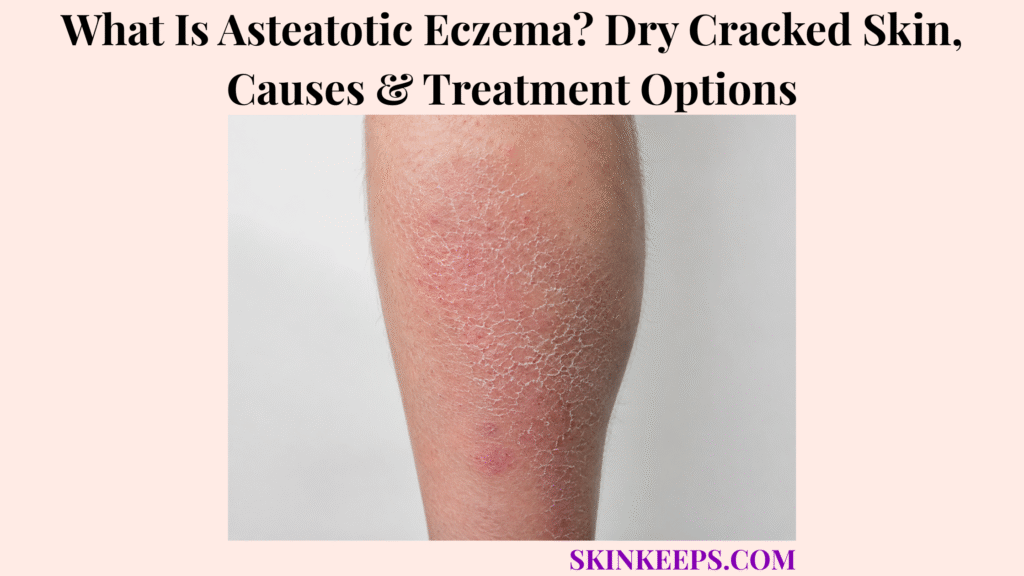
Asteatotic eczema is a dry-skin-driven type of eczema that causes itchy, rough, cracked, scaly, or fissured skin, often with a cracked-paving appearance.
The condition starts when the outer skin barrier becomes too dry and loses water and surface lipids. Once the barrier weakens, the skin can itch, scale, split, sting, bleed, or become inflamed.
Asteatotic eczema is also called xerotic eczema or winter itch because it often flares in dry, cold, low-humidity conditions. The name eczema craquelé points to the cracked appearance of the skin surface.
Why Is Asteatotic Eczema Also Called Eczema Craquelé?
Asteatotic eczema is also called eczema craquelé because the skin surface can look cracked like dried mud, cracked porcelain, or paving.
The pattern appears when dryness damages the outer skin barrier and fine cracks form across the surface. It is not only roughness; inflammation and itching are part of the eczema process.
Why Is Asteatotic Eczema Not Just Ordinary Dry Skin?
Asteatotic eczema is not just ordinary dry skin because it adds inflammation, itching, scaling, cracking, and fissures that can sting, hurt, bleed, or become infected.
Dry skin / xerosis may feel tight, flaky, or rough, but asteatotic eczema means the damaged dry barrier has moved into dermatitis. Barrier repair stays central, but actively inflamed cracked skin may need clinician-guided anti-inflammatory care.
| Feature | Ordinary Dry Skin | Asteatotic Eczema |
|---|---|---|
| Main issue | Tight, flaky, rough skin | Dryness plus eczema inflammation |
| Pattern | May be diffuse or seasonal | Cracked/fissured “crazy paving” pattern |
| Itch | Mild or variable | Often itchy and sometimes intense |
| Cracks | May be superficial | Fissures can sting, bleed, or hurt |
| Treatment | Moisturizer may be enough | Barrier repair plus trigger reduction; inflamed skin may need topical anti-inflammatory treatment |
| Safety | Usually low risk if mild | Open cracks can increase infection risk |
Practical rule: Cracked itchy dry skin needs barrier repair first, not scrubbing, hot water, or thin scented lotion alone.
What Asteatotic Eczema Symptoms Appear on Skin?
Asteatotic eczema symptoms can include very dry, rough, itchy, scaly, cracked, fissured, red, pink, brown, purple, or inflamed-looking skin, depending on skin tone and severity.
Mild cases may begin as tight rough skin with fine scale. More active flares can develop a network of cracks that sting, burn, hurt, bleed, or open the skin barrier.
What Does Mild Asteatotic Eczema Look Like?
Mild asteatotic eczema may start with very dry, tight, rough, itchy, or finely scaly skin before deeper cracks appear.
The skin may feel uncomfortable after bathing, during cold weather, near indoor heat, or when clothing rubs. Recurring mild symptoms should not be ignored if the same areas keep drying and cracking.
What Does More Severe Asteatotic Eczema Look Like?
More severe asteatotic eczema can show deeper fissures, a cracked-paving pattern, bleeding cracks, stinging, burning, pain, swelling, or signs of infection.
On lighter skin, inflammation may look red or pink. On darker skin, it may look brown, purple, gray-brown, or darker than nearby skin. Pus, honey-colored crust, spreading warmth, fever, or worsening pain is not normal dryness.
| Skin Sign | What the Reader May Notice | Why It Matters |
|---|---|---|
| Dryness | Skin feels tight or rough | Early barrier failure |
| Fine scale | Flaky, powdery, or rough surface | Supports xerotic pattern |
| Itch | Scratching urge, worse at night or in dry air | Scratching can open cracks |
| Shallow cracks | Fine lines in dry skin | Early fissuring |
| Crazy paving | Network-like cracked pattern | Classic eczema craquelé clue |
| Bleeding fissures | Cracks bleed when stretched or scratched | Needs stronger care and monitoring |
| Pain or burning | Cracks sting or hurt | Barrier breakdown is more severe |
| Pus/crust/warmth | Drainage, honey crust, spreading redness/warmth | Possible infection |
Where Does Asteatotic Eczema Usually Appear?
Asteatotic eczema most often affects the shins or lower legs, but it can also appear on the arms, thighs, trunk, hands, or other dry-prone areas.
Lower legs are classic because they often become dry, exposed to cold air, and vulnerable to barrier breakdown. Hands and arms may flare when washing, soap exposure, friction, or winter air strips the barrier.
Lower-leg eczema with swelling, heaviness, varicose veins, ankle discoloration, or ulcers needs clinician review because stasis dermatitis or venous disease may be involved.
| Area | Common Clue | Possible Trigger or Rule-Out |
|---|---|---|
| Shins | Most common classic site | Cold air, dry barrier, aging skin |
| Lower legs | Cracked/fissured eczema pattern | Rule out stasis dermatitis if swelling or ulcers appear |
| Thighs | Dry scaly patches may extend | Friction, low humidity, dry skin |
| Arms | Dry cracked eczema possible | Over-washing, soaps, winter air |
| Hands | Dry cracks may overlap with hand dermatitis | Cleansers, frequent washing, contact triggers |
| Trunk | Possible but less classic | Dry indoor air, bathing habits, systemic clues if widespread |
What Causes Asteatotic Eczema?
Asteatotic eczema develops when the skin barrier becomes too dry and loses enough water and surface lipids that itching, inflammation, scaling, and fissuring begin.
Dryness drivers often stack together: cold air, low humidity, indoor heating, long hot bathing, harsh soaps, direct heat, aging skin, frequent washing, and selected medical or medication contributors.
How Do Cold Weather and Low Humidity Trigger Asteatotic Eczema?
Cold weather and low humidity can trigger asteatotic eczema by drying the outer skin layer and increasing water loss from the skin surface.
Winter air, dry climates, indoor heating, fan heaters, radiators, fireplaces, and low indoor humidity can all reduce skin moisture. The skin may feel tight first, then itch, scale, crack, and fissure.
How Do Hot Showers and Harsh Soaps Worsen Asteatotic Eczema?
Hot showers and harsh soaps can worsen asteatotic eczema by stripping natural oils, increasing dryness, and making fissures deeper or more irritated.
Long bathing, strong detergent cleansers, antibacterial soaps used without direction, vigorous towelling, and scrubbing can all weaken the barrier. Direct heat after bathing can dry the skin again quickly.
Fragranced products, hair products, detergents, or topical products may also irritate vulnerable skin; if the timing fits, allergic contact dermatitis may need to be considered.
How Do Age and Reduced Skin Oils Contribute to Asteatotic Eczema?
Age can contribute to asteatotic eczema because older skin often becomes thinner, drier, more easily irritated, and less able to hold water.
Asteatotic eczema is common after age 60, but younger people can still develop it when dryness, washing, low humidity, eczema tendency, medicines, or skin-barrier stress is present.
| Dryness Driver | Skin Effect | Visible Eczema Result |
|---|---|---|
| Cold weather | Low environmental moisture | Winter flare and roughness |
| Low indoor humidity | More water loss from skin | Tightness, itch, scaling |
| Hot showers | Natural oils stripped | Cracks deepen after washing |
| Harsh soaps | Barrier disruption | Stinging, dryness, irritation |
| Direct heat | Skin dries further | Recurring cracks near heaters |
| Aging skin | Less water retention and oil support | Lower-leg dry fissuring |
| Medicines/illness | Selected contributors to dryness | New, severe, or resistant cases may need review |
Which Risk Factors Make Asteatotic Eczema More Likely?
Asteatotic eczema is more likely when skin is older, naturally dry, exposed to low humidity, washed frequently, exposed to harsh cleansers, or affected by medicines or health conditions that reduce skin hydration.
Risk context helps explain why the barrier is vulnerable; it does not diagnose the rash by itself. The cracked/fissured pattern and trigger history still matter.
- Age over 60 or aging-skin dryness.
- Cold weather or winter flares.
- Low indoor humidity.
- Long hot showers or baths.
- Harsh soaps, detergents, or alkaline cleansers.
- Frequent washing.
- Fragranced or irritating products.
- Direct heat from fireplaces, radiators, fan heaters, or space heaters.
- Prior eczema or sensitive skin.
- Reduced mobility or lower-leg dryness.
- Medicines or systemic illness in selected cases.
How Is Asteatotic Eczema Different From Other Dry or Scaly Skin Conditions?
Asteatotic eczema is different from ordinary dry skin, atopic dermatitis, psoriasis, stasis dermatitis, and contact dermatitis because its key pattern is dry, cracked, fissured eczema driven by barrier dryness.
The pattern, location, trigger history, swelling, scale type, infection signs, and treatment response help separate mimics.
How Is Asteatotic Eczema Different From Ordinary Dry Skin?
Asteatotic eczema is different from ordinary dry skin because eczema adds inflammation, itching, fissures, and a cracked pattern that may sting, bleed, or hurt.
Mild dryness may improve with moisturizer alone. Inflamed cracked eczema usually needs stronger barrier repair, drying-trigger reduction, and sometimes short-term anti-inflammatory treatment.
How Is Asteatotic Eczema Different From Psoriasis?
Asteatotic eczema is different from psoriasis because psoriasis often forms thicker, more sharply defined plaques, while asteatotic eczema usually shows dry fine cracks and fissuring.
Psoriasis may involve elbows, knees, scalp, and nails. Asteatotic eczema more often points toward lower-leg dry fissuring, winter dryness, hot-water worsening, and barrier breakdown.
How Is Asteatotic Eczema Different From Stasis Dermatitis?
Asteatotic eczema is different from stasis dermatitis because stasis dermatitis is linked with leg circulation problems and may include swelling, heaviness, varicose veins, brown discoloration, or ulcers.
A dry cracked lower-leg rash without swelling may fit asteatotic eczema, but lower-leg rash with swelling, ankle discoloration, ulcers, heaviness, or varicose veins needs clinician review for venous disease.
| Condition | Main Clue | Common Pattern | Why It Matters |
|---|---|---|---|
| Asteatotic eczema | Dry cracked fissures | Shins/lower legs, sometimes arms/trunk | Barrier repair + inflammation control |
| Ordinary dry skin | Tight/flaky skin | Widespread or seasonal | Moisturizer may be enough if no eczema |
| Atopic dermatitis | Chronic itchy eczema tendency | Flexures, hands, face, age-dependent pattern | Broader eczema care plan |
| Psoriasis | Thick plaques/silvery scale | Elbows, knees, scalp, nails | Different treatment path |
| Stasis dermatitis | Swelling + discoloration | Lower legs/ankles | Venous disease evaluation |
| Contact dermatitis | Exposure-linked rash | Contact area | Trigger avoidance or patch testing |
| Cellulitis | Pain, warmth, swelling, spreading redness, fever | Usually one-sided acute infection pattern | Urgent medical evaluation |
How Is Asteatotic Eczema Diagnosed or Checked?
Asteatotic eczema is usually diagnosed from the skin appearance, location, dryness pattern, trigger history, and response to barrier repair, but unclear or severe cases may need evaluation for mimics or underlying contributors.
Most cases are clinical. Tests are not needed for every dry cracked rash, but atypical, widespread, infected-looking, or treatment-resistant disease deserves closer review.
What Does a Clinician Check With Asteatotic Eczema?
A clinician checks asteatotic eczema by looking for a dry cracked “crazy paving” pattern, itch, fissures, bleeding, lower-leg distribution, infection signs, and drying triggers.
The visit may include questions about showers, baths, soap, cleansers, indoor heating, low humidity, direct heater exposure, moisturizers, medicines, health changes, mobility, and lower-leg circulation symptoms.
When Might Additional Evaluation Be Needed?
Additional evaluation may be needed when asteatotic eczema is severe, widespread, recurrent, treatment-resistant, infected-looking, associated with leg swelling or ulcers, or linked with systemic symptoms.
A clinician may consider psoriasis, stasis dermatitis, scabies, drug reaction, fungal infection, cutaneous T-cell lymphoma, systemic illness, or secondary infection when the pattern is not typical.
KOH scraping may help exclude fungal mimics when scaly lesions are unclear. Biopsy is rarely required, but it may be used in atypical or treatment-resistant cases.
- Photos of the cracked pattern.
- Timeline of onset and recurrence.
- Body areas affected.
- Shower or bath routine.
- Soap, cleanser, and fragrance exposure.
- Moisturizers tried and how often used.
- Indoor heating or low-humidity exposure.
- Itch severity and sleep impact.
- Bleeding, fissures, pus, crust, or infection signs.
- Leg swelling, ulcers, heaviness, or circulation symptoms.
- New medicines or health changes.
- Fever, weight loss, malaise, or systemic symptoms.
What Treatment Options Help Asteatotic Eczema?
Asteatotic eczema treatment focuses on restoring the skin barrier, reducing dryness triggers, and calming inflammation when the skin is red, itchy, or cracked.
Care should be stepwise: stop the drying cycle, seal the barrier, calm active inflammation, and treat infection signs when present.
How Do Thick Moisturizers and Emollients Help Asteatotic Eczema?
Thick moisturizers and emollients help asteatotic eczema by sealing water into the skin barrier, softening scale, and reducing cracking.
Ointments or thick creams are often more useful than thin scented lotions when the skin is very dry or fissured. Petrolatum-style ointments can be useful as a barrier layer, especially after bathing while the skin is still slightly damp.
Reapply to shins, lower legs, hands, and dry-prone areas as needed. A thin fragranced lotion may sting and may not seal severe dryness well enough.
When Are Topical Steroids Used for Asteatotic Eczema?
Topical steroids may be used for asteatotic eczema when skin is actively inflamed, red, itchy, or cracked and barrier repair alone is not enough.
A mild topical steroid may be enough for some flares, while stronger treatment should be clinician-guided. Older or thin skin needs caution, and long-term unsupervised steroid use should be avoided.
When Might Infection Treatment Be Needed?
Infection treatment may be needed when cracked asteatotic eczema develops pus, honey-colored crust, increasing pain, spreading redness or warmth, fever, or worsening open fissures.
Open cracks can allow secondary infection. Spreading warmth, pain, swelling, fever, or acute redness may suggest cellulitis or another infection pattern that needs clinician evaluation.
| Treatment Step | Best-Fit Symptom | Goal | Caution |
|---|---|---|---|
| Thick emollient/ointment | Very dry, cracked, rough skin | Seal moisture and soften fissures | Thin lotion may not be enough |
| Cream cleanser / soap substitute | Soap-triggered dryness or frequent washing | Reduce barrier stripping | Avoid harsh antibacterial soaps unless directed |
| Short lukewarm bathing | Dryness after washing | Clean without stripping oils | Avoid long hot showers |
| Topical steroid | Red, itchy, inflamed flare | Calm inflammation | Use correct strength and duration |
| Anti-itch support | Sleep-disrupting itch | Reduce scratching and fissure opening | Do not replace eczema treatment |
| Infection treatment | Pus, crust, spreading warmth/redness, fever | Treat secondary infection | Needs clinician evaluation |
| Systemic evaluation | Severe, widespread, resistant, systemic symptoms | Rule out contributors | Use targeted evaluation |
How Can Daily Skin Care Prevent Asteatotic Eczema Flares?
Daily prevention for asteatotic eczema means protecting the skin barrier before cracks appear, especially during cold weather, dry indoor air, frequent washing, or hot-bath routines.
Use lukewarm water instead of hot water and keep showers or baths short. A practical range is 5–10 minutes for older dry skin guidance and no more than about 15 minutes in broader prevention guidance.
Use gentle cleanser or cream cleanser, pat skin dry instead of rubbing, and apply thick moisturizer while the skin is still slightly damp. Reapply daily to shins, lower legs, hands, and dry-prone areas.
Avoid direct heat from heaters, fireplaces, radiators, fan heaters, or space heaters. When indoor air is very dry, a humidifier may help keep the environment less drying.
- Use lukewarm water instead of hot water.
- Keep showers or baths short.
- Use gentle cleanser or cream cleanser instead of harsh soap.
- Pat skin dry instead of rubbing.
- Apply thick moisturizer while skin is slightly damp.
- Reapply moisturizer to shins and dry-prone areas daily.
- Avoid scrubbing or exfoliating cracked skin.
- Avoid sitting close to direct heat.
- Use a humidifier when indoor air is very dry.
- Wear soft, non-irritating clothing.
- Protect lower legs from cold and friction.
- Review recurring or severe cracks with a clinician.
What Asteatotic Eczema Mistakes Should You Avoid?
The biggest asteatotic eczema mistake is treating cracked itchy skin as something to scrub off, when the real problem is a damaged dry skin barrier.
Long hot showers, harsh antibacterial soaps, body scrubs, exfoliating acids on fissures, fragranced lotions, direct heater exposure, and stopping care too early can keep the crack cycle going.
Do not assume every lower-leg rash is asteatotic eczema if swelling, ulcers, severe one-sided redness, or fever is present. Those features need clinician review.
| Mistake | Why It Fails | Better Action |
|---|---|---|
| Hot showers | Strip oils and worsen dryness | Use lukewarm short showers |
| Scrubbing cracks | Deepens fissures and irritation | Clean gently and pat dry |
| Thin lotion only | May not seal severe dryness | Use thick cream or ointment |
| Direct heat exposure | Increases dryness | Warm the room safely; avoid heater blast |
| Fragranced products | Can sting or irritate cracks | Use fragrance-free barrier care |
| Ignoring infection signs | Cracks can become infected | Seek care if worsening |
| Stopping care too early | Recurrence is likely if skin dries again | Keep preventive moisturization |
When Should Asteatotic Eczema Be Checked by a Doctor?
Asteatotic eczema should be checked by a clinician when dry cracked skin is severe, painful, bleeding, infected-looking, widespread, recurring, not improving with barrier care, or associated with swelling, ulcers, or unexplained symptoms.
Mild dry cracks can often improve with consistent barrier care, but deep fissures, infection signs, sleep-disrupting itch, or lower-leg swelling changes the safety level.
Which Asteatotic Eczema Symptoms Need Medical Review?
Asteatotic eczema symptoms need medical review when fissures are deep or painful, cracks bleed, infection signs appear, itch disrupts sleep, the rash spreads widely, or lower-leg swelling or ulcers are present.
Seek care for pus, honey-colored crust, spreading redness or warmth, fever, chills, severe pain, swelling, ulcers, widespread rash, no improvement after consistent moisturizing and trigger reduction, or unexplained weight loss, fevers, malaise, or systemic symptoms.
What Should You Bring to an Appointment for Asteatotic Eczema?
A helpful asteatotic eczema appointment starts with photos, flare timeline, bathing routine, cleanser list, moisturizer history, medication changes, indoor heat exposure, and infection or swelling signs.
Bring details about itch severity, sleep disruption, bleeding cracks, pus, crust, fever, leg heaviness, ulcers, circulation symptoms, new medicines, and any recent health changes.
Seek medical review if dry cracked eczema is:
What Should You Remember About Asteatotic Eczema?
The most important thing to remember about asteatotic eczema is that it is dry-skin-driven eczema, so the central treatment logic is barrier repair, not aggressive washing or cosmetic exfoliation.
Cold weather, low humidity, hot bathing, harsh soaps, direct heat, and aging skin can drive recurrence. Thick moisturizers, gentle cleansing, trigger reduction, and clinician-guided anti-inflammatory care when inflamed are the core steps.
Frequently Asked Questions About Asteatotic Eczema
Is asteatotic eczema the same as dry skin?
No. Dry skin is the underlying driver, but asteatotic eczema includes inflammation, itching, scaling, cracks, and fissures.
Why is asteatotic eczema called eczema craquelé?
It is called eczema craquelé because the surface can look cracked like cracked paving, dried mud, a dried riverbed, or cracked porcelain.
Where does asteatotic eczema usually appear?
Asteatotic eczema most often appears on the shins and lower legs, but it can also affect the arms, thighs, trunk, hands, or other dry-prone areas.
What causes asteatotic eczema?
Asteatotic eczema is driven by dry skin barrier damage. Cold weather, low humidity, indoor heating, hot bathing, harsh soap, frequent washing, aging skin, direct heat exposure, and selected medicine or health contributors may worsen it.
What is the best treatment for asteatotic eczema?
There is no single best treatment for every case. Core treatment is reducing dryness triggers, using gentle cleanser, applying thick emollients or ointments, and using clinician-guided topical anti-inflammatory treatment when skin is actively inflamed.
Can asteatotic eczema become infected?
Yes. Open fissures can allow infection, especially if cracks become painful, swollen, pus-filled, honey-crusted, warm, spreading, or linked with fever.
Should I exfoliate asteatotic eczema cracks?
No. Scrubbing or exfoliating fissured skin can deepen cracks and worsen irritation; gentle cleansing and barrier repair are safer.
When should asteatotic eczema need medical care?
Medical care is needed for deep fissures, bleeding, pain, infection signs, spreading redness or warmth, fever, swelling, ulcers, severe itch, widespread rash, or no improvement with consistent barrier care.
Sources & Evidence About Asteatotic Eczema
DermNet — Asteatotic Eczema was used for the definition as dermatitis caused by dry skin, eczema craquelé naming, shins as the most common site, upper-limb/trunk involvement, water loss from the stratum corneum, low humidity, excessive bathing, soaps/detergents, older-adult tendency, systemic and medication contributors, clinical diagnosis, thick emollients, topical steroid use for reddened skin, and recurrence prevention.
Eczema UK — Asteatotic Eczema was used for older-adult context, shins and other body sites, very dry rough scaly skin, cracked-paving or dried-riverbed appearance, overheating, winter weather, hot water, soap, vigorous towelling, dry air, emollients, and topical steroids for inflammation.
Cleveland Clinic — Asteatotic Eczema was used for patient-friendly symptom framing, age-over-60 context, body locations, infection-risk warnings from cracks, moisturizer role, gentle cleanser and warm-shower prevention, and clinician-care triggers.
AAD — Skin Care in Your 60s and 70s was used for older-skin dryness context, warm not hot bathing, short bath/shower duration, applying moisturizer soon after bathing, and indoor humidity guidance when air is dry.
StatPearls / NCBI Bookshelf — Asteatotic Eczema was used for barrier-dysfunction context, transepidermal water-loss framing, older-adult predominance, differential diagnosis, selected systemic or medication contributors, and escalation logic for atypical or resistant cases.
Primary Care Dermatology Society — Asteatotic Eczema was used for “crazy pavement” morphology, pruritic dry cracked fissured skin, shin-predominant pattern in older patients, winter/excess-washing triggers, ointment emollients, and topical steroids when inflammatory.
Educational Disclaimer: This SkinKeeps article is for educational purposes only and does not diagnose or replace medical care. Deep fissures, bleeding cracks, pus, honey-colored crust, spreading redness or warmth, fever, chills, severe pain, swelling, ulcers, severe itch, widespread rash, or dry cracked skin that does not improve with consistent barrier care should be checked by a qualified healthcare professional.