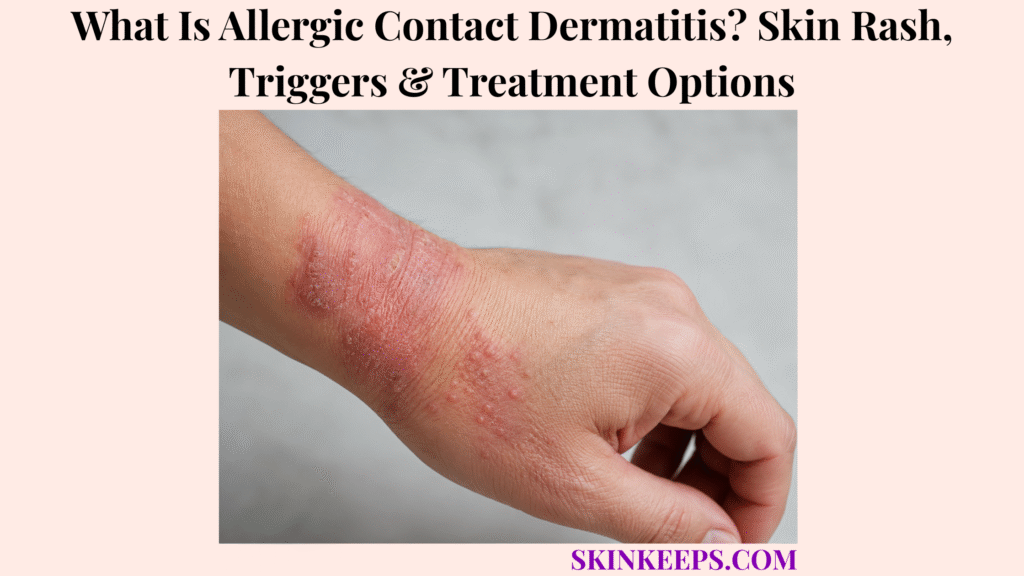
Allergic contact dermatitis is a delayed allergic skin rash that develops when the immune system reacts to a specific substance touching the skin. It is not contagious, and it is different from ordinary irritation, hives, food allergy, or general sensitive skin.
This page explains rash symptoms, delayed timing, common triggers, patch testing, treatment options, daily skin support, prevention, mistakes, and warning signs. It helps readers understand when a recurring itchy rash needs exposure tracking or dermatologist evaluation without trying to diagnose the rash at home.
What Is Allergic Contact Dermatitis and How Does It Start?
Allergic contact dermatitis is an itchy skin rash that starts when the immune system reacts to a skin-contact allergen after the person has become sensitized to that substance.
An allergen is a substance that can trigger an allergic immune response in a sensitized person. Sensitization means the immune system has learned to recognize that substance, so later contact can restart the rash.
Allergic contact dermatitis belongs within the wider dermatitis / eczema family, but its key feature is a specific contact allergen. That makes trigger identification central to long-term control.
Why Can Allergic Contact Dermatitis Appear After a Delay?
Allergic contact dermatitis can appear after a delay because type IV hypersensitivity reactions usually take time to activate immune cells in the skin.
Type IV hypersensitivity is a delayed immune reaction involving skin immune cells rather than an immediate hive-like reaction. Allergic contact dermatitis typically appears 24–72 hours after allergen exposure, but timing can vary.
The delay can hide the trigger because the rash may appear after the person has already used several products, worn several items, or touched several materials. Repeat exposure patterns can make the trigger clearer over time.
Why Is Allergic Contact Dermatitis Not Contagious?
Allergic contact dermatitis is not contagious because it is an immune reaction in one person’s skin, not an infection that spreads from person to person.
The rash itself does not spread by touch. Allergen residue can transfer from hands, clothing, tools, pets, gloves, jewelry, or products, but that is exposure transfer, not contagious infection.
Practical rule: Allergic contact dermatitis is trigger-led; finding the allergen matters as much as calming the rash.
What Allergic Contact Dermatitis Rash Symptoms Appear on Skin?
Allergic contact dermatitis can cause itching, discoloration, swelling, bumps, blisters, oozing, crusting, dryness, cracking, scaling, burning, tenderness, or thickened skin.
The rash can look different across skin tones. It may appear red or pink on lighter skin, while darker skin may show brown, purple, gray, darker-than-usual, or lighter-than-usual areas after inflammation.
What Does Acute Allergic Contact Dermatitis Look Like?
Acute allergic contact dermatitis often looks like an itchy, inflamed rash with swelling, bumps, blisters, oozing, or crusting in the area exposed to the allergen.
Blistering and oozing can happen with stronger reactions, but every rash does not blister. Itching is common, and scratching can make swelling, crusting, or secondary irritation worse.
What Does Chronic Allergic Contact Dermatitis Look Like?
Chronic allergic contact dermatitis can look dry, thickened, scaly, cracked, darker, lighter, or lichenified when the allergen exposure continues or keeps recurring.
Lichenification means thickened skin caused by repeated inflammation, rubbing, or scratching. A rash that keeps returning in the same place is an exposure clue, not just a cosmetic color issue.
| Rash Sign | What It May Look or Feel Like | What It May Suggest |
|---|---|---|
| Itching | Persistent urge to scratch | Common inflammatory symptom |
| Swelling | Puffy or raised skin | Stronger acute reaction |
| Blisters | Small fluid-filled bumps | Acute allergic dermatitis or plant-related exposure |
| Oozing / crusting | Fluid leakage or dried crust | Strong inflammation or possible secondary infection if worsening |
| Scaling / cracking | Dry, flaky, split skin | Chronic or repeated exposure |
| Thickened skin | Leathery or lichenified plaques | Long-term rubbing, scratching, or recurrence |
| Discoloration | Red, pink, brown, purple, darker, or lighter areas | Skin-tone-dependent inflammation or post-inflammatory change |
Practical rule: Allergic contact dermatitis symptoms matter most when the rash is itchy, exposure-linked, delayed, recurring, or difficult to explain.
Where Does Allergic Contact Dermatitis Usually Appear?
Allergic contact dermatitis usually appears where the allergen touches the skin, but transferred allergen can also create rash patterns on nearby or distant contact areas.
Rash location can provide exposure clues. Eyelids may point toward cosmetics, fragrance, nail products, airborne allergens, or allergens transferred from fingers, while hands often point toward soaps, gloves, metals, preservatives, plants, or workplace materials.
Feet can point toward shoe rubber, leather chemicals, adhesives, and dyes. Genital, face, or eye-area involvement should be handled carefully because these areas may need clinician-guided treatment rather than strong over-the-counter products.
| Rash Location | Possible Exposure Clue | Common Trigger Category |
|---|---|---|
| Eyelids | Cosmetics, nail products, fragrance, airborne allergens, hand transfer | Personal-care allergens |
| Hands | Soaps, gloves, metals, preservatives, chemicals, plants | Workplace or household exposure |
| Neck | Fragrance, jewelry, hair products, textile dyes | Fragrance, metal, dye |
| Ears | Earrings, headphones, hair products | Nickel or product exposure |
| Armpits | Deodorants or fragrance | Fragrance / preservative |
| Waistline | Belt buckle, metal fastener, elastic, clothing dye | Nickel, rubber, textile dye |
| Feet | Shoes, rubber, leather, adhesives, dyes | Footwear allergens |
How Is Allergic Contact Dermatitis Different From Irritant Contact Dermatitis?
Allergic contact dermatitis is an immune reaction to a specific allergen, while irritant contact dermatitis happens when a substance directly damages or irritates the skin barrier.
This distinction matters because the prevention strategy is different. Allergic contact dermatitis needs exact allergen identification, while irritant contact dermatitis focuses more on reducing exposure intensity, frequency, friction, moisture damage, and barrier disruption.
Why Does Allergic Contact Dermatitis Need Allergen Identification?
Allergic contact dermatitis needs allergen identification because small amounts of the same allergen can trigger recurring rash once sensitization has developed.
“Hypoallergenic,” “clean,” “natural,” or “sensitive skin” labels may not solve the problem if the exact allergen remains in the formula. Patch testing can help when the trigger is unclear or the rash keeps returning.
Why Is Irritant Contact Dermatitis Usually Exposure-Damage Based?
Irritant contact dermatitis is usually exposure-damage based because water, soaps, detergents, solvents, acids, alkalis, or friction can injure the skin barrier without requiring a true allergy.
Frequent washing, harsh chemicals, repeated wet work, and friction can damage the barrier directly. This comparison helps avoid confusing immune memory with direct irritation.
| Feature | Allergic Contact Dermatitis | Irritant Contact Dermatitis |
|---|---|---|
| Main mechanism | Immune reaction to a specific allergen | Direct irritation or barrier damage |
| Timing | Often delayed, commonly 24–72 hours | Can happen quickly or after repeated exposure |
| Trigger amount | Small amounts may trigger after sensitization | Often depends on strength, frequency, or duration |
| Testing | Patch testing can identify allergens | Patch testing may be negative |
| Main strategy | Avoid exact allergen and cross-reactors | Reduce irritants and repair barrier |
What Triggers Allergic Contact Dermatitis?
Allergic contact dermatitis triggers can include metals, fragrances, preservatives, cosmetics, hair dyes, rubber chemicals, adhesives, topical medicines, plants, and occupational substances.
Trigger identification can be difficult because everyday life includes many possible contact allergens. AAD patient guidance notes that more than 15,000 substances can cause allergic skin reactions, which is why exposure history and patch testing can matter.
Which Personal-Care Products Commonly Trigger Allergic Contact Dermatitis?
Personal-care products can trigger allergic contact dermatitis when fragrances, preservatives, hair dyes, sunscreen ingredients, cosmetics, deodorants, nail products, essential oils, or botanical extracts contact sensitized skin.
Examples include methylisothiazolinone in some products, acrylates in some nail systems, and paraphenylenediamine in some permanent hair dyes. “Natural” does not automatically mean allergy-safe.
Which Clothing, Metal, Rubber, and Workplace Exposures Can Trigger Allergic Contact Dermatitis?
Clothing, metal, rubber, and workplace exposures can trigger allergic contact dermatitis through nickel, textile dyes, rubber accelerators, leather chemicals, adhesives, cleaning agents, or job-specific chemicals.
Rubber accelerator allergy can affect glove users and is not the same as latex allergy. Hairdressers, beauticians, healthcare workers, cleaners, metal workers, and florists may have exposure patterns that need work-material review.
Which Plants Can Trigger Allergic Contact Dermatitis?
Plants can trigger allergic contact dermatitis when resin or plant oils touch the skin and create a delayed itchy, blistering rash in sensitized people.
Poison ivy, poison oak, and poison sumac are common examples. Allergen residue may transfer from tools, pets, shoes, clothing, gloves, or gardening equipment, so washing contaminated items can be part of prevention.
| Trigger Category | Example Exposures | Common Rash Location |
|---|---|---|
| Metals | Nickel jewelry, belt buckles, phone cases, watch straps | Ears, waistline, wrist, hands |
| Fragrance | Perfume, deodorant, lotion, hair products | Neck, face, armpits, hands |
| Preservatives | Cosmetics, wipes, wash-off products, lotions | Face, hands, eyelids |
| Hair dye | PPD-containing permanent dye | Scalp, face, neck, ears |
| Rubber chemicals | Gloves, shoes, elastic, rubber tools | Hands, feet, waistline |
| Adhesives | Plasters, tapes, medical dressings | Exact adhesive contact area |
| Topical medicines | Antibiotic ointments, medicated creams | Application site |
| Plants | Poison ivy, oak, sumac, gardening exposure | Exposed skin, hands, arms, legs |
Practical rule: Allergic contact dermatitis triggers should be organized by exposure category, not guessed from the rash alone.
How Can Patch Testing Identify Allergic Contact Dermatitis Triggers?
Patch testing can help identify the specific allergens causing allergic contact dermatitis when the trigger is unclear, recurrent, occupational, or hidden in everyday products.
Patch testing checks delayed contact-allergy reactions, not immediate food allergy or skin-prick allergy patterns. It is useful when the rash location, timing, and product history point toward contact allergy but the exact trigger is not clear.
What Happens During Patch Testing for Allergic Contact Dermatitis?
During patch testing, small amounts of selected allergens are placed on the skin, usually on the back, and checked later because allergic contact dermatitis reactions are delayed.
Patches are commonly worn for 48 hours. A follow-up reading may occur several days later, often within 4 to 7 days, because delayed reactions can take time to appear.
DermNet describes patch testing as often involving 30 to over 100 allergens at a time, depending on the case and test series. A negative result does not rule out every possible allergy, especially if the relevant allergen was not tested.
When Should Patch Testing Be Considered?
Patch testing should be considered when allergic contact dermatitis is recurrent, chronic, occupational, unclear, affecting high-clue areas such as eyelids or hands, or not improving despite standard care.
Product packaging, ingredient lists, photos, workplace materials, gloves, uniforms, jewelry, shoes, adhesives, and topical medicines can help the dermatologist choose relevant allergens. Mild one-time rashes may not need patch testing.
- Bring product ingredient lists or packaging.
- List cosmetics, moisturizers, sunscreens, hair products, nail products, and deodorants.
- Note workplace chemicals, gloves, tools, and uniforms.
- Bring photos showing rash timing and location.
- List jewelry, watches, belts, shoes, adhesives, and medical tapes.
- Track exposures from the previous several days.
- Follow the dermatologist’s patch-test instructions exactly.
What Treatment Options Help Allergic Contact Dermatitis?
Allergic contact dermatitis treatment works best when the trigger is identified and avoided while active inflammation is calmed with barrier care and clinician-guided medicines.
Medication can reduce inflammation, but it does not solve the problem if the allergen stays in cosmetics, gloves, jewelry, clothing, topical medicines, tools, or workplace materials.
How Does Allergen Avoidance Treat Allergic Contact Dermatitis?
Allergen avoidance treats allergic contact dermatitis by stopping the immune system from repeatedly encountering the specific substance that triggers the rash.
Exact allergen names matter because one allergen may appear under different ingredient names or in related materials. Contaminated clothing, tools, gloves, phone cases, jewelry, or work equipment may also need review.
Which Skin Treatments May Calm Allergic Contact Dermatitis Rash?
Skin treatments for allergic contact dermatitis may include emollients, topical corticosteroids, cool compresses, wet dressings, short oral corticosteroid courses for severe cases, antibiotics for secondary infection, or specialist treatments in chronic cases.
High-potency topical corticosteroids should not be used on thin skin such as the face, eyelids, genitals, or skin folds without medical guidance. Antihistamines may support itch control, but they do not replace allergen avoidance.
Why Can Treatment Fail if the Allergen Stays in the Routine?
Treatment can fail if the allergen stays in the routine because anti-inflammatory medicine may calm the rash temporarily while repeated exposure keeps restarting the immune reaction.
Hidden allergens, safe-looking products, botanicals, fragrance confusion, cross-contact, and multiple chemical names can all create temporary improvement followed by relapse. That pattern is not the user’s fault; it means the trigger may still be present.
| Treatment Step | Purpose | Best Use | Caution |
|---|---|---|---|
| Allergen avoidance | Stops repeat immune activation | Every confirmed or strongly suspected case | Exact allergen names matter |
| Emollients / moisturizers | Supports damaged barrier | Dry, cracked, healing skin | Must be allergen-safe for the person |
| Cool compresses / wet dressings | Reduces discomfort | Itchy, hot, inflamed rash | Avoid if infection is suspected |
| Topical corticosteroids | Reduces inflammation | Clinician-guided active dermatitis | Avoid strong steroids on face, eyelids, genitals, and folds unless prescribed |
| Oral corticosteroids | Controls severe widespread inflammation | Severe cases under medical care | Requires clinician supervision |
| Antibiotics | Treats secondary infection | Pus, worsening warmth, pain, or clinician-confirmed infection | Not for ordinary allergy rash without infection |
| Phototherapy / specialist care | Supports selected chronic cases | Persistent specialist-managed dermatitis | Not first-line self-care |
Practical rule: Allergic contact dermatitis treatment should start with allergen identification and avoidance, then add rash-calming care when needed.
How Should Daily Skin Care Support Allergic Contact Dermatitis Recovery?
Daily skin care for allergic contact dermatitis should protect the skin barrier, reduce irritation, and avoid new allergens while the rash heals.
A simplified routine is safer during a flare. Use a gentle cleanser, moisturize with an allergen-safe product, avoid exfoliating active rash, and do not add many new “gentle” products at once.
Gloves can help some exposures only if the glove material is safe for the person. Product ingredient lists should be saved when patch testing or dermatologist review is being considered.
- Stop the suspected trigger when safe to do so.
- Simplify skincare during the flare.
- Use a gentle cleanser.
- Moisturize with an allergen-safe product.
- Avoid exfoliating active rash.
- Avoid scratching when possible.
- Track products, clothing, jewelry, gloves, workplace exposures, and hobbies.
- Discuss patch testing if the rash keeps returning.
What Allergic Contact Dermatitis Mistakes Should You Avoid?
The biggest allergic contact dermatitis mistake is treating the rash repeatedly without identifying the allergen that keeps triggering it.
Common mistakes include assuming natural products are automatically safe, ignoring delayed timing, continuing workplace or glove exposures, switching to many new products at once, and relying only on antihistamines while exposure continues.
| Mistake | Why It Fails | Better Action |
|---|---|---|
| Treating only the rash | The allergen remains | Identify and avoid the trigger |
| Adding many “gentle” products | More possible allergens enter the routine | Simplify products during the flare |
| Ignoring delayed timing | The real trigger gets missed | Track exposures over several days |
| Using strong steroids on face or eyelids | Thin skin has higher side-effect risk | Ask a clinician first |
| Ignoring gloves or workplace exposures | Occupational allergens can keep re-triggering rash | Review work materials and safety data sheets |
| Skipping patch testing in recurrent rash | Hidden allergens remain unknown | Discuss patch testing with a dermatologist |
When Should Allergic Contact Dermatitis Be Checked by a Doctor?
Allergic contact dermatitis should be checked by a healthcare professional when the rash is severe, widespread, recurrent, infected-looking, painful, near the eyes, affecting daily life, or not improving after trigger avoidance and appropriate care.
Medical review is also important when the rash affects thin or sensitive areas such as eyelids, face, genitals, or skin folds because treatment choices need extra caution.
Which Allergic Contact Dermatitis Symptoms Need Faster Care?
Allergic contact dermatitis symptoms need faster care when swelling affects the eyes or face, blisters are severe, the rash is widespread, pain increases, pus appears, fever develops, or the rash keeps returning.
Warmth, worsening pain, swelling, pus, or fever can suggest an infected-looking skin pattern that needs evaluation; cellulitis is a separate infection concern and should not be managed as a routine allergy rash.
When Is Emergency Care Needed?
Emergency care is needed when rash symptoms come with trouble breathing, mouth or lip swelling, tongue or throat swelling, dizziness, fainting, or rapid systemic allergy symptoms.
Allergic contact dermatitis is usually delayed and skin-localized. Rapid swelling of the lips, mouth, tongue, throat, or face may fit an angioedema pattern and needs urgent care, especially with breathing symptoms.
Delayed allergic contact dermatitis can look different from hives / urticaria, which often appears faster and may fade more quickly. Systemic allergy symptoms should not be treated as ordinary contact dermatitis.
What Should You Remember About Allergic Contact Dermatitis?
The most important thing to remember about allergic contact dermatitis is that recurring rash usually improves most reliably when the exact allergen is found and avoided.
The rash can be delayed, location-based, and difficult to trace without exposure tracking. Patch testing can help when the rash is recurrent, unclear, occupational, eyelid-focused, hand-focused, or not improving as expected.
Frequently Asked Questions About Allergic Contact Dermatitis
Is allergic contact dermatitis contagious?
No. Allergic contact dermatitis is an immune skin reaction, not an infection. The rash itself does not spread to other people, although allergen residue can transfer from skin, clothing, tools, gloves, pets, or products.
How long does allergic contact dermatitis take to appear?
Allergic contact dermatitis typically appears 24–72 hours after contact with the allergen, although timing can vary. The delay is why the trigger may be hard to identify without exposure tracking or patch testing.
How long does allergic contact dermatitis last?
The rash may last days to weeks. Mayo Clinic describes contact dermatitis as often clearing in 2 to 4 weeks when the cause is avoided, but timing can vary by severity, exposure, location, and treatment.
What is the most common trigger of allergic contact dermatitis?
There is no single universal trigger for everyone. Common trigger categories include nickel, fragrance, preservatives, hair dye, rubber chemicals, adhesives, topical medicines, plants, and workplace substances.
How do you find out what caused allergic contact dermatitis?
Trigger identification uses rash location, exposure history, product labels, workplace materials, hobbies, jewelry, gloves, cosmetics, topical medicines, and patch testing when the rash is recurrent, unclear, occupational, or difficult to control.
Is patch testing the same as a skin-prick allergy test?
No. Patch testing checks delayed skin reactions from contact allergens, while skin-prick testing checks immediate allergic reactions. Patch testing is especially useful when allergic contact dermatitis is suspected.
What is the best treatment for allergic contact dermatitis?
The best treatment is exact allergen avoidance plus barrier support and clinician-guided anti-inflammatory treatment when needed. Medication alone may fail if the allergen remains in the routine.
When should allergic contact dermatitis be checked urgently?
Urgent care is needed if rash symptoms occur with trouble breathing, swelling of the lips, mouth, tongue, throat, or face, dizziness, fainting, severe widespread rash, fever, pus, worsening pain, eye involvement, or genital involvement.
Sources & Evidence About Allergic Contact Dermatitis
DermNet — Allergic Contact Dermatitis was used for the definition, type IV delayed hypersensitivity, 24–72 hour timing, symptoms, common allergens, diagnosis, patch testing as a key diagnostic tool, treatment, and recurrence framing.
DermNet — Patch Tests was used for patch-test process details, 48-hour allergen application, delayed readings, allergen series, 30 to over 100 allergens, baseline series estimate, and repeat open application testing context.
American Academy of Dermatology — Patch Testing Can Find What’s Causing Your Rash was used for patient-friendly patch testing steps, 48-hour patch wear, 4–7 day follow-up, 15,000+ potential allergic substances, patch testing versus immediate allergy testing, and expanded patch testing context.
Mayo Clinic — Contact Dermatitis Symptoms and Causes was used for non-contagious rash framing, allergic reaction/direct contact definition, common causes, 2–4 week timing language, symptoms, and when to seek care.
Cleveland Clinic — Contact Dermatitis was used for allergic versus irritant timing, body-location clues, allergen transfer, treatment categories, return/worsening rash warning signs, and emergency symptoms such as breathing trouble or lip/mouth swelling.
StatPearls / NCBI Bookshelf — Contact Dermatitis was used for treatment cautions, high-potency topical corticosteroid risk on thin skin, differential diagnosis, recurrence, and avoidance importance.
Educational Disclaimer: This SkinKeeps article is for educational purposes only and does not diagnose or replace medical care. A severe, widespread, infected-looking, painful, recurring, eye-area, genital, or breathing-related skin reaction should be checked by a qualified healthcare professional.