Psoriasis is a chronic immune-mediated inflammatory disease that causes skin cells to accumulate too quickly, producing thickened, scaly plaques that can itch, burn, crack or become sore. Instead of acting like ordinary dry skin, psoriasis reflects immune dysregulation that accelerates skin-cell turnover, so surface scale is a visible result of deeper inflammation and a chronic pattern of flares and remissions.
Psoriasis can appear in several forms, including plaque, guttate, inverse, pustular and erythrodermic disease, and its triggers vary from one person to another. Diagnosis is usually clinical, while treatment depends on disease type, location, severity, symptoms, scalp or nail involvement, quality-of-life burden and whether joint symptoms raise concern for psoriatic arthritis.
This article is for educational purposes only. Severe, rapidly worsening, widespread psoriasis or new joint symptoms should be medically evaluated.
What Is Psoriasis and What Does It Look and Feel Like?
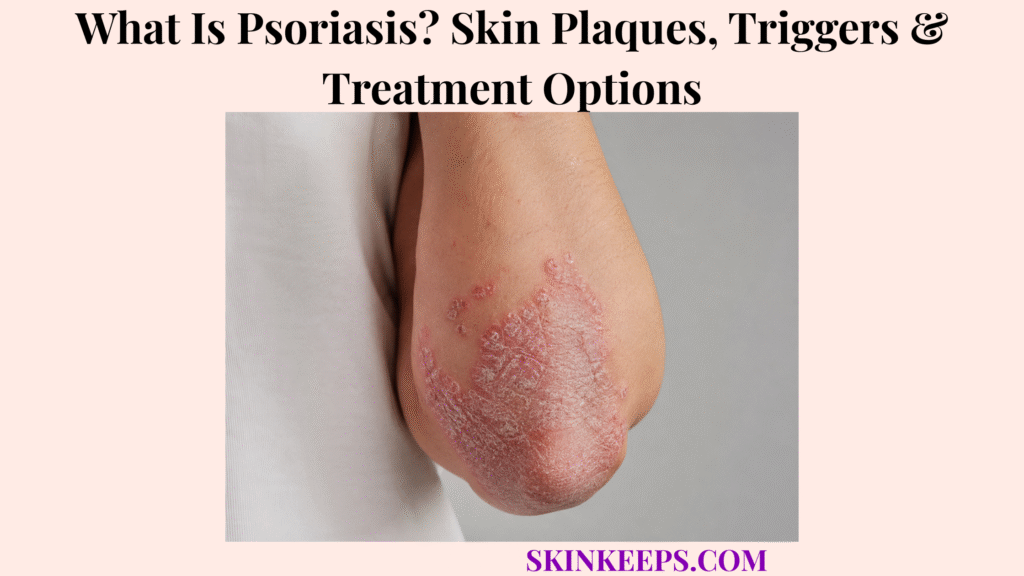
Psoriasis is an immune-driven inflammatory disease that most often produces sharply defined thickened plaques with scale, dryness and variable itching, burning or soreness.
How Does the Immune System Drive Psoriasis?
Psoriasis develops when abnormal immune activity creates inflammation and accelerates skin-cell production, causing excess cells to accumulate at the surface as plaques and scale.
The core sequence is immune dysregulation → inflammation → rapid epidermal turnover → surface accumulation → visible plaques and scaling. That is why psoriasis should not be explained as simple dryness, even though dryness, cracking and flaking can accompany active disease.
What Do Plaque Psoriasis Lesions Look and Feel Like?
Plaque psoriasis usually forms raised, thickened, scaly areas that may itch, burn, feel sore, crack or occasionally bleed.
Lesions are often sharply bordered and commonly appear on the scalp, elbows, knees and trunk, although other sites can be affected. Redness alone is not enough for recognition, because the diagnostic pattern depends more on plaque texture, scale and distribution than on one colour cue.
How Can Psoriasis Look Different Across Skin Tones?
Psoriasis inflammation does not always appear bright red, so plaque texture, scale, border definition, distribution and symptoms are often more useful than colour alone.
Colour may look pink, red, violaceous, brown or darker than surrounding skin depending on the person, and residual discoloration can remain after inflammation improves. Morphology remains the more reliable guide, especially when colour differences are subtle.
Can Psoriasis Affect the Scalp and Nails?
Yes; psoriasis can affect the scalp and nails as well as ordinary skin, with nail pitting, thickening, ridging or separation providing important clues to overall disease burden.
Scalp involvement may show dense scale along the hairline or within the scalp, while nail changes can include pitting, thickening and nail lifting. When nail findings are prominent, a dedicated nail psoriasis guide can help expand the nail-specific pattern.
Figure 1. Psoriasis recognition should start with plaque morphology: sharply defined thickened lesions with scale, common extensor or scalp distribution, and possible scalp or nail involvement are more informative than redness alone.
Which Types of Psoriasis Occur, and What Can Trigger a Flare?
Psoriasis has several clinical forms, and flares occur when an underlying immune or genetic susceptibility is activated or worsened by individual triggers such as infection, stress, skin injury or selected medicines.
How Does Plaque Psoriasis Differ From Guttate and Inverse Psoriasis?
Plaque psoriasis forms larger persistent scaly plaques, guttate psoriasis causes many smaller drop-like scaly lesions, and inverse psoriasis produces smoother inflammation within skin folds.
Plaque psoriasis is the reference form. Guttate psoriasis often presents with multiple smaller lesions and may follow streptococcal infection in susceptible people, while inverse psoriasis affects folds and may show less visible scale because of moisture and friction.
How Do Pustular and Erythrodermic Psoriasis Differ?
Pustular psoriasis produces sterile pustules with surrounding inflammation, while erythrodermic psoriasis causes severe widespread inflammation affecting most of the body and can require urgent care.
Localized pustular disease and more generalized severe pustular disease are not the same thing, and not every pustule represents infection. Erythrodermic disease is especially important because widespread inflammation may be accompanied by systemic illness and should not be treated as a routine flare.
What Causes Psoriasis, and Which Factors Can Trigger Flares?
Psoriasis reflects genetic susceptibility plus altered immune activity, while stress, infections, certain medicines, cold or dry weather, smoking and heavy alcohol use can trigger or worsen flares in some people.
The critical boundary is cause versus trigger: genetics and immune dysregulation create underlying susceptibility, whereas triggers help provoke a flare in a person who already has that tendency. Triggers vary by person, so no single trigger should be treated as universal.
How Can Skin Injury Trigger Psoriasis in a New Area?
In susceptible people, psoriasis can sometimes develop at sites of skin trauma, which is why repeated injury or scratching may contribute to new plaques.
This trauma-related pattern is commonly called the Koebner phenomenon. It does not mean every scratch creates psoriasis, but it does mean repeated rubbing, injury or irritated skin can become clinically relevant in someone with established susceptibility.
Figure 2. The key psoriasis logic is susceptibility first, flare trigger second: genetics and immune dysregulation create the underlying disease tendency, while stress, infection, trauma or other exposures may help provoke a flare in someone who already has psoriasis.
How Is Psoriasis Diagnosed and Distinguished From Similar Skin Conditions?
Psoriasis is usually diagnosed clinically from plaque morphology, distribution, scalp and nail findings, while biopsy or broader evaluation is reserved for uncertain cases or when associated disease needs assessment.
How Does a Dermatologist Diagnose Psoriasis?
A dermatologist usually diagnoses psoriasis from the medical history, skin distribution, plaque appearance and examination of the scalp and nails.
The typical sequence is history → skin examination → scalp review → nail review → pattern recognition. Biopsy is occasional rather than routine and is mainly used when another condition needs to be excluded.
What Conditions Can Be Mistaken for Psoriasis?
Eczema, seborrheic dermatitis and fungal infections can resemble psoriasis, so distribution, plaque border, scale pattern and associated findings help separate them.
Psoriasis often forms more clearly demarcated plaques than atopic dermatitis. Scalp or facial overlap can create confusion with seborrheic dermatitis. Annular or asymmetric scaly lesions may require comparison with ringworm so a fungal process is not mislabeled as psoriasis.
How Do Doctors Determine How Severe Psoriasis Is?
Psoriasis severity depends on body area, plaque characteristics, difficult locations, symptoms and quality-of-life burden—not surface area alone.
Small but strategically placed disease can still be high burden when the scalp, nails, palms, soles, genitals or other sensitive sites are involved. Itch, pain, cracking, bleeding, sleep disturbance, work impact and emotional burden also matter, so “mild-looking” surface area does not always mean mild disease.
Why Should Joint Symptoms Be Discussed During Psoriasis Evaluation?
Joint pain, stiffness, swelling, heel pain or persistent back symptoms can indicate psoriatic arthritis and should be discussed because untreated inflammatory joint disease can cause lasting damage.
This part of evaluation is a screening step, not a separate arthritis treatment guide. The goal is to notice suspicious symptoms early so skin disease is not managed in isolation when inflammatory joint involvement may also be present.
Figure 3. Psoriasis diagnosis is usually clinical, but the full path should include distribution, scalp and nail review, comparison with common mimics, severity assessment and screening for joint symptoms rather than stopping at “there is a scaly patch.”
How Is Psoriasis Treated?
Psoriasis treatment is selected according to severity, body location, symptoms, previous response and quality-of-life impact, using topical therapy, phototherapy, oral or systemic medicines or biologics as appropriate.
Which Topical Treatments Are Used for Mild or Localized Psoriasis?
Mild or localized psoriasis is often treated with topical anti-inflammatory or keratinocyte-regulating therapies, with moisturizers used as supportive skin care.
Common categories include topical corticosteroids, vitamin D-based treatments, topical retinoids, steroid-sparing options and other supportive or keratolytic measures when appropriate. Moisturizers help reduce dryness and scale, but they do not treat the immune mechanism on their own.
When Is Phototherapy Used?
Medically supervised phototherapy can be considered when psoriasis is more extensive or when appropriately selected topical therapy does not provide sufficient control.
Phototherapy should be framed as dermatologist-supervised light-based treatment rather than casual sun exposure. Its role depends on disease pattern, patient needs and how well simpler options have worked.
When Are Oral or Other Systemic Treatments Needed?
Systemic treatment becomes more appropriate when psoriasis is moderate to severe, affects difficult sites, causes substantial life impact or remains inadequately controlled with simpler approaches.
The decision is driven by severity, location, prior response, overall burden and associated disease, not by plaque count alone. Conventional immune-modifying medicines and targeted oral therapies may both be considered in selected patients.
How Do Biologic Treatments Help Moderate-to-Severe Psoriasis?
Biologic therapies target specific immune pathways involved in psoriasis and are used for selected patients whose disease severity or treatment history warrants systemic targeted therapy.
Biologics should not be described as the “best” or strongest option for everyone, because the right treatment depends on burden, site, comorbidities and prior response. Their role is to provide targeted immune intervention when appropriate, not to replace individualized treatment planning.
Figure 4. Psoriasis treatment selection should match disease burden and site: topical care commonly fits localized disease, phototherapy may help broader disease, and systemic or biologic treatment is reserved for selected patients whose severity, body sites or previous response justify escalation.
How Can Psoriasis Flares Be Controlled, and When Is Medical Reassessment Needed?
Long-term psoriasis control depends on treating active disease, recognizing personal flare patterns, protecting the skin barrier and seeking reassessment when plaques worsen, treatment fails or joint or severe systemic symptoms appear.
How Can Personal Psoriasis Triggers Be Identified and Managed?
Personal psoriasis triggers are best identified by looking for repeat patterns between flares and recent stress, illness, trauma, medicines, weather or other exposures.
The practical method is flare → review recent events → ask whether a repeat pattern exists → reduce avoidable triggers when possible. That is more useful than pretending one food or one universal trigger explains every flare.
How Does Moisturizing Help Psoriasis-Prone Skin?
Moisturizers can reduce dryness, cracking and discomfort in psoriasis-prone skin but do not treat the underlying immune disease by themselves.
Supportive skin care can make plaques feel less tight and may improve scaling or fissuring, especially when dryness compounds discomfort. If dryness is a major co-feature, a separate dry skin guide can help explain barrier support in more detail.
Why Should Scratching and Skin Trauma Be Minimized?
Repeated scratching and skin trauma can increase irritation and may provoke psoriasis in injured areas in susceptible people.
This matters because active itch and repeated rubbing can keep skin inflamed and may contribute to new plaques through a Koebner-type response. The goal is not to claim every scratch causes psoriasis, but to reduce avoidable injury that keeps the cycle active.
When Should Psoriasis Be Reassessed or Treated Urgently?
Psoriasis should be reassessed when plaques become widespread or painful, significantly disrupt daily life, resist treatment or occur with new joint symptoms, while generalized pustular or erythrodermic disease can require urgent care.
Routine reassessment is also appropriate when scalp, nail, palm, sole or genital involvement creates disproportionate burden, or when cracking, bleeding or sleep disruption becomes important. Psoriasis can often be controlled very effectively, but it should not be presented as permanently curable.
What Should You Remember About Psoriasis?
Psoriasis is a chronic immune-mediated disease that produces recurrent scaly plaques and is best managed by matching treatment to disease type, location, severity, triggers and overall life impact.
- Psoriasis is immune-mediated.
- Psoriasis is chronic.
- Psoriasis is not contagious.
- Rapid cell turnover contributes to plaques and scale.
- Plaques may itch, burn, crack or bleed.
- Scalp can be affected.
- Nails can be affected.
- Appearance varies across skin tones.
- Plaque psoriasis is the most common form.
- Guttate psoriasis produces many smaller lesions.
- Inverse psoriasis affects folds and may look smoother.
- Pustular psoriasis causes sterile pustules.
- Erythrodermic psoriasis can be urgent.
- Genetics and immune dysfunction underlie susceptibility.
- Triggers are not the same as root cause.
- Stress, infection, trauma and some medicines can trigger flares.
- Cold or dry weather, smoking and heavy alcohol use may also worsen disease in some people.
- Diagnosis is usually clinical.
- Eczema can mimic psoriasis.
- Seborrheic dermatitis can mimic psoriasis.
- Fungal infection can mimic psoriasis.
- Severity includes quality-of-life burden, not body area alone.
- Joint symptoms deserve screening.
- Topical therapy is common for localized disease.
- Phototherapy is selected for some broader disease.
- Systemic therapy is chosen by burden and response.
- Biologics target specific immune pathways.
- Moisturizing is supportive, not curative.
- Trigger management can reduce flares.
- Psoriasis is controllable but not guaranteed to be permanently curable.
Immune susceptibility → plaques and subtypes → identify triggers → confirm diagnosis and severity → choose the right treatment tier → control flares → reassess severe or joint disease.
Frequently Asked Questions About Psoriasis
The main psoriasis questions concern contagion, long-term remission, common flare triggers, the difference from eczema and possible joint involvement.
Is Psoriasis Contagious?
No; psoriasis is an immune-mediated inflammatory disease and cannot be spread through skin contact.
Can Psoriasis Go Away Completely?
Psoriasis can become very well controlled and may enter periods of clear or nearly clear skin, but current treatments are not considered a guaranteed permanent cure.
What Commonly Triggers a Psoriasis Flare?
Stress, infections, skin injury, selected medicines, cold or dry weather, smoking and heavy alcohol use can trigger flares in susceptible people, although individual patterns vary.
Is Psoriasis the Same as Eczema?
No; psoriasis and eczema are different inflammatory skin diseases, although both can produce chronic itchy or scaly patches and sometimes resemble one another.
Can Psoriasis Affect the Joints as Well as the Skin?
Yes; some people with psoriasis develop psoriatic arthritis, which can cause pain, stiffness, swelling or other inflammatory joint symptoms.
Which Sources Support This Psoriasis Guidance?
NIAMS — Psoriasis: Symptoms, Causes, & Risk Factors — Used for psoriasis definition, immune overactivity, skin-cell turnover, common locations, chronic course, symptoms and cause framing.
NIAMS — Psoriasis: Diagnosis, Treatment, and Steps to Take — Used for clinical diagnosis, biopsy context, treatment categories, moisturization support and long-term treatment expectations.
NIAMS — Psoriatic Arthritis: Symptoms, Causes, & Risk Factors — Used for joint-symptom screening context related to psoriasis.
American Academy of Dermatology — Psoriasis: Overview — Used for plaque psoriasis overview, common presentation and broad disease framing.
American Academy of Dermatology — Psoriasis: Causes — Used for genes and immune system roles, contagion boundary and common trigger categories.
American Academy of Dermatology — Psoriasis: Signs and Symptoms — Used for subtype recognition, pustular context and erythrodermic severity framing.
American Academy of Dermatology — Psoriasis: Diagnosis and Treatment — Used for topical treatment, phototherapy and systemic or biologic therapy categories.
American Academy of Dermatology — Psoriasis: Tips for Managing — Used for trigger management, skin care, minimizing irritation and supportive flare-control guidance.