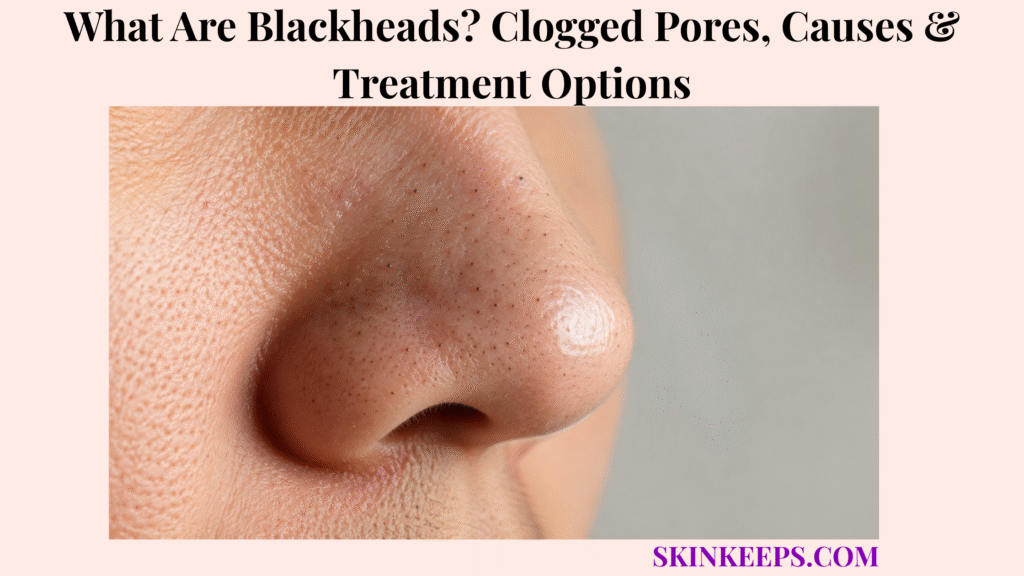
Blackheads are open comedones, meaning clogged follicle openings where oil, keratin, and dead skin cells form a plug that stays open at the skin surface.
The dark color is not dirt, and squeezing is not the treatment plan. This page explains appearance, causes, common locations, treatment options, prevention, extraction cautions, mistakes, and when to seek care.
What Are Blackheads and Why Do They Form in Clogged Pores?
Blackheads are open comedones, meaning clogged follicle openings where oil, keratin, and dead skin cell buildup remain open to the skin surface.
A follicle is a small skin opening connected to a hair follicle and oil gland. Sebum is the natural oil that helps protect the skin, while keratin and dead skin cells normally shed from the follicle lining.
When oil, keratin, and dead skin cells collect instead of clearing smoothly, they form a plug. If the plug remains open at the surface, the visible tip becomes dark and the lesion is called a blackhead.
Why Are Blackheads Called Open Comedones?
Blackheads are called open comedones because the clogged follicle opening remains open at the skin surface instead of being covered by skin.
A comedo is a plugged follicle opening. Blackheads are open comedones, while whiteheads are closed comedones where the plug is covered by skin.
Blackheads are usually non-inflammatory acne lesions. That means they often appear without pus, swelling, heat, or deep pain.
Why Are Blackheads Black if They Are Not Dirt?
Blackheads look black or dark because the open plug changes color at the surface, not because the pore is filled with dirt.
The dark visible tip can come from oxidation and pigment changes in the exposed plug. Washing harder cannot remove the follicle-plugging process, and harsh scrubbing can irritate acne-prone skin.
Blackheads are not a hygiene failure. Treatment should gently unclog follicles and help prevent new plugs instead of scraping the skin surface raw.
Practical rule: Blackheads are open comedones, not dirt, so care should focus on gentle comedone treatment rather than scrubbing or squeezing.
What Do Blackheads Look Like on Skin?
Blackheads usually look like small black, brown, gray, or dark dots, specks, or slightly raised bumps with a visible plugged opening.
They often appear in clusters on oily, acne-prone areas. Many blackheads feel slightly rough when several plugs sit close together, but they usually are not hot, swollen, pus-filled, or deeply painful.
What Does a Typical Blackhead Look and Feel Like?
A typical blackhead is a small dark plug that may look flat or slightly raised and usually is not painful, swollen, or filled with pus.
The color may look black, brown, gray, or dark. The spot may sit in a visible follicle opening, especially on the nose, chin, forehead, chest, shoulders, or back.
Typical blackheads usually behave like acne: they appear with other clogged pores or whiteheads, recur in oily areas, and improve slowly with consistent comedone care.
What Signs Suggest It Is More Than a Blackhead?
A spot may be more than a blackhead if it becomes painful, swollen, pus-filled, rapidly growing, bleeding, crusting, ulcerated, mole-like, or does not behave like acne.
A dark spot that changes like a mole, bleeds without squeezing, forms a crust, grows quickly, or appears in an unusual location should be checked. Ordinary blackheads should not be used as an explanation for every dark dot on skin.
| Feature | Typical Blackhead Clue | When to Check It |
|---|---|---|
| Color | Black, brown, gray, or dark tip | New very dark changing spot |
| Shape | Small dot or plug in a pore | Rapid growth or irregular lesion |
| Texture | Flat or slightly raised | Deep lump or cyst-like swelling |
| Pain | Usually painless | Pain, tenderness, or throbbing |
| Inflammation | Usually no swelling or pus | Pus, redness, warmth, or swelling |
| Behavior | Recurrent in oily acne-prone areas | Bleeding, crusting, ulceration, or mole-like change |
Where Do Blackheads Usually Appear?
Blackheads usually appear where oil glands are more active, especially the nose, chin, forehead, cheeks, chest, shoulders, and back.
The oily T-zone of the face can show many visible pore structures. Nose dots should not automatically be treated as blackheads because sebaceous filaments are also common there.
Hairline and forehead blackheads may be worsened by hair oils, pomades, helmets, sweat, or tight headgear. Chest, back, and shoulder blackheads may be worsened by sweat, friction, backpacks, straps, or occlusive clothing.
| Area | Why Blackheads May Form There | Treatment Caution |
|---|---|---|
| Nose | Oil-rich pores and visible filaments | Do not over-extract sebaceous filaments |
| Chin | Common comedonal acne zone | Avoid picking clustered plugs |
| Forehead | Oil, sweat, hair products, helmets | Keep hair oils and pomades away |
| Cheeks | Makeup, sunscreen, masks, friction | Use non-comedogenic products |
| Jawline | Can overlap with hormonal acne patterns | Check if inflamed or cystic |
| Chest/back | Sweat, friction, occlusive clothing | Shower after sweating; use body-safe acne products |
| Shoulders | Backpacks, straps, sweat | Reduce friction and clogged products |
What Causes Blackheads?
Blackheads form when oil, keratin, and dead skin cells build up inside a follicle and create a plug that remains open at the surface.
The cause is not poor hygiene. Blackheads happen when follicle turnover, oil production, product buildup, or acne-prone skin patterns make plugs more likely to form.
How Do Oil and Dead Skin Cells Clog Pores?
Oil and dead skin cells clog pores when sebum, keratin, and shedding skin cells collect inside the follicle instead of clearing smoothly.
Sebum helps protect the skin, but excess oil can mix with keratin and dead cells. When that mixture blocks the follicle opening, a pore plug forms.
If the plug stays open at the surface, the dark tip becomes visible as a blackhead. If the plug is covered by skin, it becomes a closed comedone or whitehead.
How Do Hormones and Oily Skin Contribute to Blackheads?
Hormones and oily skin can contribute to blackheads by increasing sebum production and making follicles easier to plug.
Puberty, androgen activity, menstrual-cycle changes, pregnancy context, and some hormonal medication patterns can affect oil production. Oily skin can make plugs recur more easily.
When inflamed pimples, nodules, cysts, or strong hormonal patterns dominate, the problem should be treated as broader acne rather than blackheads only.
How Can Skincare, Makeup, and Hair Products Worsen Clogged Pores?
Skincare, makeup, sunscreen, and hair products can worsen blackheads when heavy or comedogenic products sit on acne-prone follicles.
Oil-based makeup, thick sunscreen, heavy balms, greasy moisturizers, hair oils, and pomades can contribute, especially around the forehead, temples, hairline, cheeks, chest, and back.
Over-cleansing can irritate the barrier and make acne treatment harder to tolerate. Non-comedogenic and oil-free products are usually safer choices for acne-prone skin.
| Cause Factor | Follicle Effect | Prevention / Treatment Action |
|---|---|---|
| Excess sebum | More oil collects in follicle | Use acne-safe routine |
| Dead skin buildup | Cells block the opening | Retinoid or salicylic acid when tolerated |
| Keratin plugging | Plug becomes firm | Consistent comedone treatment |
| Hormonal oil changes | More clogged follicles | Broader acne review if inflamed or cystic |
| Heavy cosmetics | Occlusion and buildup | Use non-comedogenic products |
| Hair oils/pomades | Forehead and temple clogging | Keep oils away from acne-prone skin |
| Harsh cleansing | Barrier irritation | Clean gently and treat slowly |
Which Habits or Triggers Can Make Blackheads Worse?
Blackheads can worsen when pores stay oily, products are too heavy, skin is irritated, or treatment is stopped before new plugs are prevented.
Common triggers include heavy greasy skincare, oil-based makeup or sunscreen, hair oils touching the forehead, not removing sunscreen or makeup at night, sweaty helmets, masks, tight gear, straps, humidity, and repeated friction.
Picking, squeezing, harsh scrubs, changing products every few days, or overusing drying treatments can also make blackheads harder to control by irritating the skin barrier.
How Are Blackheads Different From Whiteheads, Sebaceous Filaments, Pimples, and Milia?
Blackheads are open comedones, while whiteheads are closed comedones; sebaceous filaments are normal oil-lined follicle structures, pimples are inflamed acne lesions, and milia are small keratin cysts.
Separating these matters because squeezing every visible pore can cause irritation and because inflamed acne, milia, and changing dark spots need different care.
How Are Blackheads Different From Whiteheads?
Blackheads are open comedones, while whiteheads are closed comedones where the plug is covered by skin.
Both are clogged-pore acne lesions, and treatment can overlap. Topical retinoids and other comedone care can help prevent new open and closed comedones.
How Are Blackheads Different From Sebaceous Filaments?
Blackheads are different from sebaceous filaments because sebaceous filaments are normal oil-lined pore structures that often appear evenly on the nose and refill quickly after extraction.
Sebaceous filaments often look like tiny gray or yellow dots that are symmetrical across the nose. Blackheads are usually darker, more plug-like, and acne-related.
Trying to permanently erase every visible pore can irritate skin. The goal is oil control and comedone prevention, not pore perfection.
How Are Blackheads Different From Inflamed Pimples?
Blackheads are usually non-inflamed, while pimples are red, swollen, tender, pus-filled, or painful acne lesions.
Benzoyl peroxide becomes more relevant when inflamed acne is also present. Painful nodules or cysts need dermatologist care because they are not simple blackheads.
How Are Blackheads Different From Milia?
Blackheads are different from milia because milia are small firm white or yellow keratin cysts, not open clogged pores with dark exposed plugs.
Milia do not usually respond like blackheads to pore-clearing acne products. Persistent milia may need professional extraction with a different technique.
| Condition | Main Clue | Open Pore? | Best Next Step |
|---|---|---|---|
| Blackhead | Dark open plug | Yes | Retinoid or salicylic acid, gentle routine |
| Whitehead | Closed skin-colored or white bump | No | Retinoid-based comedone care |
| Sebaceous filament | Even tiny gray/yellow dots, often on nose | Normal oil-lined structure | Oil control, avoid over-extraction |
| Pimple | Red, swollen, pus-filled, or tender lesion | Variable | Add anti-inflammatory acne treatment |
| Milia | Firm white/yellow cyst-like bump | No | Dermatology extraction if persistent |
| Enlarged pore | Visible opening without firm plug | Open structure | Oil control and realistic pore expectations |
How Are Blackheads Diagnosed or Checked?
Blackheads are usually recognized by appearance, location, and acne pattern, but persistent, painful, bleeding, changing, or unusual dark lesions should be checked to rule out other skin conditions.
A clinician looks at whether the spots are open comedones, where they appear, whether whiteheads or inflamed acne are present, and whether squeezing or picking has caused dark marks or scars.
What Does a Dermatologist Check With Blackheads?
A dermatologist checks blackheads by looking at the number, distribution, open and closed comedones, inflamed lesions, scarring, dark marks, product routine, and extraction history.
The visit may include questions about makeup, sunscreen, moisturizers, hair oils, pomades, medications, menstrual or hormonal patterns, pregnancy context, picking habits, and how long treatments were used.
When Might a Dark Spot Not Be a Blackhead?
A dark spot may not be a blackhead if it grows, changes, bleeds without squeezing, hurts, ulcerates, looks mole-like, appears in an unusual area, or does not behave like a comedone.
A changing mole-like dark lesion should be checked under a melanoma safety lens rather than treated as a clogged pore.
A spot that persists despite consistent acne treatment, forms a deep lump, or repeatedly crusts should also be reviewed.
What Treatment Options Help Blackheads?
Blackhead treatment usually focuses on keeping follicles from plugging again, using ingredients such as salicylic acid, topical retinoids, benzoyl peroxide when inflamed acne is also present, azelaic acid, and dermatologist procedures when needed.
Treatment is usually measured in weeks, not days. The goal is not only to empty the visible plug, but to reduce new open comedones from forming.
How Does Salicylic Acid Help Blackheads?
Salicylic acid helps blackheads by loosening clogged follicle material and supporting gentle chemical exfoliation inside acne-prone pores.
Salicylic acid is a beta-hydroxy acid. It can help blackheads and whiteheads when used consistently and gradually.
Overusing it can cause dryness, peeling, stinging, or barrier irritation. It works best as part of a steady routine, not aggressive scrubbing.
How Do Topical Retinoids Help Blackheads?
Topical retinoids help blackheads by normalizing follicle cell turnover, unclogging pores, and preventing new comedones from forming.
Retinoid options include adapalene, tretinoin, tazarotene, and trifarotene depending on country, prescription access, age, skin tolerance, and clinician guidance.
Start slowly because irritation is common. People who are pregnant, trying to conceive, or breastfeeding should ask a clinician before using retinoids.
When Does Benzoyl Peroxide Help Blackheads?
Benzoyl peroxide helps most when blackheads occur with inflamed acne, pimples, or bacteria-driven breakouts rather than isolated open comedones only.
Benzoyl peroxide can reduce acne-causing bacteria and inflammation, but it can also dry or irritate skin and may bleach towels, pillowcases, clothing, or hairline fabrics.
It is often paired with retinoid-based acne plans when acne includes both comedones and inflamed lesions.
When Are Professional Extractions or Procedures Used?
Professional extraction or procedures may be used for stubborn blackheads, macrocomedones, or comedones that do not clear with consistent topical treatment.
Extraction uses trained technique and sterile tools. It can temporarily improve visible plugs, but it does not prevent new blackheads by itself.
Poorly done extraction can cause broken skin, infection, dark marks, or scars. Some persistent comedonal acne may need dermatologist-guided topical treatment, chemical peels, or other procedures.
| Treatment Option | Best-Fit Use | Goal | Key Caution |
|---|---|---|---|
| Salicylic acid | Mild blackheads and oily pores | Loosen plugs and reduce clogging | Irritation if overused |
| Topical retinoid | Recurrent blackheads and whiteheads | Prevent new comedones | Start slowly; pregnancy caution |
| Benzoyl peroxide | Blackheads plus inflamed pimples | Reduce bacteria and inflammation | Bleaching, dryness, irritation |
| Azelaic acid | Acne-prone skin and dark-mark tendency | Acne support and discoloration support | Slower results |
| Professional extraction | Stubborn comedones | Remove plugs safely | Temporary; scarring risk if poorly done |
| Chemical peel/procedure | Selected persistent comedonal acne | Reduce comedones under supervision | Dermatologist-guided |
| Oral/systemic acne care | Broader acne with inflammation or hormonal signs | Treat beyond blackheads | Not blackhead-only first-line |
How Should a Daily Routine Prevent Blackheads From Coming Back?
Preventing blackheads requires a consistent non-comedogenic routine that clears oil and dead cells without damaging the skin barrier.
Cleanse gently once or twice daily. Remove sunscreen and makeup at night. Use non-comedogenic moisturizer and sunscreen, and keep heavy hair oils away from the forehead and temples.
Add salicylic acid or a retinoid slowly if tolerated. Introduce one active ingredient at a time, clean sweaty skin after exercise, and wash pillowcases, helmets, masks, and headgear regularly when acne-prone.
Should You Squeeze or Extract Blackheads at Home?
Squeezing blackheads at home may look satisfying, but it can irritate skin, push inflammation deeper, cause broken skin, leave dark marks, or create scars.
Do not squeeze with fingernails, force deep plugs, use dirty tools, or extract inflamed pimples. Steam does not permanently open pores, and pore strips remove some surface material temporarily without preventing new plugs.
Stubborn comedones are safer to treat with consistent topical care and professional extraction when needed. The long-term plan still has to prevent new follicle plugs.
| Home Action | Risk | Safer Alternative |
|---|---|---|
| Fingernail squeezing | Skin tears, dark marks, infection | Use comedone treatment |
| Forceful extraction | Scars and deeper inflammation | Dermatologist extraction if stubborn |
| Dirty tools | Infection risk | Avoid non-sterile tools |
| Extracting painful pimples | More inflammation and scarring | Treat inflammatory acne |
| Pore strips only | Temporary surface clearing | Add prevention routine |
| Scrub after extraction | Barrier damage | Gentle cleanser and moisturizer |
What Blackhead Treatment Mistakes Should You Avoid?
The biggest blackhead mistake is trying to scrub or squeeze the dark color away instead of treating the clogged follicle process.
Do not stack salicylic acid, retinoid, benzoyl peroxide, scrubs, and acids all at once. Do not stop treatment after one week, and do not use pore strips as the whole plan.
Heavy oils can worsen clogging in acne-prone skin. Skipping moisturizer can also backfire because dry, irritated skin often tolerates acne treatment poorly.
| Mistake | Why It Fails | Better Action |
|---|---|---|
| Scrubbing hard | Irritates skin and does not fix plugs | Use chemical comedone care |
| Squeezing daily | Marks, infection, and scarring risk | Treat and use professional extraction if needed |
| Stacking actives | Barrier damage and irritation | Add one active slowly |
| Stopping early | Comedone treatment needs weeks | Use a consistent plan |
| Pore strips only | Temporary surface clearing | Prevent new clogs |
| Heavy oils | Can worsen clogging in acne-prone skin | Use non-comedogenic products |
| No moisturizer | Irritation reduces treatment tolerance | Use lightweight non-comedogenic moisturizer |
When Should Blackheads Be Checked by a Dermatologist?
Blackheads should be checked by a dermatologist when they are widespread, recurrent, painful, scarring, mixed with inflamed acne, not improving after consistent over-the-counter treatment, or causing distress.
Many blackhead treatments need about six to eight weeks of consistent use before results can be judged. A broader eight-to-twelve-week window may be used in some acne plans, but worsening, scarring, or unusual lesions should not wait.
Which Blackhead or Acne Signs Need Medical Review?
Medical review is helpful when blackheads do not improve after consistent treatment, or when acne becomes painful, cystic, scarring, sudden, medication-related, hormone-linked, or unusual.
Seek care for painful pimples, nodules, cysts, acne scars, repeated post-inflammatory dark marks, sudden severe acne, acne after starting a medication, acne with irregular periods or excess hair growth in females, or blackhead-like lesions in unusual places.
A dark spot that is changing, bleeding, crusting, ulcerated, or mole-like should be checked as a skin-lesion concern rather than treated as acne.
What Should You Bring to a Blackhead Appointment?
A useful blackhead appointment starts with photos, product list, active ingredients, treatment timeline, makeup and hair-product history, picking habits, medication history, and any scarring or dark marks.
Bring the names of cleansers, moisturizers, sunscreens, makeup, hair oils, pomades, salicylic acid products, retinoids, benzoyl peroxide products, peels, scrubs, masks, pore strips, and any prescriptions tried.
Seek dermatologist care if:
What Should You Remember About Blackheads?
The most important thing to remember about blackheads is that they are open clogged pores, not dirt, so treatment should unclog follicles gently and prevent new plugs from forming.
Forceful squeezing may clear a visible plug briefly, but it does not control the follicle process that creates new blackheads.
Frequently Asked Questions About Blackheads
Are blackheads dirt stuck in pores?
No. Blackheads are open comedones, and the dark color is not dirt. Scrubbing harder can irritate skin and worsen acne.
What causes blackheads?
Blackheads form when follicles clog with oil, keratin, and dead skin cell buildup. Hormones, oily skin, comedogenic products, heavy makeup, hair oils, sweat, friction, and inconsistent treatment can contribute.
Are blackheads the same as whiteheads?
No. Blackheads are open comedones, while whiteheads are closed comedones where the follicle plug is covered by skin.
What is the best treatment for blackheads?
There is no one best treatment for every person. Salicylic acid and topical retinoids are common pore-unclogging options; benzoyl peroxide may help when inflammatory acne is also present.
Can I squeeze blackheads?
Forceful squeezing is not recommended. Professional extraction can help stubborn comedones, but squeezing at home can irritate skin and may cause infection, dark marks, or scarring.
Do pore strips remove blackheads permanently?
No. Pore strips may remove some surface material temporarily, but they do not correct the follicle-plugging process that creates new blackheads.
How long does blackhead treatment take?
Treatment usually needs weeks of consistent use, not days. Acne treatment is commonly given about six to eight weeks before judging whether it is helping.
When should blackheads need dermatologist care?
Dermatologist care is helpful for widespread blackheads, scarring, painful acne, cysts, dark marks, no improvement after consistent treatment, acne causing distress, or any blackhead-like spot that is changing, bleeding, crusting, or unusual.
Sources & Evidence About Blackheads
DermNet — Comedonal Acne was used for open and closed comedone framing, blackheads being dark because of surface pigment rather than dirt, forehead and chin distribution, sebaceous duct cell proliferation, increased sebum, and follicle plugging.
Cleveland Clinic — Comedonal Acne was used for comedones as clogged pores or follicles filled with sebum and skin cells, open versus closed comedones, small dark spots, causes, risk factors, and treatment categories.
Cleveland Clinic — Blackheads was used for blackheads as open comedones, milder acne form, dark open bumps, causes including sebum and keratin, and non-contagious framing.
Mayo Clinic — Acne Symptoms and Causes was used for acne occurring when hair follicles become plugged with oil and dead skin cells, producing blackheads, whiteheads, and pimples.
American Academy of Dermatology — How to Treat Different Types of Acne was used for black dots not being dirt, retinoids to unclog pores for blackheads and whiteheads, benzoyl peroxide wash context, six-to-eight-week timing, and comedo extraction for stubborn lesions.
American Academy of Dermatology — Acne Diagnosis and Treatment was used for dermatologist diagnosis by breakout type and location, retinoids for blackheads and whiteheads, and the 6–8 week treatment expectation.
American Academy of Dermatology — Acne Clinical Guideline was used for evidence-based acne therapy categories including benzoyl peroxide, topical retinoids, salicylic acid, and azelaic acid.
Educational Disclaimer: This SkinKeeps article is for educational purposes only and does not diagnose or replace medical care. Painful acne, cysts, nodules, scarring, spreading inflammation, sudden severe acne, medication-related acne, acne with hormonal symptoms, or any dark spot that is changing, bleeding, crusting, ulcerated, or unusual should be checked by a qualified healthcare professional or dermatologist.