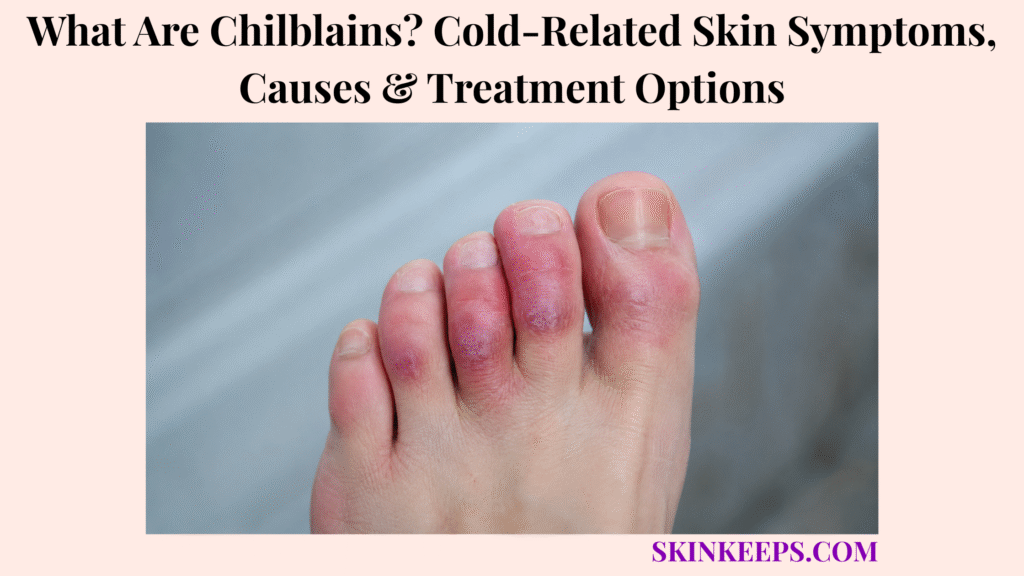
Chilblains are inflamed, itchy, painful, or swollen skin patches that appear after exposure to cold, especially cold and damp conditions.
They are not the same as frostbite, and they should not be rapidly heated or scratched open. This page covers symptoms, body sites, causes, diagnosis, treatment, prevention, recurrence, mistakes, and doctor-review signs when lesions are persistent, ulcerated, infected-looking, recurrent, or high-risk.
What Are Chilblains and Why Do They Happen After Cold Exposure?
Chilblains are inflamed, itchy, painful, or swollen skin patches that appear after exposure to cold, especially cold and damp conditions, because small blood vessels react abnormally during cooling and rewarming.
The reaction usually affects acral skin, meaning cold-exposed outer areas such as toes, fingers, heels, ears, and nose.
Cold can narrow small blood vessels. During rewarming, an exaggerated inflammatory response can lead to swelling, itching, burning, pain, and color change.
Why Are Chilblains Also Called Pernio?
Chilblains are also called pernio or perniosis, which are medical names for cold-related inflammatory skin lesions.
The terms describe the same general cold-triggered pattern: itchy, tender, swollen patches or bumps after cold exposure, especially cold and damp exposure.
Chilblains are not frostbite. Frostbite involves freezing injury to skin and tissue, while chilblains are inflammatory lesions after non-freezing cold exposure.
Why Do Cold and Damp Conditions Trigger Symptoms?
Cold and damp conditions can trigger chilblains when small blood vessels narrow in the cold and then inflame during rewarming.
In susceptible skin, rewarming may cause inflammation and leakage of fluid or blood into nearby tissue. That leakage can contribute to swelling, itching, tenderness, and burning.
Symptoms may appear hours after cold exposure, so the connection is not always obvious at first.
Practical rule: Chilblain care is built around cold avoidance, dry protection, gradual warming, and medical review when lesions persist, recur, ulcerate, or look infected.
What Chilblain Symptoms Appear on Skin?
Chilblains can cause itchy, painful, swollen, tender, burning, red, purple, blue, brown, or darker skin patches, sometimes with blisters, cracks, or sores.
The color can look different across skin tones. On lighter skin, lesions may look red, pink, purple, or bluish. On brown or black skin, they may look purple-brown, grayish, blue-brown, darker, swollen, or more textured than nearby skin.
What Do Mild Chilblains Look and Feel Like?
Mild chilblains often feel itchy, burning, tender, or painful and may look swollen, red, purple, blue, brown, or darker after cold exposure.
Small bumps or patches may appear on toes, fingers, heels, feet, hands, ears, or nose.
Symptoms may sting during rewarming and may feel worse if the area is scratched, rubbed by shoes, or exposed again to cold and damp conditions.
What Do Severe Chilblains Look Like?
Severe chilblains can blister, crack, ulcerate, scab, become raw, hurt persistently, heal slowly, or leave thinner skin after repeated episodes.
Broken skin raises the risk of secondary infection, especially when the area is scratched, wet, tightly covered, or poorly protected.
Repeated cold and damp exposure can prolong irritation, delay healing, and leave the area more vulnerable during the next cold season.
What Signs Suggest Infection or Another Problem?
Infection or another problem is more likely when chilblain-like lesions develop pus, bad smell, fever, spreading warmth, worsening swelling, increasing pain, black tissue, numbness, or a non-healing ulcer.
Ordinary chilblains are not bacterial infection by default. Antibiotics are not routine unless bacterial infection is suspected or diagnosed.
Black tissue, dead-looking skin, reduced sensation, severe pain, or a non-healing sore needs urgent assessment because circulation or tissue injury may be involved.
| Symptom | What User May Notice | Why It Matters |
|---|---|---|
| Itch / burning | Worse after cold exposure. | Typical chilblain clue. |
| Swelling | Puffy toes, fingers, ears, or nose. | Inflammatory response. |
| Purple/blue/dark color | More visible after cold or rewarming. | Small-vessel involvement. |
| Tender bumps | Painful raised areas. | Common pernio pattern. |
| Blisters | Fluid-filled areas. | More severe barrier damage. |
| Ulcers/open sores | Broken skin. | Infection/scarring risk. |
| Fever/pus/odor | Systemic or bacterial concern. | Medical review needed. |
| Black tissue/numbness | Possible tissue or circulation problem. | Urgent care. |
Where Do Chilblains Usually Appear?
Chilblains usually appear on cold-exposed areas such as toes, fingers, heels, feet, hands, ears, nose, and sometimes the lower legs or other exposed skin.
They can also appear over pressure areas where tight shoes, damp socks, tight gloves, or poor insulation keep skin cold and poorly warmed.
Location helps raise suspicion, but location alone does not diagnose chilblains. Cold-related, infectious, vascular, allergic, autoimmune, and pressure-related problems can overlap.
| Area | Common Trigger | Safety Note |
|---|---|---|
| Toes | Cold floors, wet socks, tight shoes. | Check ulcers, numbness, diabetes risk. |
| Fingers | Cold air, damp gloves, rapid rewarming. | Watch Raynaud’s pattern. |
| Heels / feet | Damp footwear and pressure. | Use dry roomy insulated footwear. |
| Hands | Cold exposure and poor glove protection. | Prevent before exposure. |
| Ears | Cold wind exposure. | Cover in cold weather. |
| Nose | Cold wind exposure. | Protect exposed skin. |
| Lower legs | Cold exposure or vascular risk context. | Review if persistent or atypical. |
| Pressure points | Tight footwear/gloves. | Avoid circulation restriction. |
What Causes Chilblains?
Chilblains are caused by an abnormal inflammatory response of small blood vessels after cold exposure, especially when the skin is rewarmed too quickly or repeatedly exposed to cold and damp conditions.
The main driver is cold-related vascular inflammation, not infection by default.
How Do Small Blood Vessels Create Chilblains?
Small blood vessels create chilblains when cold narrows them and rewarming triggers an inflamed response that causes swelling, itch, and pain.
Cold can reduce blood flow in small vessels. Rewarming increases blood flow again, but in susceptible people the response can become inflamed.
This can allow fluid or blood to leak into surrounding tissue, causing swelling, tenderness, itch, burning, and visible color change. This is not the same as a blood clot.
Why Can Rapid Heating Make Chilblains Worse?
Rapid heating can make chilblains worse because cold skin may react poorly when it is warmed too suddenly with hot water, direct heat, or a heater.
Avoid putting cold feet or hands straight into hot water, against a heater, near a fire, or under a hot-water bottle.
Warm gradually with dry socks, gloves, layered clothing, blankets, and room-temperature warming.
Are Chilblains Caused by Infection?
Chilblains are not primarily caused by infection, but scratching, blisters, cracks, or ulcers can allow secondary infection.
Broken skin should be protected, kept clean, and monitored for pus, odor, spreading warmth, swelling, fever, or worsening pain.
Pus, fever, red streaking, or spreading warmth can suggest bacterial infection and should shift the plan from routine chilblain care to medical review.
| Cause Factor | Skin Effect | Practical Action |
|---|---|---|
| Cold exposure | Small-vessel constriction. | Keep warm before exposure. |
| Damp socks/shoes | Prolonged cooling. | Keep feet dry. |
| Rapid heating | Inflammatory rebound. | Warm gradually. |
| Tight footwear/gloves | Pressure and poorer circulation. | Use roomy insulated footwear/gloves. |
| Repeated cold exposure | Longer irritation and recurrence. | Plan prevention. |
| Broken skin | Infection entry. | Cover and monitor. |
| Poor circulation | Reduced skin recovery. | Lower threshold for care. |
| Autoimmune tendency | Secondary chilblain pattern possible. | Medical evaluation if recurrent/atypical. |
Who Is More Likely to Get Chilblains?
Chilblains are more likely in people exposed to cold and damp conditions, especially if they have poor circulation, Raynaud’s-type symptoms, low body weight, smoking or nicotine exposure, tight footwear, or certain autoimmune or vascular conditions.
Older adults with new chilblain-like lesions should be reviewed because simple primary chilblains are less typical in later life.
How Are Chilblains Different From Other Cold or Skin Conditions?
Chilblains can resemble frostbite, Raynaud’s phenomenon, cold urticaria, eczema, cellulitis, vasculitis, acrocyanosis, and chilblain lupus, so timing, symptoms, distribution, and persistence matter.
Every winter toe rash is not automatically chilblains. Persistent, ulcerated, infected-looking, black, numb, elderly-onset, autoimmune-pattern, or circulation-risk lesions need a broader diagnosis.
How Are Chilblains Different From Frostbite?
Chilblains are inflammatory patches after cold exposure, while frostbite is freezing injury to skin and tissue.
Frostbite may cause numbness, hard or waxy skin, white or gray skin, blisters after rewarming, or tissue damage.
Suspected frostbite needs urgent care, not routine chilblain self-care.
How Are Chilblains Different From Raynaud’s Phenomenon?
Raynaud’s phenomenon causes episodic color changes triggered by cold or stress, while chilblains cause persistent itchy or painful inflamed patches after cold exposure.
Raynaud’s often causes attacks of white, blue, then red color change. Chilblains usually last longer as swollen, itchy, painful, inflamed patches or bumps.
Raynaud’s can coexist with chilblains, and secondary Raynaud’s or connective tissue disease signs need evaluation.
How Are Chilblains Different From Cellulitis or Infection?
Chilblains are cold-triggered inflammatory lesions, while cellulitis is a bacterial infection that causes spreading warmth, swelling, pain, and sometimes fever.
Pus, fever, rapid spread, worsening warmth, or increasing swelling can suggest cellulitis or another infection rather than uncomplicated chilblains.
Broken chilblains can become infected, but chilblains themselves are not infection by default.
How Are Chilblains Different From Eczema or Contact Dermatitis?
Chilblains follow cold exposure, while eczema and contact dermatitis follow barrier sensitivity, dryness, irritants, allergens, or product exposure patterns.
Dermatitis/eczema may recur with dryness and itching even without cold exposure.
Allergic contact dermatitis may follow shoe materials, sock dyes, adhesives, topical products, rubber, leather treatments, or glove materials.
How Are Chilblains Different From Chilblain Lupus?
Chilblain lupus can look like ordinary chilblains, but it is linked to lupus and is more concerning when lesions are persistent, recurrent, ulcerated, atypical, or associated with systemic symptoms.
Lupus erythematosus may need consideration when chilblain-like lesions persist, recur outside typical cold exposure, ulcerate, or appear with systemic symptoms.
Do not diagnose lupus from toe lesions alone. Dermatology or rheumatology review may be needed when the pattern is atypical.
| Condition | Main Clue | Trigger / Timing | Safer Next Step |
|---|---|---|---|
| Chilblains | Itchy/painful swollen cold-related patches. | Hours after cold/damp exposure. | Gradual warming + prevention. |
| Frostbite | Numb, hard/waxy, freezing injury. | Extreme cold/freezing. | Urgent care. |
| Raynaud’s | Episodic white/blue/red color change. | Cold or stress attacks. | Evaluate if severe/secondary signs. |
| Cold urticaria | Hives after cold exposure. | Minutes after cold contact. | Allergy/urticaria evaluation. |
| Cellulitis | Spreading hot painful infection. | May follow skin break. | Antibiotic evaluation. |
| Acrocyanosis | Persistent bluish discoloration, often cold-related. | Cold/vascular tone. | Circulation evaluation if concerning. |
| Chilblain lupus | Persistent/recurrent chilblain-like lesions. | Cold plus autoimmune context. | Dermatology/rheumatology review. |
Some chilblain-like lesions can blister, so the cause of blisters matters before choosing treatment.
How Are Chilblains Diagnosed or Checked?
Chilblains are usually diagnosed from the skin appearance, cold-exposure history, timing of symptoms, and exclusion of other conditions.
A clinician may look at the affected skin, ask about recent cold or damp exposure, review timing, and check whether symptoms match pernio or another condition.
What Does a Clinician Check With Chilblains?
A clinician checks chilblains by reviewing recent cold or damp exposure, symptom timing, body sites, itch, pain, swelling, blisters, ulcers, infection signs, Raynaud’s symptoms, and circulation or autoimmune risk.
The visit may include questions about wet socks, tight footwear, cold floors, cold wind, rapid rewarming, smoking or nicotine exposure, medicines, diabetes, circulation disease, immune suppression, and autoimmune symptoms.
Photos can help show how the color, swelling, blisters, ulcers, or scabs changed over time.
When Might Tests or Biopsy Be Needed?
Tests or biopsy may be needed when chilblain-like lesions are persistent, recurrent, severe, ulcerated, elderly-onset, atypical, systemic, or suspicious for lupus, vasculitis, poor circulation, infection, or another diagnosis.
Testing may include selected blood work, circulation assessment, infection testing, autoimmune evaluation, or biopsy when the diagnosis is unclear.
The goal is not to test every mild winter flare; it is to avoid missing secondary chilblains, chilblain lupus, vascular disease, infection, vasculitis, or tissue injury.
What Treatment Options Help Chilblains Heal?
Chilblain treatment focuses on keeping the skin warm and dry, avoiding rapid heating, protecting broken skin, reducing itch or inflammation, and using medication only when symptoms are severe, recurrent, or not improving.
Many cases improve within about two to three weeks when further cold exposure is avoided, but that timing is not a safety guarantee for ulcers, infection signs, black tissue, numbness, diabetes, poor circulation, or severe pain.
How Should Mild Chilblains Be Treated at Home?
Mild chilblains are usually managed by keeping the affected areas warm and dry, warming gradually, avoiding scratching, and protecting the skin from further cold and damp exposure.
Use warm socks, gloves, layered clothing, and dry footwear. Change damp socks quickly and keep feet dry.
Gentle moisturizer may help if skin is dry or cracked. Blisters or open areas should be protected with clean dressings and checked if they worsen.
When Are Creams or Medicines Used for Chilblains?
Creams or medicines may be used when chilblains are very itchy, painful, recurrent, severe, or not improving with warming and prevention.
Topical corticosteroids may be used in selected cases for itch or inflammation when a clinician confirms the diagnosis.
Nifedipine or other vasodilator approaches may be considered for severe or recurrent cases under clinician guidance. Antibiotics are used only if secondary bacterial infection develops.
How Should Broken or Ulcerated Chilblains Be Treated?
Broken or ulcerated chilblains should be kept clean, covered, protected from scratching and pressure, and checked for infection, circulation problems, diabetes risk, or autoimmune causes.
Avoid scratching, picking, hot water, direct heat, harsh acids, alcohol, or strong irritants on broken skin.
Seek medical review for ulcers, pus, spreading color change, bad smell, fever, severe pain, numbness, black tissue, or poor healing.
| Chilblain Situation | First Treatment Direction | Key Caution |
|---|---|---|
| Mild itchy patches | Warm/dry protection and cold avoidance. | Avoid direct heat. |
| Painful swollen lesions | Gradual warming + symptom care. | Review if persistent. |
| Blisters | Protect skin roof. | Do not pop or pick. |
| Ulcers/open sores | Clean cover + medical review. | Infection/circulation risk. |
| Recurrent/severe lesions | Clinician review + possible medicine. | Check underlying causes. |
| Elderly-onset/atypical lesions | Investigation for secondary cause. | Do not assume simple pernio. |
How Can Chilblains Be Prevented?
Chilblain prevention depends on keeping the whole body warm, keeping hands and feet dry, avoiding tight footwear, and warming cold skin gradually.
Prevention should start before cold exposure, not after lesions appear.
How Should Recurrent or Persistent Chilblains Be Managed?
Recurrent or persistent chilblains should be reviewed because repeated cold lesions can signal ongoing cold exposure, poor circulation, Raynaud’s, medication effects, autoimmune disease, or another diagnosis.
Track seasonality, cold exposure, damp footwear, tight shoes, recurrence at the same sites, symptoms without cold exposure, ulcers, blisters, scarring, and thin skin.
Lesions lasting more than two to three weeks, new lesions in older adults, Raynaud’s-type attacks, systemic symptoms, black tissue, numbness, or ulcers should shift the plan toward medical evaluation.
| Pattern | Why It Matters | Next Step |
|---|---|---|
| Every winter only | Cold exposure pattern. | Prevention plan. |
| Lasts more than 2–3 weeks | Not simple self-limited case. | Medical review. |
| Ulcers or scarring | Complicated disease. | Evaluate infection/circulation. |
| No cold trigger | Atypical pattern. | Broaden diagnosis. |
| Older adult new onset | Secondary cause concern. | Clinician evaluation. |
| Raynaud’s/systemic signs | Connective tissue concern. | Specialist review. |
| Black tissue/numbness | Circulation or tissue injury concern. | Urgent care. |
What Chilblain Mistakes Should You Avoid?
The biggest chilblain mistake is rapidly heating cold skin with hot water, direct heaters, fires, or intense heat, because sudden rewarming can worsen the small-vessel reaction.
Do not put cold toes or fingers straight into hot water, against a heater, near a fire, or under a hot-water bottle.
Do not scratch itchy lesions, pop blisters, keep wearing damp socks or tight shoes, ignore ulcers, or use steroid or antibiotic creams repeatedly without diagnosis.
| Mistake | Why It Fails | Better Action |
|---|---|---|
| Rapid heating | Can worsen vessel reaction. | Warm gradually. |
| Hot water/direct heater | Irritates cold-reactive skin. | Use socks, gloves, layers, room-temperature warming. |
| Scratching | Breaks skin and increases infection risk. | Soothe and protect. |
| Popping blisters | Opens skin barrier. | Protect blister roof. |
| Tight wet shoes | Prolongs cold, moisture, and pressure. | Dry roomy footwear. |
| Ignoring ulcers | Infection/circulation concern. | Medical review. |
| Assuming all winter toe spots are chilblains | Mimics exist. | Check persistent/atypical cases. |
| Random repeated creams | Can delay correct diagnosis. | Confirm cause if recurrent or severe. |
When Should Chilblains Be Checked by a Doctor?
Chilblains should be checked by a clinician when symptoms last more than two to three weeks, keep recurring, become blistered or ulcerated, look infected, are very painful, occur without clear cold exposure, or happen in someone with diabetes, poor circulation, immune suppression, or autoimmune symptoms.
Medical review is also important for new chilblain-like lesions in an older adult or when Raynaud’s-type color attacks are present.
Which Chilblain Signs Need Medical Review?
Medical review is needed when chilblains last more than two to three weeks, recur frequently, become severely painful, blister, ulcerate, ooze pus, smell bad, spread, cause fever, turn black, or cause numbness.
Spreading red, purple, brown, or darker color change, red streaking, reduced sensation, or dead-looking tissue should not be managed as routine chilblains.
Lesions without clear cold exposure, summer-season lesions, or persistent ulcerated lesions need a broader diagnostic check.
Which People Should Be More Cautious With Chilblains?
People with diabetes, poor circulation, peripheral artery disease, Raynaud’s symptoms, lupus or autoimmune symptoms, immune suppression, neuropathy, foot ulcers, or older-adult new lesions should be more cautious with chilblains.
Smokers or people using nicotine with circulation symptoms should use a lower threshold for care when lesions are painful, ulcerated, infected-looking, black, numb, or persistent.
Seek medical review if chilblains involve:
What Should You Remember About Chilblains?
The most important thing to remember about chilblains is that they are cold-related inflammatory skin patches, so safe care depends on preventing cold-damp exposure, warming skin gradually, protecting the barrier, and checking persistent or complicated lesions.
They are usually not frostbite, not infection by default, and not always harmless when lesions recur, ulcerate, persist, or appear in high-risk patients.
Frequently Asked Questions About Chilblains
Are chilblains the same as frostbite?
No. Chilblains are inflammatory cold-related skin lesions, while frostbite is freezing injury to skin and tissue. Suspected frostbite needs urgent care.
What do chilblains look like?
They may look like itchy, painful, swollen, red, purple, blue, brown, or darker patches or bumps, usually after cold exposure. Blisters, cracks, or ulcers can occur in more severe cases.
What causes chilblains?
Cold exposure narrows small blood vessels, and rewarming can trigger inflammation and leakage into surrounding tissue, especially after cold and damp exposure.
How long do chilblains last?
Many cases improve within about two to three weeks if further cold exposure is avoided, but persistent, worsening, ulcerated, infected-looking, or high-risk cases need medical review.
What is the best treatment for chilblains?
There is no one best treatment for every case. Mild cases focus on keeping warm and dry, gradual warming, avoiding cold and damp exposure, protecting broken skin, and avoiding scratching. Severe, recurrent, or persistent cases may need clinician-directed medicines.
Can chilblains get infected?
Yes, especially if blisters, cracks, scratching, or ulcers break the skin. Pus, spreading warmth, worsening pain, bad smell, red streaking, or fever should be checked.
Why should rapid heating be avoided with chilblains?
Sudden heating with hot water, direct heaters, fires, or hot-water bottles can worsen the blood-vessel reaction. Cold skin should be warmed gradually.
When should chilblains need medical care?
Medical care is needed for symptoms lasting more than 2–3 weeks, recurrence, ulcers, infection signs, severe pain, black tissue, reduced sensation, diabetes, poor circulation, Raynaud’s symptoms, autoimmune symptoms, or new chilblains in an older adult.
Sources & Evidence About Chilblains
NHS — Chilblains was used for symptoms, cold exposure link, 2–3 week improvement expectation, prevention advice, and when to seek medical care.
NHS Inform — Chilblains was used for cold-vessel narrowing, rewarming mechanism, rapid-heating caution, prevention steps, and nifedipine context.
DermNet — Chilblains was used for pernio/perniosis terminology, acral cold-exposed lesions, pathophysiology, risk factors, differential diagnosis, elderly-onset caution, and treatment overview.
Mayo Clinic — Chilblains Symptoms and Causes was used for symptoms after cold exposure, swelling and blistering on hands and feet, Raynaud’s/connective tissue associations, and repeated-exposure complications such as scarring or thin skin.
Mayo Clinic — Chilblains Diagnosis and Treatment was used for diagnosis by skin exam and recent cold-exposure history, possible biopsy, nifedipine in selected nonresponsive cases, and lifestyle/prevention measures.
Cleveland Clinic — Chilblains / Pernio was used for common sites, causes, treatment overview, prevention, and provider-review triggers when symptoms persist after 2–3 weeks.
StatPearls / NCBI Bookshelf — Pernio was used for evaluation and management of pernio, prevention-focused care, secondary-cause consideration, infection monitoring after skin breakdown, and clinician-directed medication context.
DermNet — Chilblain Lupus Erythematosus was used for differential support separating ordinary pernio from chilblain lupus and other cold-related mimics.
Educational Disclaimer: This SkinKeeps article is for educational purposes only and does not diagnose or replace medical care. Persistent, recurrent, blistering, ulcerated, pus-filled, bad-smelling, fever-associated, black, numb, severely painful, spreading, non-healing, elderly-onset, diabetes-related, poor-circulation, immune-risk, Raynaud’s-associated, autoimmune-pattern, or unclear chilblain-like lesions should be checked by a qualified healthcare professional. Do not rapidly heat cold affected skin with hot water, direct heaters, fires, or hot-water bottles, and do not scratch or pop blisters.