
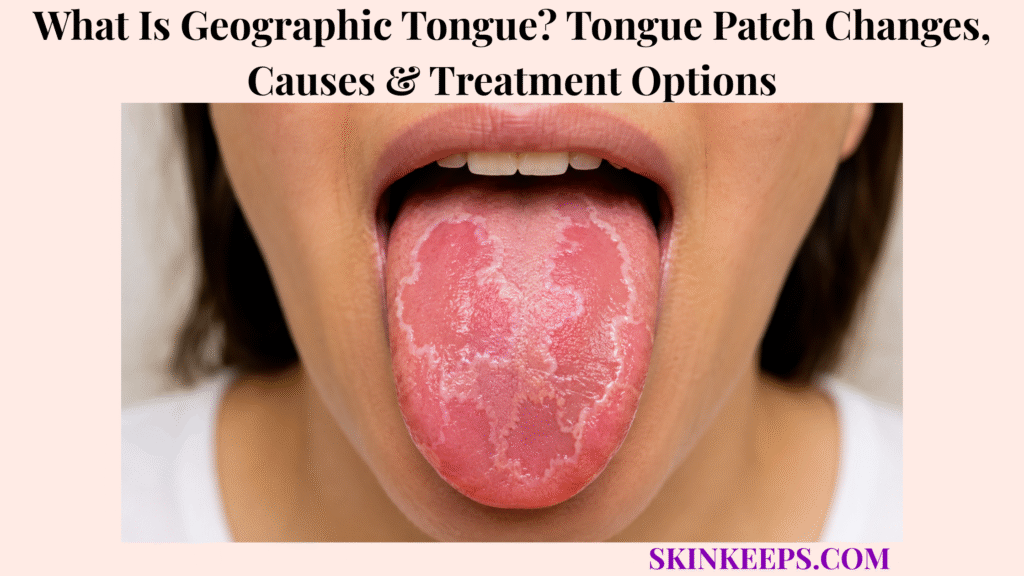
Geographic tongue, also called benign migratory glossitis, is a harmless inflammatory tongue-surface condition that creates smooth red or pink patches where filiform papillae temporarily disappear or flatten. Pale white, cream, yellowish, or grey borders can give the tongue a map-like appearance.
The patches may change shape, disappear, and reappear elsewhere, with no symptoms or intermittent burning and food sensitivity. Geographic tongue is not contagious, is not caused by infection, and does not become oral cancer, but fixed or destructive tongue changes need professional evaluation.
How Can You Recognize Geographic Tongue Patches?
Geographic tongue usually appears as smooth red or pink patches with irregular pale borders on the upper or side surfaces of the tongue.
The patches may be circular, oval, winding, or joined into a larger map-like pattern. The normal rough texture is reduced inside the patch because filiform papillae are missing or flattened.
Borders may look white, cream, yellowish, or grey and can be slightly raised. Patch size, shape, and location often change, and the tongue may look nearly normal between episodes.
Many people have no discomfort. Others notice burning, tingling, tenderness, soreness, or sensitivity to certain foods and drinks.
- Smooth red or pink centre.
- Irregular circular, oval, or winding outline.
- Pale or white raised border.
- Loss of normal rough texture.
- Map-like areas that may merge or separate.
- Change in size, shape, or location.
- Possible burning or food sensitivity.
- Professional check when first-time or uncertain.
Figure 1. Geographic tongue usually creates smooth red or pink patches with pale winding borders on the upper or side tongue, and the pattern changes over time.
Where on the Tongue Does Geographic Tongue Usually Appear?
Geographic tongue usually appears on the upper surface, side borders, or front part of the tongue.
Several tongue regions can be involved at the same time. The tip may be affected, and the pattern may extend unevenly across the dorsal surface.
Rare similar lesions can occur on other oral surfaces, sometimes called ectopic geographic tongue or geographic stomatitis. A red patch outside the tongue has a broader differential and should not automatically receive the same label.
| Site | Typical Role | Visibility | Care Boundary |
|---|---|---|---|
| Dorsal tongue | Most common surface | Easy to inspect | Look for map-like migration |
| Lateral borders | Common location | May be partly hidden | Check both sides |
| Tip or front | Possible location | Usually visible | Compare over time |
| Several regions | Possible during active episodes | Variable | Document shape and movement |
| Other oral surfaces | Uncommon | May be difficult to classify | Professional assessment |
Why Do Geographic Tongue Patches Look Smooth and Red?
Geographic tongue patches look smooth and red because filiform papillae temporarily disappear or flatten inside the affected area.
A normal tongue has many tiny papillae that create a textured surface. When filiform papillae are reduced, the surface looks smoother and the blood vessels beneath the thinner tissue make it appear red or pink.
Inflammatory change and altered surface cells create the pale winding border. The characteristic change mainly involves filiform papillae; it does not mean that all taste buds have been removed.
Simplified mechanism: local inflammation → filiform papilla loss → smooth red patch → pale advancing border → recovery or change elsewhere.
Why Do Geographic Tongue Patches Move and Change Shape?
Geographic tongue patches seem to move because one area begins to recover while another area becomes inflamed and loses papillae.
The lesion does not physically slide across the tongue. Borders expand unevenly, patches merge or separate, and the original area may regain its normal texture while another area becomes smooth.
Changes may occur over hours, days, or weeks. The tongue may clear before another episode develops, and episodes can recur without permanent tissue destruction.
Migration is a key reassuring clue because a fixed ulcer, leukoplakia, erythroplakia, or tumor behaves differently.
Figure 2. Temporary loss or flattening of filiform papillae creates the smooth red surface, while recovery in one area and inflammation elsewhere create the migrating pattern.
What Causes Geographic Tongue to Develop?
The exact cause of geographic tongue remains unknown.
It appears to involve recurring inflammatory changes in the tongue surface. It is not caused by bacteria, fungi, poor oral hygiene, contagious contact, or simply eating spicy food.
No single food, deficiency, disease, or lifestyle factor explains every case, so reported associations should not be treated as proven causes.
Can Family History Influence Geographic Tongue?
Family history may influence susceptibility, but it does not confirm the diagnosis.
Geographic tongue can occur in several relatives, suggesting inherited factors may contribute, but many people have no known family history.
Is Geographic Tongue Related to Psoriasis or Other Inflammatory Conditions?
Geographic tongue has been reported alongside psoriasis and some inflammatory or allergic conditions, but association does not prove cause.
A typical tongue pattern alone should not be used to diagnose an autoimmune or systemic disorder. Additional investigation depends on other skin, nail, joint, allergy, or inflammatory symptoms.
Can Vitamin or Mineral Deficiencies Cause Geographic Tongue?
Iron, zinc, folate, and B-vitamin deficiencies have been proposed as associations, but they are not a universal cause.
Testing is more useful when tongue changes occur with fatigue, pallor, restricted diet, weight loss, anemia signs, or wider nutritional concerns. Supplements should match a confirmed need.
| Proposed Factor | Reported Link | Proven Cause? | When Evaluation Helps |
|---|---|---|---|
| Family history | Possible clustering | No | Several relatives plus typical pattern |
| Psoriasis or inflammation | Reported association | No | Other skin, nail, joint, or inflammatory signs |
| Iron, zinc, folate, B vitamins | Proposed association | No universal cause | Fatigue, pallor, restricted diet, weight loss |
| Spicy foods | Symptom irritant | No | Repeated burning after exposure |
| Poor oral hygiene | Myth | No | Assess only for a separate oral problem |
Which Factors May Make Geographic Tongue Symptoms More Noticeable?
Some foods, drinks, oral-care products, and irritants may make burning or tenderness more noticeable during a geographic tongue flare.
Common personal irritants include spicy, acidic, sour, salty, or very hot foods; hot drinks; alcohol; tobacco; strongly flavored or alcohol-containing mouthwash; irritating toothpaste; and mechanical rubbing.
Stress may coincide with more sensitivity for some people. These exposures can aggravate a patch that is already present but are not established universal causes.
Trigger tracker: food or product → symptom intensity → patch location → duration → repeat reaction.
What Symptoms Can Geographic Tongue Cause Beyond Visible Patches?
Geographic tongue causes no discomfort in many people, but some experience burning, stinging, tingling, tenderness, or food sensitivity.
Spicy, sour, acidic, salty, or very hot foods and drinks can make sensitive areas more noticeable. Some people report altered taste or anxiety about the changing appearance.
Severe constant pain, deep ulceration, major swelling, fever, or difficulty swallowing is not typical and should prompt evaluation for another condition.
| Symptom Level | Possible Experience | Usual Direction |
|---|---|---|
| None | Changing patches without discomfort | Reassurance |
| Mild | Tenderness or food sensitivity | Identify personal irritants |
| Intermittent | Burning, stinging, or tingling | Gentle care and symptom review |
| Persistent or severe | Constant pain, ulcer, swelling, swallowing problem | Reassess the diagnosis |
Is Geographic Tongue Contagious or Caused by an Infection?
Geographic tongue is not contagious and is not caused by a bacterial, fungal, or sexually transmitted infection.
It cannot spread through kissing, shared cups, utensils, or ordinary household contact. A partner or household member does not need treatment.
Antifungal or antibiotic medicine is unnecessary unless a separate infection is confirmed. The pattern spreads across one person’s tongue through changing inflammation, not infectious transmission.
- Contagious: no.
- Fungal cause: no.
- Bacterial cause: no.
- Sexually transmitted: no.
- Poor-hygiene cause: no.
- Benign inflammatory condition: yes.
Can Geographic Tongue Become Oral Cancer?
Confirmed geographic tongue is benign, is not considered precancerous, and does not become oral cancer.
Its migration, changing border, and recovery pattern differ from a fixed malignant lesion. However, not every red, white, or ulcerated tongue patch is geographic tongue.
A fixed, bleeding, ulcerated, hardened, thickened, raised, continuously enlarging, or otherwise suspicious lesion needs professional assessment rather than reassurance based on resemblance.
Safety distinction: confirmed migrating geographic pattern → benign; fixed or destructive lesion → clinical evaluation.
How Is Geographic Tongue Different From Fissured Tongue?
Geographic tongue causes smooth changing red patches, while fissured tongue causes grooves or furrows that remain in relatively fixed positions.
Geographic patches migrate and may burn. Fissures stay in place and are usually painless, although debris can collect in deep grooves. Both conditions can occur in the same person, and neither is contagious or cancerous.
| Feature | Geographic Tongue | Fissured Tongue |
|---|---|---|
| Main pattern | Smooth red patches with pale borders | Grooves or furrows |
| Movement | Patches change location | Fissures remain relatively fixed |
| Texture | Smooth areas from papilla loss | Deep lines or cracks |
| Symptoms | Often none; may burn | Usually none; debris may irritate |
| Contagious? | No | No |
| Cancerous? | No | No |
How Is Geographic Tongue Different From Other Red or White Tongue Lesions?
The changing map-like pattern helps distinguish geographic tongue, but removable plaques, fixed patches, true ulcers, and hardened growths follow different diagnostic pathways.
How Does Geographic Tongue Differ From Oral Thrush?
Geographic tongue creates smooth red patches with winding pale borders, while oral thrush often produces creamy white plaques that may wipe away.
Thrush is fungal and may leave a red or bleeding surface when plaques are removed. Geographic tongue is not fungal and does not routinely need antifungal treatment.
How Does Geographic Tongue Differ From Atrophic Glossitis?
Atrophic glossitis may make much or all of the tongue smooth, glossy, and red, while geographic tongue usually forms discrete migrating patches.
Atrophic glossitis may be associated with iron, folate, or vitamin B12 deficiency, so blood testing is more useful when anemia or malnutrition signs are present.
How Does Geographic Tongue Differ From Oral Lichen Planus?
Oral lichen planus may create persistent white lace-like lines, red areas, or painful erosions, while geographic tongue usually migrates.
Lichen planus can involve the cheeks, gums, and other oral surfaces and may require ongoing professional monitoring.
How Does Geographic Tongue Differ From Leukoplakia and Erythroplakia?
Leukoplakia and erythroplakia usually form persistent fixed white, grey, or red patches, while geographic tongue changes location, shape, and border.
Fixed lesions require examination and may need biopsy, especially with tobacco or heavy alcohol exposure.
How Does Geographic Tongue Differ From a Traumatic or Aphthous Ulcer?
A traumatic or aphthous ulcer is a break in the tongue surface, while geographic tongue is usually smooth rather than deeply ulcerated.
Ulcers may have a yellow-white base and can occur next to a sharp tooth, appliance, or bite injury. A true ulcer lasting around two weeks or longer needs assessment.
How Does Geographic Tongue Differ From Tongue Cancer?
Geographic tongue migrates and may disappear, while tongue cancer can cause a persistent ulcer, lump, hardened area, or fixed red or white patch.
Bleeding, progressive pain, swallowing difficulty, a neck lump, or unexplained weight loss requires prompt specialist evaluation.
| Condition | Surface Appearance | Removable? | Migrates? | Pain | Evaluation Threshold |
|---|---|---|---|---|---|
| Geographic tongue | Smooth red patches with pale borders | No | Yes | None to burning | Confirm if first-time or uncertain |
| Oral thrush | Creamy white plaques | Often | No | Soreness possible | Evaluate removable plaques or immune risk |
| Atrophic glossitis | Smooth glossy red tongue | No | No | Burning possible | Check deficiency signs |
| Oral lichen planus | White lace lines or erosions | No | Usually persistent | Can be painful | Professional monitoring |
| Leukoplakia | Fixed white or grey patch | No | No | Often painless | Examine; possible biopsy |
| Erythroplakia | Fixed red patch | No | No | Variable | Prompt assessment |
| Traumatic or aphthous ulcer | Surface break | No | No | Often painful | Assess if persistent |
| Tongue cancer | Fixed ulcer, lump, or hard patch | No | No | May progress | Prompt specialist evaluation |
How Do Clinicians Diagnose Geographic Tongue?
Geographic tongue is usually diagnosed from its characteristic appearance and a history of patches appearing, disappearing, or moving.
The clinician examines patch texture, border, size, and location under good lighting and checks the rest of the mouth.
The review may include burning, taste change, food sensitivity, medicines, tobacco, alcohol, oral-care products, and symptoms suggesting deficiency or inflammatory disease.
Follow-up photographs can document migration. No single blood test confirms geographic tongue, and a classic pattern usually does not need biopsy.
- History of patch migration.
- Visual examination under good lighting.
- Texture, border, size, and location review.
- Full-mouth examination.
- Food and product symptom review.
- Medication, tobacco, and alcohol history.
- Systemic symptom assessment.
- Follow-up photographs when helpful.
When Are Tests or a Tongue Biopsy Needed?
Testing is usually unnecessary for classic geographic tongue, but it may be needed when the patch is fixed, suspicious, unusually painful, or diagnostically unclear.
Removable white material may lead to fungal testing. Fatigue, pallor, restricted diet, or weight loss may justify a blood count and iron, folate, or vitamin B12 assessment.
Ulcerated, indurated, bleeding, thickened, continuously enlarging, or fixed red or white lesions may require specialist review and biopsy.
| Clinical Finding | Likely Next Step | Purpose |
|---|---|---|
| Classic migrating pattern | Clinical diagnosis | Support benign geographic tongue |
| Removable white material | Fungal evaluation | Separate candidiasis |
| Fatigue, pallor, restricted diet | Blood tests | Check anemia or deficiency |
| Fixed red or white patch | Oral exam ± biopsy | Exclude serious lesion |
| Ulcerated, bleeding, or hard lesion | Prompt specialist review | Obtain tissue diagnosis |
| Severe persistent burning | Broader evaluation | Identify another oral pain cause |
Does Geographic Tongue Require Treatment?
Most cases of geographic tongue do not require treatment because the condition is benign and often painless.
Patches may resolve without intervention, and reassurance is appropriate when the pattern is confirmed and symptoms are absent.
Management should target discomfort rather than forcing the tongue to look permanently uniform. The condition has a good prognosis and does not cause lasting tissue damage.
| Situation | Best Direction | Reason |
|---|---|---|
| Confirmed and painless | Reassurance | No medical treatment needed |
| Mild food sensitivity | Trigger identification | Reduce burning during flares |
| Persistent discomfort | Clinician-directed symptom relief | Improve comfort and eating |
| Fixed or atypical patch | Testing or biopsy | Not a classic pattern |
| High anxiety | Explanation and follow-up | Reduce fear without overtreatment |
How Can Mild Geographic Tongue Discomfort Be Managed?
Mild discomfort can often be managed by avoiding personal irritants during flares and using gentle oral care.
- Temporarily reduce foods that repeatedly cause burning.
- Limit spicy, sour, acidic, highly salted, or very hot foods during symptomatic periods.
- Avoid alcohol-containing mouthwash when it irritates the tongue.
- Stop tobacco exposure.
- Use gentler toothpaste if strong flavouring or foaming agents worsen symptoms.
- Maintain normal gentle oral hygiene.
- Drink enough fluids.
- Do not scrape smooth patches.
- Use a symptom diary when triggers are unclear.
- Do not avoid foods indefinitely when they cause no symptoms.
Which Treatments Can Relieve Painful Geographic Tongue?
Painful geographic tongue may be treated with clinician-selected symptom-relief options, but these treatments do not reliably eliminate the tendency to recur.
Options may include a topical oral anesthetic, antihistamine-containing rinse, anesthetic rinse, topical corticosteroid, topical tacrolimus in selected resistant cases, and appropriate oral pain relief.
A confirmed nutritional deficiency or coexisting oral condition should be treated for its own reason. Evidence for many geographic tongue therapies is limited, so treatment should match symptom severity.
| Option | Symptom Target | Role | Limitation | Supervision |
|---|---|---|---|---|
| Topical oral anesthetic | Temporary pain or burning | Short-term relief | Does not change recurrence | Yes |
| Antihistamine rinse | Burning or irritation | Symptom relief | Limited evidence | Yes |
| Anesthetic rinse | Pain during flares | Temporary comfort | Short duration | Yes |
| Topical corticosteroid | Inflammatory discomfort | Selected cases | Not a routine cure | Yes |
| Topical tacrolimus | Resistant symptoms | Specialist option | Not first-line | Yes |
| Oral pain relief | Pain control | Supportive care | Suitability varies | Clinician or pharmacist guidance |
| Deficiency treatment | Confirmed deficiency | Treats coexisting problem | Does not prove cause | Yes |
Which Geographic Tongue Treatment Mistakes Should Be Avoided?
Geographic tongue should not be scraped, burned, cut, chemically treated, or treated as material that needs to be removed.
| Mistake | Why It Fails | Possible Harm | Safer Response |
|---|---|---|---|
| Aggressive scraping | Patches are not debris | More burning or trauma | Gentle oral hygiene |
| Peroxide, acids, or oils | Chemical irritation | Burns or ulcers | Avoid harsh products |
| Bleach or household remedies | Unsafe for oral tissue | Tissue injury | Clinical advice |
| Antifungal without thrush | Wrong target | Delayed diagnosis | Test removable plaques |
| Antibiotics | Not a bacterial condition | Side effects and resistance | Use only for separate infection |
| High-dose vitamins | Deficiency not proven | Toxicity or delay | Test when indicated |
| Skin creams | Not formulated for oral use | Irritation or toxicity | Use oral-specific treatment |
| Ignoring a fixed patch | False reassurance | Missed serious lesion | Examine or biopsy if suspicious |
Can Geographic Tongue Be Prevented or Cured Permanently?
Geographic tongue cannot be reliably prevented or cured permanently in every susceptible person.
Episodes may resolve spontaneously, the tongue may look normal for a period, and patches may later recur in the same or another location.
Avoiding personal irritants can reduce discomfort but does not necessarily prevent new patches. Good oral care supports general mouth health but does not guarantee prevention.
Restrictive diets, detox routines, supplements, or antiseptic regimens should not be presented as guaranteed clearance.
Expectation timeline: flare → migration → spontaneous clearing → symptom-free period → possible recurrence.
When Should Tongue Patches Be Checked by a Dentist or Clinician?
Tongue patches should be checked when they first appear, cannot be confidently identified, cause meaningful symptoms, or do not behave like a typical migrating pattern.
- First-time tongue patch.
- Uncertain pattern.
- Burning or pain that interferes with eating.
- Symptoms that persist despite avoiding irritants.
- White material that can be wiped or scraped away.
- Signs of anemia or nutritional deficiency.
- Immune suppression.
- Patch on an unusual oral site.
- Persistent anxiety despite reassurance.
Prompt evaluation: a patch fixed for about two weeks or longer, a true ulcer, hardness, thickening, spontaneous bleeding, continuous enlargement, worsening pain, chewing or swallowing difficulty, a neck lump, unexplained weight loss, or persistent taste change.
Figure 3. A typical migrating map-like pattern is usually diagnosed clinically, while fixed, ulcerated, bleeding, hardened, enlarging, or otherwise unclear lesions need targeted testing or biopsy.
What Should You Remember About Geographic Tongue?
Geographic tongue is a benign migratory tongue condition that causes smooth red patches where filiform papillae temporarily disappear.
- Geographic tongue is also called benign migratory glossitis.
- Smooth red patches form where filiform papillae temporarily disappear or flatten.
- Pale winding borders create a map-like appearance.
- Patches can change size, shape, and location.
- The condition is harmless, noncontagious, and unrelated to oral cancer.
- The exact cause remains unknown.
- Foods and products may aggravate symptoms without causing the condition.
- Most cases need reassurance rather than treatment.
- Symptom care targets discomfort, not forced visual clearance.
- Fixed, ulcerated, bleeding, hardened, or progressive lesions need evaluation.
What Questions Do People Ask About Geographic Tongue?
Why do geographic tongue patches move?
The patches do not physically slide. One area recovers while another becomes inflamed and loses filiform papillae, so the map-like pattern changes over time.
Is geographic tongue a fungal infection?
No. Geographic tongue is not fungal and does not routinely need antifungal treatment. Removable white plaques, immune suppression, recent antibiotics, or persistent soreness may justify evaluation for oral thrush.
Can geographic tongue spread through kissing?
No. It is not contagious and does not spread through kissing, shared cups, utensils, or household contact.
Does poor oral hygiene cause geographic tongue?
No. It is not a poor-hygiene condition. Gentle oral care supports comfort and general mouth health but does not guarantee prevention.
Can spicy food cause geographic tongue?
Spicy food may worsen burning when patches are already present, but it is not proven to cause the underlying condition.
Can stress make geographic tongue symptoms worse?
Some people report more sensitivity during stress, but stress is a possible aggravator rather than a proven universal cause.
Is geographic tongue related to vitamin deficiency?
Deficiencies have been proposed as associations, but they do not explain every case. Testing is more useful when fatigue, pallor, restricted diet, weight loss, or other deficiency signs are present.
Are geographic tongue and fissured tongue the same condition?
No. Geographic tongue causes migrating smooth red patches, while fissured tongue causes grooves that remain relatively fixed. They can occur together.
Can geographic tongue affect taste?
Some people notice altered taste, but many have no symptoms. Persistent taste change that does not match a typical flare should be assessed.
How long do geographic tongue patches last?
Patches may change over hours, days, or weeks, may clear, and may recur later. A fixed lesion that does not behave this way needs evaluation.
Can geographic tongue disappear permanently?
Episodes may disappear and long symptom-free periods may occur, but no established treatment prevents recurrence in every susceptible person.
Does geographic tongue become oral cancer?
Confirmed geographic tongue does not become oral cancer. Fixed, ulcerated, bleeding, hardened, enlarging, or suspicious patches still need examination because they may be another condition.
Should geographic tongue be scraped or brushed away?
No. The red areas reflect temporary surface inflammation and papilla loss, not debris. Aggressive scraping can worsen irritation.
When does a tongue patch need a biopsy?
Biopsy may be needed when a lesion is fixed, ulcerated, hard, thickened, bleeding, continuously enlarging, treatment-resistant, or diagnostically uncertain.
Which Sources Support This Geographic Tongue Guidance?
Mayo Clinic — Geographic Tongue: Symptoms and Causes — Definition, papilla loss, smooth red map-like patches, migration, symptoms, unknown cause, noninfectious and noncancerous status.
Cleveland Clinic — Geographic Tongue — Patient-friendly symptoms, possible associations, diagnosis, symptom relief, prognosis, and recurrence expectations.
NCBI Bookshelf / StatPearls — Geographic Tongue — Benign migratory glossitis terminology, filiform papilla loss, clinical diagnosis, differential diagnosis, biopsy boundaries, and management options.
This SkinKeeps article is educational and does not diagnose tongue patches or replace dental, medical, oral-medicine, ENT, nutrition, or cancer-screening care. Have new, fixed, ulcerated, bleeding, hardened, thickened, enlarging, persistently painful, swallowing-related, or uncertain patches examined; do not scrape, burn, bleach, acid-treat, or medicate the tongue with antifungals, antibiotics, high-dose vitamins, skin creams, or household remedies without a confirmed reason.