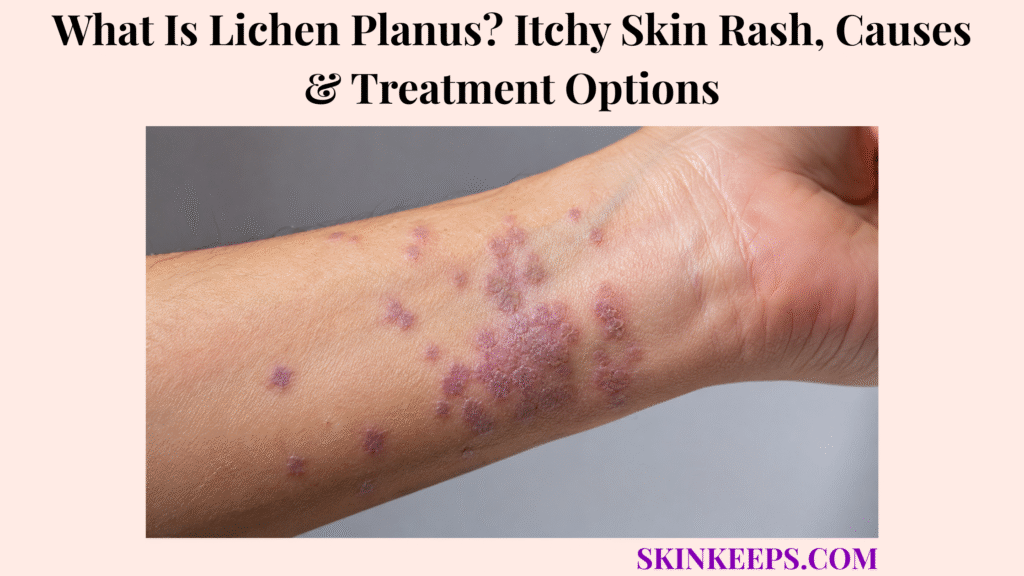
Lichen planus is a non-contagious immune-mediated inflammatory disease that can affect the skin, mouth, genitals, scalp and nails. Classic cutaneous disease produces small, firm, shiny and often itchy flat-topped papules, while mucosal, follicular and nail disease can look very different.
Cutaneous lichen planus often improves spontaneously, but oral and genital disease can remain chronic and relapsing. Lichen planopilaris can permanently destroy hair follicles, and progressive nail lichen planus can scar the nail matrix, so treatment urgency depends strongly on which tissue is affected.
Prompt clinical assessment is appropriate for persistent painful oral ulcers, difficulty eating or swallowing, genital erosions or scarring, progressive scalp hair loss, rapidly worsening nail destruction, or a longstanding oral lesion that becomes thickened, ulcerated, firm, repeatedly bleeding or clearly different from its usual pattern. Stable localized itchy skin lichen planus is usually less urgent than destructive scalp, nail or mucosal disease.
How Can You Recognize Lichen Planus?
Lichen planus is recognized by site-specific inflammatory lesions, with classic skin disease producing shiny flat-topped papules while oral, genital, scalp and nail disease can look substantially different.
What Does Cutaneous Lichen Planus Look Like?
Cutaneous lichen planus typically produces small, firm, shiny and flat-topped papules that may appear violet, red, grey or brown.
Fine white surface lines called Wickham striae can cross the papules. The inner wrists, forearms, ankles, shins and lower back are common sites, and individual papules can merge into larger plaques. Itch ranges from absent or mild to intense, and colour varies across skin tones rather than following one universal purple appearance.
Can Lichen Planus Leave Dark Marks?
Yes; lichen planus can leave persistent post-inflammatory brown, grey or darker pigmentation after active lesions flatten.
These residual marks represent hyperpigmentation rather than ongoing active inflammation and can remain visible for months or longer, especially in deeper skin tones.
What Does Oral Lichen Planus Look Like?
Oral lichen planus commonly produces white lacy lines on the cheeks, gums or tongue, while erosive disease can cause painful red or ulcerated areas.
Reticular white striae may be painless, whereas erosive oral disease can burn or make spicy, acidic or crunchy foods uncomfortable. Oral lichen planus can occur without skin lesions elsewhere and often follows a chronic relapsing course.
How Does Genital Lichen Planus Present?
Genital lichen planus can cause itching, burning, soreness, erosions and red or violaceous lesions, with scarring possible in persistent erosive disease.
Vulvovaginal erosive disease can be painful and may scar when inflammation persists. Penile disease can appear as violet papules, plaques or ring-shaped lesions. Structural change deserves specialist assessment rather than being treated as a minor extension of ordinary skin disease.
What Happens When Lichen Planus Affects the Scalp?
Scalp lichen planus, called lichen planopilaris, can inflame and permanently destroy hair follicles, producing scarring alopecia.
Itching, burning, tenderness and progressive patchy hair loss can accompany active disease. Treatment aims to stop further follicular destruction; follicles already replaced by scar tissue do not regrow normal hair.
What Happens When Lichen Planus Affects the Nails?
Nail lichen planus can cause ridging, thinning, splitting and progressive matrix scarring that may permanently deform or destroy the nail.
Affected nails can become dull, grooved, thin or split and may stop growing. Earlier treatment becomes important when matrix damage is progressing because established scarring may not recover.
Figure 1. Lichen planus is a multi-site inflammatory disease. Skin disease often produces itchy flat-topped papules, while oral, genital, scalp and nail disease can be more persistent or structurally destructive.
Why Does Lichen Planus Develop, and Which Forms Can Occur?
Lichen planus develops through an immune-mediated inflammatory reaction, although the exact initiating cause remains unknown and several triggers or associations may contribute in selected patients.
What Causes Lichen Planus?
The exact cause of lichen planus is unknown, but T-cell-mediated inflammation attacks cells within the skin or mucosal epithelium.
The immune response produces interface inflammation and epithelial injury. Lichen planus is not an infection and is not contagious.
Is Lichen Planus Associated With Hepatitis C?
Yes; hepatitis C has an established association with lichen planus, but the strength of that association varies by population and geography.
Testing is most appropriate when personal risk, local prevalence, clinical history or another medical reason makes hepatitis C relevant. The association does not mean hepatitis C causes most lichen planus or that every patient requires the same testing approach.
Can Medicines Cause a Lichen-Planus-Like Rash?
Yes; some medications can trigger a lichenoid drug eruption that closely resembles spontaneous lichen planus.
Reported categories include some blood-pressure medicines, diuretics, pain medicines and antimalarial drugs. A complete medication history matters because a lichenoid drug eruption is not automatically identical to spontaneous lichen planus. Prescription medicines should not be stopped or changed without the prescribing clinician.
Can Dental Materials Trigger Oral Lichenoid Disease?
Yes; a localized oral lichenoid contact reaction can occasionally develop next to a dental restoration or material.
Amalgam-associated contact reactions are a recognized example when the lesion is anatomically related to the restoration and allergy is supported. This local reaction should remain distinct from spontaneous oral lichen planus.
Which Major Forms of Lichen Planus Matter Clinically?
The clinically most important forms are cutaneous, oral, genital, scalp and nail lichen planus because each has different treatment and complication risks.
Hypertrophic, annular, linear, pigmentosus and actinic variants also occur, but they should remain secondary to the main site-based treatment framework.
Figure 2. Lichen planus reflects T-cell-driven interface inflammation, but the initiating trigger is often uncertain. The affected tissue determines whether the outcome is a skin eruption, chronic mucosal disease, scarring alopecia or nail-matrix damage.
How Is Lichen Planus Distinguished and Diagnosed?
Lichen planus is often diagnosed from its clinical pattern, while biopsy and targeted testing are used when the morphology is atypical, a high-risk site is involved or an important mimic remains possible.
How Is Lichen Planus Different From Eczema or Psoriasis?
Lichen planus produces shiny flat-topped papules, whereas eczema more often causes poorly defined dry or weeping patches and psoriasis usually forms sharply bordered scaly plaques.
A dermatitis / eczema eruption is usually less sharply defined and may become dry, cracked or weeping, while lichen planus keeps a more papular flat-topped morphology.
Psoriasis usually forms sharply bordered plaques with more prominent scale on sites such as the elbows, knees and scalp. Atypical overlap can require biopsy.
How Is Oral Lichen Planus Distinguished From Other Mouth Lesions?
Symmetrical white lacy oral striae support oral lichen planus, while a persistent focal thickened, irregular or changing lesion requires consideration of another diagnosis.
Candidiasis, leukoplakia, lupus-related lesions, contact reactions and chronic ulcerative disorders can enter the differential. Persistent erosive or changing lesions may need biopsy to confirm the pattern and exclude another oral disorder.
How Is Genital Lichen Planus Distinguished From Lichen Sclerosus?
Genital lichen planus often produces erosive red disease and may involve the vagina, whereas lichen sclerosus has a different clinical and histologic pattern despite overlapping symptoms.
Both can cause itching, soreness, erosions and scarring. Lichen sclerosus more often produces porcelain-white atrophic or sclerotic change, while erosive genital lichen planus can show red erosions with lacy white borders. Correct diagnosis matters because long-term management differs.
When Is a Skin or Mucosal Biopsy Needed?
Biopsy is most useful when lichen planus is atypical, erosive, destructive, diagnostically uncertain or develops unexpected long-term change.
- Atypical cutaneous lesions.
- Erosive oral disease.
- Erosive genital disease.
- Progressing scalp disease.
- Progressing nail disease.
- A changing longstanding oral lesion.
- An uncertain differential diagnosis.
Which Additional Tests May Be Needed?
Additional testing depends on the suspected trigger or mimic and may include blood tests, patch testing, nail biopsy or medication review.
Hepatitis C testing is considered when clinically relevant, patch testing can support a suspected dental contact reaction, nail biopsy may help when nail disease is uncertain, and medication review belongs in every suspected lichenoid eruption. Broad testing panels are not necessary without an indication.
| Condition | Typical Morphology | Main Site | Key Distinguishing Clue |
|---|---|---|---|
| Lichen planus | Shiny flat-topped papules or site-specific mucosal lesions | Wrists, ankles, mouth, genitals, scalp, nails | Wickham striae and tissue-specific manifestations. |
| Eczema | Poorly defined dry, inflamed or weeping patches | Flexible; often flexural | Barrier dryness and patch-like rather than classic flat-topped papules. |
| Psoriasis | Sharply bordered scaly plaques | Elbows, knees, scalp and other sites | Prominent scale and plaque morphology. |
| Lichen sclerosus | White atrophic or sclerotic plaques | Often genital | Whitening, atrophy and sclerosis rather than classic LP papules. |
How Is Lichen Planus Treated?
Lichen planus treatment depends on the affected site, symptom severity and risk of irreversible scarring or tissue damage.
Does Every Case of Skin Lichen Planus Need Treatment?
No; mild cutaneous lichen planus can resolve spontaneously and may require only symptom control or observation.
Treatment becomes more relevant when itch is troublesome, the eruption is widespread, plaques are thick and persistent, quality of life is affected or another involved site risks permanent structural damage.
How Is Itchy Skin Lichen Planus Treated?
Itchy cutaneous lichen planus is commonly treated with topical corticosteroids to reduce inflammation and pruritus.
Topical calcineurin inhibitors, phototherapy, oral retinoids, short systemic corticosteroid courses or selected immune-modifying therapy can be considered when disease extent and severity justify escalation. No exact medication schedule fits every patient.
How Is Oral Lichen Planus Treated?
Asymptomatic oral lichen planus may only need monitoring, while painful erosive disease commonly requires topical anti-inflammatory treatment.
Topical corticosteroids formulated for oral use are common first-line therapy for symptomatic disease. Other topical or systemic anti-inflammatory treatment may be needed when erosions are severe. Gentle oral hygiene and avoidance of individually identified irritants support treatment but do not replace it.
How Is Genital Lichen Planus Treated?
Genital lichen planus often requires active anti-inflammatory treatment because persistent erosive disease can cause pain and scarring.
Topical corticosteroids and calcineurin inhibitors are used to suppress inflammation, while difficult erosive disease can require specialist systemic immunomodulatory treatment. Existing scarring or structural narrowing needs site-specific specialist care.
Why Does Lichen Planopilaris Need Early Treatment?
Lichen planopilaris needs early treatment because ongoing follicular inflammation can cause permanent scarring hair loss.
Treatment aims to stop progression rather than regrow follicles already replaced by scar tissue. Depending on disease activity, treatment can include topical or injected corticosteroids, hydroxychloroquine and other immune-modifying therapy.
Why Does Nail Lichen Planus Need Early Treatment?
Nail lichen planus needs early treatment when progressive because matrix inflammation can permanently scar, deform or destroy the nail.
Corticosteroid injections or systemic therapy can be considered when multiple nails are involved or destruction is progressing. Treatment can suppress active inflammation but cannot guarantee reversal of established matrix scarring.
Which Daily-Care Habits Can Reduce Lichen Planus Irritation?
Gentle skin and mucosal care can reduce irritation and avoid trauma that may worsen lichen planus symptoms.
Gentle cleansing, reduced scrubbing and friction, avoidance of personally identified oral or genital irritants, and stress-management strategies can reduce symptom triggers. Self-care does not replace treatment when scalp, nail or erosive genital disease risks permanent damage.
| Site | Treatment Priority | Primary Goal |
|---|---|---|
| Mild skin LP | Observation or symptom-directed topical therapy | Control itch while allowing self-resolution when appropriate. |
| Oral LP | Site-specific anti-inflammatory treatment + surveillance | Control pain/erosion and monitor persistent change. |
| Genital LP | Active anti-inflammatory treatment | Reduce erosions, pain and scarring risk. |
| Lichen planopilaris | Earlier anti-inflammatory treatment | Stop follicular destruction and further scarring alopecia. |
| Nail LP | Earlier treatment when progressive | Preserve the nail matrix and remaining nail structure. |
How Long Does Lichen Planus Last, and Which Complications Need Follow-Up?
Cutaneous lichen planus often resolves within one to two years, whereas oral, genital, scalp and nail disease can persist longer and may require continued surveillance.
Does Skin Lichen Planus Go Away?
Yes; cutaneous lichen planus commonly resolves within roughly one to two years, although relapses and residual pigmentation can last longer.
The individual course varies. Active papules can disappear while brown, grey or darker pigment remains, so residual colour should not automatically be interpreted as ongoing inflammation.
Why Can Oral and Genital Lichen Planus Last Longer?
Oral and genital lichen planus often follow a chronic relapsing course because mucosal inflammation can remain active for years.
Oral disease can persist for years or decades with periods of remission and relapse. Erosive genital disease can also require prolonged treatment because persistent inflammation creates pain and scarring risk.
Can Oral Lichen Planus Increase Cancer Risk?
Yes; oral lichen planus carries a small but clinically meaningful risk of malignant transformation, particularly in higher-risk persistent or erosive disease.
A 2024 systematic review and meta-analysis of 101 studies including 38,083 patients estimated malignant transformation of oral lichen planus at about 1.43%. Higher-risk features included epithelial dysplasia, erosive or atrophic lesions, tongue involvement, tobacco use, alcohol use and hepatitis C. The low absolute risk supports surveillance, not alarm.
Which Oral Changes Need Earlier Reassessment?
A longstanding oral lichen planus lesion needs earlier review if it becomes more ulcerated, thickened, firm, irregular, repeatedly bleeding or clearly different from its usual pattern.
A changing focal lesion can require repeat biopsy. Longstanding erosive disease benefits from dental, oral-medicine or dermatology follow-up according to the local care pathway.
Which Other Lichen Planus Complications Can Become Permanent?
Lichen planopilaris, nail lichen planus and chronic erosive genital lichen planus can cause permanent scarring or structural damage.
Scalp inflammation can permanently destroy follicles, nail-matrix inflammation can permanently deform or eliminate nails, and chronic genital erosions can cause scarring, narrowing or adhesions. These complications should not be generalized to ordinary localized cutaneous LP.
When Should Lichen Planus Be Assessed Promptly?
Lichen planus deserves prompt specialist assessment when scalp, nail, oral or genital disease is progressing in a way that risks permanent damage or significant functional impairment.
- Rapidly progressing hair loss.
- Worsening nail destruction.
- Severe genital pain or scarring.
- Difficulty eating.
- Difficulty swallowing.
- Persistent or changing oral ulceration.
These patterns are more urgent than a stable localized itchy skin rash because delayed treatment can allow irreversible follicular, matrix or mucosal damage.
Figure 3. Cutaneous lichen planus often resolves, while oral and genital disease can remain chronic. Lichen planopilaris and progressive nail lichen planus need earlier treatment because follicular or matrix destruction can become irreversible.
What Should You Remember About Lichen Planus?
Lichen planus is a non-contagious immune-mediated inflammatory disease whose prognosis and treatment depend heavily on whether it affects the skin, mouth, genitals, scalp or nails.
- Classic skin lichen planus produces shiny flat-topped papules.
- Oral lichen planus produces lacy white or erosive lesions.
- Genital lichen planus can scar.
- Lichen planopilaris can permanently destroy hair follicles.
- Nail lichen planus can permanently damage the nail matrix.
- The exact cause remains uncertain.
- Hepatitis C, medicines and dental materials matter only in selected contexts.
- Diagnosis is often clinical, but biopsy may be needed.
- Treatment must be site-specific.
- Persistent oral lichen planus requires surveillance.
- Cutaneous lichen planus often resolves.
The decision pathway is identify site → distinguish mimic → confirm if needed → treat by risk → monitor complications.
Frequently Asked Questions About Lichen Planus?
The most common lichen planus questions concern its cause, contagiousness, duration, treatment and long-term oral risk.
What Causes Lichen Planus?
The exact cause of lichen planus is unknown, but the disease involves T-cell-driven immune inflammation of skin or mucosal tissues. Hepatitis C, medications and local contact triggers matter only in selected contexts and do not explain every case.
Is Lichen Planus Contagious?
No; lichen planus is not contagious and cannot spread from one person to another. It is an immune-mediated inflammatory disease rather than a transmissible skin, oral or genital infection.
How Long Does Skin Lichen Planus Usually Last?
Cutaneous lichen planus commonly improves within about one to two years, although residual pigmentation and occasional relapses can last longer. Oral and genital disease often persist longer, while scalp and nail disease can cause permanent structural damage.
Which Treatments Are Used for Lichen Planus?
Lichen planus treatment ranges from observation or topical therapy for mild skin disease to site-specific treatment for persistent oral or genital disease and earlier anti-inflammatory treatment for scalp or nail disease that risks permanent damage.
Can Oral Lichen Planus Increase the Risk of Oral Cancer?
Yes; oral lichen planus carries a low but measurable long-term malignant-transformation risk, supporting continued review of persistent or changing lesions. The absolute risk is small, but a thickened, ulcerated, firm, bleeding or distinctly changing oral area deserves reassessment.
Which Sources Support This Lichen Planus Guidance?
American Academy of Dermatology — Lichen Planus: Signs and Symptoms — Multi-site manifestations, skin morphology and colour variation, post-inflammatory pigmentation, oral disease, genital disease, scalp symptoms and progressive nail damage.
American Academy of Dermatology — Lichen Planus: Causes — Unknown cause, immune mechanism, hepatitis C association, lichenoid drug eruptions, dental-material reactions and the importance of medication history.
American Academy of Dermatology — Lichen Planus: Diagnosis and Treatment — Clinical diagnosis, selective biopsy/testing, skin treatment, oral therapy, genital therapy, early treatment of lichen planopilaris and nail lichen planus.
DermNet — Lichen Planus — Cutaneous and mucosal forms, pigmentation, variants, natural history, approximately one-to-two-year cutaneous course and chronic mucosal behaviour.
DermNet — Oral Lichen Planus — White reticular and erosive oral morphology, chronic relapsing course, biopsy context, pain and the need to assess persistent ulcers or enlarging nodules.
DermNet — Lichen Planopilaris — Scalp symptoms, permanent follicular destruction, scarring alopecia, biopsy context and the treatment goal of stopping further hair loss rather than restoring scarred follicles.
PubMed — 2024 Systematic Review and Meta-Analysis of Oral Lichen Planus Malignant Transformation — 101 studies with 38,083 patients, pooled oral lichen planus malignant-transformation estimate of 1.43%, and higher-risk features including dysplasia, erosive/atrophic disease, tongue involvement, tobacco, alcohol and hepatitis C.