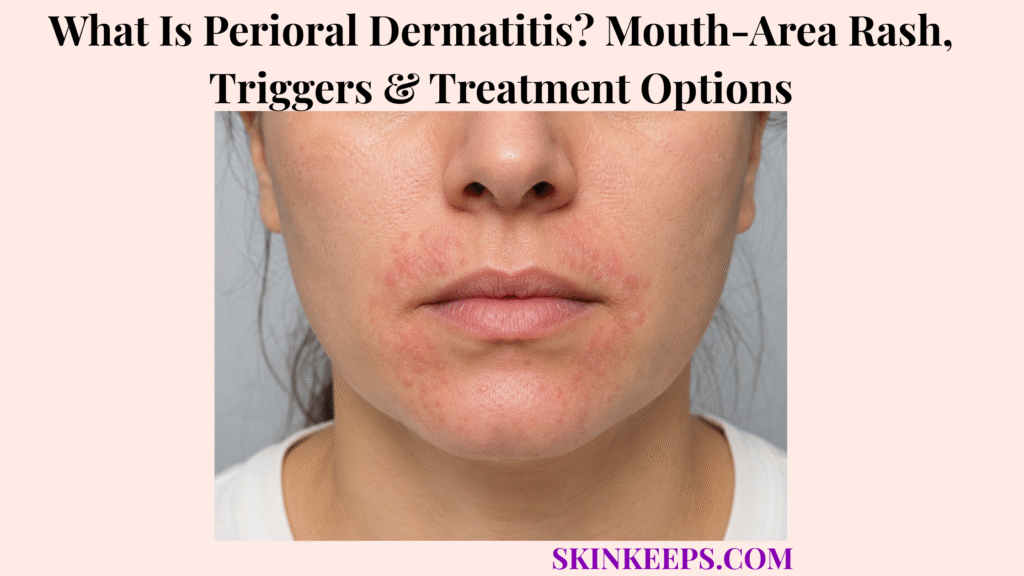
Perioral dermatitis is a chronic inflammatory facial eruption that produces clusters of small papules around the mouth, often on dry or sensitive skin with a narrow clear zone immediately beside the lips. Tiny pustules or vesicles can occur, burning or tightness is common, and broader periorificial disease can spread beside the nose or around the eyes.
The exact cause remains uncertain, but facial corticosteroids are a major recognized association and occlusive skincare, cosmetics, sunscreen formulations or other irritants can contribute in susceptible skin. Treatment focuses first on removing aggravating exposures and simplifying facial care, with topical or oral anti-inflammatory therapy added when disease severity requires it.
This article is for educational purposes only and does not constitute medical advice, diagnosis, or treatment. A persistent facial eruption that spreads rapidly, becomes markedly swollen or painful, develops significant crusting or suspected infection, involves the eyes with redness or ocular symptoms, or repeatedly fails appropriate treatment should be evaluated by a licensed dermatologist or qualified healthcare professional. Prescribed topical, inhaled or intranasal corticosteroids should not be altered without appropriate medical guidance when their use is medically necessary.
How Can You Recognize Perioral Dermatitis?
Perioral dermatitis usually appears as clusters of small papules or tiny pustules around the mouth on dry, sensitive or mildly scaly skin, often with relative sparing immediately beside the lips.
What Does Perioral Dermatitis Look Like, and Where Does It Appear?
Perioral dermatitis produces numerous small relatively uniform papules around the mouth and chin and can extend beside the nose, around the nostrils or around the eyes.
The eruption can include tiny pustules or vesicles on a dry or flaky background, but deep nodules and cysts are not typical. When the mouth is dominant, “perioral dermatitis” remains appropriate; when one or more facial orifices are involved, “periorificial dermatitis” is the broader term.
Why Is the Skin Immediately Beside the Lips Often Clear?
A narrow zone directly beside the vermilion border is often relatively spared, creating one of the most useful distribution clues for perioral dermatitis.
The papules can form a ring around the mouth while leaving a visible clear strip next to the lips. This is a useful clue rather than a mandatory criterion, because severe disease can extend closer to the vermilion.
Can Perioral Dermatitis Look Like Acne or Feel Like Eczema?
Perioral dermatitis can look acne-like because of its papules and pustules and can feel dry or irritated, but typical acne comedones are absent and broad eczematous patches are less characteristic.
Burning, tightness, sensitivity and itching can occur, while substantial pain is less typical. The papular periorificial pattern matters more than the word “dermatitis,” because this is not simply ordinary eczema around the lips.
How Can Perioral Dermatitis Appear on Darker Skin or in Children?
In darker skin, papules may appear skin-coloured, purple, brownish or hyperpigmented rather than bright red, and children can develop the same periorificial pattern.
Erythema can be less visually obvious in darker skin, and temporary pigment change may remain after inflammation settles. Childhood periorificial dermatitis also includes a granulomatous variant with monomorphic skin-coloured, red or yellow-brown papules.
Figure 1. Perioral dermatitis centers around the mouth and chin, often spares a narrow strip beside the vermilion border, and may extend around the nose or eyes as broader periorificial dermatitis.
What Triggers Perioral Dermatitis, and Why Do Steroid Creams Matter?
The exact cause of perioral dermatitis remains uncertain, but facial corticosteroids are a major recognized association and occlusive skincare, irritants and other exposures can aggravate susceptible facial skin.
What Causes Perioral Dermatitis?
Perioral dermatitis is thought to involve impaired epidermal-barrier function and abnormal inflammatory responses to external exposures rather than one proven infectious or allergic cause.
The condition is multifactorial: barrier susceptibility can increase penetration of irritants and water loss, encouraging dryness, sensitivity and repeated product use that further aggravates the skin.
Why Can Facial Corticosteroids Create a Rebound Cycle?
Facial corticosteroids can temporarily suppress visible inflammation while perpetuating perioral dermatitis, so stopping them can produce a rebound flare that encourages repeated reuse.
The characteristic cycle is steroid applied → temporary improvement → steroid withdrawn → flare → steroid restarted → temporary suppression again. A withdrawal flare does not prove that the steroid is successfully treating the underlying disorder.
Stronger or prolonged facial steroid use can require a clinician-guided withdrawal strategy rather than abrupt self-directed cessation.
Can Inhaled Steroids, Cosmetics or Heavy Moisturizers Contribute?
Inhaled or intranasal corticosteroid contact, occlusive moisturizers, cosmetics and some sunscreens can contribute to periorificial dermatitis in susceptible patients.
Medically necessary inhaled or intranasal steroids may need to continue, with facial deposition minimized when appropriate rather than stopping treatment independently. Heavy ointments, occlusive creams and multiple active skincare products can aggravate the eruption, so simplification is usually more useful than adding more products.
Can Toothpaste, Microorganisms, Weather or Hormones Trigger Flares?
Toothpaste, dental products, heat, wind, ultraviolet exposure and hormonal changes may modify disease in some people, while Demodex, Candida and bacteria have uncertain causal significance.
These exposures are possible contributors rather than universal causes. Microorganisms have been detected in some lesions, but that finding does not establish perioral dermatitis as a bacterial, fungal or mite infection.
Figure 2. A facial steroid can make the eruption look temporarily calmer, then stopping it can trigger rebound and tempt reuse; that temporary suppression does not equal durable disease control.
How Is Perioral Dermatitis Distinguished and Diagnosed?
Perioral dermatitis is usually diagnosed clinically from its small periorificial papules, lip-sparing distribution and exposure history, while testing is reserved for atypical or treatment-resistant disease.
How Is Perioral Dermatitis Different From Acne and Rosacea?
Perioral dermatitis lacks the typical comedones of acne. It also has a stronger periorificial distribution than rosacea, which more often emphasizes central facial redness, flushing and telangiectasia.
Acne may include blackheads, whiteheads, deeper nodules or cysts. Perioral dermatitis more often produces small relatively uniform papules or pustules on dry skin with relative lip sparing, while rosacea concentrates more strongly on the central cheeks and nose.
Overlap can occur, so one facial bump pattern should not be diagnosed by location alone.
How Is Perioral Dermatitis Different From Contact or Lip-Licker’s Dermatitis?
Allergic contact dermatitis more often causes broader itchy inflammatory patches linked to exposure, while lip-licker’s dermatitis characteristically crosses the vermilion border rather than sparing the skin immediately beside it.
Contact dermatitis often has stronger pruritus and a less monomorphic papular pattern. Lip-licker’s dermatitis follows the reach of repeated saliva contact rather than the classic spared perivermilion strip.
Is Perioral Dermatitis Usually Diagnosed Without Testing?
Yes; a typical case is usually diagnosed by examination and exposure history without routine laboratory testing.
Assessment focuses on papule morphology, distribution, lip sparing, topical-steroid exposure, skincare and cosmetics, oral products and previous treatment response.
When Are Scrapings, Cultures, Patch Testing or Biopsy Used?
Targeted testing is used when infection, contact allergy or another inflammatory disorder remains plausible, while biopsy is uncommon in classic perioral dermatitis.
KOH or fungal studies can investigate a fungal mimic, swab or culture can evaluate suspected bacterial infection, and patch testing can investigate allergic contact dermatitis. Biopsy is reserved mainly for atypical, resistant or granulomatous disease when another diagnosis remains possible.
Figure 3. Comedones favor acne, central flushing and telangiectasia favor rosacea, and a broader itchy exposure-pattern eruption favors contact dermatitis; testing is reserved for uncertainty.
How Is Perioral Dermatitis Treated?
Perioral dermatitis treatment begins by removing aggravating facial products and problematic corticosteroids, simplifying skincare, and adding topical or oral anti-inflammatory therapy according to disease severity.
What Is Zero Therapy, and How Are Problematic Steroids Withdrawn?
Zero therapy simplifies the facial routine by stopping unnecessary cosmetics and irritating or occlusive products, while facial corticosteroids that perpetuate disease are withdrawn with an approach appropriate to their strength and duration of use.
Practical simplification means reducing multiple actives, avoiding heavily occlusive ointments and using very gentle cleansing while the eruption settles. Stronger or prolonged steroid use may need clinician-guided tapering, and rebound should not automatically trigger repeated steroid restarting.
Medically necessary inhaled or intranasal corticosteroids should not be stopped independently.
Which Topical Treatments Are Used for Mild Perioral Dermatitis?
Topical metronidazole, erythromycin and pimecrolimus are established treatment options for appropriate mild or localized perioral dermatitis.
Azelaic acid and several other topical agents are also used in selected cases, but sensitive inflamed skin can sting initially. Treatment choice should reflect tolerability, distribution and patient factors rather than one universal regimen.
When Are Oral Tetracycline-Class Treatments Used?
Oral tetracycline-class therapy, commonly including doxycycline, is used for moderate, widespread, persistent or insufficiently responsive disease largely for its anti-inflammatory effect.
Using an antibiotic-class medicine does not mean bacteria are the proven cause of perioral dermatitis. Pregnancy and young-child treatment requires age- and pregnancy-appropriate alternatives rather than automatically copying adult tetracycline therapy.
How Long Does Treatment Take, and What If Standard Therapy Fails?
Perioral dermatitis usually requires several weeks of treatment, and persistent disease should prompt reassessment of diagnosis, steroid exposure, skincare triggers and adherence before specialist escalation.
A typical treatment course often spans roughly 4–8 weeks, but full clearance can take longer. Resistant disease should first trigger a review of ongoing steroid exposure, occlusive or irritating skincare, contact allergy, infection and diagnostic accuracy before combination therapy or specialist options are considered.
Figure 4. Trigger removal and skincare simplification come first; topical or oral anti-inflammatory therapy is then matched to severity, while resistant disease should prompt diagnostic reassessment before escalation.
How Long Does Perioral Dermatitis Last, and How Can Recurrence Be Reduced?
Perioral dermatitis usually improves gradually over weeks, may temporarily worsen after corticosteroid withdrawal, and can recur if treatment stops too early or aggravating facial exposures are restarted.
Can Perioral Dermatitis Get Worse Before It Gets Better?
Yes; perioral dermatitis can flare temporarily after a facial corticosteroid is withdrawn, particularly when the steroid had been suppressing visible inflammation.
Anticipating rebound helps prevent the suppression–rebound cycle from restarting. The flare should be managed with the planned steroid-withdrawal and anti-inflammatory strategy rather than automatically assuming the steroid must be resumed.
How Quickly Does Perioral Dermatitis Clear, and Can It Return?
Clearance usually takes several weeks and sometimes a few months, and recurrence can occur when treatment is stopped prematurely or a triggering exposure returns.
Severity, previous steroid exposure, continued product triggers, treatment adherence and diagnostic accuracy all affect recovery. No single course guarantees permanent cure.
How Should Skincare Be Reintroduced, and Does the Rash Scar?
Once active disease settles, simple non-irritating skincare should be reintroduced cautiously, and classic perioral dermatitis generally heals without permanent scarring.
Reintroducing one simple product at a time makes recurrent irritation easier to identify. Gentle fragrance-free care is usually preferable to a rapid return to multiple active or occlusive products.
Temporary post-inflammatory pigment can remain, particularly in darker skin, even after the papular eruption has become inactive.
When Should Persistent Perioral Dermatitis Be Reassessed?
Perioral dermatitis should be reassessed when an adequate treatment course produces little improvement, the distribution becomes atypical, or prominent itching, crusting, nodules or systemic symptoms suggest another diagnosis.
Persistent disease should reopen the questions of hidden steroid exposure, contact allergy, fungal or bacterial disease, acne, rosacea, granulomatous disease and adherence. Patch testing, infection testing or biopsy is then selected according to the remaining diagnostic question rather than added routinely.
What Should You Remember About Perioral Dermatitis?
Perioral dermatitis is a papular inflammatory eruption centered around the mouth that often spares the immediate lip border and is strongly associated with facial corticosteroid exposure and aggravating skincare products.
- Perioral dermatitis is the mouth-centered form of broader periorificial dermatitis.
- Small papules are characteristic and tiny pustules or vesicles can occur.
- Dryness, scaling, burning and sensitivity are common.
- Relative lip-border sparing is useful but not mandatory.
- Disease can extend around the nose or eyes.
- Appearance varies across skin tones and children can be affected.
- The exact cause remains uncertain and is not proven to be infectious.
- Facial corticosteroids are a major recognized association.
- Temporary steroid suppression is not durable disease control.
- Withdrawal can produce a rebound flare.
- Occlusive skincare, cosmetics and some other exposures can aggravate disease.
- Toothpaste and microorganisms are possible contributors, not universal causes.
- Acne typically includes comedones; rosacea emphasizes central facial flushing and erythema.
- Contact dermatitis follows a different exposure and morphology pattern.
- Diagnosis is usually clinical and testing is targeted.
- Treatment begins with trigger removal and skincare simplification.
- Topical treatment suits many mild or localized cases.
- Oral tetracycline-class therapy can treat more significant disease where appropriate.
- Pregnancy and childhood require different medication choices.
- Recovery is gradual and recurrence can occur.
- Persistent resistant disease should trigger diagnostic reassessment.
Recognize distribution → Identify steroid/products → Distinguish mimics → Remove aggravators → Treat by severity → Anticipate rebound → Reintroduce skincare cautiously → Reassess recurrence.
Frequently Asked Questions About Perioral Dermatitis
The most important perioral-dermatitis questions concern its early appearance, corticosteroid rebound, differentiation from acne or rosacea, treatment choices and recurrence.
What Are the First Signs of Perioral Dermatitis?
Early perioral dermatitis usually appears as small clustered bumps around the mouth with dry, sensitive or mildly scaly skin and relative sparing beside the lips. Burning, tightness and extension around the nose or eyes can occur.
Why Do Steroid Creams Make Perioral Dermatitis Worse?
Facial steroids can temporarily suppress the rash but perpetuate the underlying eruption, and withdrawal can cause a rebound flare that encourages repeated steroid reuse. Rebound does not mean long-term steroid use should automatically continue.
How Can You Tell Perioral Dermatitis From Acne or Rosacea?
Perioral dermatitis usually lacks acne comedones and concentrates around facial orifices, while rosacea more often emphasizes central facial flushing, redness and telangiectasia. Relative lip sparing also supports perioral dermatitis.
Which Treatments Are Used for Perioral Dermatitis?
Treatment begins with removal of aggravating products and problematic facial steroids, followed when needed by topical therapy or oral anti-inflammatory tetracycline-class treatment according to severity. Common topical options include metronidazole, erythromycin and pimecrolimus.
Why Does Perioral Dermatitis Come Back After It Clears?
Recurrence can occur when treatment ends too early or triggering exposures such as inappropriate facial corticosteroids or irritating skincare are reintroduced. Gradual skincare reintroduction and reassessment of repeated recurrence can help identify the perpetuating factor.
Which Sources Support This Perioral Dermatitis Guidance?
DermNet — Periorificial Dermatitis — Primary source for terminology, morphology, lip sparing, triggers, microbial uncertainty, diagnosis, zero therapy, targeted testing, treatment options, recurrence and scarring context.
American Academy of Dermatology — Perioral Dermatitis — Used for appearance across skin tones, steroid association, withdrawal flare, gentle skincare, antibiotic-class treatment and gradual clearance over weeks to months.
StatPearls — Perioral Dermatitis — Used selectively for current diagnostic framing, multifactorial pathophysiology and severity-based oral tetracycline-class treatment context.
DermNet — Periocular Dermatitis — Used narrowly for periocular extension, topical-treatment options, steroid taper context, child-appropriate alternatives and refractory-treatment positioning.