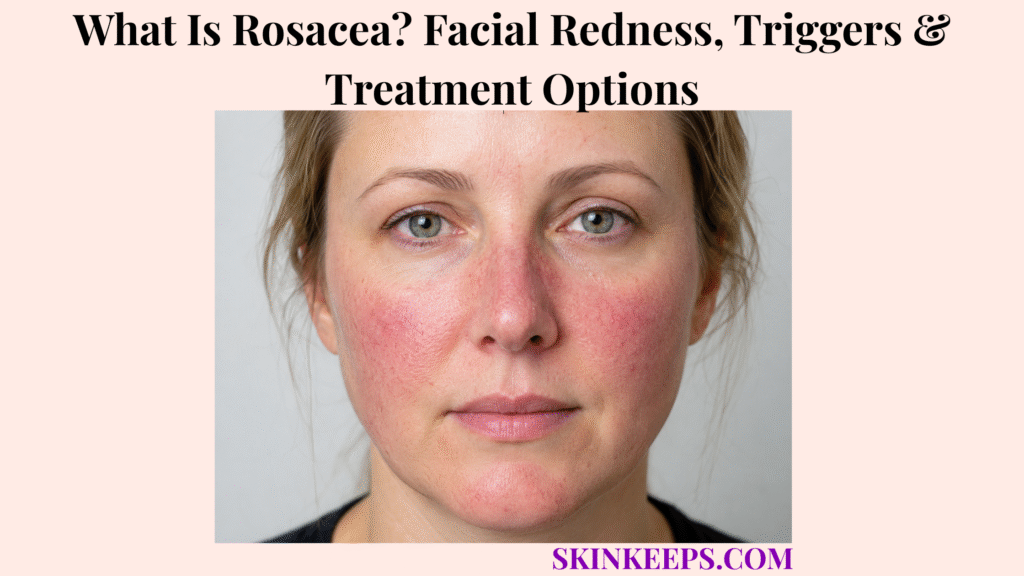
Rosacea is a chronic inflammatory condition of the central face that can cause flushing, persistent facial discoloration, visible blood vessels, inflammatory bumps, sensitive skin and sometimes eye or skin-thickening symptoms. The signs can come and go, overlap and look different across skin tones, so rosacea is better understood as a pattern of features than as one fixed appearance.
Different rosacea features can occur together, personal triggers vary, and diagnosis is usually clinical. Treatment therefore matches the dominant problem—such as persistent color change, papules and pustules, visible vessels, ocular disease or phymatous thickening—while gentle skin care, sun protection and individual trigger control support long-term management.
This article is for educational purposes only. Persistent facial symptoms, eye pain or visual changes, or progressive skin thickening should be professionally evaluated.
What Is Rosacea and What Does It Look and Feel Like?
Rosacea is a chronic inflammatory facial disorder that can cause temporary flushing, persistent color change, visible vessels, acne-like bumps and burning or sensitive skin.
Why Does Facial Redness Develop in Rosacea?
Rosacea appears to involve abnormal neurovascular and immune responses that increase facial blood-vessel reactivity and inflammation, although no single proven cause explains the disease.
A useful model is susceptibility → neurovascular and immune dysregulation → vascular reactivity plus inflammation → flushing, persistent erythema or discoloration and other rosacea signs. Genetic, environmental, microbial and skin-barrier factors may contribute, but none should be presented as the one universal cause.
How Do Flushing and Persistent Facial Color Change Differ?
Rosacea flushing is temporary, while persistent erythema or discoloration lasts longer and may become a background feature between flares.
Color also varies by skin tone. Rosacea may look red, violet, brown or only subtly different from a person’s baseline, so warmth, burning, stinging, swelling, papules and visible or suspected vascular change can matter as much as obvious redness.
Can Rosacea Cause Bumps, Visible Vessels and Sensitive Skin?
Yes; rosacea can produce papules, pustules, visible small blood vessels, swelling, burning, stinging, tightness and dryness in varying combinations.
Inflammatory bumps can resemble acne, but rosacea is a separate disorder and does not require the comedonal pattern typical of acne.
Where Does Rosacea Usually Appear?
Rosacea most commonly affects the cheeks, nose, chin and forehead, although the eyes and eyelids can also be involved.
Central-face distribution is a useful clue, but the disease should still be interpreted from the complete pattern of vascular, inflammatory, sensory, ocular and phymatous findings.
Figure 1. Rosacea is best recognized as a cluster of central-facial vascular, inflammatory, sensory, ocular and phymatous features rather than as redness alone.
Which Rosacea Features Can Occur, and What Commonly Triggers Flares?
Rosacea can produce overlapping vascular, inflammatory, ocular and phymatous features, while personal triggers such as sunlight, heat or stress can provoke flares without being the underlying cause of the disease.
What Is Papulopustular Rosacea?
Papulopustular rosacea causes inflammatory facial papules and pustules, often on a background of persistent facial inflammation or color change.
These lesions can coexist with flushing, visible vessels and sensitivity. They should be treated as one rosacea phenotype rather than used to redefine the condition as “adult acne.”
What Is Ocular Rosacea?
Ocular rosacea affects the eyes or eyelids and can cause redness, burning, dryness, gritty sensation, eyelid inflammation or recurrent stye-like problems.
Eye findings deserve their own assessment because ocular disease can be important even when facial rosacea is mild. The dedicated ocular rosacea page covers eye-specific manifestations in more depth.
How Can Rosacea Cause Thickened Skin or Rhinophyma?
Phymatous rosacea can cause progressive tissue thickening, and the nose is the best-known site where advanced change can produce rhinophyma.
Progressive nasal thickening belongs to the rhinophyma pathway because established structural overgrowth may require procedural management rather than ordinary redness treatment alone.
Which Factors Commonly Trigger Rosacea Flares?
Common rosacea triggers include sunlight, heat, cold or wind, stress, hot drinks, spicy food, alcohol, exercise and irritating skin-care products, but triggers vary greatly between individuals.
A trigger provokes or worsens a flare; it is not the same as the underlying disease cause. This distinction avoids blaming one food, drink or lifestyle exposure for why rosacea exists.
Figure 2. Rosacea phenotypes describe what the disease is showing; triggers describe exposures that may intensify those features. The two questions should not be merged.
How Is Rosacea Diagnosed and Distinguished From Similar Facial Conditions?
Rosacea is usually diagnosed clinically from its facial pattern, symptom history, flare behavior and eye findings, with testing reserved for atypical cases or suspected mimics.
How Does a Dermatologist Diagnose Rosacea?
A dermatologist diagnoses rosacea by reviewing symptom history, flare triggers and distribution and examining the facial skin and eyes when relevant.
The process is usually history → flare pattern → facial examination → phenotype assessment → eye assessment when indicated → exclusion of plausible mimics. There is no universal blood-test panel that proves classic rosacea.
What Conditions Can Be Mistaken for Rosacea?
Acne, seborrheic dermatitis, contact dermatitis, lupus-related facial eruptions and perioral dermatitis can resemble rosacea.
Greasy or flaky inflammation may suggest seborrheic dermatitis rather than rosacea. A clear exposure pattern can point toward allergic contact dermatitis. Mouth-centered papules with a different distribution may fit perioral dermatitis.
Why Can Rosacea Be Missed in Darker Skin Tones?
Rosacea may be overlooked in darker skin when clinicians depend too heavily on obvious redness instead of burning, warmth, swelling, papules, pustules and change from baseline color.
Telangiectasia may also be less visible, so morphology, sensory symptoms, repeated flushing or warmth and persistent color change from a person’s baseline deserve greater weight.
When Are Tests or Skin Biopsy Needed?
Routine tests are usually unnecessary for classic rosacea, but targeted testing or biopsy may be used when another diagnosis is suspected or the presentation is atypical.
Testing should answer a specific differential question rather than be used as a standard requirement for every person with typical rosacea.
Figure 3. Rosacea is usually diagnosed clinically from a characteristic phenotype pattern; testing is reserved for presentations in which another diagnosis remains plausible.
How Is Rosacea Treated?
Rosacea treatment is matched to the dominant phenotype, meaning persistent redness, inflammatory bumps, visible vessels, ocular symptoms and thickened skin may each require different therapies.
Which Treatments Help Persistent Facial Redness?
Persistent rosacea redness may be treated with clinician-directed redness-targeting topical medicines and, in selected cases, laser or light-based therapy.
Brimonidine or oxymetazoline may be considered for persistent erythema in selected patients, while laser or intense-pulsed-light approaches can target vascular features. Treatment choice depends on the person’s phenotype, skin characteristics, tolerance and clinical context.
Which Treatments Help Rosacea Papules and Pustules?
Inflammatory rosacea bumps may be treated with topical agents such as ivermectin, metronidazole or azelaic acid, depending on the individual clinical pattern.
The goal is to reduce inflammatory lesions without turning the section into an acne regimen or a product-ranking list.
When Are Oral Medicines Used?
Oral treatment may be considered when inflammatory rosacea is more substantial, persistent or inadequately controlled with topical therapy.
Doxycycline is commonly used in clinician-directed treatment, while other systemic options are reserved for selected difficult disease. Dosing and duration depend on the clinical plan and are not universal.
How Are Visible Vessels, Ocular Disease or Thickened Skin Treated?
Visible facial vessels may respond to laser or light-based procedures, ocular rosacea needs eye-directed care, and significant phymatous thickening may require procedural treatment.
This feature-specific approach is why rosacea should not be managed with one universal “best treatment.”
Figure 4. Rosacea treatment is matched to the dominant feature: persistent redness, inflammatory lesions, visible vessels, ocular disease and phymatous change have different treatment directions.
How Can Rosacea Flares Be Controlled, and When Should It Be Reassessed?
Long-term rosacea control depends on gentle skin care, sun protection, identifying personal triggers and seeking reassessment when symptoms remain uncontrolled or involve the eyes or progressive skin thickening.
What Skin-Care Routine Is Best for Rosacea-Prone Skin?
Rosacea-prone skin usually benefits from gentle cleansing, regular moisturization and avoiding harsh scrubbing, aggressive exfoliation or irritating products.
Introduce new products cautiously, support the skin barrier and avoid over-treating sensitive facial skin simply because burning or redness is present.
How Does Sunscreen Help Rosacea?
Daily broad-spectrum photoprotection can reduce sun-triggered rosacea flares and is an important part of long-term disease management.
Sun protection supports flare control; it is not a cure and does not replace treatment for persistent vascular, inflammatory, ocular or phymatous disease.
How Can Personal Rosacea Triggers Be Identified?
Personal triggers are best identified by tracking repeatable links between a flare and recent exposures rather than avoiding every trigger reported by other people.
A practical pattern is flare → note recent exposure → look for repetition → identify a consistent personal trigger → reduce that exposure when feasible. This avoids unnecessary blanket food or lifestyle restrictions.
When Should Rosacea Be Reassessed by a Dermatologist or Eye Doctor?
Professional reassessment is appropriate for persistent or worsening facial symptoms, poor treatment response, progressive skin thickening or eye pain, light sensitivity, visual change or significant eyelid inflammation.
Reassessment is also reasonable for worsening flushing, recurrent papules despite acne-directed treatment, increasing visible vessels, uncertain diagnosis or symptoms that interfere substantially with daily life. Rosacea can often be controlled effectively, but it should not be presented as permanently curable.
What Should You Remember About Rosacea?
Rosacea is a chronic inflammatory facial disorder with overlapping vascular, inflammatory, ocular and phymatous features, so diagnosis and treatment should focus on the specific signs present in each person.
- Rosacea mainly affects the central face and often follows a relapsing course.
- Flushing is temporary, while persistent discoloration can remain between flares.
- Visible vessels, papules, pustules, burning, stinging, dryness and swelling can coexist.
- Rosacea is not acne and is not contagious.
- Eye involvement and phymatous thickening can occur.
- Several phenotypes can overlap in the same person.
- The exact cause remains uncertain and multifactorial.
- Sun, heat, weather, stress, food, drink and skin-care exposures are possible triggers, not the root cause.
- Rosacea may be harder to recognize when redness is subtle in darker skin tones.
- Diagnosis is usually clinical, with testing reserved for atypical cases.
- Treatment should match the dominant phenotype rather than follow one universal regimen.
- Gentle skin care, sunscreen and personal trigger tracking support long-term control.
- Eye pain, visual change or progressive skin thickening warrants reassessment.
- Rosacea can be controlled, but no guaranteed permanent cure exists.
Core pathway: Recognize phenotype → identify trigger pattern → confirm diagnosis → treat dominant features → protect skin barrier → monitor ocular or phymatous progression.
Which Sources Support This Rosacea Guidance?
DermNet — Rosacea — Used for chronic central-face disease framing, phenotype recognition, skin-of-color nuance, clinical diagnosis, differential diagnosis, trigger management and treatment categories.
American Academy of Dermatology — Rosacea Overview — Used for facial distribution, color variation across skin tones, ocular and thickening features, non-contagious status and chronic-course framing.
American Academy of Dermatology — Rosacea Diagnosis and Treatment — Used for clinical diagnosis, selective testing, gentle skin care, sun protection and feature-directed treatment.
American Academy of Dermatology — Rosacea Triggers — Used for trigger variability and the personal-trigger tracking approach.
NIAMS — Rosacea Diagnosis, Treatment, and Steps to Take — Used for no-specific-test framing, chronic control, individualized treatment, gentle care, sun protection and ocular reassessment.
National Rosacea Society — Treatment Algorithms — Used for the phenotype-based model and treatment matching across persistent erythema, inflammatory lesions, telangiectasia and other rosacea features.
Frequently Asked Questions About Rosacea
The main rosacea questions concern acne, contagion, triggers, long-term cure and eye involvement.
Is Rosacea the Same as Acne?
No; rosacea and acne are different disorders, although rosacea can produce inflammatory papules and pustules that resemble acne breakouts.
Is Rosacea Contagious?
No; rosacea does not spread from person to person.
What Commonly Triggers a Rosacea Flare?
Sunlight, heat, weather extremes, stress, hot drinks, spicy foods, alcohol, exercise and irritating products can trigger flares in some people, but personal triggers vary.
Can Rosacea Go Away Permanently?
Rosacea is chronic and currently has no guaranteed permanent cure, although treatment can control symptoms and produce long periods of remission.
Can Rosacea Affect the Eyes as Well as the Skin?
Yes; ocular rosacea can cause eye redness, dryness, burning, gritty sensation and eyelid inflammation, sometimes even when facial symptoms are mild.