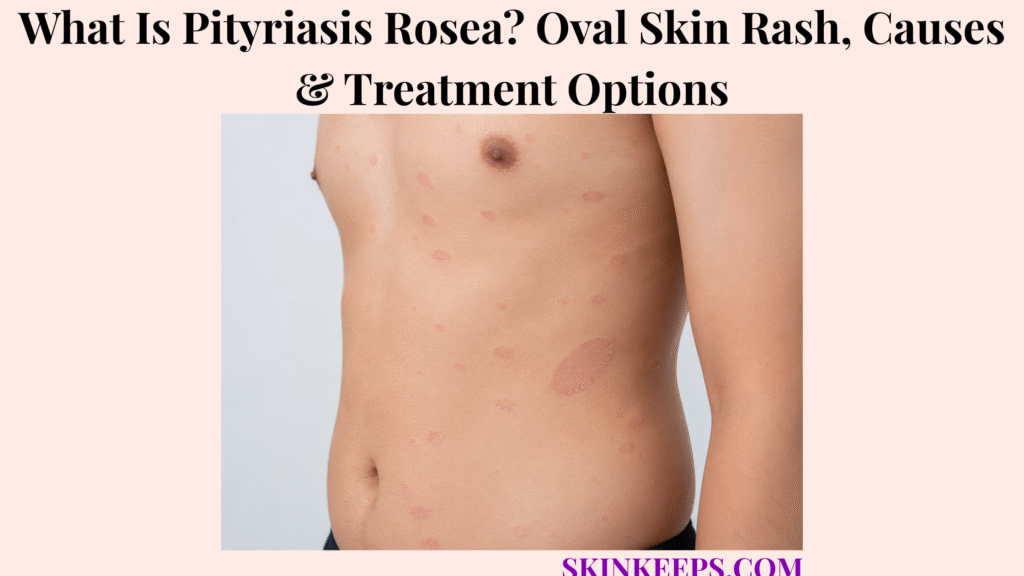
Pityriasis rosea is a usually self-limited inflammatory rash that classically begins with one larger oval herald patch followed days to weeks later by multiple smaller scaly lesions across the trunk. The herald patch often measures about 2–5 cm and may show a fine collarette of scale just inside its border.
The later oval lesions commonly align with skin-cleavage lines, creating the familiar Christmas-tree or fir-tree pattern across the back. Most cases resolve spontaneously and treatment mainly controls itch or discomfort, but atypical presentations should be distinguished from ringworm, guttate psoriasis, secondary syphilis and medication-related eruptions.
This article is for educational purposes only and does not constitute medical advice, diagnosis, or treatment. A presumed pityriasis rosea rash should be medically assessed when the diagnosis is uncertain, the palms or soles are involved, the eruption is unusually severe or persistent, significant systemic illness develops, a new medicine may be responsible, or the patient is pregnant—particularly early in pregnancy—because several infections, inflammatory disorders and medication reactions can mimic pityriasis rosea.
How Can You Recognize Pityriasis Rosea?
Pityriasis rosea classically begins with one larger oval scaly herald patch followed days to weeks later by many smaller oval lesions aligned along skin-cleavage lines of the trunk.
What Does the Herald Patch Look Like?
The herald patch is usually a single round or oval 2–5 cm lesion on the chest, abdomen or back with fine collarette scale just inside its border.
It is generally larger than the later lesions and can be slightly raised, pink, salmon, red, brown, gray or violet depending on skin tone and inflammation. One isolated herald-like patch is not enough by itself to prove pityriasis rosea.
What Happens After the Herald Patch Appears?
Several days to a few weeks later, pityriasis rosea usually produces numerous smaller oval scaly lesions across the chest and back, sometimes extending to the neck or proximal limbs.
The secondary lesions commonly remain smaller than the herald patch and may also show a delicate collarette scale. The face, scalp, palms and soles are less typical sites but can be involved in atypical variants.
Why Does Pityriasis Rosea Form a Christmas-Tree Pattern?
The long axes of the secondary oval lesions follow natural skin-cleavage lines, creating an angled branching pattern across the back that resembles a Christmas or fir tree.
This relationship—oval lesion orientation → cleavage-line alignment → branching trunk distribution—is more diagnostically useful than the presence of one round scaly patch alone.
Does Everyone Have a Herald Patch or the Same Symptoms?
No; some patients lack a herald patch or have atypical lesions, and itching ranges from absent to severe.
Darker skin may show gray, violet, brown or less obviously red lesions, and papular variants can be more prominent in some patients with deeply pigmented skin. Mild malaise, headache, fever or sore throat can precede the eruption, while post-inflammatory dark or light marks may remain after the active rash fades.
Figure 1. The classic pattern is herald patch → delayed smaller collarette-scaled lesions → cleavage-line alignment → Christmas-tree distribution → spontaneous fading.
Why Does Pityriasis Rosea Develop, and What Can Trigger a Similar Rash?
The exact cause of pityriasis rosea remains uncertain, although HHV-6/HHV-7-related immune activation is a leading hypothesis and some medicines can produce a similar pityriasis-rosea-like eruption.
What Causes Pityriasis Rosea, and What Is the HHV-6/HHV-7 Theory?
No single cause has been proven, but research has repeatedly examined reactivation or immune responses involving HHV-6 and HHV-7 as possible contributors.
These viruses are commonly acquired in childhood and remain latent in the body. Their association with pityriasis rosea is biologically plausible, but current evidence does not prove that they cause every case.
Are HHV-6 and HHV-7 the Same as Cold-Sore or Genital-Herpes Viruses?
No; HHV-6 and HHV-7 are different human herpesviruses from the HSV types responsible for ordinary cold sores and genital herpes.
The shared “herpesvirus” family name does not mean pityriasis rosea is a form of cold sore or genital herpes.
Is Pityriasis Rosea Contagious or Hereditary?
Pityriasis rosea has a low apparent person-to-person transmission risk and no established hereditary pattern.
Occasional clusters have been reported, but routine isolation or school exclusion is generally unnecessary. No proven prevention strategy or familial inheritance pattern has been established.
Can Medicines Cause a Pityriasis-Rosea-Like Eruption?
Yes; selected medicines can produce pityriasis-rosea-like eruptions, so recent drug exposure should be reviewed when the rash is unusually severe, persistent or atypical.
A drug-related eruption is not the same as classic idiopathic pityriasis rosea. Timing, morphology and sometimes histopathology can support the distinction, and medication changes should be made with the prescribing clinician rather than independently.
Figure 2. HHV-6/7 remain proposed contributors to classic PR, whereas a new medicine can cause a separate PR-like eruption that requires medication-history review.
How Is Pityriasis Rosea Distinguished and Diagnosed?
Pityriasis rosea is usually diagnosed clinically from its herald-patch sequence, collarette scale and cleavage-line distribution, with targeted testing used when ringworm, psoriasis, secondary syphilis or another diagnosis remains plausible.
How Is the Herald Patch Different From Ringworm?
A herald patch can resemble ringworm / tinea corporis, but classic pityriasis rosea progresses to a patterned secondary eruption while fungal scraping can confirm dermatophyte infection when ringworm remains possible.
Pityriasis rosea more often develops a delayed generalized eruption with multiple oval collarette-scaled lesions. Tinea corporis is a dermatophyte infection and should be treated as fungal disease only when the clinical picture or testing supports that diagnosis.
How Is Pityriasis Rosea Different From Guttate Psoriasis?
Guttate psoriasis usually produces many small scaly papules or plaques, while pityriasis rosea more characteristically forms oval collarette-scaled lesions along cleavage lines and may begin with a herald patch.
Guttate psoriasis can follow streptococcal infection and often has a drop-like morphology rather than the herald-patch-to-cleavage-line sequence of classic pityriasis rosea.
Why Is Secondary Syphilis an Important Mimic?
Secondary syphilis can resemble pityriasis rosea, especially when a widespread papulosquamous eruption involves the palms or soles or occurs with mucosal lesions, lymphadenopathy or relevant exposure history.
Substantial palm or sole involvement is atypical for classic pityriasis rosea and should lower the threshold for appropriate syphilis testing when the exposure history or morphology makes that diagnosis plausible.
When Are Laboratory Tests or Skin Biopsy Needed?
Routine testing is unnecessary in a classic case, but fungal studies, syphilis testing or biopsy become useful when the morphology, distribution, duration or history is atypical.
Fungal scraping answers a ringworm question, syphilis serology addresses a specific clinical or exposure concern, and biopsy is reserved for persistent or uncertain disease. Routine HHV-6/HHV-7 blood or PCR testing does not confirm ordinary pityriasis rosea and is not recommended for a classic presentation.
Figure 3. Classic PR is usually clinical; fungal studies, syphilis testing, medication review or biopsy are selected only when the pattern creates a specific diagnostic uncertainty.
How Is Pityriasis Rosea Treated?
Most pityriasis rosea needs only reassurance and symptom relief because the eruption usually resolves spontaneously within several weeks.
Does Every Case Need Treatment?
No; people with mild or non-itchy pityriasis rosea may need only reassurance while the rash follows its natural course.
There is no need to “eradicate” a typical mild eruption. Reassessment becomes more important when morphology, distribution or duration no longer fits the expected pattern.
How Can Emollients, Topical Corticosteroids and Antihistamines Help?
Emollients reduce dryness, topical corticosteroids can calm inflammation and itch, and oral antihistamines may help when pruritus interferes with sleep or daily activity.
Fragrance-free moisturizers, cooler showers, loose clothing and avoiding overheating can make the rash more comfortable. Topical corticosteroid strength should be selected according to site, age and severity rather than used strongly or indiscriminately.
When Is Acyclovir or Phototherapy Considered?
Acyclovir or dermatologist-supervised phototherapy may be considered for selected severe, extensive or especially troublesome pityriasis rosea, but neither is needed routinely.
Evidence suggests acyclovir can accelerate improvement in some patients, while phototherapy is an option for selected symptomatic disease. Supportive care remains first-line for ordinary mild cases.
Do Antibiotics or Antifungals Treat Pityriasis Rosea?
No; uncomplicated pityriasis rosea is not treated routinely with antibiotics or antifungals because it is neither an ordinary bacterial infection nor a dermatophyte infection.
Macrolide antibiotics have not shown consistent disease-directed benefit and are not standard treatment. Antifungals belong only to a confirmed or strongly suspected fungal diagnosis instead.
Figure 4. Mild disease usually needs reassurance, itch can be treated symptomatically, severe disease may justify selected escalation, and pregnancy or atypical persistence changes the need for confirmation and follow-up.
How Long Does Pityriasis Rosea Last, and Which Situations Need Closer Attention?
Pityriasis rosea usually clears in about 6–10 weeks, but pregnancy, palm/sole involvement, significant systemic symptoms or a rash lasting beyond roughly three months deserves closer assessment.
How Long Does the Rash Last, and Can It Leave Dark or Light Marks?
The active pityriasis rosea eruption usually resolves within several weeks, while post-inflammatory dark or light marks can persist for months after the rash itself has cleared.
A typical course is about 6–10 weeks. Hyperpigmentation or hypopigmentation can be especially visible in darker skin and may take 6–12 months to fade; these colour changes are not the same as scarring.
Does Pityriasis Rosea Need Special Attention During Pregnancy?
Yes; suspected pityriasis rosea during pregnancy—especially early pregnancy—should be clinically confirmed and discussed with the obstetric team because published studies have raised possible but uncertain concerns about adverse outcomes.
A 2025 review found conflicting evidence overall, with greater concern reported when onset occurred before about 15 weeks and when disease was widespread or accompanied by constitutional symptoms. Most reported pregnancies still had favorable outcomes, so pityriasis rosea should not be described as inevitably causing pregnancy loss.
Why Do Palms, Soles or Prominent Mouth Lesions Need Reassessment?
Classic pityriasis rosea usually spares the palms and soles, so substantial involvement there—or prominent oral lesions—makes alternative diagnoses more important to exclude.
Secondary syphilis and other papulosquamous disorders become more important when palms or soles are involved. Occasional oral lesions can occur in pityriasis rosea, but prominent mucosal disease warrants a broader differential.
When Should a Presumed Case Be Reassessed?
A presumed pityriasis rosea eruption should be reassessed if it continues worsening, lasts beyond about three months, repeatedly recurs, develops atypical morphology or occurs with substantial systemic illness.
Pregnancy, new medication exposure, palm/sole involvement and repeated recurrence also justify another look at the diagnosis. Recurrence is possible but uncommon.
What Should You Remember About Pityriasis Rosea?
Pityriasis rosea is a self-limited papulosquamous rash that classically progresses from one oval herald patch to multiple smaller collarette-scaled lesions following cleavage lines across the trunk.
- Pityriasis rosea usually resolves on its own.
- A herald patch is classic but not mandatory.
- Collarette scale is a useful recognition clue.
- Secondary lesions appear days to weeks later.
- The trunk is the classic site.
- Cleavage-line alignment creates the Christmas-tree pattern.
- Itch ranges from absent to severe.
- Darker skin may show gray, violet, brown or more persistent pigment marks.
- Mild constitutional symptoms can precede the rash.
- The exact cause remains uncertain.
- HHV-6 and HHV-7 are proposed associations, not proven universal causes.
- HHV-6/7 are different from HSV-1/2.
- Direct transmission concern is low and no hereditary pattern is established.
- Medicines can cause PR-like eruptions.
- Diagnosis is usually clinical.
- Ringworm can mimic the herald patch.
- Guttate psoriasis is another major papulosquamous differential.
- Secondary syphilis matters when palms, soles, mucosa or exposure history raise concern.
- Routine HHV testing is not diagnostic.
- Biopsy is selective.
- Most cases need only symptomatic treatment.
- Emollients, topical corticosteroids and antihistamines can reduce symptoms.
- Acyclovir and phototherapy are selected options rather than routine first-line care.
- Antibiotics are not standard disease-directed treatment.
- The active rash usually clears in weeks.
- Pigment marks can remain longer and are not scarring.
- Pregnancy deserves individual confirmation and obstetric discussion.
- Persistent or atypical disease needs reassessment.
Recognize herald-patch sequence → Confirm patterned secondary eruption → Exclude important mimics → Treat symptoms → Monitor special situations → Expect spontaneous resolution.
Frequently Asked Questions About Pityriasis Rosea
The most important pityriasis-rosea questions concern the herald patch, contagiousness, ringworm differentiation, expected duration and pregnancy-specific assessment.
What Does the Herald Patch of Pityriasis Rosea Look Like?
The herald patch is usually one larger oval or round scaly lesion on the trunk with a fine collarette of scale just inside its border. It commonly measures about 2–5 cm and appears before the smaller secondary eruption.
Is Pityriasis Rosea Contagious?
Pityriasis rosea has a low apparent risk of direct person-to-person transmission and generally does not require routine isolation or school exclusion. A suspected viral association does not mean the rash spreads like ringworm or ordinary viral exanthems.
How Can You Tell Pityriasis Rosea From Ringworm?
A herald patch can resemble ringworm, but pityriasis rosea usually develops a later generalized cleavage-line eruption, while fungal testing supports tinea corporis when the diagnosis is uncertain. Antifungal treatment belongs to fungal disease, not classic pityriasis rosea.
How Long Does Pityriasis Rosea Usually Take to Clear?
Most cases clear spontaneously in roughly 6–10 weeks, although post-inflammatory colour changes can remain much longer. A rash persisting beyond about three months should be reassessed.
Does Pityriasis Rosea Require Special Care During Pregnancy?
Yes; suspected pityriasis rosea during pregnancy, particularly early pregnancy, should be medically confirmed and discussed with the obstetric team because published pregnancy-risk data are limited and conflicting. Most reported outcomes are favorable, so risk should not be presented as inevitable.
Which Sources Support This Pityriasis Rosea Guidance?
DermNet — Pityriasis Rosea — Primary source for herald patch, collarette scale, secondary eruption, Christmas-tree pattern, atypical variants, viral uncertainty, drug eruptions, differential diagnosis, testing and 6–10-week resolution.
American Academy of Dermatology — Pityriasis Rosea: Signs and Symptoms — Used for skin-tone variation, body distribution, oral involvement and the usual several-week course.
American Academy of Dermatology — Pityriasis Rosea: Causes — Used for current HHV-6/HHV-7 framing and the distinction from HSV-related cold sores or genital herpes.
American Academy of Dermatology — Pityriasis Rosea: Diagnosis and Treatment — Used for clinical diagnosis, symptom treatment, pregnancy confirmation, medication-history review and reassessment of prolonged disease.
CDC — About Syphilis — Used narrowly for the clinical relevance of palm/sole involvement and why secondary syphilis must remain in the differential of an atypical papulosquamous eruption.
International Journal of Women’s Dermatology 2025 — The Risks of Pityriasis Rosea in Pregnancy: A Review — Used for the limited and conflicting pregnancy evidence, greater concern with very early onset and the need for close clinical/obstetric assessment.
JMIR Dermatology — From the Cochrane Library: Interventions for Pityriasis Rosea — Used for selected acyclovir benefit, weak evidence for many routine interventions and the lack of support for macrolide antibiotics as standard disease-directed treatment.