
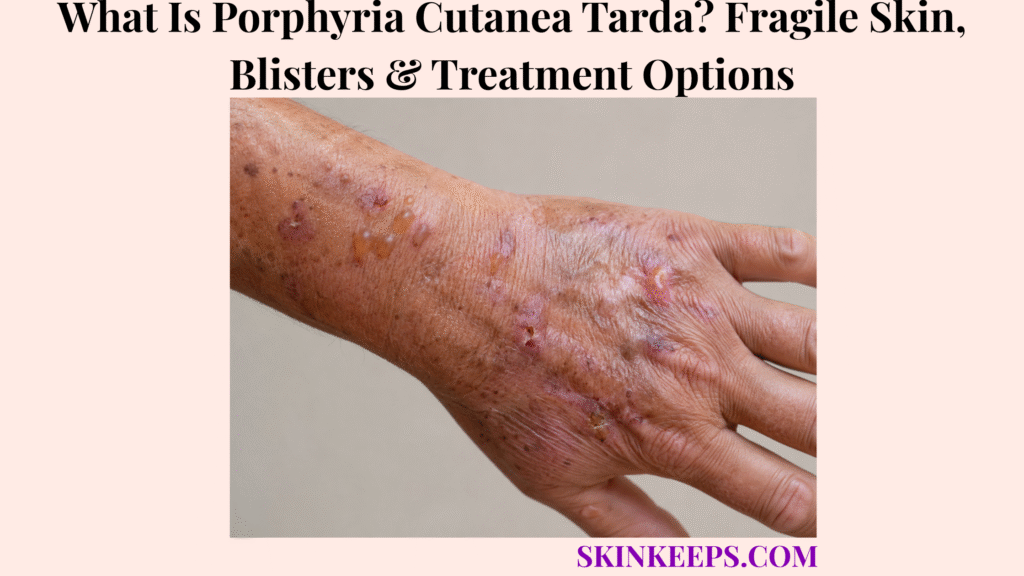
Porphyria cutanea tarda is a porphyrin-metabolism disorder that makes sun-exposed skin unusually fragile and prone to blisters, erosions, slow healing and scarring. Reduced hepatic uroporphyrinogen decarboxylase activity allows photosensitizing porphyrins to accumulate, and light exposure then converts that biochemical burden into visible skin injury.
PCT requires laboratory confirmation because fragile blistering skin is not specific to one disease. Iron, liver disease, alcohol, estrogen, smoking and inherited susceptibility can contribute, while treatment reduces the underlying porphyrin burden through clinician-directed phlebotomy or low-dose antimalarial therapy; skin protection remains important because healing is gradual and recurrence can occur.
This article is for educational purposes only and does not constitute medical advice, diagnosis, or treatment. Persistent unexplained blistering or skin fragility on sun-exposed areas should be evaluated by a licensed dermatologist or qualified healthcare professional, particularly when lesions are worsening, becoming infected, healing poorly or occurring with signs of liver or systemic illness, because laboratory testing is required to distinguish porphyria cutanea tarda from other blistering and photosensitivity disorders.
What Is Porphyria Cutanea Tarda and How Does It Affect the Skin?
Porphyria cutanea tarda occurs when excess porphyrins accumulate and make the skin abnormally sensitive to light, leading to fragile, easily injured skin on sun-exposed areas.
Why Do Porphyrins Build Up in Porphyria Cutanea Tarda?
PCT develops when activity of the hepatic enzyme uroporphyrinogen decarboxylase is reduced, allowing photosensitizing porphyrins to accumulate.
This is a systemic biochemical problem in the heme-production pathway rather than a defect limited to the skin. The skin becomes one of the most visible targets because circulating porphyrins can absorb light and generate tissue-damaging reactions.
Why Does PCT Mainly Affect Sun-Exposed Skin?
Accumulated porphyrins absorb light energy in exposed skin and trigger tissue injury, making repeatedly exposed areas especially vulnerable to blistering and fragility.
The sequence is porphyrin accumulation → light exposure → photosensitive tissue injury → fragile skin → blister or erosion. Sunlight therefore activates injury but does not create the underlying metabolic abnormality.
Is PCT Simply a Skin Disease?
No; the skin manifestations are prominent, but PCT reflects an underlying porphyrin-processing disorder that requires systemic evaluation rather than skin treatment alone.
Iron status, liver health, susceptibility factors and biochemical porphyrin levels all matter because successful treatment must reduce the underlying disease activity rather than only covering or drying the blisters.
Figure 1. PCT connects a hepatic porphyrin-processing defect to light-triggered skin injury: porphyrins accumulate first, then ultraviolet/visible-light exposure makes sun-exposed tissue fragile and blister-prone.
What Skin Signs and Symptoms Does Porphyria Cutanea Tarda Cause?
PCT typically causes unusually fragile sun-exposed skin with recurrent fluid-filled blisters, erosions and slow healing that can leave scars, pigment change or small white cyst-like lesions.
Where Do PCT Blisters and Fragile Skin Usually Appear?
PCT blistering and fragility mainly affect chronically sun-exposed skin, especially the backs of the hands and forearms.
Minor trauma can tear these areas more easily than expected because the skin has become structurally fragile. Lesions may recur in the same general exposed regions as long as biochemical disease remains active.
What Happens When PCT Blisters Break or Heal?
PCT blisters can rupture into erosions and crusts, heal slowly and leave scars or small white cyst-like lesions after the active blister has resolved.
Some healed areas can develop small white cyst-like bumps resembling milia. These post-healing bumps should still be assessed in context rather than assuming every white bump in a person with PCT has the same cause.
Can PCT Cause Pigment Changes or Increased Facial Hair?
Yes; PCT can be associated with altered skin pigmentation and increased facial hair in some affected people alongside its blistering and fragility.
Repeated inflammation and healing may leave areas of persistent hyperpigmentation or other pigment alteration. Hypertrichosis, especially on the face, is a recognized but secondary clinical clue.
Figure 2. PCT lesions often progress from fragile sun-exposed skin to blistering, erosion and slow healing, sometimes leaving scars, pigmentary change or small white cyst-like lesions.
What Causes or Triggers Porphyria Cutanea Tarda?
PCT reflects an underlying porphyrin-processing abnormality, while iron excess, liver-related factors, alcohol exposure, estrogen use, smoking and inherited susceptibility can help promote clinically apparent disease in some people.
How Do Iron and Liver Problems Contribute to PCT?
Excess iron and liver-related abnormalities can disrupt the metabolic environment involved in porphyrin handling and are therefore important contributors to evaluate when PCT is suspected.
Iron is tightly linked to hepatic UROD dysfunction in PCT, and many clinically active cases occur alongside iron overload or liver disease. Evaluation therefore looks beyond the skin to the biochemical and hepatic environment in which porphyrins are accumulating.
Which Exposures Can Increase the Risk of Clinically Active PCT?
Alcohol exposure, estrogen use and smoking are among the modifiable factors that can contribute to clinically apparent PCT in susceptible people.
These are contributors rather than universal causes, and different patients have different combinations of susceptibility factors. Changes involving prescribed estrogen or other medications should be discussed with the treating clinician rather than stopped independently.
Is Porphyria Cutanea Tarda Inherited?
Some PCT occurs in people with inherited susceptibility, while other cases develop without an obvious family history.
Familial PCT involves inherited UROD deficiency, whereas many patients have sporadic hepatic enzyme suppression without a germline UROD variant. Genetic testing is therefore selective rather than a routine requirement for every patient.
How Is Porphyria Cutanea Tarda Diagnosed?
PCT cannot be confirmed from fragile skin and blisters alone; diagnosis requires laboratory evidence of abnormal porphyrin accumulation together with evaluation for relevant iron, liver and inherited contributors.
Which Porphyrin Tests Help Confirm PCT?
Porphyrin testing of appropriate biological samples is central to confirming that a photosensitive blistering disorder is actually porphyria cutanea tarda.
Urine and plasma porphyrin measurements are commonly used first, followed by porphyrin fractionation or other specialist biochemical testing when needed to distinguish PCT from other porphyrias. Appearance alone is insufficient because several blistering and photosensitivity disorders can look similar.
Why Are Blood, Urine, Liver and Iron Tests Important?
Additional laboratory testing helps confirm the porphyrin abnormality and identify iron or liver-related factors that may be driving or complicating PCT.
Clinician-directed evaluation can include porphyrin studies, iron markers, liver testing and assessment for relevant liver or infectious contributors. The exact panel should follow the patient’s history rather than a one-size-fits-all checklist.
When Might Genetic or Additional Testing Be Needed?
Genetic or broader diagnostic testing may be considered when inherited susceptibility, an atypical presentation or another blistering/photosensitivity disorder needs clarification.
Testing is most useful when the laboratory pattern and clinical history need further explanation. Atypical cases may require specialist porphyria input or skin biopsy to exclude a non-porphyria blistering disorder.
Figure 3. PCT is not a visual diagnosis alone: porphyrin testing confirms the biochemical disorder, while iron, liver and selective genetic evaluation identify important contributors.
How Is Porphyria Cutanea Tarda Treated, and How Can New Blisters or Recurrence Be Prevented?
PCT treatment reduces excess porphyrin burden through clinician-directed therapy while simultaneously managing contributing factors and protecting fragile skin from ultraviolet exposure, trauma and secondary injury.
How Does Phlebotomy Help Treat PCT?
Therapeutic phlebotomy reduces body iron in a controlled medical setting, helping remove an important factor that promotes excess porphyrin accumulation in PCT.
As iron stores fall under medical supervision, the hepatic environment becomes less favorable for continued porphyrin accumulation and porphyrin levels gradually decline. This is medically prescribed treatment, not self-directed blood removal.
When Are Low-Dose Antimalarial Medicines Used?
Low-dose antimalarial therapy is an alternative clinician-directed approach that can help reduce accumulated porphyrins in appropriately selected PCT patients.
Low-dose hydroxychloroquine or chloroquine can mobilize stored porphyrins and help achieve biochemical remission when phlebotomy is unsuitable or another strategy is preferred. PCT uses deliberately low dosing because higher antimalarial doses can worsen porphyrin release and hepatic injury, so treatment must remain specialist-directed.
Why Must Iron, Liver and Exposure Triggers Be Managed?
Treating PCT without addressing persistent iron, liver or exposure-related contributors can leave the conditions that promoted porphyrin accumulation in place and increase the chance of future disease activity.
Management may therefore include treating relevant liver disease, addressing excess iron and discussing alcohol, estrogen and smoking exposure with the treating team. Trigger reduction complements—not replaces—porphyrin-lowering treatment.
How Should Fragile Skin Be Protected, and Can PCT Return?
During active PCT, reducing relevant light exposure and protecting fragile skin from trauma, friction and wound contamination can prevent additional injury, but recurrence remains possible after remission if contributing factors persist or return.
Protective clothing, gloves, careful handling of blistered skin and prompt attention to infection can reduce secondary injury while biochemical disease is being treated. Laboratory reassessment—not blister appearance alone—should guide whether recurrent symptoms represent active PCT.
Figure 4. PCT treatment reduces porphyrin-driving burden with phlebotomy or selected low-dose antimalarial therapy while addressing contributors and protecting fragile skin; remission is achievable but recurrence can occur.
What Should You Remember About Porphyria Cutanea Tarda?
Porphyria cutanea tarda is a photosensitive porphyrin disorder that causes fragile sun-exposed skin and recurrent blistering and requires laboratory confirmation plus treatment directed at the underlying porphyrin burden.
- PCT is one specific porphyria phenotype.
- Excess porphyrins are central to the disease.
- Reduced hepatic UROD activity is the core biochemical defect.
- Light activates porphyrin-related tissue injury.
- Fragile sun-exposed skin is characteristic.
- Blisters and vesicles can occur.
- Blisters can rupture into erosions and crusts.
- Healing may be slow.
- Scarring can occur.
- Small white cyst-like lesions can remain after healing.
- Pigment change can occur.
- Increased facial hair can occur in some people.
- Iron is an important contributor.
- Liver factors matter.
- Alcohol can contribute but is not the sole cause.
- Estrogen can contribute but is not the sole cause.
- Smoking can contribute.
- Some PCT has inherited susceptibility.
- PCT is not contagious.
- Appearance alone does not confirm PCT.
- Porphyrin testing is central to diagnosis.
- Iron and liver evaluation help identify contributors.
- Genetic testing is selective.
- Therapeutic phlebotomy reduces iron burden.
- Low-dose antimalarial therapy is another clinician-directed option.
- Trigger management remains important.
- Photoprotection reduces additional photosensitive injury.
- Trauma and friction should be minimized.
- Wound contamination and infection need attention.
- Clinical and biochemical remission is possible.
- PCT can recur after remission.
Recognize photosensitive fragile skin → Confirm porphyrin excess → Identify contributing factors → Reduce porphyrin burden → Protect skin → Monitor remission and recurrence.
Frequently Asked Questions About Porphyria Cutanea Tarda
The most important PCT questions concern inheritance, contagion, remission, whether blisters are always present and the possibility of recurrence after treatment.
Is Porphyria Cutanea Tarda Inherited?
Some PCT involves inherited susceptibility, but many people develop clinically apparent disease without an obvious family history. Genetic testing is selective, and iron, liver and exposure-related susceptibility factors still matter even when familial disease is present.
Is Porphyria Cutanea Tarda Contagious?
No; PCT is a metabolic porphyrin disorder and cannot spread from one person to another through skin contact.
Can Porphyria Cutanea Tarda Be Cured?
PCT can often be brought into clinical and biochemical remission by reducing porphyrin burden and managing contributing factors, but recurrence remains possible and permanent cure cannot be guaranteed.
Does Porphyria Cutanea Tarda Always Cause Blisters?
Blistering is a classic PCT feature, but the broader skin pattern also includes abnormal fragility, erosions, scarring, pigment change and other photosensitive findings. Absence of one visible blister at a single visit does not exclude the disease.
Can Porphyria Cutanea Tarda Come Back After Treatment?
Yes; PCT can recur after remission, particularly when contributing iron, liver or exposure-related factors remain or return. Follow-up and repeat laboratory assessment are appropriate when recurrence is suspected.
Which Sources Support This Porphyria Cutanea Tarda Guidance?
DermNet — Porphyria Cutanea Tarda — Primary source for PCT definition, UROD deficiency, photosensitive blistering and fragility, liver/iron contributors, laboratory confirmation and treatment principles.
StatPearls — Porphyria Cutanea Tarda — Used for the current 2026 biochemical mechanism, porphyrin testing approach, susceptibility factors, remission/recurrence framing and laboratory follow-up context.
American Porphyria Foundation — Porphyria Cutanea Tarda — Used for clinician-directed phlebotomy, low-dose hydroxychloroquine/chloroquine, trigger management, sunlight protection, wound-infection precautions and relapse after remission.
American Porphyria Foundation — Porphyria FAQ — Used for practical PCT diagnostic testing, blister/fragility framing and treatment individualization.