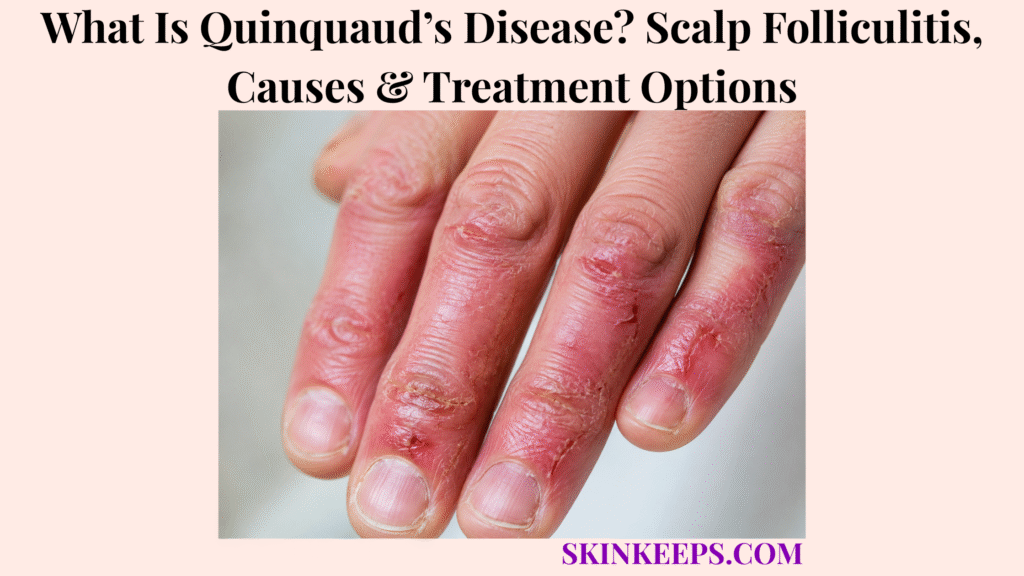
Folliculitis decalvans, historically called Quinquaud’s disease, is a chronic neutrophilic scarring alopecia that causes recurrent scalp inflammation and can permanently destroy hair follicles. Active disease often produces follicular pustules, perifollicular crusting and inflammatory change around areas that progressively lose follicular openings and become scarred.
Hair tufting can be an important clue, but diagnosis depends on the whole pattern and may be supported by trichoscopy, microbiology, fungal testing or biopsy when needed. Treatment focuses on stopping active inflammation and preserving follicles that remain, because follicles already replaced by scar tissue generally do not regenerate hair.
This article is for educational purposes only. Persistent scalp pustules, scarring or progressive hair loss should be evaluated by a dermatologist.
What Is Quinquaud’s Disease and What Does Folliculitis Decalvans Look Like?
Quinquaud’s disease is folliculitis decalvans, a chronic inflammatory scarring alopecia that causes follicular pustules, crusting, tufted hairs and progressively permanent hair loss.
Why Is Folliculitis Decalvans Classified as a Scarring Alopecia?
Folliculitis decalvans is a scarring alopecia because chronic follicular inflammation can destroy follicles and replace them with fibrotic scar tissue.
The core progression is persistent inflammation → follicular injury → follicular destruction → fibrosis → irreversible alopecia. Anti-inflammatory treatment can protect follicles that remain at risk, but it cannot simply recreate a follicle that has already been replaced by scar tissue.
What Do FD Pustules and Crusts Look Like?
Active folliculitis decalvans commonly produces follicular pustules, yellow or perifollicular crusting, scale and inflammation around the advancing edge of affected scalp.
Erosions, discharge or occasional bleeding can occur around active follicles. The clinically important zone is often the inflammatory margin, because that is where follicles may still be present but threatened by ongoing disease activity.
What Is Hair Tufting in Folliculitis Decalvans?
Hair tufting is a characteristic pattern in which several hair shafts appear to emerge together from one enlarged follicular opening, producing a doll’s-hair or toothbrush-like appearance.
Tufting is a useful clue because it often accompanies established follicular damage, but it is not completely unique to folliculitis decalvans and should not be treated as a stand-alone diagnostic test.
How Does FD Progress From Inflammation to Permanent Hair Loss?
Active pustules and crusting can expand outward while previously inflamed areas become smooth or atrophic scarred patches where follicles have been permanently lost.
Itch, tenderness, burning or pain may occur, although some people have little discomfort despite active disease. The mismatch between an inflammatory edge and a smoother scarred center explains why early recognition matters: the margin may still contain follicles that can be preserved.
Figure 1. Folliculitis decalvans matters because the disease can move from active pustular inflammation to permanent follicular loss; the treatment opportunity is greatest before vulnerable follicles are replaced by scar tissue.
What Causes Folliculitis Decalvans, and Is It Contagious?
The exact cause of folliculitis decalvans remains uncertain, but current models involve abnormal inflammatory responses around follicles, often discussed in relation to Staphylococcus aureus, rather than a simple contagious scalp infection.
Is Staphylococcus aureus the Cause of Folliculitis Decalvans?
Staphylococcus aureus is frequently discussed in folliculitis decalvans, but current evidence does not support describing FD as a straightforward ordinary Staph infection.
Bacteria may participate in the disease environment, while an abnormal host inflammatory response is thought to be important. That distinction explains why antibiotics can be useful without proving that one organism is the sole cause of every case.
How Does Neutrophilic Inflammation Damage Hair Follicles?
Neutrophilic inflammation concentrates around active follicles, producing pustules and tissue injury that can eventually rupture follicles and lead to perifollicular fibrosis.
The reader-level sequence is neutrophils → perifollicular inflammation → follicular injury → rupture → scar formation. This is the mechanism that links a visibly inflamed scalp to permanent cicatricial alopecia.
Is Folliculitis Decalvans Contagious or Inherited?
Folliculitis decalvans is not generally considered contagious and is not usually regarded as a straightforward inherited disorder, although uncommon familial cases have been reported.
Family members do not need treatment simply because one person has FD, and the suspected bacterial contribution should not be interpreted as evidence that the scarring alopecia itself spreads from person to person.
Figure 2. The best current model is not “Staph infection causes FD,” but a susceptible follicular environment plus abnormal inflammatory response, with possible bacterial participation, leading to recurrent neutrophilic injury and scarring.
How Is Folliculitis Decalvans Diagnosed and Distinguished From Other Scalp Disorders?
Folliculitis decalvans is usually recognized from scarring alopecia combined with follicular pustules, crusting, perifollicular inflammation and tufted hairs, with trichoscopy, microbiology or biopsy used when clarification is needed.
How Does a Dermatologist Recognize Folliculitis Decalvans?
The key diagnostic pattern is scarring hair loss together with active follicular pustules or crusting, inflammatory margins and characteristic hair tufting.
The dermatologist looks at the chronic course, distribution, active-versus-scarred scalp pattern and whether follicular openings are being lost. This is what separates FD from ordinary folliculitis, where pustules can occur without the same defining pathway to cicatricial alopecia.
What Does Trichoscopy Show in Folliculitis Decalvans?
Trichoscopy can reveal tufted hairs, perifollicular redness and scale, scattered pustules and white scarred areas that support the diagnosis and help identify active disease.
These findings improve pattern recognition and can help distinguish active margins from established fibrosis, but trichoscopy alone does not prove FD without the broader clinical context.
When Are Scalp Swabs, Fungal Tests or Biopsy Needed?
Microbiology, fungal testing or scalp biopsy may be used when the diagnosis is uncertain, infection needs characterization or another scarring alopecia must be excluded.
Swabs can help characterize organisms and guide antimicrobial decisions, while fungal testing can help exclude dermatophyte disease such as ringworm when tinea capitis is plausible. Biopsy is selective and can show early neutrophilic follicular inflammation or later follicular destruction and fibrosis.
What Conditions Can Resemble Folliculitis Decalvans?
Tinea capitis, dissecting cellulitis, lichen planopilaris, discoid lupus and other cicatricial alopecias can resemble folliculitis decalvans, particularly when pustules and permanent hair loss occur together.
Inflammatory scarring disease such as discoid lupus erythematosus belongs to a different disease mechanism, so treatment should follow the confirmed scarring-alopecia subtype rather than the presence of hair loss alone.
Figure 3. The key diagnostic fork is scarring versus nonscarring disease; once scarring is present, the active margin, tufting, trichoscopy and selective tests help define which cicatricial alopecia is responsible.
How Is Folliculitis Decalvans Treated?
Folliculitis decalvans treatment aims to suppress active follicular inflammation, stop pustules and crusting and prevent additional permanent hair loss rather than regenerate follicles already destroyed by scarring.
What Is the Main Goal of FD Treatment?
The main goal is to control active inflammation early enough to preserve remaining follicles and prevent expansion of cicatricial alopecia.
Success should not be measured only by whether pustules disappear. The deeper objective is suppress inflammation → reduce active lesions → prevent follicular destruction → preserve hair that can still survive.
How Are Antibiotics Used for Folliculitis Decalvans?
Dermatologist-directed antibiotics are commonly used in FD because they may provide antimicrobial and anti-inflammatory effects within the active follicular disease process.
Tetracycline-class therapy, selected combination regimens and topical antimicrobial treatment may be used depending on the clinical situation. Treatment choice and duration should be clinician-directed rather than copied as a self-treatment regimen.
How Are Corticosteroids and Other Anti-Inflammatory Treatments Used?
Topical, intralesional or selected systemic anti-inflammatory treatments can be used to reduce active perifollicular inflammation according to disease severity and response.
Topical corticosteroids and intralesional corticosteroid treatment can be used in selected active areas, while more extensive disease may require broader specialist-directed anti-inflammatory strategies.
When Are Isotretinoin or Other Systemic Treatments Considered?
Recurrent, difficult or treatment-resistant folliculitis decalvans may require isotretinoin or other specialist-selected systemic therapies when conventional approaches do not adequately control active disease.
FD is rare and the evidence base is more limited than for many common scalp disorders, so treatment must be individualized. Long-term follow-up is often needed because FD may relapse after improvement.
Figure 4. FD treatment is a hair-preservation strategy: suppress inflammation at the active margin, reassess disease activity, escalate resistant disease when needed, and protect remaining follicles rather than promising regrowth from established scar tissue.
How Can People With Folliculitis Decalvans Protect the Scalp and Preserve Remaining Hair?
Scalp care in folliculitis decalvans should minimize unnecessary trauma, support prescribed treatment and focus on preserving non-scarred follicles while monitoring for recurrent inflammatory activity.
How Should the Scalp Be Cared for During Active FD?
During active folliculitis decalvans, the scalp should be handled gently and pustules should not be repeatedly squeezed, picked or traumatized.
Prescribed scalp treatment should be followed consistently, crust and scale should be managed gently, and clinician-directed medicated or antiseptic shampoo can be used as supportive care where appropriate. Shampoo is an adjunct, not a cure for the scarring inflammatory process.
Can Hair Grow Back After Folliculitis Decalvans Is Controlled?
Hair can continue growing from follicles that have not been permanently destroyed, but follicles replaced by scar tissue generally do not regenerate hair.
This distinction is central to expectations: improving the disease can stabilize hair loss and protect surviving follicles, while smooth scarred areas with destroyed follicular structures should not be promised to regrow.
When Can Hair Restoration Be Considered?
Cosmetic camouflage or selected surgical hair restoration may be considered only after folliculitis decalvans has remained inactive, because active disease can damage newly transplanted follicles.
Restoration belongs after disease control, not before it. The timing and suitability require specialist assessment rather than a fixed transplant interval or graft-count rule.
When Should Folliculitis Decalvans Be Reassessed?
Dermatology reassessment is appropriate when pustules or crusting persist, scarred areas expand, tufting appears, hair loss progresses despite treatment or the disease returns after a period of control.
New smooth scarred patches, recurrent pain or inflammation, treatment failure or uncertainty about the diagnosis all deserve review. Early control matters because further follicular destruction can become irreversible.
What Should You Remember About Quinquaud’s Disease / Folliculitis Decalvans?
Quinquaud’s disease is folliculitis decalvans, a chronic neutrophilic scarring alopecia in which active scalp inflammation can permanently destroy hair follicles.
- Quinquaud’s disease is a historical name for folliculitis decalvans.
- FD is not generic scalp folliculitis.
- FD is a scarring alopecia.
- Neutrophilic inflammation is central.
- Pustules and perifollicular crusting mark active disease.
- Tufted hairs are an important clue but are not completely unique.
- The active margin and scarred centre represent different disease stages.
- Scarred scalp has lost follicles.
- Established scarring hair loss is permanent.
- Itch, pain, burning or tenderness may occur.
- Some people have little discomfort despite active disease.
- The exact cause remains uncertain.
- Staphylococcus aureus may contribute but is not a proven sole cause.
- FD is not generally contagious.
- Familial cases are uncommon.
- Diagnosis is primarily clinical.
- Trichoscopy can help identify tufting, inflammation and scarred areas.
- Scalp culture can be useful in selected cases.
- Fungal testing can help exclude tinea capitis.
- Biopsy is selective rather than universal.
- Ordinary folliculitis differs because scarring changes the diagnostic task.
- Other cicatricial alopecias may need exclusion.
- Treatment aims to suppress active inflammation.
- Antibiotics are commonly used without implying FD is a simple infection.
- Corticosteroid treatment can help selected active disease.
- Isotretinoin or other systemic treatment may be specialist-selected.
- Long-term relapse can occur.
- Gentle scalp care is supportive rather than curative.
- Destroyed follicles do not simply regrow.
- Hair restoration should wait until disease is inactive.
Pustules/crusting → identify scarring → confirm FD → suppress active inflammation → preserve remaining follicles → monitor recurrence.
Frequently Asked Questions About Quinquaud’s Disease / Folliculitis Decalvans
The main questions concern terminology, contagion, hair regrowth, long-term control and recurrence.
Is Quinquaud’s Disease the Same as Folliculitis Decalvans?
Yes; Quinquaud’s disease is a historical name for folliculitis decalvans.
Is Folliculitis Decalvans Contagious?
No; FD is not generally considered contagious despite the suspected involvement of Staphylococcus aureus in its disease mechanism.
Can Hair Grow Back After Folliculitis Decalvans?
Hair may continue growing from surviving follicles, but hair usually does not regrow from follicles permanently replaced by scar tissue.
Can Folliculitis Decalvans Be Permanently Cured?
FD can often be controlled, but it may follow a chronic relapsing course and permanent remission cannot be guaranteed.
Why Does Folliculitis Decalvans Keep Coming Back?
FD can recur because suppressing one episode of inflammation does not necessarily eliminate the underlying tendency toward chronic follicular inflammation.
Which Sources Support This Folliculitis Decalvans Guidance?
DermNet — Folliculitis Decalvans — Used for definition, neutrophilic scarring alopecia, pustules/crusting, tufting, trichoscopy, Staphylococcus hypothesis, diagnosis, biopsy, treatment categories, recurrence and permanent hair loss.
DermNet — Trichoscopy of Localised Cicatricial Hair Loss — Used for trichoscopic findings including tufted hairs, perifollicular scale, pustules and fibrosis-related white areas.
British Association of Dermatologists — Folliculitis Decalvans — Used for non-contagious framing, symptoms, scalp swabs, fungal testing, recurrence, treatment expectations and hair-restoration caution.
European Academy of Dermatology and Venereology — Folliculitis Decalvans Position Statement — Used for the contemporary treatment objective of controlling inflammation and preventing further permanent hair loss.
Journal of the European Academy of Dermatology and Venereology — Management of Folliculitis Decalvans — Used for chronic relapsing course, treatment framework and the principle that established scarring does not provide an expected hair-regrowth target.