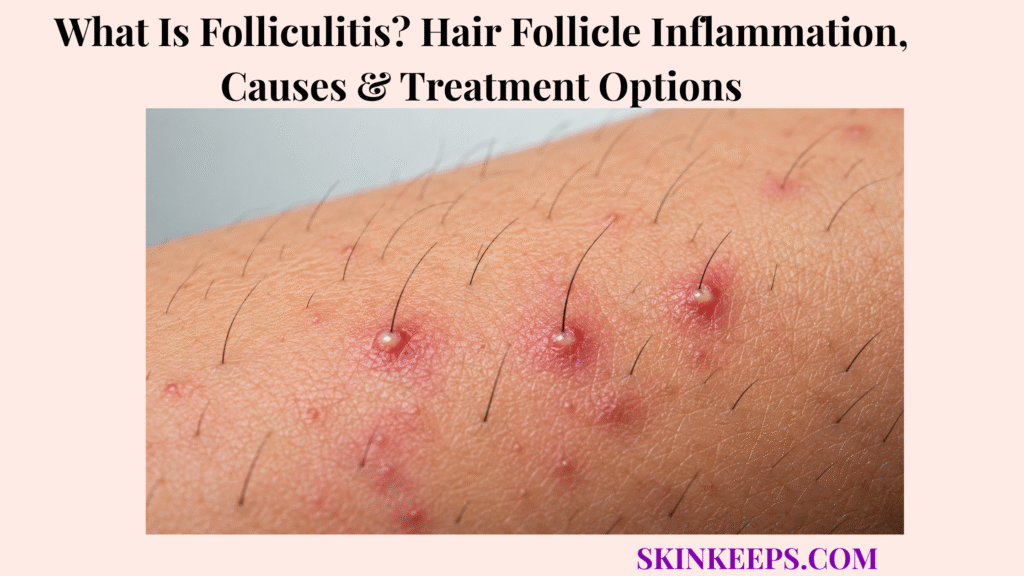
Folliculitis is inflammation of one or more hair follicles that can cause small red, skin-coloured, itchy, tender, burning, crusted, or pus-filled bumps on hair-bearing skin.
It is not one single infection. Infection, shaving, friction, occlusion, sweat, products, medicines, and inflammatory disorders can produce similar follicular eruptions, so treatment must match the cause, depth, severity, and recurrence pattern.
How Can You Recognize Folliculitis Around a Hair Follicle?
Folliculitis usually causes relatively uniform bumps or pustules centered around individual hairs on hair-bearing skin.
The lesions may be red, pink, purple, brown, skin-coloured, or pus-filled depending on skin tone and inflammation. They can itch, burn, feel sore or tender, crust after opening, or appear in groups.
Common sites include the scalp, beard area, neck, chest, back, buttocks, thighs, arms, and legs. Appearance identifies a follicular pattern but cannot prove whether the cause is bacterial, yeast-related, shaving-related, occlusive, medication-related, or inflammatory.
- Small bumps or pustules centered around hairs.
- Relatively uniform lesions rather than several different pore lesions.
- Itching, tenderness, burning, or soreness.
- Crusting or drainage from some pustules.
- Grouped bumps on hair-bearing skin.
- Recent shaving, sweating, friction, hot-tub exposure, or product change.
- Rapid spread, deep pain, fever, hair loss, or scarring as warning signs.
Figure 1. Folliculitis commonly produces relatively uniform bumps or pustules centered around hairs, but appearance alone cannot determine the cause.
How Does Folliculitis Develop Inside a Hair Follicle?
Folliculitis develops when a follicle becomes inflamed after irritation, blockage, physical injury, microbial invasion, overgrowth, or another inflammatory trigger.
Close shaving, rubbing, sweat, occlusion, and irritating products can disturb the follicular opening. Bacteria, yeast, viruses, or parasites can then cause infection in selected cases, while other eruptions remain noninfectious.
How Do Superficial and Deep Folliculitis Differ?
Superficial folliculitis affects the upper follicle, while deep folliculitis extends farther down and is more likely to be painful, swollen, recurrent, or complicated.
Small papules and pustules often fit a superficial pattern. Larger painful nodules, boils, carbuncles, and abscess-like lesions suggest deeper involvement and require a lower threshold for medical assessment.
| Feature | Superficial Folliculitis | Deep Folliculitis |
|---|---|---|
| Depth | Upper follicle and nearby surface skin. | Deeper follicle and surrounding tissue. |
| Feel | Itchy, mildly tender, burning, or sore. | More painful, swollen, and pressure-sensitive. |
| Appearance | Small papules or pustules. | Nodule, boil, carbuncle, or abscess-like lesion. |
| Risk | Often limited when mild. | Greater risk of spread, scarring, or hair loss. |
| Care | Basic care may help selected mild cases. | Medical review is more likely to be needed. |
Figure 2. Superficial folliculitis stays near the upper follicle, while deep folliculitis extends farther down and carries greater risk of boils, abscesses, scarring, or hair loss.
What Causes Folliculitis in Hair-Bearing Skin?
Folliculitis can be caused by bacterial, yeast-related, viral, or parasitic infection as well as shaving, friction, heat, sweat, occlusion, products, medicines, and inflammatory skin conditions.
Which Infections Can Cause Folliculitis?
Infectious folliculitis may be bacterial, yeast-related, viral, or parasitic, and the likely organism depends on the distribution and exposure history.
Bacterial folliculitis commonly involves Staphylococcus aureus. Hot-tub or spa-pool folliculitis is linked with Pseudomonas exposure in warm water, often affecting swimsuit-covered skin.
Malassezia folliculitis produces small, uniform, often itchy papules and pustules, especially on the upper chest, shoulders, and back. It can resemble acne but usually lacks blackheads and whiteheads.
Which Noninfectious Triggers Can Inflame Hair Follicles?
Shaving, waxing, plucking, ingrown-hair irritation, tight clothing, protective equipment, heat, sweating, friction, pressure, heavy oils, chemicals, and medicines can inflame follicles without a primary bacterial infection.
A purely irritant, shaving-related, product-related, or occlusion-related eruption improves by reducing the trigger. Antibiotics cannot correct every nonbacterial follicular eruption.
| Trigger or Organism | Typical Clue | Common Area | Treatment Direction |
|---|---|---|---|
| Staphylococcal bacteria | Tender pustules around hairs. | Beard, scalp, trunk, or limbs. | Antibacterial care when indicated. |
| Pseudomonas / hot tub | Itchy bumps after warm-water exposure. | Swimsuit-covered skin. | Avoid source; assess if severe or persistent. |
| Malassezia yeast | Itchy uniform acne-like bumps. | Upper trunk, shoulders, and back. | Antifungal direction when supported. |
| Shaving or ingrown hair | Bumps after hair removal. | Beard, legs, or pubic area. | Pause or modify shaving. |
| Friction or occlusion | Bumps under tight clothing or equipment. | Thighs, buttocks, back, or pressure zones. | Reduce friction and trapped sweat. |
| Products or medicines | Eruption after exposure or treatment change. | Contact or widespread pattern. | Review and remove the trigger safely. |
Which Factors Make Folliculitis More Likely to Develop?
Folliculitis becomes more likely when follicles are repeatedly damaged, blocked, kept hot and damp, exposed to contaminated tools or water, or affected by reduced infection resistance.
Risk factors increase likelihood but do not identify the cause of one outbreak. A shaving history does not exclude yeast, and a pustule does not prove bacteria.
- Repeated close shaving, waxing, or plucking.
- Poorly cleaned or repeatedly reused grooming equipment.
- Tight clothing, helmets, pads, gloves, or protective gear.
- Heavy sweating and delayed change from damp clothing.
- Warm, poorly maintained hot tubs, spa pools, or whirlpools.
- Oily or occlusive skin and hair products.
- Existing acne, dermatitis, or damaged skin.
- Diabetes or another condition that reduces infection resistance.
- Immune suppression or immune-suppressing medicines.
- Long antibiotic exposure in a relevant clinical context.
- Repeated outbreaks in the same location.
How Do Common Folliculitis Patterns Differ From One Another?
Common folliculitis patterns differ by exposure, location, itch versus pain, lesion depth, and whether the eruption repeatedly returns.
| Pattern | Appearance | Exposure Clue | Common Area | Next Step |
|---|---|---|---|---|
| Superficial bacterial | Small pustules around hairs. | Skin injury, shaving, or damaged skin. | Beard, scalp, trunk, or limbs. | Basic care or medical treatment if persistent. |
| Hot-tub folliculitis | Itchy papules or pustules after soaking. | Hot tub, spa pool, or jacuzzi. | Swimsuit-covered skin. | Avoid exposure; assess severe or lasting disease. |
| Malassezia folliculitis | Itchy, uniform acne-like bumps. | Heat, sweat, oils, antibiotics, or steroid context. | Chest, shoulders, upper back. | Consider yeast evaluation and antifungal care. |
| Shaving-related | Bumps following shaving, waxing, or plucking. | Close hair removal and razor friction. | Beard, neck, legs, or pubic area. | Pause or modify the trigger. |
| Scalp folliculitis | Itchy or tender follicular scalp bumps. | Sweat, products, infection, or chronic inflammation. | Scalp. | Review recurrence, scarring, or hair loss. |
| Deep folliculitis | Painful nodule, boil, or abscess-like lesion. | Deeper infection or inflammation. | Any hair-bearing site. | Medical assessment. |
Rare scarring follicular disorders require specialist diagnosis. Recurrent scalp bumps with hair loss or scarring should not be managed as routine superficial folliculitis.
How Is Folliculitis Different From Acne, Ingrown Hairs, and Boils?
Folliculitis can resemble acne, ingrown hairs, razor bumps, keratosis pilaris, boils, contact dermatitis, impetigo, or hidradenitis suppurativa, but their defining patterns differ.
How Is Folliculitis Different From Acne?
Folliculitis often produces uniform follicle-centered bumps, while acne may include several lesion types such as inflamed pimples, nodules, and cysts.
Open blackheads and closed whiteheads support pore blockage in acne and are generally absent from classic Malassezia folliculitis.
How Is Folliculitis Different From Ingrown Hairs or Razor Bumps?
Ingrown hairs and razor bumps usually follow hair removal and may show a hair curving or trapped beneath the skin, while folliculitis means the follicle itself is inflamed and may or may not be infected.
Both can occur together, especially when close shaving injures follicles and promotes inflammation or microbial entry.
How Is Folliculitis Different From Boils?
Superficial folliculitis is usually small and surface-level, while boils are deeper, larger, more painful infections involving the follicle and surrounding tissue.
A deep lump should not be squeezed or opened at home. Recurrent boils or clusters of connected boils need medical review.
How Is Folliculitis Different From Contact Dermatitis or Impetigo?
Product-triggered dermatitis or eczema usually creates an itchy exposure-shaped rash rather than uniform bumps centered on hairs.
Impetigo more often produces superficial sores, blisters, or characteristic crusting and is not defined by a follicle-centered distribution.
How Is Folliculitis Different From Hidradenitis Suppurativa?
Hidradenitis suppurativa causes deep recurrent painful nodules, abscesses, tunnels, and scars in folds such as the armpits, groin, under the breasts, or buttocks.
Repeated deep fold lesions with drainage or scarring should not be labelled routine folliculitis without assessment.
| Condition | Defining Clue | Usual Location | Main Difference |
|---|---|---|---|
| Folliculitis | Follicle-centered papules or pustules. | Hair-bearing skin. | May be infectious or noninfectious. |
| Acne | Blackheads, whiteheads, pimples, nodules, or cysts. | Face, chest, and back. | Comedones help identify acne. |
| Ingrown hair | Hair trapped or curving under skin. | Shaved areas. | Hair-direction problem. |
| Razor bumps | Inflamed bumps after close shaving. | Beard, neck, legs, or pubic area. | Hair-removal pattern drives the eruption. |
| Keratosis pilaris | Chronic rough tiny follicular plugs. | Arms, thighs, or cheeks. | Usually not pustular or painful. |
| Boil | Deep painful pus-filled lump. | Any hair-bearing area. | Deeper infection. |
| Contact dermatitis | Itchy rash matching an exposure. | Product-contact site. | Not consistently centered on follicles. |
| Hidradenitis suppurativa | Deep recurrent fold nodules, tunnels, or scars. | Skin folds. | Chronic deeper disease. |
How Do Clinicians Diagnose Folliculitis and Identify Its Cause?
Clinicians diagnose folliculitis by examining whether the lesions center on hair follicles and reviewing location, depth, symptoms, exposure, medicines, and recurrence.
The history should cover shaving, waxing, hot-tub use, sweating, tight clothing, protective equipment, products, recent medicines, previous antibiotics or antifungals, diabetes, immune suppression, and prior treatment response.
Which Tests May Be Needed?
Testing is not required for every mild case, but recurrent, severe, treatment-resistant, or unclear disease may need a bacterial swab and culture, skin scraping, microscopy, or rarely biopsy.
Culture can identify bacterial causes and sensitivities. Scraping or microscopy may support a yeast-related diagnosis. Biopsy is reserved for persistent or unusual eruptions when another follicular disorder must be excluded.
Figure 3. Diagnosis combines the follicular pattern with exposure, depth, safety signs, and selected testing so treatment can be matched to the actual cause.
- When the bumps started and whether they recur.
- Itching, burning, pain, crusting, drainage, or spread.
- Exact site and whether each lesion centers on a hair.
- Recent shaving, waxing, plucking, or razor changes.
- Hot-tub, spa-pool, gym, sweat, or damp-clothing exposure.
- Tight clothing, helmets, pads, or repeated friction.
- Oils, creams, hair products, chemicals, or new skincare.
- Current medicines, steroids, antibiotics, or immune-suppressing therapy.
- Previous washes, acne treatment, antibiotics, or antifungals tried.
- Diabetes, immune suppression, recurrent infection, or poor healing.
- Fever, spreading redness, severe pain, deep lump, eye involvement, hair loss, or scarring.
Which Treatment Options Help Folliculitis Clear?
Folliculitis treatment depends on the cause, depth, severity, location, and whether the eruption is mild, recurrent, bacterial, yeast-related, shaving-related, irritant, or deep.
How Can Mild Folliculitis Be Managed at Home?
Selected mild localised cases may improve with gentle cleansing, warm compresses, careful drying, and removal of shaving, friction, heat, sweat, or occlusion triggers.
Temporarily pause hair removal, wear clean breathable clothing, change out of damp garments, avoid scratching or squeezing, and use a fresh towel. Widespread, worsening, recurrent, or high-risk disease should not rely on self-care alone.
How Is Infectious Folliculitis Treated?
Infectious folliculitis is treated according to the suspected or confirmed organism, so bacterial, yeast-related, viral, and parasitic forms require different approaches.
A clinician may recommend an antiseptic or antimicrobial wash, topical antibiotic, or oral antibiotic for appropriate bacterial disease. Yeast-related folliculitis requires antifungal therapy because antibacterial medicines do not treat Malassezia.
A large boil or abscess may require professional drainage. Viral or parasitic follicular disease needs organism-specific treatment.
How Is Noninfectious or Recurrent Folliculitis Managed?
Noninfectious or recurrent folliculitis is managed by removing the trigger and preventing repeated follicle injury.
This may involve changing shaving technique, reducing friction and occlusion, reviewing oily products, controlling sweat, and asking a clinician to assess medication or inflammatory triggers. Persistent shaving-related disease may sometimes need dermatologist-directed hair-reduction options.
| Likely Cause | Severity | First Direction | When Prescription or Procedure Care Is Considered |
|---|---|---|---|
| Mild irritant or friction | Localised. | Gentle care and trigger reduction. | Persistent or recurrent inflammation. |
| Shaving-related | Localised to hair-removal sites. | Pause close shaving and change technique. | Continued inflammation, dark marks, or scarring. |
| Bacterial | Tender pustular pattern. | Culture if recurrent, severe, or resistant. | Topical or oral antibiotics when indicated. |
| Malassezia / yeast | Itchy uniform bumps. | Consider yeast evaluation. | Antifungal treatment. |
| Hot-tub / Pseudomonas | Exposure-linked. | Avoid the source and monitor. | Severe, persistent, systemic, or high-risk disease. |
| Deep boil or abscess | Painful lump. | Medical review. | Professional drainage and cause-directed medicine. |
| Recurrent unclear eruption | Repeated flares. | Trigger record plus testing. | Dermatology-directed plan. |
Which Folliculitis Mistakes Can Delay Healing?
The main folliculitis mistake is treating every follicle-centered bump as acne or bacterial infection without checking its exposure, pattern, and depth.
| Mistake | Why It Fails | Better Action |
|---|---|---|
| Calling every bump acne | Misses infectious and noninfectious follicular causes. | Check whether lesions are uniform and follicle-centered. |
| Using antibiotics without a cause review | Yeast, friction, shaving, and product triggers remain. | Match treatment to the likely cause. |
| Continuing close shaving | Repeatedly reinjures inflamed follicles. | Pause or modify hair removal. |
| Squeezing pustules | Increases inflammation, spread, and scarring risk. | Use gentle care and warm compresses. |
| Opening a deep lump at home | Can spread infection and delay proper drainage. | Arrange medical assessment. |
| Reusing contaminated razors | May reintroduce organisms and trauma. | Clean, dry, or replace equipment. |
| Aggressive scrubbing | Damages follicles and the surrounding barrier. | Wash gently. |
| Applying heavy oils | Can increase occlusion in susceptible areas. | Use lighter non-occlusive products. |
Do not share towels, razors, or grooming tools during an active infectious-looking eruption. Repeatedly switching medicines without identifying the pattern can hide the original trigger.
How Can Recurrent Folliculitis Be Prevented?
Preventing recurrent folliculitis focuses on reducing repeated follicle injury, sweat trapping, occlusion, contaminated grooming tools, and exposure patterns linked with flares.
- Clean and fully dry reusable shaving equipment.
- Replace dull or contaminated blades.
- Avoid very close shaving when flares recur.
- Shave in the direction of hair growth when appropriate.
- Change out of sweaty or damp clothing promptly.
- Shower gently after heavy sweating.
- Reduce friction from tight clothing and equipment.
- Avoid poorly maintained hot tubs and spa pools.
- Wash swimwear, towels, and frequently contaminated clothing.
- Use non-occlusive products when blockage is a trigger.
- Do not share razors, towels, or grooming equipment.
- Track the site, exposure, treatment, and recurrence pattern.
- Follow a clinician’s prevention plan for frequent outbreaks.
When Can Folliculitis Cause Complications or Need Medical Care?
Folliculitis needs medical care when it becomes deep, rapidly spreading, very painful, recurrent, fever-associated, near the eyes, scarring, hair-loss-associated, or resistant to suitable basic care.
A deep follicular infection can progress toward boils, carbuncles, or abscesses. Spreading warmth and redness may indicate cellulitis.
Inflammation may leave post-inflammatory hyperpigmentation, while deeper damage can cause scars or permanent hair loss.
Which Folliculitis Signs Need Medical Review?
Medical review is needed when folliculitis spreads quickly, becomes severely painful or swollen, forms a large deep lump, drains persistently, or causes fever or systemic illness.
Which People Need Extra Caution?
People with diabetes, immune suppression, medicines that lower infection resistance, recurrent infections, poor wound healing, or extensive disease need earlier assessment.
Seek prompt care for rapidly spreading redness, severe pain, fever, chills, red streaks, a large deep lump, worsening drainage, eye-area involvement, or signs of an abscess or deeper skin infection.
- Rapidly spreading redness or warmth.
- Severe pain or swelling.
- Fever, chills, or feeling unwell.
- Large or deep lump.
- Persistent or worsening drainage.
- Involvement near an eye.
- Repeated outbreaks or treatment failure.
- Hair loss or scarring.
- Diabetes, immune suppression, or poor healing.
- Previous recurrent boils, abscesses, or serious skin infections.
What Should You Remember About Folliculitis?
Folliculitis describes inflammation centered on hair follicles, so the safest treatment depends on the cause and depth of the inflammation.
- Folliculitis causes follicle-centered bumps or pustules on hair-bearing skin.
- It can look acne-like, but classic folliculitis is often relatively uniform.
- It is not one single infection.
- Bacteria, Pseudomonas exposure, Malassezia yeast, shaving, friction, sweat, products, medicines, and inflammation can produce different patterns.
- Antibiotics do not treat every form.
- Mild localised cases may improve with gentle care and trigger removal.
- Deep, recurrent, painful, spreading, fever-associated, eye-area, scarring, or hair-loss-associated disease needs assessment.
- Diabetes, immune suppression, and poor healing lower the threshold for medical care.
- Prevention should target the exposure or trigger linked with recurrence.
What Questions Do People Ask About Folliculitis?
Is folliculitis contagious?
It depends on the cause. Some infectious forms may spread through shared towels, razors, close contact, or contaminated water, while shaving-related, friction-related, product-related, and inflammatory folliculitis are not contagious in the same way.
Can folliculitis clear without treatment?
Some mild localised cases may improve with gentle care, warm compresses, and removal of the trigger. Persistent, recurrent, painful, spreading, or high-risk disease should be examined.
How long does folliculitis usually last?
Duration varies with the cause, depth, treatment, continuing exposure, and recurrence pattern. A precise timeline cannot be applied to every bacterial, yeast-related, shaving-related, or inflammatory form.
Can shaving cause folliculitis?
Yes. Shaving can injure follicles, increase friction, introduce microbes, or contribute to ingrown-hair inflammation. Temporarily stopping close shaving and improving equipment care may help.
Is folliculitis the same as acne?
No. Folliculitis is inflammation centered around hair follicles, while acne can include blackheads, whiteheads, inflamed pimples, nodules, and cysts. The two conditions can sometimes look similar or coexist.
Can folliculitis spread to other hair follicles?
It can spread or recur depending on the cause, scratching, contaminated grooming equipment, trapped sweat, occlusion, water exposure, or untreated infection. Increasing spread should be assessed.
Can folliculitis cause permanent hair loss?
Superficial cases usually do not, but deep or scarring folliculitis can damage follicles and cause permanent hair loss. Scalp disease with hair loss or scars needs medical review.
Should you pop folliculitis bumps?
No. Squeezing can increase inflammation, spread infection, worsen dark marks or scarring, and delay the correct diagnosis. Deep or worsening lumps should be assessed rather than drained at home.
Which Sources Support This Folliculitis Guidance?
Mayo Clinic — Folliculitis Symptoms and Causes — Definition, symptoms, superficial and deep types, bacterial and nonbacterial causes, risks, complications, prevention, and warning signs.
Mayo Clinic — Folliculitis Diagnosis and Treatment — Clinical diagnosis, scraping, culture, rare biopsy, cause-led medicines, professional drainage, and recurrence considerations.
American Academy of Dermatology — Folliculitis — Acne-like breakout framing, follicular injury, shaving and friction triggers, warm-compress care, prevention, and dermatology review.
DermNet — Folliculitis — Infectious and noninfectious cause categories, occlusion, irritation, follicular diseases, and diagnostic framing.
DermNet — Bacterial Folliculitis — Staphylococcal disease, superficial and deep patterns, Pseudomonas context, complications, swab culture, and treatment direction.
DermNet — Malassezia Folliculitis — Itchy monomorphic upper-trunk papules and pustules, absence of comedones, risk factors, testing, and antifungal direction.
DermNet — Spa Pool Folliculitis — Pseudomonas folliculitis after warm-water exposure, swimsuit distribution, symptoms, diagnosis, prevention, and medical-care boundaries.
This SkinKeeps article is for educational purposes only and does not diagnose or replace medical care. Follicle-centered bumps that are rapidly spreading, severely painful, swollen, fever-associated, eye-area, deep, draining, recurrent, scarring, hair-loss-associated, treatment-resistant, diabetes-related, immune-suppression-related, medication-related, or uncertain should be checked by a qualified healthcare professional. Seek urgent care for fever, rapidly spreading redness, severe pain, swelling, red streaks, a large deep lump, worsening drainage, eye-area involvement, or signs of cellulitis or abscess. Do not diagnose folliculitis from photographs, pop or squeeze bumps, open deep lesions at home, use antibiotics without appropriate guidance, keep shaving over inflamed follicles, share razors or towels, scrub aggressively, or delay assessment of recurrent outbreaks.