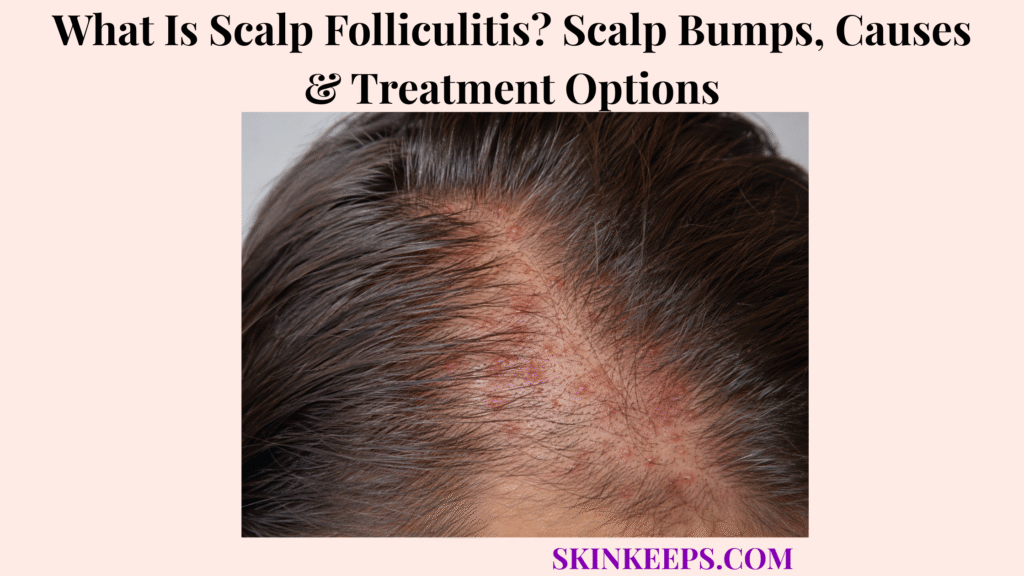
Scalp folliculitis is inflammation of hair follicles on the scalp that commonly causes small itchy or tender follicle-centered bumps and pustules that may become scratched, sore or crusted. The inflammation can be driven by more than one factor, so the appearance of pustules does not automatically mean every case is a simple bacterial infection.
Possible microbial contributors, friction, heat, moisture and occlusion can all matter, but the most important diagnostic boundary is whether the process remains superficial. Progressive hair loss, scarring, deep nodules, abscesses or sinus tracts should prompt evaluation for a different scalp disorder rather than repeated treatment as ordinary scalp folliculitis.
This article is for educational purposes only. Progressive hair loss, scarring, deep painful nodules or persistent scalp pustules should be professionally evaluated.
What Is Scalp Folliculitis and What Does It Look and Feel Like?
Scalp folliculitis is inflammation centered on scalp hair follicles that commonly causes small itchy pustules or papules that can become tender, scratched or crusted.
What Happens Inside a Hair Follicle During Scalp Folliculitis?
Scalp folliculitis develops when irritation or microbial involvement triggers inflammation around a hair follicle, leading to papules or pustules and sometimes crusting after scratching.
A useful mechanism is follicular irritation or microbial involvement → inflammation → papule or pustule → itch or soreness → erosion and crust. This broader follicular mechanism is covered in the folliculitis overview, while this page stays focused on the scalp.
What Do Scalp Folliculitis Bumps Usually Look Like?
Scalp folliculitis typically produces small follicle-centered bumps or pustules that may be scattered, intensely itchy and crusted after scratching.
Some lesions become sore or eroded because itching makes them difficult to leave alone. The key clue is that the inflammatory bump is centered around a hair follicle rather than being a broad plaque or unrelated scalp nodule.
Where Does Scalp Folliculitis Commonly Appear?
Scalp folliculitis can affect different parts of the scalp, while the frontal hairline can be particularly troublesome in the classic presentation.
The number of lesions varies from only a few pustules to a much more numerous eruption, so lesion count alone does not define severity or cause.
Can Scalp Folliculitis Cause Permanent Hair Loss?
Ordinary scalp folliculitis is generally not characterized by progressive scarring hair loss, so bald patches or visible scarring should prompt evaluation for a different follicular scalp disorder.
Hair loss changes the diagnostic task because conditions such as folliculitis decalvans and dissecting cellulitis can produce follicular pustules while also damaging follicles and causing scarring alopecia.
Figure 1. Ordinary scalp folliculitis is a follicle-centered pustular process; progressive bald patches or visible scarring are not routine findings and should change the diagnostic pathway.
What Causes Scalp Folliculitis and Which Factors Can Make It Worse?
Scalp folliculitis can involve several microorganisms and follicular-irritation factors, so it should not be reduced to one universal bacterial cause.
Which Bacteria Can Be Associated With Scalp Folliculitis?
Bacteria such as Cutibacterium acnes and, particularly in more severe cases, Staphylococcus aureus may contribute to scalp folliculitis.
These organisms are possible contributors rather than a rule for every patient. Folliculitis can also arise through irritation, occlusion or other inflammatory mechanisms.
Can Malassezia Yeast Contribute?
Yes; Malassezia species are among the microorganisms associated with the inflammatory process in some cases of scalp folliculitis.
This explains why antifungal shampoos can be helpful for selected people, but yeast involvement should not be assumed simply because scalp pustules are present.
Can Hair-Follicle Mites Contribute?
Demodex folliculorum has also been implicated in some follicular inflammation, although it should not be presented as the universal cause of scalp folliculitis.
The broader clinical picture still determines whether a microbial hypothesis is relevant and whether a targeted treatment is reasonable.
Can Friction, Sweat, Heat or Occlusion Worsen Folliculitis?
Friction, heat, moisture and occlusion can injure or irritate follicles and may make folliculitis easier to trigger or harder to control.
Repeated personal irritation patterns matter more than blaming scalp folliculitis on “poor hygiene.” Tight or occlusive contact, heat and persistent moisture can increase follicular stress even when normal hygiene is adequate.
Figure 2. Scalp folliculitis may reflect microbial contributions, physical irritation or both. The map prevents “every pustule is Staph” oversimplification.
How Is Scalp Folliculitis Diagnosed and Distinguished From Similar Scalp Conditions?
Scalp folliculitis is usually diagnosed from follicle-centered pustules, itching or tenderness and scalp examination, while hair loss, scarring, scaling or deep nodules point toward alternative diagnoses that may need additional testing.
How Does a Dermatologist Diagnose Scalp Folliculitis?
A dermatologist assesses lesion appearance, follicular distribution, itch or pain, scalp findings and whether hair loss or scarring is present.
The practical sequence is appearance → distribution → symptoms → hair and scarring assessment → testing when needed. Typical superficial disease is largely a clinical diagnosis.
When Are Bacterial Swabs or Cultures Needed?
A bacterial swab or culture may be useful when infection is suspected, disease is recurrent or treatment is not working as expected.
Microscopy, culture and sensitivity testing can help identify a bacterial cause and guide antimicrobial decisions in selected cases rather than being mandatory for every ordinary scalp eruption.
What Conditions Can Be Mistaken for Scalp Folliculitis?
Scalp acne, seborrheic dermatitis, fungal scalp disease and several deeper or scarring follicular disorders can resemble scalp folliculitis.
Pimple-like scalp disease can overlap visually with acne, while flaky or greasy scaling can point toward seborrheic dermatitis. Tinea capitis remains a separate fungal scalp diagnosis and should not be assigned an invented internal URL.
Which Signs Suggest a Scarring or Deeper Disorder Instead?
Progressive scarring hair loss suggests disorders such as folliculitis decalvans, while deep painful nodules, abscesses or draining sinus tracts point away from ordinary superficial scalp folliculitis.
Ordinary scalp folliculitis usually means small superficial pustules without progressive hair loss. Folliculitis decalvans produces chronic pustular inflammation with scarred bald areas, while dissecting cellulitis is characterized by deeper nodules or cysts, purulent drainage and eventual scarring alopecia.
Figure 3. Hair loss, scarring, scaling with broken hairs, or deep nodules shift the problem away from uncomplicated scalp folliculitis and toward a different diagnostic pathway.
How Is Scalp Folliculitis Treated?
Scalp folliculitis treatment should be matched to the suspected cause and severity, ranging from gentle scalp care and targeted shampoo to clinician-directed topical or oral therapy for persistent disease.
How Do Medicated or Antifungal Shampoos Help?
Antifungal shampoos such as ketoconazole- or ciclopirox-containing products may help selected scalp folliculitis when yeast involvement is considered relevant.
A mild regular shampoo remains reasonable supportive care. Antifungal shampoo is a targeted option, not a universal cure for every scalp pustule.
When Are Topical Antibiotics Used?
Topical antibiotics may be used in selected scalp folliculitis when bacterial involvement is suspected rather than automatically for every pustular scalp eruption.
Selection should follow the clinical pattern and, when appropriate, culture information rather than assuming all recurrent lesions require the same topical antibiotic.
How Are Anti-Inflammatory Treatments Used?
Mild topical corticosteroid treatment or selected antihistamines may be used to reduce inflammation or itching, but they do not replace antimicrobial therapy when infection requires treatment.
This separates symptom control from cause control: reducing itch or inflammation can improve comfort without proving that a microbial driver has been eliminated.
When Are Oral Antibiotics or Isotretinoin Considered?
Persistent or recurrent scalp folliculitis may require oral antibiotic treatment, while selected difficult or treatment-resistant disease may prompt dermatologist-directed isotretinoin.
Tetracycline-class treatment is one clinician-directed option for persistent disease because antibacterial and anti-inflammatory effects may both be useful. Dosing, duration and isotretinoin decisions should remain individualized rather than presented as self-treatment instructions.
Figure 4. Scalp folliculitis treatment escalates according to the suspected driver and severity; recurrent or resistant disease should trigger diagnostic reassessment rather than endless product switching.
How Can Scalp Folliculitis Be Prevented From Recurring, and When Should It Be Reassessed?
Recurrence control focuses on gentle scalp care, avoiding repeated irritation or picking and reassessing the diagnosis when pustules continue to return despite appropriate treatment.
How Should the Scalp Be Washed During Folliculitis?
A mild regular shampoo is generally appropriate for scalp folliculitis, with medicated shampoo added only when clinically relevant.
Harsh washing and aggressive scrubbing can add physical irritation to already inflamed follicles, so supportive scalp care should be gentle rather than abrasive.
Why Should Scalp Folliculitis Bumps Not Be Scratched or Picked?
Scratching or picking scalp folliculitis can create erosions, crusting and additional irritation in already inflamed follicles.
Reducing manipulation also makes it easier to judge whether lesions are truly improving instead of repeatedly being re-injured.
Can Friction or Occlusion Make Recurrence Harder to Control?
Repeated rubbing, heat, moisture or occlusion can continue irritating follicles, so reducing a clear personal aggravating exposure may help reduce recurrence.
There is no need for a universal product-ban list. The useful target is a repeatable exposure pattern that consistently precedes or worsens the follicular eruption.
When Should Scalp Folliculitis Be Evaluated by a Dermatologist?
Dermatology evaluation is appropriate when scalp pustules repeatedly return, become widespread or painful, fail treatment, produce drainage, or are accompanied by deep nodules, hair loss or scarring.
Fever, spreading infection, diagnostic uncertainty, several hairs emerging from abnormal scarred follicles or progressively scarred areas also warrant reassessment. Progressive hair loss or scarring should not be treated as routine scalp folliculitis.
What Should You Remember About Scalp Folliculitis?
Scalp folliculitis is ordinary inflammation of scalp hair follicles that usually causes itchy or tender follicle-centered bumps without progressive scarring hair loss.
- Scalp folliculitis centers on hair follicles and commonly produces papules or pustules.
- Itching can be intense, while tenderness, soreness, erosions and crusting may follow.
- The frontal hairline can be particularly troublesome.
- Ordinary scalp folliculitis is not a primary scarring alopecia.
- Progressive hair loss or scarred bald patches change the diagnostic task.
- The exact cause is not always clear and should not be reduced to one bacterium.
- Cutibacterium acnes, S. aureus, Malassezia and Demodex can be relevant contributors in selected cases.
- Friction, heat, moisture and occlusion may aggravate follicular inflammation.
- Diagnosis is usually clinical, while swab, culture and sensitivity testing are selective.
- Scalp acne, seborrheic dermatitis and fungal scalp disease are important mimics.
- Folliculitis decalvans causes scarring alopecia; dissecting cellulitis produces deeper nodules, abscesses or sinus tracts and can scar.
- Antifungal shampoos and topical antibiotics are selected according to the suspected driver, not used universally.
- Anti-inflammatory treatment can reduce symptoms without replacing cause-directed therapy when infection is present.
- Oral antibiotics and isotretinoin are clinician- or specialist-directed options for selected persistent disease.
- Gentle washing and avoiding picking help reduce additional follicular irritation.
- Recurrent or treatment-resistant disease should trigger diagnostic reassessment.
Core pathway: Follicle-centered bumps → identify driver → check for hair loss or scarring → treat cause → reduce irritation → reassess recurrence.
Frequently Asked Questions About Scalp Folliculitis
The main scalp-folliculitis questions concern contagion, hair loss, acne confusion, recurrence and antifungal shampoo.
Is Scalp Folliculitis Contagious?
Scalp folliculitis is not one single contagious disease category because different microbial and inflammatory factors can contribute, so transmission risk depends on the underlying cause.
Can Scalp Folliculitis Cause Hair Loss?
Ordinary scalp folliculitis is generally not associated with progressive scarring hair loss, so bald patches or scarring should prompt evaluation for another scalp disorder.
Is Scalp Folliculitis the Same as Scalp Acne?
No; scalp folliculitis is follicular inflammation, while acne has a different follicular-sebaceous disease mechanism even though both can create pimple-like bumps.
Can Scalp Folliculitis Keep Coming Back?
Yes; recurrence can occur when microbial involvement, irritation, treatment failure or an alternative diagnosis remains unresolved.
Does Antifungal Shampoo Help Scalp Folliculitis?
Antifungal shampoo may help selected cases where yeast involvement is relevant, but it is not a universal treatment for all scalp folliculitis.
Which Sources Support This Scalp Folliculitis Guidance?
DermNet — Scalp Folliculitis — Used for the definition, itchy scalp pustules, frontal-hairline pattern, microbial contributors, shampoo options, topical treatment, oral antibiotics and isotretinoin context.
DermNet — Bacterial Folliculitis — Used for follicular inflammation mechanisms, superficial pustules, non-scarring superficial disease and selective bacterial swab, culture and sensitivity testing.
DermNet — Diagnosis of Scalp Rashes — Used for the ordinary scalp-folliculitis no-hair-loss pattern and comparison with tinea capitis, folliculitis decalvans and deeper scalp disorders.
DermNet — Dissecting Cellulitis of the Scalp — Used for deep nodules, abscess-like disease, drainage and scarring-alopecia red flags that point away from uncomplicated scalp folliculitis.
American Academy of Dermatology — Folliculitis — Used for friction, rubbing, heat and moisture as follicular injury or aggravating factors and for general clinical folliculitis principles.