Seborrheic dermatitis is a chronic inflammatory skin condition that causes recurrent flaking, scaling and irritation in oil-rich areas such as the scalp, eyebrows, sides of the nose, ears and central chest. The rash can look white, yellowish, greasy, dry, darker, lighter or simply different from a person’s baseline depending on site, severity and skin tone.
The condition is associated with Malassezia yeast, the sebaceous environment and a susceptible inflammatory or skin-barrier response, but it is not simply a fungal infection. Diagnosis is usually clinical, treatment is matched to the body site and degree of inflammation, and maintenance is often needed because flares commonly return.
This article is for educational purposes only. Severe, treatment-resistant, infected-looking, eye-involving or hair-loss-associated symptoms should be professionally evaluated.
What Is Seborrheic Dermatitis and What Does It Look and Feel Like?
Seborrheic dermatitis is a chronic inflammatory disorder that causes recurrent white or yellowish scale, flaking, itching and irritation in characteristic oil-rich areas of the scalp, face and upper body.
Why Does Seborrheic Dermatitis Affect Oily Areas?
Seborrheic dermatitis favors sebaceous-gland-rich skin such as the scalp, eyebrows, nose folds, ears, eyelids, beard area and central chest.
These sites provide a lipid-rich environment in which Malassezia normally lives, but oil alone does not cause seborrheic dermatitis. Disease develops when local microbial activity interacts with individual inflammatory and barrier susceptibility.
What Do the Flakes and Scaly Patches Look Like?
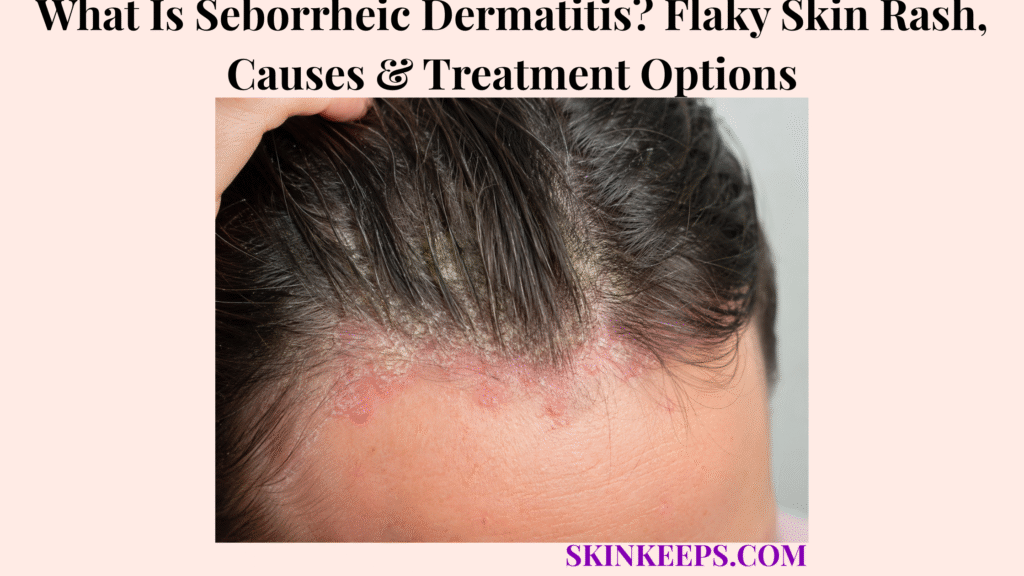
Seborrheic dermatitis commonly causes white or yellowish scale that may appear dry, flaky or somewhat greasy over inflamed or discolored skin.
Scalp disease can look like persistent dandruff, while more pronounced flares may produce adherent scale, crusting or irritation. Bright redness is not required; on darker skin, affected areas may look darker, lighter, violaceous or mainly scaly compared with the surrounding skin.
Can Seborrheic Dermatitis Cause Itching or Burning?
Yes; seborrheic dermatitis can cause itching, burning, irritation and sensitivity in addition to visible scale.
Some people notice little discomfort despite obvious flaking, while others have substantial itch or stinging. Sensory symptoms therefore support the pattern but do not determine the diagnosis on their own.
Can Seborrheic Dermatitis Affect the Face, Beard, Ears or Eyelids?
Yes; facial seborrheic dermatitis commonly affects the eyebrows, nasolabial folds, ears and beard area, while eyelid involvement can produce scaling around the lashes.
The same person can have scalp and facial disease together. Eyelid symptoms that include persistent eye pain, marked swelling, light sensitivity or vision change need separate clinical assessment rather than being assumed to be routine dermatitis.
Figure 1. Seborrheic dermatitis favors sebaceous-gland-rich areas, especially the scalp and central face, so distribution is often more useful than redness alone.
What Causes Seborrheic Dermatitis and Why Does It Keep Coming Back?
Seborrheic dermatitis appears to result from the interaction of Malassezia-related activity, sebaceous skin conditions, host inflammation and skin-barrier susceptibility rather than one single cause.
Is Malassezia the Sole Cause of Seborrheic Dermatitis?
No; Malassezia is an important contributor, but seborrheic dermatitis also depends on how susceptible skin and the immune or barrier system respond.
Malassezia normally lives on human skin, so finding it on the skin does not by itself prove seborrheic dermatitis. The useful model is sebaceous environment + yeast-related metabolites + susceptible host response → inflammation and scaling.
Which Factors Can Trigger a Seborrheic Dermatitis Flare?
Stress, seasonal changes, irritating products and individual skin sensitivity can aggravate seborrheic dermatitis in some people without being the underlying cause of the disease.
Cold or dry seasons, fatigue and periods of physical or emotional stress are common flare contexts reported in clinical guidance. These are aggravating factors, not proof of why the disease originally developed.
Why Does Seborrheic Dermatitis Keep Returning?
Seborrheic dermatitis tends to recur because it is a chronic relapsing condition rather than a one-time infection that disappears permanently after treatment.
An active flare can clear substantially and still return later. This is why management often shifts from flare control to an individualized maintenance plan instead of stopping all care as soon as the flakes disappear.
Can Babies and Adults Both Develop Seborrheic Dermatitis?
Yes; seborrheic dermatitis has infantile and adult patterns, with cradle cap occurring in infants and scalp or facial disease being common in adults.
Infantile disease is often discussed separately because age, distribution and natural history differ. This article remains focused on the general seborrheic dermatitis mechanism and adult-style recurrent management.
Figure 2. Seborrheic dermatitis is best understood as a multifactorial inflammatory condition; flare triggers can intensify disease without being the sole underlying cause.
How Is Seborrheic Dermatitis Diagnosed and Distinguished From Similar Scaly Rashes?
Seborrheic dermatitis is usually diagnosed clinically from its scale, characteristic sebaceous-area distribution, symptoms and recurrent pattern, while thicker plaques or atypical features may point toward another diagnosis.
How Does a Dermatologist Diagnose Seborrheic Dermatitis?
A dermatologist usually diagnoses seborrheic dermatitis by examining the type of scale, affected body sites, inflammation, symptoms and recurrence history.
The practical sequence is appearance → distribution → scale → symptoms → recurrence → examination. Routine testing is usually unnecessary when the pattern is classic; selected biopsy or other testing is used when another disorder remains plausible.
How Is Seborrheic Dermatitis Different From Dandruff?
Dandruff is generally a milder scalp-predominant pattern dominated by flaking, while seborrheic dermatitis includes more inflammation and can extend beyond the scalp.
The two belong on a related spectrum rather than being completely unrelated conditions. Facial, ear or chest involvement and more visible inflammation make seborrheic dermatitis more likely than uncomplicated dandruff.
How Is Seborrheic Dermatitis Different From Psoriasis?
Seborrheic dermatitis usually produces thinner flaky or somewhat greasy scale, while psoriasis more often forms thicker, sharply defined plaques and may involve characteristic sites beyond sebaceous areas.
Some people show overlapping scalp findings called sebopsoriasis, so a rigid either-or label is not always possible from scale alone. Plaque structure, borders, body distribution and treatment response all help clarify the pattern.
What Other Conditions Can Resemble Seborrheic Dermatitis?
Atopic dermatitis can produce chronic itchy inflamed scaling, but its broader history and distribution usually differ from the classic sebaceous-area pattern.
A new or repeatedly exposure-linked facial or scalp eruption may fit allergic contact dermatitis better than seborrheic dermatitis, especially when a hair, skin or cosmetic product clearly precedes the rash.
Dermatophyte ringworm can also produce scaling, but it is a true fungal infection with a different lesion pattern and diagnostic pathway from seborrheic dermatitis.
Central facial flushing, persistent color change or papules may suggest rosacea rather than seborrheic dermatitis, although the two disorders can coexist in the same person.
Figure 3. Dandruff, seborrheic dermatitis and psoriasis can all scale, but inflammation, plaque thickness and distribution help separate their usual patterns.
How Is Seborrheic Dermatitis Treated?
Seborrheic dermatitis treatment is matched to the affected site, amount of inflammation and severity, using antifungal therapy to reduce Malassezia-related activity and anti-inflammatory treatment when needed.
How Do Antifungal Shampoos and Creams Help?
Antifungal treatments such as ketoconazole or ciclopirox can reduce Malassezia-related activity and improve scaling and inflammation.
Scalp disease is commonly treated with medicated shampoos, while facial or body disease may need a formulation appropriate for thinner or more sensitive skin. Product strength, frequency and contact time vary, so one universal schedule should not be applied to every site or hair type.
When Are Topical Corticosteroids Used?
Short courses of appropriately selected topical corticosteroids may reduce inflammation, itching and irritation during more active seborrheic dermatitis flares.
They are generally used as flare-control medicines rather than indefinite maintenance, with extra caution on thin facial and eyelid skin because long-term steroid exposure can cause local adverse effects.
When Are Tacrolimus or Pimecrolimus Used?
Topical calcineurin inhibitors such as tacrolimus or pimecrolimus may be used as steroid-sparing anti-inflammatory options for selected recurrent facial disease.
These medicines are clinician-directed choices rather than universal first-line treatment for every patient, and their role depends on site, frequency of recurrence and prior response.
How Are Thick Scales or Persistent Flaking Managed?
Selected medicated shampoos or keratolytic ingredients can help loosen accumulated scale when ordinary antifungal treatment alone does not adequately control flaking.
Agents such as salicylic acid may be used in appropriate products, but aggressive scraping or improvised chemical combinations can irritate the skin and should not replace a site-appropriate treatment plan.
When Is Stronger Treatment Needed?
Extensive, unusually resistant or repeatedly relapsing seborrheic dermatitis should be reassessed before escalating treatment, because difficult disease may require prescription or systemic therapy in selected cases.
Reassessment matters because treatment failure can reflect inadequate maintenance, poor tolerance, coexisting psoriasis or another incorrect diagnosis—not simply a need for a stronger antifungal.
Figure 4. Treatment changes with the body site, inflammatory burden and recurrence pattern rather than relying on one universal shampoo or cream.
How Can Seborrheic Dermatitis Flares Be Controlled, and When Should It Be Reassessed?
Long-term seborrheic dermatitis control usually requires maintenance treatment, gentle skin and scalp care, and reassessment when symptoms remain severe, repeatedly recur or develop atypical features.
Why Is Maintenance Treatment Important?
Maintenance treatment matters because seborrheic dermatitis commonly returns after an active flare improves.
A practical long-term model is active flare → improvement → individualized intermittent maintenance → reassessment if recurrence remains frequent. The goal is control, not a guarantee that the disease will never return.
How Should the Scalp Be Washed When Flares Keep Returning?
Treatment shampoo should be used according to the specific product and disease severity, then adjusted toward an appropriate maintenance schedule as symptoms improve.
Medicated shampoos need adequate use according to their instructions, but frequency and contact time differ by active ingredient. Hair type also matters; overly drying routines can be especially problematic for tightly coiled, chemically treated or fragile hair.
How Should Facial or Beard-Area Seborrheic Dermatitis Be Managed?
Facial and beard-area seborrheic dermatitis should be managed with gentle cleansing and site-appropriate medicated treatment rather than aggressive scrubbing or repeated picking.
Because facial skin is thinner and more visible, treatment choice should balance antifungal effect, anti-inflammatory need and irritation risk instead of automatically copying a scalp regimen onto the face.
Should Flakes Be Scratched or Scraped Off?
No; aggressive scratching or scraping can worsen irritation and damage already inflamed skin.
Persistent scale is better addressed by disease control and, when appropriate, selected scale-loosening treatments rather than forceful mechanical removal.
When Should Seborrheic Dermatitis Be Evaluated by a Dermatologist?
Professional reassessment is appropriate when scaling is severe or widespread, treatment repeatedly fails, significant pain or crusting develops, eye symptoms persist or unexpected hair loss appears.
Assessment is also reasonable when symptoms interfere with sleep or daily life, the diagnosis is uncertain, secondary infection is suspected or improvement lasts only briefly despite appropriate treatment. Seborrheic dermatitis does not ordinarily cause permanent progressive hair loss, so substantial hair loss changes the diagnostic task.
Persistent flaking alone may fit chronic disease, but progressive hair loss, severe inflammation or repeated treatment failure warrants reassessment.
What Should You Remember About Seborrheic Dermatitis?
Seborrheic dermatitis is a chronic inflammatory condition of oil-rich skin in which Malassezia, host susceptibility and skin-barrier or inflammatory responses interact to produce recurrent scaling and irritation.
- It commonly affects the scalp, eyebrows, nose folds, ears, beard area, eyelids and central chest.
- Scale may be white, yellowish, dry, flaky or somewhat greasy.
- Itch, burning and irritation can accompany the visible scale.
- Bright redness is not required, especially across different skin tones.
- Seborrheic dermatitis is not contagious.
- Malassezia contributes, but the disease is not simply a fungal infection.
- Stress, season changes and irritation can aggravate flares without being the root cause.
- Dandruff is generally the milder scalp-predominant end of the same disease spectrum.
- Diagnosis is usually clinical and depends heavily on morphology plus distribution.
- Psoriasis, atopic dermatitis, contact dermatitis, ringworm and rosacea can resemble parts of the presentation.
- Antifungal treatment is central, with anti-inflammatory therapy added when needed.
- Facial and eyelid treatment must be site-appropriate.
- Maintenance treatment often reduces recurrence after an active flare improves.
- No treatment should be presented as a guaranteed permanent cure.
- Progressive hair loss, severe inflammation or resistant disease should trigger diagnostic reassessment.
Core pathway: Recognize sebaceous-area scaling → separate mechanism from trigger → confirm the clinical pattern → treat by site and inflammation → maintain control → reassess atypical or resistant disease.
Frequently Asked Questions About Seborrheic Dermatitis
The main questions concern dandruff, fungus, contagion, permanent cure and hair loss.
Is Seborrheic Dermatitis the Same as Dandruff?
Dandruff is generally considered the milder scalp-predominant end of the seborrheic dermatitis spectrum, with less obvious inflammation.
Is Seborrheic Dermatitis Caused by a Fungus?
Not by fungus alone; Malassezia contributes to seborrheic dermatitis, but host inflammation, skin-barrier factors and individual susceptibility also matter.
Is Seborrheic Dermatitis Contagious?
No; seborrheic dermatitis does not spread from one person to another.
Can Seborrheic Dermatitis Go Away Permanently?
Seborrheic dermatitis is usually chronic and relapsing, but treatment and maintenance can control symptoms and reduce flare frequency.
Can Seborrheic Dermatitis Cause Hair Loss?
Seborrheic dermatitis does not ordinarily cause permanent hair loss, so substantial or progressive hair loss should prompt reassessment for another scalp condition.
Which Sources Support This Seborrheic Dermatitis Guidance?
DermNet — Seborrhoeic Dermatitis — Used for the multifactorial Malassezia/host-response model, sebaceous-area distribution, clinical diagnosis, differential diagnosis, antifungal therapy, short-course corticosteroids, calcineurin inhibitors and keratolytic options.
American Academy of Dermatology — Seborrheic Dermatitis: Diagnosis and Treatment — Used for clinical diagnosis, treatment goals, maintenance logic, site-tailored care and current prescription-treatment context.
Mayo Clinic — Seborrheic Dermatitis: Symptoms and Causes — Used for oily-area distribution, white/yellow scale, skin-tone variation, non-contagious status, chronic recurrence and permanent-hair-loss boundary.
Mayo Clinic — Seborrheic Dermatitis: Diagnosis and Treatment — Used for clinical assessment, selective biopsy, antifungal treatment and scalp-care nuance.