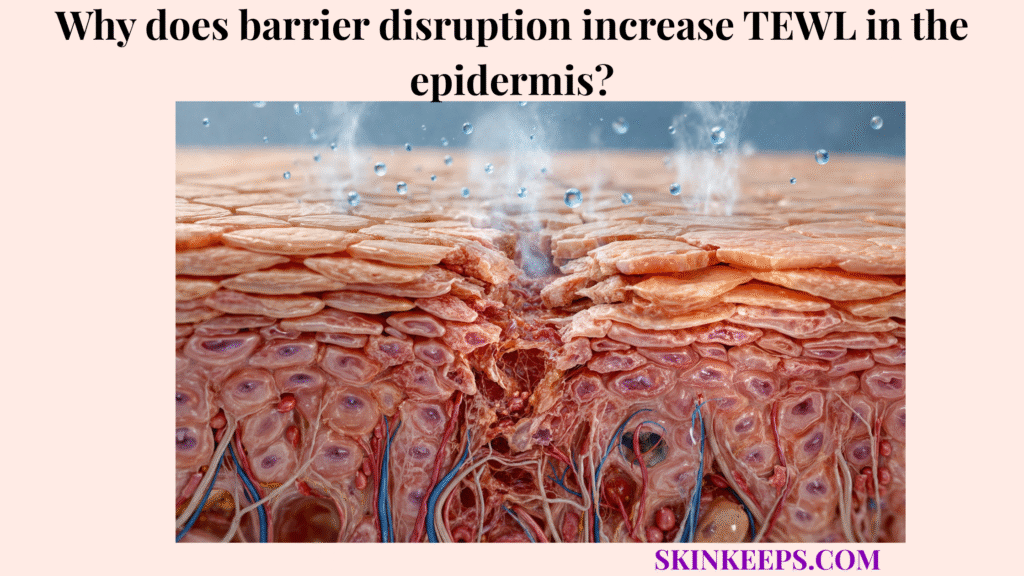
Barrier disruption increases TEWL because it breaks the epidermis’s outer seal and creates more pathways for water to escape through the stratum corneum.
Once the barrier is disrupted, lipid loss, corneocyte damage, and weaker water retention all combine to increase transepidermal water loss.
This biological failure creates the distinct sensation of tightness, dryness, roughness, stinging, redness, and chronic dehydration even when moisturizer is applied.
This outline explains exactly why barrier disruption increases TEWL, what structural failures drive the process, when to intervene, how to recognize it in real skin, and what steps stop the cycle fast.
You cannot treat a leaking barrier as if it simply needs more water; you must treat it as a structural failure that requires immediate mechanical and chemical stabilization to restore comfort.
What is the structural failure that explains why barrier disruption increases TEWL?
The structural failure that explains why barrier disruption increases TEWL is the breakdown of the stratum corneum seal, which allows more water to escape through the skin surface.
Barrier disruption is physical or chemical damage to the outer skin seal, especially the brick-and-mortar structure of the stratum corneum.
When this highly organized system suffers micro-cracks, lipid loss, or weakened corneocyte cohesion, the epidermis loses its resistance, creating easier escape pathways for internal hydration.
This physical breakdown translates rapidly into visible consequences, leaving the skin feeling intensely tight, rough, stripped, and prone to reactive dehydration.
- The insult → over-exfoliation, harsh pH, foaming cleansers, weather stress
- The breach → micro-tears, lipid depletion, corneocyte instability
- The result → barrier disruption increases TEWL
When should you intervene if barrier disruption increases TEWL?
You should intervene as soon as barrier disruption starts causing persistent tightness, stinging, dryness, or flaking, because early repair is significantly easier than advanced recovery.
Providing early support is drastically easier than delayed recovery, because calming a mildly unstable barrier demands far less time than rehabilitating a repeatedly leaking, highly inflamed epidermis.
The categories below function as practical, symptom-based timing cues to prompt immediate action, rather than acting as strict diagnostic thresholds.
Intervention timing dictates recovery speed across the following three stages of failure.
When do early signs mean barrier disruption is starting to increase TEWL?
Early signs mean barrier disruption is starting to increase TEWL when the skin exhibits mild tightness after cleansing, slight stinging with routine products, dullness, or small flaky patches.
These signs act as the earliest functional clues that the cellular structure is fracturing and the barrier is leaking more moisture than it should.
Action: Simplify the routine immediately and start gentle barrier support.
When do moderate signs mean barrier disruption is actively increasing TEWL?
Moderate signs mean barrier disruption is actively increasing TEWL when you experience persistent dryness that returns quickly, recurring roughness, sensitivity to weather or cleansers, and distinct redness after applying normal skincare.
These escalating signs suggest the barrier is not just irritated once, but is struggling to retain water consistently under daily stress.
Action: Stop strong actives and move into focused barrier repair.
When do severe signs mean barrier disruption increases TEWL enough to need urgent repair?
Severe signs mean barrier disruption increases TEWL enough to need urgent repair when the tissue develops deep cracking, severe burning, raw over-exfoliated patches, and repeated barrier collapse that fails to improve.
These severe symptoms mean the epidermal barrier is failing faster than your routine care is capable of containing the damage.
Action: Treat this as an urgent barrier crisis and consider professional support.
How does lipid matrix depletion explain why barrier disruption increases TEWL?
Lipid matrix depletion explains why barrier disruption increases TEWL because the skin loses the waterproofing seal that normally keeps water locked inside the epidermis.
Barrier lipids construct the vital mortar-like system that tightly fills the intercellular spaces, keeping the epidermis highly impermeable to water escape.
Once this crucial mortar is depleted, the physical barrier becomes instantly easier to disrupt, substantially harder to reseal, and highly vulnerable to environmental triggers.
- Loss of ceramides → structural gaps
- Loss of fatty-acid support → weaker seal
- Acid-mantle disruption → higher vulnerability
- Combined result → barrier disruption increases TEWL
How does ceramide loss explain why barrier disruption increases TEWL?
Ceramide loss explains why barrier disruption increases TEWL by destabilizing the structured lipid sheets between skin cells and creating microscopic gaps that allow water to evaporate more easily.
Ceramides are fundamental because they help form the cohesive mortar of the stratum corneum and maintain precise lamellar lipid organization.
When this intricate lamellar organization weakens, the skin loses its defense; water escapes into the air much more easily, and environmental irritants penetrate the tissue far faster. Ceramides are the predominant stratum corneum lipids and commonly account for about 50% of the lipid mass of the barrier matrix [PMC, 2024].
How does fatty-acid disruption explain why barrier disruption increases TEWL?
Fatty-acid disruption explains why barrier disruption increases TEWL by weakening the protective environment of the barrier and making the skin less able to maintain a stable seal.
Fatty acids directly support the biological barrier environment, including maintaining the acidic conditions that help protect overall epidermal function.
Without this continuous fatty-acid support, the surface seal becomes chemically less stable and far more vulnerable to recurrent irritation and massive water loss.
How does acid-mantle disruption explain why barrier disruption increases TEWL?
Acid-mantle disruption explains why barrier disruption increases TEWL because harsh or alkaline products destabilize the surface environment and weaken the resilience needed to control water loss.
Maintaining a mildly acidic skin surface helps to actively support normal barrier function and healthy lipid processing.
When the surface pH rises, the protective enzymes and critical barrier-repair processes become significantly less well regulated. The skin surface is normally mildly acidic, generally around pH 4.5 to 5.5; when surface pH rises, protease activity increases and barrier integrity becomes harder to maintain [PMC, 2024].
How do damaged corneocytes and lost NMFs worsen the TEWL caused by barrier disruption?
Damaged corneocytes and lost NMFs worsen the TEWL caused by barrier disruption because the skin loses both its physical protective shield and part of its internal water-binding capacity.
It is vital to understand that corneocyte damage weakens the actual brick side of the barrier, not just the lipid mortar holding it together.
Premature shedding removes these essential cells too early, drastically reducing outer-layer density and compromising the structural thickness of the skin.
Furthermore, Natural Moisturizing Factor (NMF) loss weakens the skin’s internal water retention capacity, causing dryness even when heavy moisturizing products are applied externally.
- Barrier disruption → corneocyte damage
- Corneocyte damage → premature shedding
- Premature shedding → NMF loss
- NMF loss → less water retention
- Result → barrier disruption increases TEWL further
How do damaged corneocytes worsen the TEWL caused by barrier disruption?
Damaged corneocytes worsen the TEWL caused by barrier disruption by acting as weaker, less cohesive structural bricks that fail to protect the underlying layers effectively.
These mechanically weak cells cause the outer barrier to physically leak more water, accelerating the dehydration cycle.
This structural weakness manifests clinically as greater surface roughness, extreme tissue fragility, and profoundly poor tolerance for routine skincare applications.
How does premature shedding worsen the TEWL caused by barrier disruption?
Premature shedding worsens the TEWL caused by barrier disruption because over-exfoliation forces corneocytes off before they are ready, exposing less mature cells and leaving the barrier thinner and more permeable.
Accelerated cellular shedding prevents the natural formation of a dense, fully mature, and highly protective outer shield.
This persistent depletion makes recovery exceptionally difficult because the barrier keeps actively losing the mature protective cells required to halt the water leak.
How do lost Natural Moisturizing Factors worsen the TEWL caused by barrier disruption?
Lost Natural Moisturizing Factors worsen the TEWL caused by barrier disruption by robbing corneocytes of their internal water-binding compounds, resulting in tighter, drier, and more fragile skin.
Natural Moisturizing Factors act precisely like internal sponges securely placed inside the corneocytes to bind and hold hydration.
When those critical compounds decline, the skin retains considerably less water biologically, regardless of how much external moisturizer is layered on top of the surface.
What are the main reasons barrier disruption increases TEWL?
Barrier disruption increases TEWL because the outer epidermal seal becomes structurally weaker, lipid protection declines, corneocytes lose function, and internal water retention drops, making water escape more easily through the stratum corneum.
- The outer seal breaks
- Barrier lipids become depleted
- Corneocytes become weaker or shed too early
- Natural Moisturizing Factors decline
- Water escapes faster than the skin can retain it
How does healthy skin compare to skin where barrier disruption increases TEWL?
Healthy skin retains water efficiently through a balanced and cohesive barrier structure, while skin where barrier disruption increases TEWL loses water faster and feels tighter, drier, and more irritated.
| Barrier status | Lipid density | Corneocyte condition | Water retention | Sensation | Visible appearance |
|---|---|---|---|---|---|
| Healthy skin | Balanced and cohesive | Strong and hydrated | Higher | Comfortable | Smooth and resilient |
| Skin where barrier disruption increases TEWL | Depleted or disorganized | Fragile, dry, fast-shedding | Lower | Tight, burning, stinging | Rough, flaky, red |
Evaluating this comparison confirms that the defining difference is not simply having “dry versus oily” skin, but rather possessing a stable, functional seal versus an actively leaking one.
What are the signs that barrier disruption increases TEWL in your skin?
Signs that barrier disruption increases TEWL in your skin include acute tightness after cleansing, flaking that returns quickly, persistent dryness despite moisturizing, rough texture, redness, and severe stinging with simple products.
These clinical indicators point directly to a physiological state where invisible water loss is severely outpacing the skin’s capacity for water retention.
Recognizing the pattern matters immensely: repeated tightness and escalating daily reactivity are significantly more important than one isolated dry day during winter.
- Tightness after cleansing
- Flaking that returns quickly
- Persistent dryness despite moisturizing
- Rough texture
- Redness or burning
- Stinging with simple products
- Skin that feels stripped or raw
How can skincare interventions stop the cycle when barrier disruption increases TEWL?
Skincare interventions stop the cycle when barrier disruption increases TEWL by immediately removing irritating triggers, restoring hydration, and mechanically resealing the damaged barrier surface.
Effective repair must start by aggressively removing the behaviors and products that keep reopening the fragile barrier.
Hydration absolutely matters, but applying hydration alone is not enough to heal the skin without simultaneously reducing further mechanical and chemical damage.
Resealing the surface with heavy, lipid-rich products gives the epidermis a much better physical chance to recover uninterrupted.
Problem: Tight, reactive, high-TEWL skin
Implication: Barrier disruption is allowing water to escape
Solution: Remove triggers, hydrate gently, reseal the surface
How can you remove the triggers when barrier disruption increases TEWL?
You can remove the triggers when barrier disruption increases TEWL by immediately stopping retinoids, exfoliating acids, physical scrubs, and harsh foaming cleansers, and switching to gentler cleansing.
Continued exposure to strong triggers actively keeps the barrier from stabilizing by stripping newly formed lipids before they can properly settle.
The immediate task is concrete: you must identify what causes disruption of the epidermal barrier and stop those triggers entirely first, before attempting to optimize anything else in your skincare routine.
How can you rehydrate the skin when barrier disruption increases TEWL?
You can rehydrate the skin when barrier disruption increases TEWL by applying gentle humectants, such as glycerin and panthenol, to replenish hydration without introducing aggressive active ingredients.
Deploying calm, consistent, and simple hydration is substantially more helpful for barrier recovery than indiscriminately layering many new, complex products.
Humectants help best when the routine is dramatically simplified and the barrier is no longer being actively stripped by harsh cleansers.
How can you reseal the skin when barrier disruption increases TEWL?
You can reseal the skin when barrier disruption increases TEWL by applying barrier-supportive creams or heavy occlusive layers to create a temporary surrogate seal while the epidermis recovers.
These rich, dense products effectively reduce ongoing water escape by adding a highly protective, temporary physical shield over the compromised cells.
Resealing does not replace the skin’s internal barrier biology, but it successfully buys the required time for deep cellular recovery to occur.
What are the best ways to stop barrier disruption from increasing TEWL?
The best ways to stop barrier disruption from increasing TEWL are to remove the causes of barrier damage, hydrate the skin gently with humectants, and reseal the surface with lipid-rich or occlusive support until the epidermis recovers.
- Stop harsh actives immediately
- Switch to gentle cleansing
- Use humectants to restore hydration
- Apply barrier-supportive creams
- Add occlusive protection if the barrier is badly compromised
- Stay consistent long enough for recovery
What are the key takeaways about why barrier disruption increases TEWL?
The key takeaways about why barrier disruption increases TEWL focus on the structural breakdown of the epidermal seal, the specific roles of lipid depletion and corneocyte damage, and the necessity of immediate, targeted repair.
- Barrier disruption increases TEWL because it breaks the epidermal seal that normally keeps water inside.
- Lipid depletion and corneocyte damage are the two main mechanisms that drive the increase in water loss.
- Early intervention works better than waiting for the skin to become raw, burning, or chronically reactive.
- Repair requires removing triggers, restoring hydration, and rebuilding the barrier seal.
What emergency steps can you take when barrier disruption increases TEWL?
When barrier disruption increases TEWL, the most effective emergency steps involve stopping all irritating products immediately, cleansing as gently as possible, applying a simple humectant layer, and sealing the skin with a heavy barrier-supportive cream.
Executing an emergency repair is about forcefully stopping the leak before ever trying to optimize texture, glow, or introduce new corrective actives.
- Stop all irritating products tonight
- Cleanse as gently as possible or reduce cleansing temporarily
- Apply a simple humectant layer
- Seal with a barrier-supportive cream or occlusive layer
- Avoid exfoliation until the skin feels stable again
When barrier disruption increases TEWL, the fastest improvement usually comes from simplifying the routine and protecting the skin from further damage while water loss is reduced.
Use this framework to shift your routine from irritation and over-treatment to fast barrier recovery as soon as barrier disruption starts increasing TEWL.
Understanding how to physically stop water loss gives you the power to break the cycle of reactive, burning skin for good.
FAQs about why barrier disruption increases TEWL
Why does barrier disruption increase TEWL so quickly?
Barrier disruption increases TEWL so quickly because even microscopic breaks in the lipid seal instantly create more permeable pathways for internal water to evaporate into the environment.
Can barrier disruption increase TEWL without visible peeling?
Yes, barrier disruption can increase TEWL before severe peeling appears, often showing up first as tight, stingy, or unusually dry skin across the surface.
Does over-exfoliation increase TEWL by disrupting the barrier?
Yes, over-exfoliation increases TEWL by stripping essential lipids, damaging mature corneocytes, and weakening the entire outer seal.
What is the fastest way to stop barrier disruption from increasing TEWL?
The fastest way to stop barrier disruption from increasing TEWL is to halt harsh triggers, hydrate the tissue gently, and reseal the barrier with supportive creams or occlusives.
When should I worry that barrier disruption is increasing TEWL too much?
You should worry that barrier disruption is increasing TEWL too much when intense dryness, flaking, stinging, burning, or redness shifts from occasional flare-ups to persistent daily symptoms.