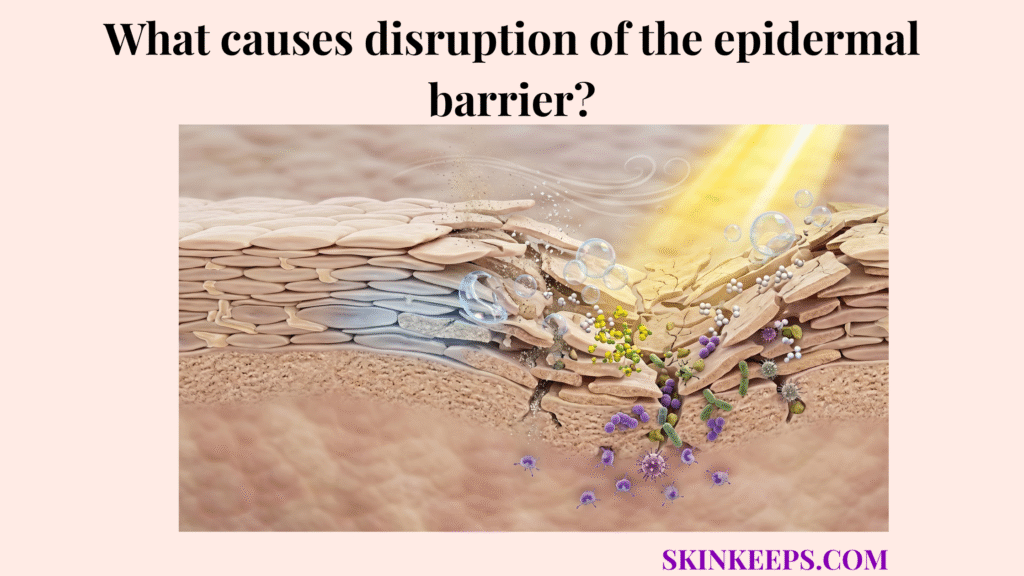
Disruption of the epidermal barrier is caused when the outer skin layer loses the structural, lipid, and cellular integrity needed to keep water in and irritants out. This breakdown can be triggered by harsh external exposure, repeated skin-care stress, inflammation, environmental damage, or internal weakness in the skin’s ability to maintain itself.
A disrupted barrier does not only mean dry skin. It often means the skin is losing water faster, becoming easier to irritate, and reacting more strongly to products, weather, and microbes. TEWL—transepidermal water loss—is the standard objective measure of this leakiness, and higher levels track with weaker barrier function across many disrupted states.
Understanding what causes disruption of the epidermal barrier makes it easier to identify the real trigger, tell whether the damage is sudden or ongoing, and choose repair strategies that actually match the cause.
Why is the epidermal barrier so easy to disrupt in the first place?
The epidermal barrier—the outer defensive system that keeps water in and irritants out—is easy to disrupt because it is a finely balanced outer defense system that must stay thin enough for flexibility but strong enough for defense, all while facing constant stress.
Barrier performance depends on a precise relationship between corneocytes, lipid lamellae, hydration, and surface chemistry rather than on one component alone. This complexity creates multiple points of failure that can be triggered by even minor environmental shifts.
Because the barrier sits at the skin surface, it is exposed constantly to friction, cleansing, climate, UV, and topical chemicals. That exposure makes vulnerability a normal property of barrier biology, not an exceptional event.
What breaks first when epidermal barrier disruption begins?
When epidermal barrier disruption begins, the earliest failures usually involve weakened lipid sealing—the organization of fats between cells that prevents leakage—reduced water retention, and less stable corneocyte cohesion, which refers to how well surface cells remain connected to maintain structural integrity.
The barrier often weakens first at the level of lipid organization between surface cells, because those intercellular lipids (or lipid lamellae)—the lipid layers between corneocytes that seal the barrier—provide the mortar-like seal that limits water escape. Once this matrix fractures, the entire structure becomes permeable to irritants.
Once water retention drops, the surface becomes drier and more reactive, which then makes inflammation and further barrier failure easier to trigger. This sequence places the intercellular lipid matrix at the center of early permeability failure and the subsequent rise in TEWL, the standard marker of barrier leakiness.
How do harsh external exposures cause disruption of the epidermal barrier?
Harsh external exposures cause epidermal barrier disruption by stripping protective components, increasing water loss, and overwhelming the skin’s barrier resilience—the skin’s ability to tolerate stress and recover efficiently.
Direct outside damage usually acts by one or more of three routes: lipid extraction, physical removal of the stratum corneum (the outermost epidermal layer made of cells and lipids), or acute inflammatory stress. Not all insults damage the barrier in the same way, but they all converge on higher leakiness.
How do cleansers and solvents disrupt the epidermal barrier?
Cleansers and solvents disrupt the epidermal barrier by extracting surface lipids and disturbing stratum corneum organization. In healthy volunteers, Törmä et al. (2008) found that 1% SDS exposure caused barrier-repair gene changes and real injury rather than simple transient dryness (ScienceDirect, 2008).
How do weather and environmental exposure disrupt the epidermal barrier?
Weather and environmental exposure disrupt the epidermal barrier by increasing surface stress and reducing barrier efficiency. Engebretsen et al. (2016) concluded that low humidity and low temperatures generally decrease skin barrier function and increase susceptibility to mechanical stress (Wiley, 2016).
How does friction or over-exfoliation disrupt the epidermal barrier?
Friction or over-exfoliation disrupts the epidermal barrier by removing protective surface cells too quickly. Olesen et al. (2019) showed that repeated tape stripping increased TEWL by a median 31.8 g/m²/h and removed roughly one third of the epidermis, illustrating how mechanical removal rapidly impairs integrity (Nature, 2019). Understanding how over-exfoliation damages epidermal lipid layers is essential to avoid this physical breakdown.
| External Stressor | Verified Effect | Clinical Meaning |
|---|---|---|
| Mechanical over-removal | TEWL increased 5.7-fold | Friction causes abrupt collapse |
| Harsh detergents | Filaggrin fell 60% | Damage to structure and biology |
| Solvent exposure | SC thickness fell 18% | Thinning and destabilization |
How do internal skin conditions and inflammation cause disruption of the epidermal barrier?
Internal skin conditions and inflammation cause epidermal barrier disruption by weakening barrier formation from within and making the skin slower to recover after stress.
Inflammatory skin disease can impair barrier assembly even before a harsh product is applied, because cytokine-driven changes alter lipids and structural proteins. This “inside-out” failure creates a chronic state of vulnerability.
Barrier weakness and inflammation often reinforce one another in a cycle. A leaky barrier is more vulnerable to environmental insult, which then drives internal inflammatory barrier weakness, further impairing the stratum corneum’s structural integrity.
What hidden daily habits commonly cause disruption of the epidermal barrier?
Many cases of epidermal barrier disruption are caused not by one dramatic event, but by repeated low-level routine-related barrier damage where stress outpaces the skin’s capacity for recovery.
Hidden triggers include cleansing too often, layering too many strong actives, and ignoring early stinging. One common but overlooked factor is why hot water strips protective oils from the epidermis, leading to unnecessary routine stress.
The skin can tolerate temporary stress better than relentless stress. Cumulative exposure and irritant persistence are central drivers of both barrier breakdown and the difficulty of recovery.
How does acute epidermal barrier disruption differ from chronic barrier disruption?
Acute disruption—sudden barrier breakdown after a strong insult—happens quickly, while chronic disruption—repeated or ongoing instability that never fully resolves—develops when the skin is repeatedly stressed without enough repair time.
| Pattern | Typical Cause | Visible Signs |
|---|---|---|
| Acute Disruption | Over-exfoliation, harsh treatment | Burning, redness, rapid stinging |
| Chronic Disruption | Repeated irritation, long-term overuse | Persistent dryness, sensitivity, dullness |
How can you tell when epidermal barrier disruption is getting worse?
Epidermal barrier disruption is getting worse when the skin becomes less tolerant, less comfortable, and slower to return to baseline after everyday stress. Identifying which signs indicate epidermal barrier breakdown is critical to stopping the progression before a total collapse occurs.
Barrier Danger Signs Checklist
How does a healthy epidermal barrier compare with a disrupted one?
A healthy epidermal barrier feels calm and resilient, while a disrupted barrier loses water faster, reacts more easily, and appears rougher because corneocytes—the specialized outer cells that form the skin’s physical barrier—fail to maintain their protective organization.
| Barrier State | Water Retention | Irritant Tolerance | Appearance |
|---|---|---|---|
| Healthy barrier | Stable | Higher | Calm, resilient |
| Disrupted barrier | Reduced (High TEWL) | Lower | Red, flaky, dull |
What steps stop disruption of the epidermal barrier?
Stopping epidermal barrier disruption requires removing the cause first, then rebuilding stability with a lower-stress approach that prioritizes replenishing barrier lipids over aggressive correction.
How do you remove the trigger causing epidermal barrier disruption?
You remove the trigger by stopping the harsh product or treatment pattern that is creating the damage. Patel et al. (2022) state that the mainstay of treatment remains avoidance of the irritant together with moisturizers to maintain function (PMC, 2022).
How do you restore stability after epidermal barrier disruption?
You restore stability by reducing routine complexity and supporting water and lipid recovery. Spada et al. (2021) reported that a ceramide-dominant regimen over 28 days restored skin permeability-barrier measures, supporting the principle that stability comes before correction (PMC, 2021).
How do you prevent repeated epidermal barrier disruption?
You prevent repeated disruption by reintroducing strong actives slowly and watching for early warning signs. Motamedi et al. (2021) note that topical retinoids are limited by irritation, supporting gradual reintroduction after recovery (PMC, 2021).
What ingredients and habits help rebuild a disrupted epidermal barrier?
The best support for a disrupted epidermal barrier is not aggressive correction, but restoration of water balance, lipid stability, and lower daily stress.
Moisturization supports multiple layers of barrier recovery, including the physical, chemical, and immunologic layers. Using routines that support the epidermal barrier matrix—the lipid system between cells—ensures the skin has the necessary building blocks to reseal itself effectively.
Adisrupted barrier is rarely just a product problem. It is usually the result of stress exceeding recovery. When you reduce signal noise and protect the seal, resilience follows naturally.
What are the key takeaways about what causes disruption of the epidermal barrier?
- ● Disruption is caused by stress outpacing the skin’s capacity for repair.
- ● Intercellular lipids and cell cohesion are the first structural points of failure.
- ● Harsh external exposure and internal inflammation drive chronic instability.
- ● Successful repair requires removing triggers before attempting to fix the surface.
What daily steps can you take to reduce the risk of epidermal barrier disruption?
Daily Barrier Preservation Protocol
By prioritizing barrier resilience over aggressive results, you build a skin surface that is calmer, stronger, and significantly less reactive over the long term.