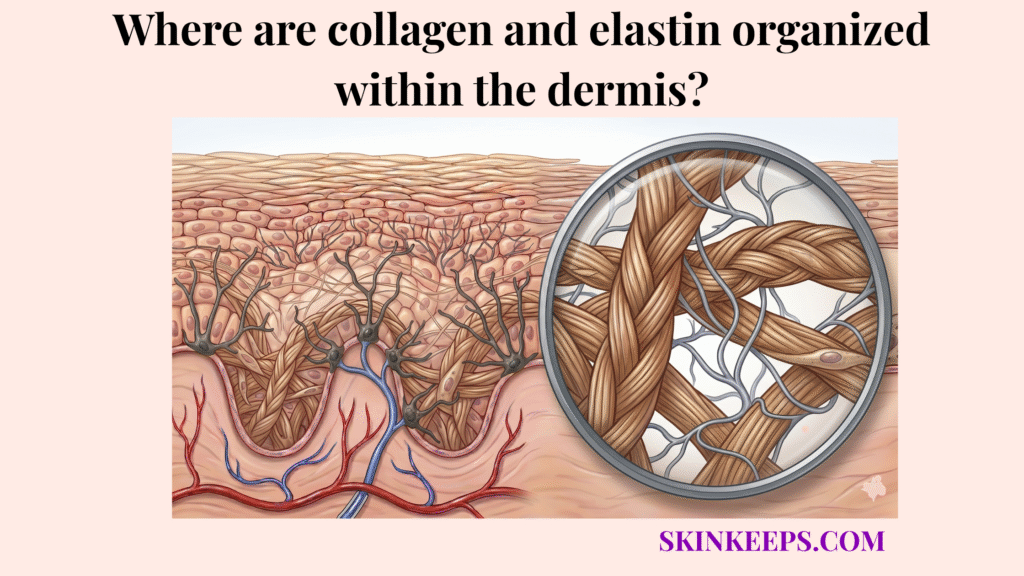
Collagen and elastin are organized throughout the dermis—the connective-tissue layer beneath the epidermis—but they are not arranged in the same way or with the same density in every dermal layer. Collagen forms the main structural framework of the dermis, while elastin forms a supportive elastic network that allows the skin to stretch and recoil.
This organization matters because skin strength does not come from collagen alone, and elasticity does not come from elastin alone. Quantitatively, collagen contributes about 70–80% of the dry weight of the dermis, while elastin is a much smaller component at roughly 2–4% of the dermal extracellular matrix—the structural environment containing fibers, ground substance, and support molecules; this contrast is one reason organization matters more than simple presence (Tzaphlidou, 2004).
Understanding dermal collagen and elastin organization makes it easier to explain why the skin feels firm yet flexible, why aging changes both strength and recoil, and what actually weakens dermal resilience over time. The sections below will map the dermis by layer, isolate collagen and elastin arrangement, and explain how aging and damage distort that structure.
Why does dermal collagen and elastin organization matter for skin structure?
Dermal collagen and elastin organization matters because the skin’s firmness, flexibility, and resilience depend on how these fibers are structured together within the dermis.
The dermis must provide strength without becoming rigid, and it must allow stretch and recoil without collapsing under daily mechanical stress.
This balance depends on the arrangement, alignment, density, and interaction of fibers rather than on the total fiber amount alone. Collagen and elastic tissue serve distinct but cooperative biomechanical functions in standard histologic descriptions of the dermis.
How is dermal collagen and elastin organization divided between the papillary and reticular dermis?
Dermal collagen and elastin organization is divided between a finer upper papillary zone and a denser deeper reticular zone, with each layer contributing differently to support and elasticity. The papillary dermis is the thinner, more delicate upper dermal zone, while the reticular dermis is the deeper, thicker, denser dermal zone.
The papillary dermis is more delicate and loosely organized to support the epidermal interface, while the reticular dermis is deeper, thicker, and more fiber-dense to anchor the skin and provide bulk mechanical strength.
The papillary dermis has been described as the thinner outermost portion of the dermis, constituting approximately 10% of the 1–4 mm-thick dermis, while the reticular dermis forms the bulk of the layer (Geerligs, 2010).
Collagen and elastin are present in both regions, but their layered dermal structure differs by layer, which is why the upper dermis behaves differently from the deeper dermis.
Where is collagen organized within dermal collagen and elastin organization?
Within dermal collagen and elastin organization, collagen is arranged as finer fibers in the papillary dermis and thicker structural bundles in the reticular dermis. Collagen fibers are the main structural fibers that resist pulling and deformation.
Collagen forms the main structural framework of the dermis and its organization changes by depth to accommodate both surface flexibility and deep mechanical strength.
How is collagen organized in the papillary dermis?
Collagen fibers in the papillary dermis are finer and more loosely arranged.
This layer supports the upper dermis and helps interface mechanically with the epidermis above it.
Papillary collagen is less bulky and more delicate than the deeper framework of the reticular dermis, providing the necessary compliance required just beneath the epidermal junction.
How is collagen organized in the reticular dermis?
Collagen fibers in the reticular dermis are thicker and more densely bundled.
This layer provides most of the dermis’s tensile strength and overall physical resilience.
To understand which dermal layer contains dense collagen fibers, you must look here: its collagen organization creates the deeper mechanical framework of the skin, forming the thick collagen bundles that dominate this region and resist profound stretching forces.
Where is elastin organized within dermal collagen and elastin organization?
Within dermal collagen and elastin organization, elastin is arranged as a distributed elastic network that supports recoil across both upper and deeper dermal layers. Elastic fibers, which form the elastin network, are the fibers that help tissue stretch and recoil.
Elastin is organized as a supportive elastic fiber network throughout the dermis rather than acting as the main load-bearing framework.
Understanding how are elastin fibers arranged in the dermal matrix reveals a layered approach: in the upper dermis, elastic fibers are finer and more delicate, running perpendicularly toward the epidermis, while in the deeper dermis, they become thicker, running parallel to the skin surface to contribute to broader-scale recoil.
Elastin does not replace collagen’s support role; it complements it by allowing the tissue to stretch and recover shape after deformation. Elastic fibers are biomechanically suited to recoil, whereas collagen is suited to resisting extension.
How does dermal collagen and elastin organization create firmness and elasticity together?
Dermal collagen and elastin organization creates firmness and elasticity together by combining structural resistance with elastic recoil in the same connective framework.
Collagen provides resistance to pulling and deformation, while elastin allows the dermis to stretch and return toward its original shape.
Together they prevent the skin from being either too stiff or too lax, uniting upper support and deep strength into a cohesive structural unit.
How does papillary dermal collagen and elastin organization differ from reticular dermal organization?
Papillary dermal collagen and elastin organization is finer and more delicate, while reticular dermal organization is denser, stronger, and more mechanically dominant.
The papillary dermis supports the epidermal interface with finer fibers and a looser matrix, while the reticular dermis provides deep strength and larger-scale mechanical resilience.
This layer-specific difference is why dermal architecture is best understood as a vertical system rather than one uniform fiber bed.
| Dermal layer | Collagen organization | Elastin organization | Main structural role |
|---|---|---|---|
| Papillary dermis | Finer, looser fibers | Finer elastic support | Upper support and flexibility near the epidermis |
| Reticular dermis | Thicker, denser bundles | Broader recoil network | Deep mechanical strength and elasticity |
How does healthy dermal collagen and elastin organization differ from aged or damaged organization?
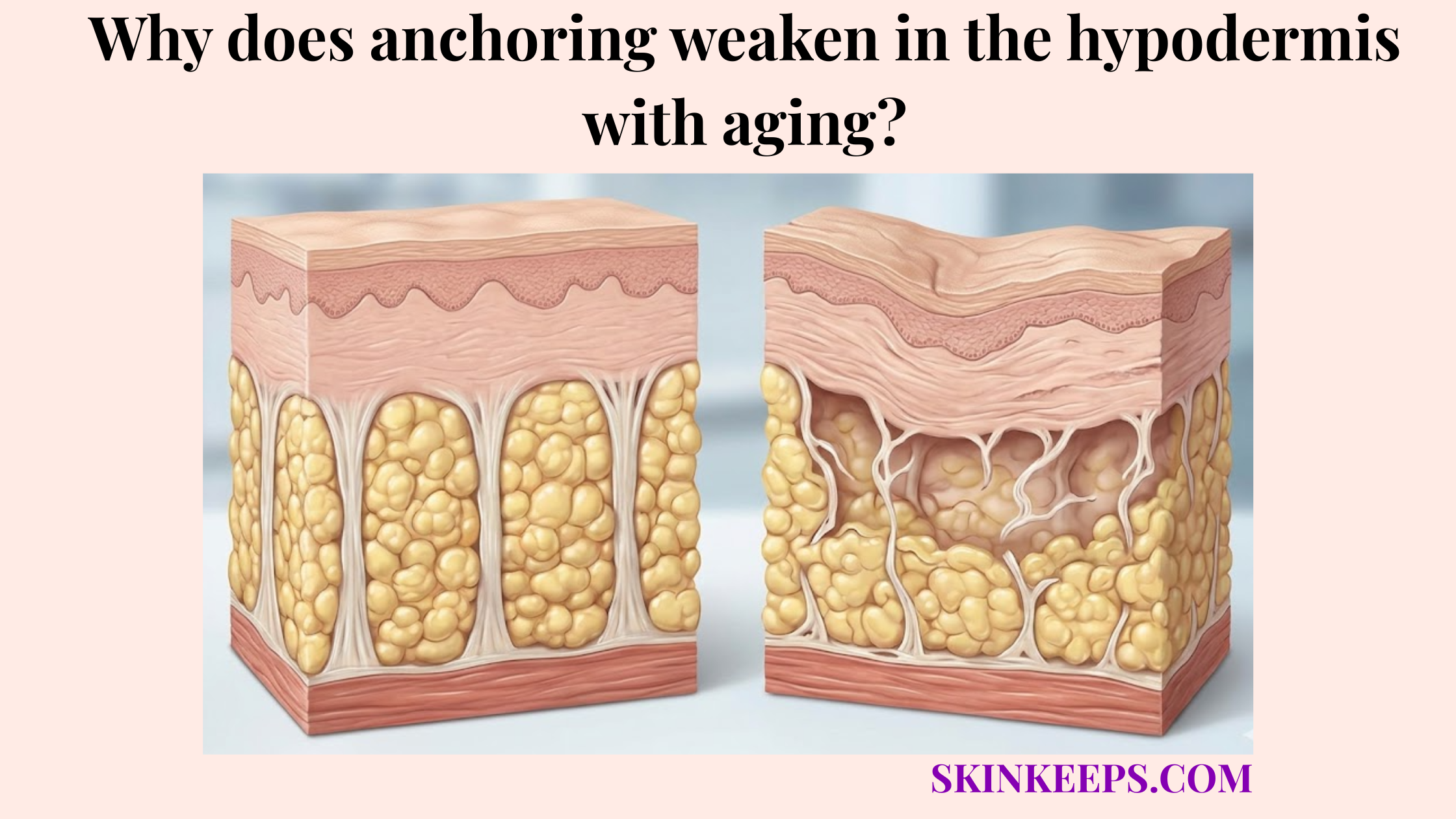
Healthy dermal collagen and elastin organization supports stronger, more resilient skin, while aged or damaged organization reduces both firmness and recoil.
Healthy dermal organization is more coherent, balanced, and mechanically efficient.
Aging weakens fiber quality, alignment, and recoil performance, while UV damage can distort both collagen support and elastin architecture. Asking why does collagen density decrease in the dermis with age helps clarify how chronological aging and environmental damage systematically break down this organized framework.
| Structural state | Collagen quality | Elastin quality | Visible skin effect |
|---|---|---|---|
| Healthy organization | More coherent and supportive | More responsive recoil | Firmer, smoother, more resilient skin |
| Aged or damaged organization | Weaker or disorganized | Less elastic or distorted | Laxity, roughness, reduced bounce |
Which signs suggest dermal collagen and elastin organization is weakening?
Dermal collagen and elastin organization may be weakening when the skin looks less firm, less elastic, and less able to maintain its shape smoothly.
Warning signs can include reduced firmness, skin that does not rebound as well after movement, increased laxity, fine wrinkling that becomes more persistent, less smooth structural support under the surface, and slower recovery after compression or stretch.
These visible and functional changes reflect weaker connective architecture rather than just surface dryness.
What factors weaken dermal collagen and elastin organization?
Dermal collagen and elastin organization weakens when cumulative damage reduces fiber quality, alignment, and long-term structural integrity.
The main weakening factors include chronic UV exposure, aging, oxidative stress, ongoing inflammation, smoking, and poor long-term photoprotection.
These factors do not just reduce “firmness” abstractly. They act by degrading or disorganizing the matrix that keeps dermal structure coherent.
What habits and ingredients help support dermal collagen and elastin organization?
The best support for dermal collagen and elastin organization focuses on protection, lower chronic stress, and long-term structural preservation rather than quick-fix surface correction.
The goal is not to promise instant regeneration, but to preserve the architecture that remains and reduce the processes that distort it over time.
This transition guides us to the protective steps below.
How does sun protection help support dermal collagen and elastin organization?
Sun protection helps support dermal collagen and elastin organization because UV exposure is one of the strongest long-term disruptors of dermal structure.
Daily SPF helps reduce cumulative collagen and elastin damage and preserve the organization that remains.
This is a preservation strategy, not a claim of direct structural rebuilding from sunscreen alone.
How do retinoids help support dermal collagen and elastin organization?
Retinoids help support dermal collagen and elastin organization by supporting healthier skin renewal and matrix-related signaling over time.
Retinoids are often used when the goal is to improve long-term skin quality and firmness support.
They work best with barrier-supportive care rather than aggressive layering or overuse.
How do barrier support and lower inflammation help preserve dermal collagen and elastin organization?
Barrier support and lower inflammation help preserve dermal collagen and elastin organization because chronic surface irritation can increase deeper tissue stress over time.
Better barrier stability reduces unnecessary inflammatory burden and helps create conditions that are less disruptive to long-term structural quality.
More stable skin conditions help preserve dermal quality indirectly, even if barrier care is not the same thing as direct collagen or elastin rebuilding.
Problem: dermal organization is weakening
Implication: firmness and elasticity are becoming less stable
Solution: reduce cumulative damage, support skin stability, and use long-term protective care
What are the key takeaways about dermal collagen and elastin organization?
Collagen and elastin are both organized throughout the dermis, but not in the same way.
To protect skin health, maintaining this layered organization requires long-term structural preservation.
Summary Points
- Collagen provides structural strength, while elastin supports stretch and recoil
- Their organization differs between the papillary and reticular dermis
- Healthy dermal function depends on coordinated fiber arrangement, not just the presence of connective tissue
- Aging and UV damage weaken that organization over time
FAQs About Dermal Collagen and Elastin Organization
Are collagen and elastin found in the same exact way throughout the dermis?
Both are present throughout the dermis, but their arrangement differs by layer and by fiber role. Papillary organization is finer; reticular organization is denser.
Does collagen create elasticity by itself?
Collagen mainly provides structural strength, while elastin provides recoil. Skin resilience depends on both systems working together.
Why does aging change both firmness and bounce?
Aging affects both collagen support and elastic-fiber quality, so the skin loses both structural resistance and recoil performance.
Can skin care directly rebuild dermal collagen and elastin quickly?
Quick rebuilding should not be promised; realistic support focuses on protection, long-term care, and lowering damage rather than instant regeneration.
What daily steps can you take to help preserve dermal collagen and elastin organization?
Daily steps can help preserve dermal collagen and elastin organization by reducing damage pressure and supporting long-term structural stability.
The most useful strategy is consistency: daily photoprotection, lower irritation, steady barrier care, and careful use of long-term supportive actives if appropriate.
Daily Structural Preservation Checklist
Dermal strength and elasticity do not come from isolated fibers working alone. They come from organized connective architecture.
Build your routine around protection and structural preservation if your goal is firmer, more resilient, more elastic skin over time.