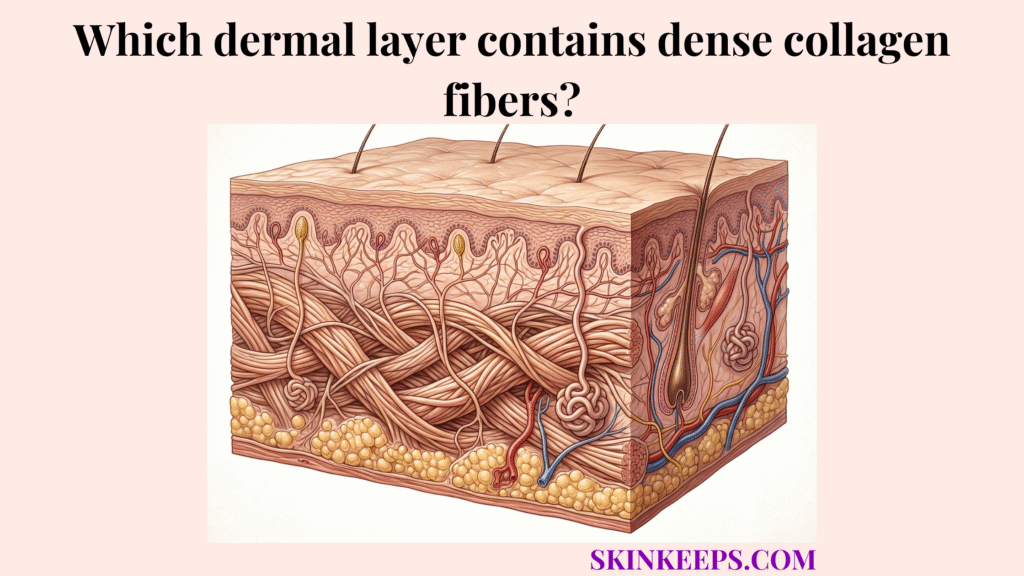
The dermal layer that contains dense collagen fibers is the reticular dermis, the deeper and thicker portion of the dermis. This layer contains larger, denser collagen bundles that give the skin most of its tensile strength and structural firmness. Standard histology references describe the reticular dermis as the deep dermal layer composed of dense connective tissue with thick collagen bundles.
The upper dermis also contains collagen, but it is finer and looser in arrangement. The difference matters because the skin does not rely on collagen presence alone; it relies on where collagen is placed, how densely it is packed, and how strongly it is organized. A layer-by-layer dermis analysis describes papillary dermis as thinner and looser, while the reticular dermis is dominated by thicker, denser bundles.
Understanding where dense dermal collagen fibers are located makes it easier to explain why the reticular dermis gives the skin its deeper strength, how this differs from the papillary dermis, and what happens when that dense collagen architecture weakens over time.
Where are dense dermal collagen fibers located?
Dense dermal collagen fibers are located mainly in the reticular dermis—the deeper, thicker, denser dermal zone beneath the papillary layer—where the skin’s deeper structural framework is concentrated.
The reticular dermis is the deeper part of the dermis beneath the papillary layer, and it contains thicker, more tightly packed collagen bundles than the upper dermis.
Lynch et al., 2022 report that the human papillary dermis is roughly 60–120 μm thick, while the reticular dermis ranges about 1000–4000 μm, reinforcing that dense dermal collagen fibers are concentrated in a much deeper, bulkier layer rather than in the thin upper dermis (Scientific Reports, 2022).
Why does the reticular dermis contain dense dermal collagen fibers?
The reticular dermis contains dense collagen fibers—thickly packed structural proteins that form the main load-bearing framework of the skin—because this deeper layer is responsible for most of the skin’s tensile strength and mechanical support.
The deeper dermis must bear more mechanical stress than the upper dermis, so it is built for deeper structural support rather than delicate interface work.
Dense collagen bundles provide resistance to stretching and deformation, which is why they are concentrated in the deeper dermis instead of the papillary dermis. Histology references consistently describe the reticular dermis as the dense connective-tissue bulk of the dermis.
How do dense dermal collagen fibers differ from papillary dermal collagen?
Dense dermal collagen fibers differ from papillary dermal collagen because they are thicker, more tightly bundled, and more responsible for deep mechanical strength. This contrasts directly with the papillary dermis, which is the thinner, more delicate upper dermal zone.
Papillary dermal collagen is finer and looser, supporting the upper dermis and its interface with the epidermis rather than providing the main load-bearing framework.
Lynch et al., 2022 found that the reticular dermis was on average about 3 times stiffer than the papillary dermis in ex vivo mechanical testing, which supports the histologic point that dense dermal collagen fibers are not only thicker in appearance but functionally more load-bearing (Scientific Reports, 2022).
| Dermal layer | Collagen pattern | Fiber thickness | Main role |
|---|---|---|---|
| Papillary dermis | Finer and looser | Thinner | Upper support and flexibility |
| Reticular dermis | Dense dermal collagen fibers | Thicker | Deep strength and structural firmness |
How are dense dermal collagen fibers organized in the reticular dermis?
Dense dermal collagen fibers are organized as thicker, interwoven bundles that create the deeper structural framework of the skin. A collagen bundle is a grouped collection of collagen fibers providing structural rigidity.
Dense dermal collagen fibers are organized into thicker bundles rather than delicate loose strands.
These bundles are interwoven into a supportive connective framework that helps the skin resist pulling, compression, and structural distortion. A 1984 collagen-distribution study described the reticular layer as a dense connective matrix with thick, regularly oriented bundles, in contrast to the finer organization above (J Invest Dermatol, 1984).
How do dense dermal collagen fibers support skin firmness and tensile strength?
Dense dermal collagen fibers support skin firmness and tensile strength—the resistance of a material to breaking under tension—by creating a deeper connective framework that resists deformation.
Dense dermal collagen fibers resist stretching and tearing and provide the skin with deeper firmness and load-bearing support.
Without this dense collagen framework, the skin would be less stable under movement and external stress. Structural histology sources describe the dermis as a connective framework for strength and flexibility, with collagen as its principal fibrous component.
How do dense dermal collagen fibers work with elastin in the reticular dermis?
Dense dermal collagen fibers work with elastin by supplying structural strength while elastic fibers help the skin rebound after stretch, utilizing elastic recoil—the ability of a tissue to snap back to its original shape after being stretched.
Dense dermal collagen fibers provide resistance and structure, while elastin adds flexibility and recoil to the same deep connective layer.
Together they allow the skin to feel strong without becoming rigid. StatPearls notes that the reticular dermis contains thick elastic fibers alongside collagen and that elastin supports gliding, stretching, and recoil rather than replacing collagen’s support role.
How do healthy dense dermal collagen fibers compare with weakened or damaged collagen structure?
Healthy dense dermal collagen fibers maintain deeper skin strength, while weakened collagen structure reduces firmness and makes the skin less resilient.
Healthy dermal organization is more coherent, balanced, and mechanically efficient, while damaged organization weakens bundle quality, alignment, and recoil support.
Lynch et al., 2022 observed that dermal mechanical stiffness decreased by about 40% from the youngest to the oldest age groups in both papillary and reticular dermal layers, while histology showed that collagen degradation became more pronounced with age and photoexposure (Scientific Reports, 2022).
| Collagen state | Bundle quality | Structural support | Visible skin effect |
|---|---|---|---|
| Healthy dense dermal collagen fibers | Coherent and well organized | Stronger | Firmer, smoother, more resilient skin |
| Weakened or damaged collagen structure | Less organized or reduced | Lower | Laxity, roughness, reduced firmness |
Which signs suggest dense dermal collagen fibers are weakening?
Dense dermal collagen fibers may be weakening when the skin becomes less firm, less taut, and less able to maintain its deeper structural shape.
Warning signs can include reduced firmness, increased laxity, skin that feels less supported beneath the surface, more persistent fine wrinkling, slower rebound after compression or facial movement, and less smooth structural tension over time.
These visible changes reflect deeper connective weakening rather than only superficial dryness. Photoaging and dermal-aging literature tie collagen disorganization to laxity, roughness, reduced bounce, and deeper wrinkling.
What factors weaken dense dermal collagen fibers?
Dense dermal collagen fibers weaken when cumulative damage reduces fiber quality, bundle integrity, and long-term connective support.
The main weakening factors are chronic UV exposure, aging, oxidative stress, smoking, ongoing inflammation, and repeated tissue stress without adequate protection.
Photoaging literature describes solar elastosis—the accumulation of abnormal elastic tissue—and collagen degradation as major dermal consequences of chronic UV exposure, while Lynch et al., 2022 observed that collagen degradation was more pronounced in photoexposed skin than in protected skin (Scientific Reports, 2022). This dynamic directly explains why collagen density decreases in the dermis with age.
What habits and ingredients help preserve dense dermal collagen fibers?
The best way to preserve dense dermal collagen fibers is to reduce cumulative damage and support long-term dermal stability rather than chase quick surface fixes.
The goal is preservation, not unrealistic claims of instantly rebuilding the deep dermal framework.
The sections below detail how to execute this preservation effectively.
How does sun protection help preserve dense dermal collagen fibers?
Sun protection helps preserve dense dermal collagen fibers because UV damage is one of the strongest long-term disruptors of deep collagen structure.
Daily SPF helps reduce cumulative collagen and elastin damage and helps preserve the dense collagen architecture already present.
Protection is preservation-focused rather than reconstructive. Chronic UV exposure is a major driver of collagen degradation and elastotic distortion within the dermis.
How do retinoids help support skin with weakened dense dermal collagen fibers?
Retinoids help support skin with weakened dense dermal collagen fibers by improving matrix-related signaling and long-term skin quality over time.
Retinoids are often used when the goal is to support firmer-feeling skin over time, and that they work best with barrier-friendly care rather than aggressive irritation.
Griffiths et al., 1993 reported that treatment of photodamaged skin with tretinoin produced an 80% increase in type I collagen formation, compared with a decrease in the control condition, making retinoids one of the strongest evidence-based support strategies for collagen preservation and remodeling (NEJM, 1993).
How does lower chronic inflammation help preserve dense dermal collagen fibers?
Lower chronic inflammation helps preserve dense dermal collagen fibers because ongoing tissue stress increases matrix disruption over time.
Calmer skin environments are more supportive of long-term structural preservation than chronically irritated ones.
Less chronic stress helps maintain dermal integrity over time, even if it does not instantly rebuild deep collagen bundles. Reviews of photoaging and matrix damage consistently connect inflammation and oxidative burden to collagen deterioration.
Problem: dense dermal collagen fibers are weakening
Implication: deep structural support is becoming less stable
Solution: reduce cumulative damage, protect the skin, and support long-term dermal preservation
What are the key takeaways about dense dermal collagen fibers?
Dense dermal collagen fibers are found mainly in the reticular dermis and form the deeper mechanical framework of the skin.
By anchoring the structural biology, these bundles guarantee dermal performance across decades of use.
Summary Points
- Dense dermal collagen fibers are found mainly in the reticular dermis.
- They are thicker and more tightly organized than the finer collagen of the papillary dermis.
- Their main role is to provide deep tensile strength and structural firmness.
- Aging and UV damage weaken their organization over time.
- The best preservation strategy focuses on protection, lower chronic stress, and long-term skin support.
FAQs About Dense Dermal Collagen Fibers
Which dermal layer contains dense collagen fibers?
The reticular dermis contains the dense collagen bundles that provide most of the skin’s deep structural support.
Does the papillary dermis also contain collagen?
Yes, but papillary collagen is finer and looser than the thick bundles of the reticular dermis.
Why does dense reticular collagen matter so much for skin firmness?
Dense reticular collagen resists deformation and provides deep tensile strength, which is why it contributes so much to firmness.
What weakens dense dermal collagen fibers over time?
UV exposure, aging, oxidative stress, smoking, and chronic inflammation gradually reduce fiber quality and bundle integrity.
What daily steps can you take to help preserve dense dermal collagen fibers?
Daily steps can help preserve dense dermal collagen fibers by limiting cumulative dermal damage and supporting long-term structural stability.
Preservation works better than aggressive short-term correction when the goal is deeper skin firmness and resilience.
Daily Structural Preservation Checklist
Dense dermal collagen fibers are one of the main reasons skin feels firm and structurally supported.
Build your routine around long-term structural preservation if your goal is firmer, more resilient skin over time.