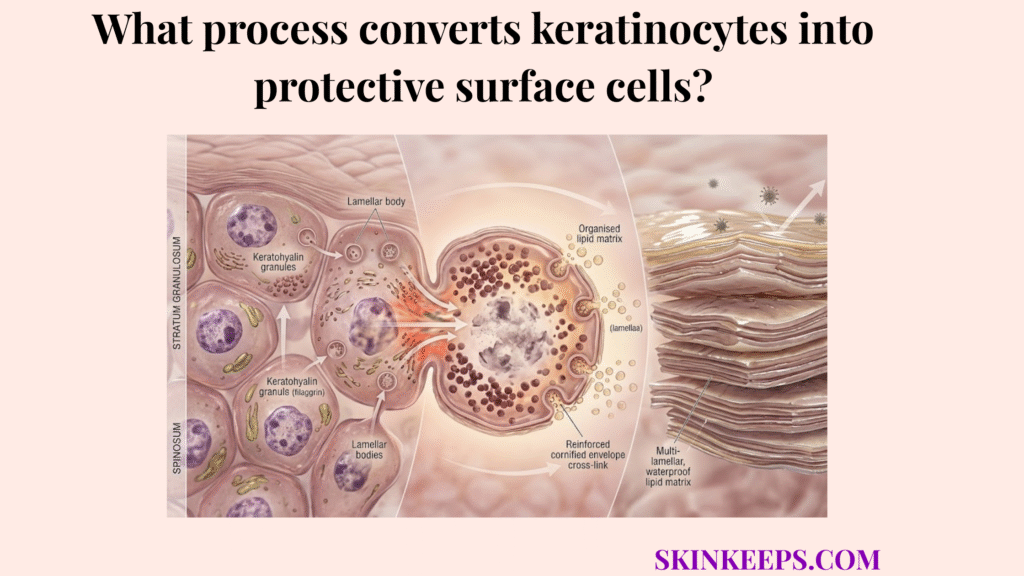
The process that converts keratinocytes into protective surface cells is keratinization, a highly coordinated biological sequence where living epidermal cells gradually harden, lose their nuclei, and transform into flattened corneocytes. This process, also called cornification, is the mechanism that creates the skin’s outermost physical barrier. The distinction between keratinization and its terminal corneocyte outcome is foundational to barrier biology.
This conversion is essential for resilience and waterproofing. When it is poorly regulated, the result can be visible scaling, roughness, hyperkeratotic buildup, or a weaker surface shield. Terminal differentiation and lamellar-body lipid delivery are both central to that barrier outcome.
Understanding how keratinization converts keratinocytes into surface cells makes it easier to explain why the skin becomes tougher as cells rise, why the granular layer is such an important transition zone, and what actually helps maintain healthy maturation.
What is keratinization, and how does it convert keratinocytes into surface cells?
Keratinization converts keratinocytes into surface cells by moving them through a staged transition from living, dividing cells at the base of the epidermis into the flattened, hardened barrier cells that constitute the stratum corneum. This terminal differentiation pathway is essential for creating the skin’s functional outer shield and ensuring long-term resilience.
How do structural proteins help keratinization convert keratinocytes into surface cells?
Structural proteins help keratinization convert keratinocytes into surface cells by filling the cell with a dense, rigid framework of fibers that provide the tensile strength required for barrier durability.
Protein-driven hardening is the part of keratinization that gives the future corneocyte its mechanical resilience. This process aggregates intracellular components to prepare the cell for the harsh environmental conditions at the skin surface.
How do keratin fibers support the conversion of keratinocytes into surface cells?
Keratin fibers support the conversion of keratinocytes into surface cells by forming the internal structural scaffolding that makes the cell increasingly tough and resistant to mechanical surface stress.
As keratinocytes move upward, the intracellular keratin network becomes a dominant mechanical component of the future corneocyte. Keratin-filled corneocytes account for about 85% of the dry weight of the stratum corneum, which helps explain why protein compaction is so central to mechanical barrier strength (PMC).
The resilience of this shield depends fundamentally on how keratin filaments are organized in upper epidermal layers, where they create a dense, interlocking matrix.
How does filaggrin support the conversion of keratinocytes into surface cells?
Filaggrin supports the conversion of keratinocytes into surface cells by actively aggregating keratin fibers into dense bundles, creating a highly organized internal matrix that solidifies the cell.
Filaggrin degradation products are a main source of several major natural moisturizing factor components, and NMF can make up about 10% of corneocyte mass and roughly 20–30% of the dry weight of the stratum corneum (PMC).
How does the granular layer drive the process by which keratinization converts keratinocytes into surface cells?
The granular layer drives the process by which keratinization converts keratinocytes into surface cells because it acts as the primary transition zone where cells lose their living features and release the lipids required for waterproofing.
This transition is marked by two dramatic changes: the breakdown of the nucleus and the formation of the cornified envelope. Understanding why keratinocytes lose their nuclei during epidermal maturation explains how the cell sacrifices its living functions to become a specialized barrier unit.
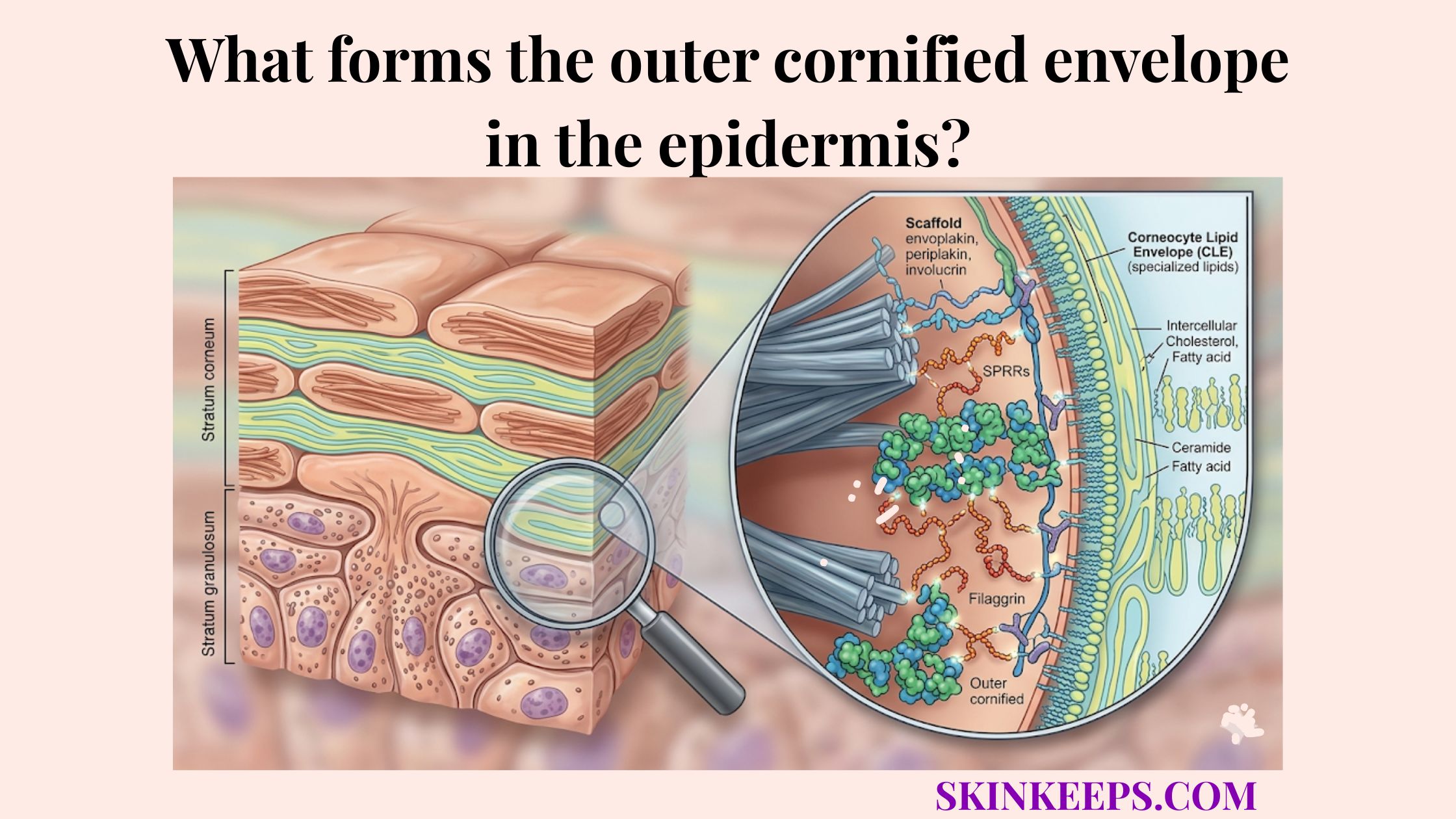
Simultaneously, the cell builds its final armor. The quality of the surface defense depends heavily on what forms the outer cornified envelope in the epidermis, as this insoluble shell prevents moisture loss and blocks environmental irritants.
How does a healthy versus disrupted cycle change the way keratinization converts keratinocytes into surface cells?
A healthy cycle allows keratinization to convert keratinocytes into surface cells at a balanced pace, whereas a disrupted cycle results in incomplete maturation, visible scaling, or excessive cell retention.
| Process State | Clinical Pattern | Visible Skin Result |
|---|---|---|
| Healthy Keratinization | Balanced maturation | Smooth, resilient surface |
| Too-Fast Maturation | Incomplete differentiation | Scaling, redness, weaker barrier |
| Too-Slow Maturation | Excess cell retention | Thickening, dullness, congestion |
What ingredients help support the process by which keratinization converts keratinocytes into surface cells?
Specific ingredients support the process by which keratinization converts keratinocytes into surface cells by regulating the speed of turnover and reinforcing the quality of the final cornified envelope.
How do retinoids help regulate the process by which keratinization converts keratinocytes into surface cells?
Retinoids help regulate the process by which keratinization converts keratinocytes into surface cells by binding to nuclear receptors that normalize cellular turnover and ensure cells mature correctly before reaching the surface.
Histological studies of topical retinoids have reported epidermal changes such as stratum corneum compaction and increased epidermal thickness after about 15 days of treatment (PMC).
How do niacinamide and supportive nutrients help strengthen the final surface-cell barrier?
Niacinamide and supportive nutrients strengthen the final surface-cell barrier by increasing the synthesis of essential lipids and supporting the proteins that build a resilient cornified envelope.
Topical niacinamide has been shown to stimulate de novo ceramide synthesis and improve epidermal permeability-barrier function, which prevents the surface from becoming brittle or reactive (PubMed).
What are the key takeaways about how keratinization converts keratinocytes into surface cells?
The key takeaways about how keratinization converts keratinocytes into surface cells focus on the essential hardening of cells through proteins like keratin and filaggrin to create a waterproof barrier.
- ● Keratinization transforms living cells into tough protective shields.
- ● Keratin, filaggrin, and lipid release are central to this conversion.
- ● Healthy skin depends on balanced maturation, not just speed.
- ● Support strategy combines regulation, barrier support, and stability.
What steps can you take to support the process by which keratinization converts keratinocytes into surface cells?
You can support the process by which keratinization converts keratinocytes into surface cells by prioritizing biological balance in your routine over aggressive surface removal.
Daily Keratinization Support Protocol
Closing insight: Healthy surface cells are not created by forcing the skin to shed faster at all costs. They are created when keratinization stays organized, balanced, and well supported.
Build your routine around healthier cellular maturation if your goal is a smoother barrier, more resilient surface skin, and better long-term skin quality.
Ultimately, when you support the flow of your skin’s escalator, radiance follows naturally.