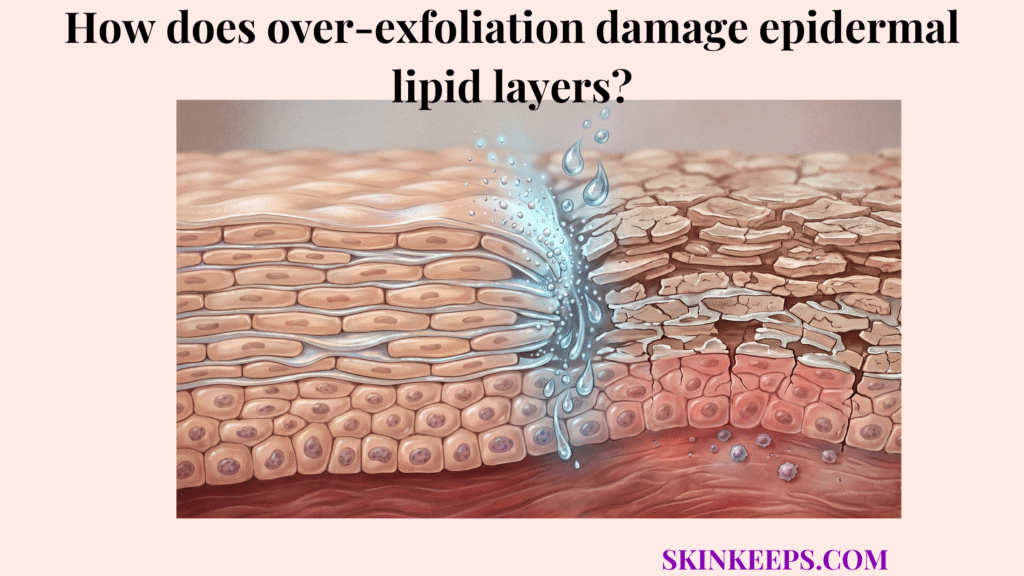
Over-exfoliation damages epidermal lipid layers by stripping the surface barrier faster than the skin can rebuild its protective lipid matrix. When exfoliation is too frequent, too strong, or poorly layered with other actives, the lipids between surface cells become depleted and disorganized, making the skin lose water faster and react more easily. The stratum corneum barrier depends on corneocytes surrounded by ordered lipids, so when that architecture is disrupted, permeability rises.
This is why over-exfoliated skin often feels tight, stingy, dry, shiny, red, or oddly oily and irritated at the same time. The problem is not only dead-cell removal; the deeper issue is the loss of the lipid structure needed to keep the epidermis sealed, calm, and resilient. TEWL—transepidermal water loss, the standard measure of barrier leakiness—rises when this structure weakens, and higher TEWL is a standard marker of barrier disruption.
Understanding how over-exfoliation damages epidermal lipid layers makes it easier to explain why a ‘smoother’ routine can suddenly produce burning, flaking, and chronic sensitivity, and what actually helps reverse that pattern.
Why are epidermal lipid layers so important to barrier defense?
Epidermal lipid layers—the intercellular lipids in the stratum corneum that seal the barrier—are essential because they form the sealing system that helps the skin stay hydrated, protected, and less reactive.
These lipids maintain a highly ordered lamellar lipid organization, which is the ordered layered arrangement of barrier lipids between cells. This architecture ensures that the skin remains waterproof and resilient against environmental stress.
Barrier comfort, flexibility, and resilience all depend on this lipid architecture remaining organized rather than patchy or stripped. Reviews of stratum corneum barrier function consistently identify intercellular lipids as central to permeability control, highlighting their role in blocking both water escape and irritant entry.
What part of the epidermal lipid system gets damaged first during over-exfoliation?
Over-exfoliation first damages the organized sealing pattern of epidermal lipid layers, weakening the barrier before larger visible symptoms fully appear.
The earliest damage usually appears in the lipid organization between outer corneocytes—flattened outer skin cells surrounded by barrier lipids—rather than as immediate full-thickness barrier collapse. This microscopic fracturing is the first step in the “leak” phase of disruption.
Once this lamellar seal becomes patchy, water loss rises, tolerance drops, and inflammatory reactivity becomes easier to trigger. This is why early over-exfoliation often feels “off” or slightly tight before it looks dramatically damaged or red.
How does chemical over-exfoliation damage epidermal lipid layers?
Chemical exfoliation—desquamation driven by acids or peeling agents—damages epidermal lipid layers by accelerating surface turnover beyond the skin’s ability to rebuild its protective lipid seal.
Acids and peeling agents can push desquamation beyond controlled renewal when they are too frequent, too concentrated, or combined without recovery time. The problem is intensity exceeding the biological speed of lipid replacement.
How do repeated acids strip protective surface balance?
Repeated acids strip protective surface balance by disturbing the conditions that support stable desquamation and adequate rebuilding of intercellular lipids. Soleymani et al. (2018) describe chemical peels as targeted cutaneous ablation induced by caustic agents, which is why repeated acid exposure should be framed as cumulative barrier injury when recovery time is inadequate (PMC, 2018).
How does acid stacking intensify lipid-layer damage?
Acid stacking intensifies lipid-layer damage by combining multiple resurfacing stresses before the skin has restored the lipid architecture disturbed by the first one. Motamedi et al. (2021) emphasize that topical retinoids are limited by irritation, supporting the warning that layering acids with other high-irritancy actives can intensify barrier injury (PMC, 2021).
How does physical over-exfoliation damage epidermal lipid layers?
Physical exfoliation—mechanical removal through scrubs, friction, or rubbing—damages epidermal lipid layers by mechanically stripping the surface faster than healthy barrier renewal can replace it.
Scrubs, rubbing, rough cleansing tools, and repetitive friction can remove protective surface cells too quickly and disturb the lipids surrounding those cells. This “abrasive” stripping physically tears the lamellar sheets apart.
Repeated mechanical stripping produces micro-level barrier disruption that exposes less protected skin below. Human tape-stripping work shows TEWL rises sharply as the stratum corneum is mechanically removed, proving that friction damage is a genuine barrier injury (Wiley, 2019).
How does over-exfoliation turn lipid loss into higher TEWL and irritation?
Over-exfoliation turns lipid loss into chronic discomfort by increasing TEWL and making the skin more permeable to irritation. Once the seal is broken, the skin enters a self-reinforcing “Spiral” of decline.
Once lipid layers weaken, water escapes more easily through the epidermis and the surface becomes drier, tighter, and more fragile. This dehydration makes the remaining cells more brittle and prone to further cracking.
Irritants also penetrate more easily once the lipid seal is compromised, which then amplifies inflammation and slows recovery. At this point, the skin is in a state of “stress exceeding recovery,” where even simple water can feel like a sting.
How does acute over-exfoliation differ from chronic over-exfoliation damage?
Acute over-exfoliation—sudden barrier stripping after a strong insult—causes sudden lipid-layer damage, while chronic over-exfoliation keeps the epidermis in a repeated cycle of depletion.
| Pattern | Typical Cause | Lipid-Layer Effect | Skin Response |
|---|---|---|---|
| Acute | One strong peel or acid episode | Sudden stripping | Burning, redness, stinging |
| Chronic | Repeated use without recovery | Ongoing depletion | Persistent dryness, sensitivity |
How can you tell when over-exfoliation is damaging epidermal lipid layers?
Over-exfoliation is damaging epidermal lipid layers when the skin becomes less comfortable, less tolerant, and less able to stay hydrated between routine steps. Declining tolerance is often the first true clinical warning.
Warning Signs Checklist
How do healthy epidermal lipid layers compare with over-exfoliated lipid layers?
Healthy epidermal lipid layers keep the skin sealed and resilient, while over-exfoliated lipid layers become disorganized, leaky, and easier to irritate.
| Lipid state | Barrier sealing | Water retention | Surface feel |
|---|---|---|---|
| Healthy | Organized and stable | Stronger (Low TEWL) | Calm, smooth, flexible |
| Over-exfoliated | Depleted or disorganized | Weaker (High TEWL) | Tight, stingy, reactive |
What steps stop over-exfoliation damage to epidermal lipid layers?
Stopping over-exfoliation damage requires removing the stripping trigger first, then giving the epidermis time and support to restore its lipid architecture. You cannot “repair” a barrier while you are still actively dismantling it.
How do you stop the exfoliation trigger?
You stop the exfoliation trigger by pausing acids, scrubs, and unnecessary active layering. Motamedi et al. (2021) frame tolerability as a limiting factor, supporting the rule that continuing multiple resurfacing steps prolongs damage instead of correcting it when a stripping pattern is present (PMC, 2021).
How do you calm the skin while lipid layers recover?
You calm the skin by simplifying the routine to low-irritation cleansing and lipid support. Spada et al. (2021) found that a ceramide-dominant regimen improved barrier permeability over 28 days, supporting the principle that lipid-supportive stability works better than aggressive correction (PMC, 2021).
How do you prevent the damage from restarting too early?
You prevent restart by reintroducing actives gradually and watching for early warning signs. Utilizing a diagnostic tool like the Routine Stability Index (RSI) can help you quantify whether your product layering is exceeding your skin’s stability threshold, preventing future over-treatment.
Problem: lipid layers are being over-stripped
Implication: water and tolerance are lost faster than they can rebuild
Solution: stop the trigger, simplify, and allow repair to catch up
What ingredients help rebuild epidermal lipid layers after over-exfoliation?
The best ingredients after over-exfoliation are the ones that restore lipid balance, reduce dehydration stress, and help the barrier rebuild without more irritation. This means replenishing the epidermal barrier matrix directly.
Priority ingredients include Ceramides, Cholesterol, and Free Fatty Acids. These components are most effective when used together to mimic the skin’s own lamellar structure. Humectants like Glycerin help reduce dehydration stress, while occlusives provide a temporary seal while the internal lipids reorganize.
What are the key takeaways about over-exfoliation damage to epidermal lipid layers?
- ● Over-exfoliation strips and disorganizes the lipid seal between cells.
- ● This failure increases TEWL and makes the skin hypersensitive to irritants.
- ● Both chemical and physical methods can cause damage if recovery is ignored.
- ● Successful repair starts with stopping the trigger and using lipid-friendly care.
What daily steps can you take to avoid over-exfoliation damage?
You can avoid damage by matching exfoliation intensity to your skin’s recovery capacity. Smoothing should be a result of balance, not constant stripping.
Daily Prevention Checklist
when you respect the speed of your skin’s lipid repair, you achieve smoother skin without the chronic irritation that comes from over-processing the epidermis.