Epidermal cell turnover slows with age as the skin’s renewal machinery becomes less efficient over time, with the earliest meaningful deceleration becoming more noticeable from early adulthood onward. As new cells are produced more slowly and older cells are shed less efficiently, the skin begins to look duller, rougher, and less radiant.
This reflects deeper shifts in the epidermis’s regenerative capacity, distinguishing youthful skin, which recovers rapidly, from older skin, which appears more tired, thicker, or more congested. This biological lag is the primary reason why surface texture and internal luminosity decline across the decades.
Understanding when epidermal cell turnover slows with age, why that slowdown happens, and what can help counteract it makes it easier to explain why healthy skin renewal is a speed problem. The sections below break down the timeline, the underlying biological triggers, the decade-by-decade differences, and the most useful ways to support a healthier skin cycle.
When does epidermal cell turnover begin to slow with age?
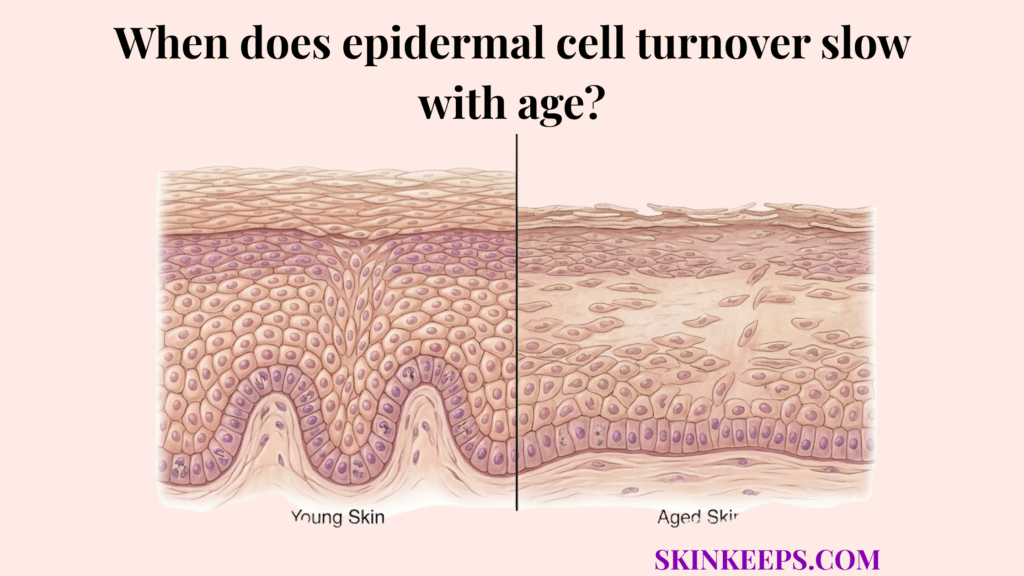
Epidermal cell turnover begins to slow with age in early adulthood, with the slowdown becoming more biologically meaningful across the 20s and 30s before growing more obvious in later decades.
Turnover is fastest in infancy, childhood, and adolescence, then gradually lengthens as biological aging progresses. The rate of epidermal cell turnover has been reported to reduce by about half between ages 30 and 70, which shows that meaningful deceleration becomes more pronounced across adulthood [PMC, 2022].
Why does epidermal cell turnover slow with age?
Epidermal cell turnover slows with age because the mitotic efficiency of the basal layer declines, cellular energy availability drops, and accumulated UV damage interferes with the signaling needed for healthy renewal.
Aging reduces the skin’s internal renewal efficiency through lower proliferative activity and weaker biologic signaling from the basal layer. This is driven by the role basal keratinocytes play in epidermal cell division, which becomes less robust over time.
Reduced ATP production, mitochondrial inefficiency, and flatter dermal-epidermal communication further weaken rapid turnover support. When cellular energy drops, the “engine” simply lacks the fuel required to maintain a 28-day cycle.
Extrinsic damage, especially chronic UV exposure, adds long-term pressure by worsening DNA stress and photoaging-related disruption. This external insult compounds internal fatigue, forcing the skin to prioritize repair over renewal.
| Trigger Type | Main Example | Effect on Turnover |
|---|---|---|
| Internal | Reduced cellular energy (ATP) | Lower renewal efficiency |
| Internal | Hormonal change & signaling | Less robust replacement cues |
| External | Cumulative UV damage | Disrupted DNA signaling |
| External | Chronic inflammation | Added system pressure |
How do epidermal turnover rates compare across different decades?
Epidermal turnover rates compare distinctly across decades, with younger skin renewing faster and older skin often taking substantially longer to complete the same visible cycle.
Younger skin tends to clear and replace surface cells more quickly, resulting in a naturally radiant and smoother appearance. In contrast, older skin keeps those cells visible for longer, which directly explains the emergence of how new epidermal cells are pushed toward the surface more slowly.
Intrinsic aging has been described as causing slower epidermal turnover of 60 days or more in older adults, compared with faster renewal in younger skin [Wiley, 2024].
| Age Range | Turnover Pattern | Typical Visible Result |
|---|---|---|
| Childhood | Fastest renewal phase | Fresh, fast-recovering skin |
| 20s to early 30s | Early slowdown begins | Balanced but gradually less rapid |
| 40s and beyond | More delayed renewal | Duller, thicker, rougher-looking skin |
| Older adulthood | Markedly prolonged | More visible backlog and slower refresh |
What ingredients help counteract the effects of age-related epidermal turnover slowdown?
The most effective ingredients to counteract the effects of age-related epidermal turnover slowdown are those that either stimulate deeper cellular division, such as retinoids, or reduce the visible surface backlog of dead cells, such as Alpha Hydroxy Acids.
The strongest solution strategy uses two different levers: deeper stimulation from below to “re-power” the engine, and backlog reduction at the surface to clear the way. This combined approach addresses both the epidermal barrier matrix and its regenerative source.
The goal is not aggressive, daily peeling, but rather a strategic, more efficient long-term renewal support that mimics youthful biological pace.
How do topical retinoids help counteract age-related epidermal turnover slowdown?
Topical retinoids help counteract age-related epidermal turnover slowdown by binding to nuclear receptors that signal the basal layer to produce new keratinocytes more efficiently over time.
Retinoids are especially relevant when dullness, roughness, and slower recovery become persistent because they act significantly deeper than simple surface-smoothing scrubs. Histological studies of topical retinoids have reported epidermal changes such as stratum corneum compaction and increased epidermal thickness after about 15 days of treatment [PMC, 2006].
How do Alpha Hydroxy Acids help manage age-related epidermal turnover slowdown?
Alpha Hydroxy Acids help manage age-related epidermal turnover slowdown by chemically loosening the intercellular bonds that hold dead cells on the surface, reducing the visible dullness created by sluggish cycling.
AHAs do not replace the biological necessity of deeper renewal; instead, they help reduce the visible backlog that slower cycling inevitably leaves behind. This clearance ensures the skin surface remains reflective and smooth.
| Slowdown Problem | Surface Effect | Support Response |
|---|---|---|
| Reduced deep renewal | Dullness & slow refresh | Stimulate with Retinoids |
| Surface dead-cell backlog | Roughness & thickness | Use gentle AHA exfoliation |
| UV-related stress | Ongoing deceleration | Protect with Broad-spectrum SPF |
What are the key takeaways about age-related epidermal turnover slowdown?
The key takeaways focus on the predictable timeline of deceleration starting in early adulthood and the dual-approach required to maintain skin radiance across the lifespan.
- ● Epidermal cell turnover slows with age, often becoming more obvious across adulthood.
- ● The slowdown is driven by reduced basal efficiency, hormonal shifts, and UV damage.
- ● Slower turnover appears as dullness, roughness, and slower recovery.
- ● Retinoids, strategic exfoliation, and daily SPF are the strongest routine anchors.
What steps can you take today to manage age-related epidermal turnover slowdown?
You can manage age-related epidermal turnover slowdown today by introducing cellular stimulators at night and maintaining strong UV protection during the day to preserve the skin’s remaining regenerative capacity.
Age-Management Protocol: Renewal Habits
Closing insight: Age-related turnover slowdown is normal, but it is not untouchable. The most effective routines work by supporting renewal from below while managing excess buildup at the surface.
Build your routine around long-term renewal support if your goal is brighter texture, smoother skin, and a more youthful-looking turnover cycle.
Ultimately, when you support the flow of your skin’s escalator, radiance follows naturally.