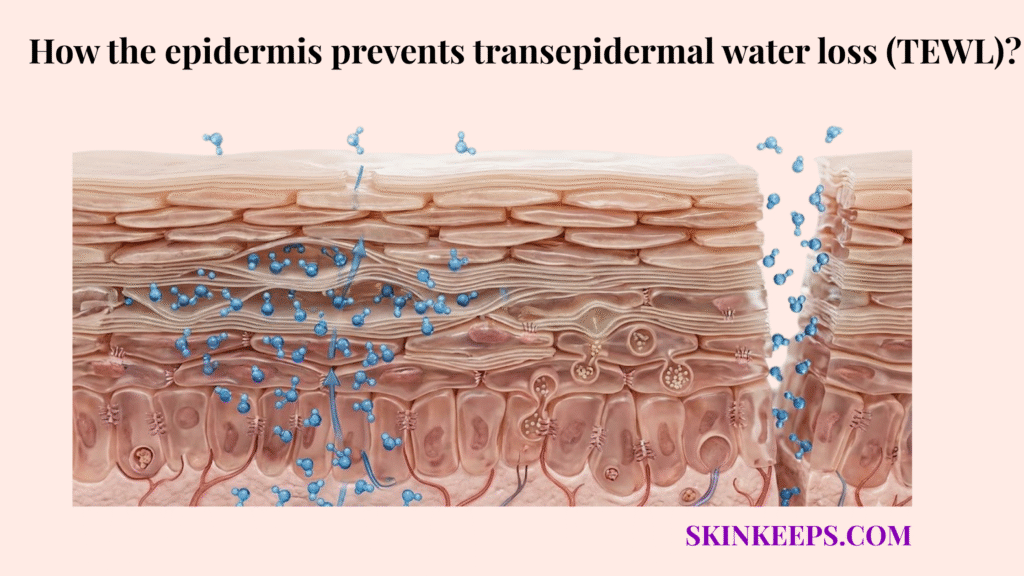
The epidermis helps prevent transepidermal water loss (TEWL) by using a tightly organized barrier made of corneocytes, surface lipids, and natural moisturizing factors to slow water escape and preserve skin hydration. Some water movement through the skin is natural, but visible dehydration becomes more likely when the epidermis cannot regulate that movement well.
Excessive TEWL connects directly to visible concerns such as chronic dryness, tightness, flaking, irritation, and reduced comfort. These problems often feel persistent because the barrier is not holding water efficiently, allowing essential hydration to escape faster than it can be replenished.
This guide explains exactly what transepidermal water loss (TEWL) is, how the epidermis limits it, how to recognize when that control is under strain, and how to support repair with targeted skincare. To provide immediate clarity, this section answers the most common questions about transepidermal water loss using concise, clinically grounded explanations.
Quick Answers to Common Questions About TEWL
What is transepidermal water loss (TEWL)?
Transepidermal water loss is the continuous movement of water from deeper skin layers toward the surface and into the external environment. This normal physical process becomes a visible concern when the epidermis cannot regulate the speed of water escape effectively.
Is TEWL always bad?
TEWL is not always bad, because some outward water movement is a normal part of skin physiology. The clinical problem is not the existence of TEWL itself, but rather excessive TEWL caused by impaired barrier control and weakened surface structures.
Why does high TEWL make skin feel dry and tight?
High TEWL makes skin feel dry and tight because water leaves the surface faster than the epidermis can retain and balance it. This rapid evaporation depletes the outer layers of necessary moisture, directly causing flaking, reduced flexibility, and persistent discomfort.
What part of the epidermis helps prevent TEWL?
The stratum corneum is the main epidermal structure that helps prevent excessive TEWL. This highly specialized outer layer relies on tightly packed corneocytes, an organized lipid matrix, and internal water-binding factors to successfully slow evaporation and maintain hydration.
What ingredients help support high TEWL?
The most useful ingredient categories for high TEWL are humectants, barrier-repair lipids, and occlusives, but they do different jobs. Humectants attract water to the surface, barrier lipids help restore the structural seal, and occlusives physically reduce surface evaporation.
Can dehydrated skin and barrier damage happen together?
Dehydration and barrier dysfunction often appear together because the epidermis can be low in water and poor at holding that water at the same time. A weak structural seal practically guarantees that any internal hydration will quickly evaporate away.
When should someone seek medical review?
Medical review is appropriate when dryness, irritation, redness, or barrier discomfort is severe, persistent, unusual, or not improving with gentle care. A dermatologist should evaluate symptoms that worsen rapidly or fail to respond to standard barrier-supporting routines.
What Is Transepidermal Water Loss (TEWL) in the Epidermis?
Transepidermal water loss (TEWL) is the natural process in which water moves from deeper, more hydrated skin layers toward the drier external environment.
This movement is driven by a simple moisture gradient. Deeper dermal tissue contains significantly more water, while the skin surface is exposed to a much drier atmosphere, prompting water to naturally move upward toward the air.
TEWL only becomes a visible problem when the epidermis cannot regulate that movement efficiently, allowing vital moisture to evaporate too rapidly and leaving the outer layers parched.
How Does Water Move Upward Through the Skin?
Water moves upward through the skin because it follows a natural gradient from wetter tissue below toward the drier surface above.
This gradient dictates that moisture will always seek equilibrium with the surrounding environment, pulling hydration from the dermis steadily through the epidermal layers.
The epidermis does not stop water movement entirely; rather, it effectively slows and regulates it to ensure the outer barrier remains flexible while minimizing total moisture loss.
Why Does TEWL Increase When the Barrier Is Impaired?
TEWL increases when the barrier is impaired because the structures that normally slow evaporation are less organized and less effective.
Water still moves upward naturally due to the moisture gradient. However, an impaired structure means there is significantly less resistance at the surface, allowing water molecules to escape into the atmosphere with minimal obstruction.
The process follows a clear flow: dermal water reservoir → upward movement → surface exposure → controlled retention (in healthy skin) or excessive evaporation (in impaired skin).
When that structure starts to weaken, it becomes easier to see why barrier disruption increases TEWL in the epidermis, especially when the surface can no longer slow evaporation efficiently.
How Does the Epidermis Prevent TEWL Through Its Brick-and-Mortar Barrier?
The epidermis limits excessive TEWL through the structure of the stratum corneum, which behaves like a brick-and-mortar barrier that slows water escape.
In this functional model, the “bricks” are the hardened corneocytes, while the “mortar” consists of the surrounding lipid matrix.
When either the cellular bricks or the lipid mortar becomes disorganized or depleted, evaporation becomes significantly harder to control, leading directly to elevated TEWL.
How Do Corneocytes Act as the “Bricks” That Limit TEWL?
Corneocytes limit TEWL by forming the rigid, flattened outer cells of the stratum corneum, where they create a compact physical barrier against evaporation.
These flattened, protein-rich cells form the structural face of the outer barrier, providing a durable shield against the external environment.
Their dense stacking pattern helps slow water loss by increasing resistance at the surface, creating a maze-like path that water must navigate. [ScienceDirect, 2012] notes the stratum corneum is stacked up to 18–20 layers depending on the body site.
That same protective system also relies on how corneocytes limit water evaporation in the epidermis, since those flattened outer cells form the structural “brick” component of the barrier.
How Do Ceramides, Cholesterol, and Fatty Acids Act as the “Mortar” That Limits TEWL?
Ceramides, cholesterol, and free fatty acids limit TEWL by forming the extracellular lipid matrix that fills the spaces between corneocytes and helps slow evaporation.
This lipid matrix is absolutely essential for cellular cohesion and maintaining overall barrier continuity against environmental stressors.
These major lipid classes work together synergistically to seal the barrier, often described as existing in an approximately equimolar ratio to effectively restrict water mobility. [The Open Dermatology Journal]
A major part of that barrier depends on the lipids that form the epidermal barrier matrix, because those surface lipids help maintain cohesion and slow water escape between corneocytes.
What Signs Suggest That the TEWL-Control Barrier Is Breaking Down?
When the barrier that limits TEWL is under strain, the skin often shows dryness, surface flaking, tightness, redness, and increased reactivity.
These clinical signs translate into frustrating daily experiences: the skin feels uncomfortably tight immediately after cleansing, stings easily with basic lotions, looks flaky or dull, and becomes noticeably less tolerant to routine products.
- Bricks → corneocytes
- Mortar → ceramides, cholesterol, free fatty acids
- Result → lower TEWL when the barrier is intact
To understand the deeper failure pattern behind persistent water loss, it also helps to examine what causes disruption of the epidermal barrier, because repeated stressors often damage the same surface defenses that normally keep TEWL under control.
How Do Natural Moisturizing Factors Reduce TEWL in the Epidermis?
Natural moisturizing factors help reduce TEWL by binding water inside the corneocytes, making the outer layer better able to stay flexible and hydrated.
These factors are essentially a collection of water-soluble compounds located within the cells. While surface lipids slow water escape from the outside, NMFs help hold water securely within the outer cells themselves.
The main NMF components work constantly to trap hydration, and when they are depleted, the skin rapidly loses its internal moisture reservoir.
Which Natural Moisturizing Factors Help the Epidermis Hold Water?
The main natural moisturizing factors that help the epidermis hold water are amino acids and other water-soluble compounds such as pyrrolidone carboxylic acid, urea, and lactate.
These are highly hygroscopic compounds, meaning they attract and help hold water within the stratum corneum to maintain cellular volume.
Their primary function is strictly to bind hydration internally, consisting primarily of amino acids (40%) and pyrrolidone carboxylic acid (12%). [ScienceDirect, 2023]
How Does Low NMF Content Worsen TEWL?
Low NMF content worsens TEWL because the outer cells lose water-holding capacity and become less able to stay flexible and hydrated.
When NMF is depleted, the corneocytes cannot physically bind incoming hydration, meaning even if water reaches the surface, it evaporates quickly.
This severely low water-holding capacity directly contributes to dehydration-like symptoms, creating a tighter, significantly less comfortable skin surface.
What Signs Suggest That Low NMF Content Is Contributing to TEWL?
Low NMF content may contribute to TEWL when the skin develops dehydration lines, reduced flexibility, and a tight or parchment-like feel.
It is crucial to clarify the difference between surface oiliness and true water deficiency; skin can be highly oily on the surface but still lack the internal water needed for flexibility.
- Amino acids → internal water binding → tight, inflexible surface when depleted
- PCA → hydration attraction → prominent dehydration lines when depleted
- Urea → moisture retention → dry, parchment-like texture when depleted
How Does a Healthy Epidermis Compare With an Impaired Epidermis With High TEWL?
A healthy epidermis controls evaporation more effectively, while an impaired epidermis allows water to escape too easily and tends to feel drier, tighter, and more reactive.
The difference between these states can be easily understood through structural continuity, physical sensation, and visible appearance in the mirror.
| Barrier status | TEWL level | Lipid condition | Hydration state | Visible symptoms | Physical sensations |
|---|---|---|---|---|---|
| Healthy | Low/Controlled | Intact and organized | Well-bound and flexible | Smooth, clear, resilient | Comfortable, calm |
| Impaired | High/Excessive | Depleted or disorganized | Rapidly evaporating | Flaky, dull, red | Tight, stinging, irritated |
How Does Epidermal Structure Differ When TEWL Is Lower Versus Higher?
When TEWL is lower, the epidermal barrier is more organized and cohesive, whereas higher TEWL is more often associated with disrupted surface structure and weaker barrier continuity. An intact structure features tightly overlapping cells and a dense lipid seal, while a disorganized structure reveals microscopic gaps that allow essential hydration to freely evaporate.
How Does the Skin Feel When TEWL Is Controlled Versus Excessive?
When TEWL is controlled, the skin tends to feel more comfortable and flexible, while excessive TEWL leaves it feeling tight, reactive, and easier to irritate. Controlled evaporation supports soft, pliable tissue, whereas excessive moisture loss results in a rigid surface that easily stings upon contact with mild daily products.
How Does the Skin Look When TEWL Is Controlled Versus Excessive?
When TEWL is controlled, the skin usually looks smoother and more resilient, while excessive TEWL is more likely to show flaking, dullness, and rough surface texture. Proper hydration retention reflects light evenly, whereas high evaporation rates leave behind retained dead cells that visibly obscure clarity and create a highly uneven surface.
Which Repair Strategy Should You Choose for TEWL in the Epidermis?
The best repair strategy for TEWL depends on whether the main issue is poor water binding, weak lipid support, severe barrier compromise, or a combination of all three.
Not every dry-feeling skin state needs the exact same type of support, as treating lipid depletion with simple water attractants will not resolve the underlying leak.
| Main symptom | Likely epidermal weakness | Best support category | Expected benefit |
|---|---|---|---|
| Dehydration lines, tight but oily | Low NMF, poor water binding | Humectants | Attracts and holds water |
| Chronic flaking, stinging | Depleted lipid matrix | Barrier-repair lipids | Restores the structural seal |
| Severe reactivity, rapid evaporation | Extreme barrier compromise | Occlusives | Blocks outward water loss |
When Should You Choose Humectants?
Humectants are most useful when the skin shows signs of surface dehydration and needs better short-term water binding.
The dehydration pattern often presents as a tight surface with visible fine lines, even if the skin is naturally oily. Humectants support water binding by actively attracting moisture from the surrounding environment and the deeper dermis into the stratum corneum.
Humectants work best as part of a broader barrier-support routine, not as a lone solution in every case, because they cannot physically seal the moisture they attract.
When Should You Choose Barrier-Repair Lipids?
Barrier-repair lipids are most useful when chronic dryness, redness, or irritation suggest that the structural seal of the epidermis is under strain.
This barrier-stress pattern indicates that the mortar holding the skin cells together has been severely weakened. Ceramides, cholesterol, and fatty-acid support are appropriate because they actively replenish the missing extracellular matrix components required to restore the structural seal.
These lipids help significantly more when the issue is weak barrier cohesion than when the issue is water binding alone, providing essential long-term stability.
When Should You Choose Occlusives?
Occlusives are most useful during more severe recovery phases, when the barrier needs additional help reducing surface evaporation.
The severe-recovery pattern involves extreme reactivity where almost any product causes stinging and water escapes immediately. Occlusives work by creating a physical, hydrophobic film over the epidermis that directly reduces evaporation at the surface.
However, occlusives are not a full substitute for hydration or lipid repair underneath; they simply buy the skin time to recover its own natural defenses.
How Can You Repair the Epidermis to Reduce TEWL?
Repairing the epidermis to reduce TEWL works best when the routine follows a clear order: hydrate, restore lipids, seal when needed, and then reassess the response.
This specific order ensures that you first introduce water, then provide the structural mortar to hold it, and finally apply an outer shield if the environment demands it, before observing the results.
- Hydrate → restore lipids → seal → reassess response
How Can Humectants Help Reduce TEWL?
Humectants help reduce TEWL most effectively when they improve water availability near the surface and are paired with a strategy that also supports retention.
They actively attract and bind water molecules into the upper layers of the epidermis. Damp-skin use is often more practical than applying them to a fully dry face, as this provides an immediate source of water for the humectants to grab onto.
Humectants should not be treated as the only repair step, because without a lipid seal, the gathered moisture will simply evaporate back into the air.
How Can Barrier-Repair Lipids Help Reduce TEWL?
Barrier-repair lipids help reduce TEWL by improving the continuity of the lipid matrix that slows water escape between corneocytes.
Structurally, they patch the microscopic gaps in the barrier mortar. They pair perfectly with hydration support by locking in the water that humectants have drawn to the surface.
Consistency in applying these lipids matters significantly more than aggressive product stacking; rebuilding a stable matrix takes gentle, daily repetition.
How Can Occlusives Help During Recovery?
Occlusives can help during recovery by reducing surface evaporation long enough for the underlying barrier to regain stability.
They form a protective roof over the stratum corneum. They are especially useful when the skin feels very exposed, reactive, or heavily subjected to dry, cold, or windy climates.
They work best when there is already some hydration and barrier support underneath, effectively sealing in the active repair process.
What Mistakes Worsen TEWL in the Epidermis?
Even a well-designed repair routine can underperform if repeated skincare mistakes keep pushing the epidermis toward more evaporation and less barrier stability.
Repair efforts and routine mistakes often cancel each other out, meaning that adding ceramide creams will not resolve TEWL if you are simultaneously stripping the barrier with harsh cleansers.
| Mistake | Why it worsens TEWL | Better alternative |
|---|---|---|
| Over-exfoliation | Removes barrier structure prematurely | Controlled, less frequent renewal |
| Humectants alone | Evaporates without a lipid seal | Pair with lipid support |
| Occlusives on dry skin | Traps dryness without adding water | Hydrate first, support lipids, then seal |
Why Does Over-Exfoliation Worsen TEWL?
Over-exfoliation worsens TEWL because it removes too much of the outer barrier structure before the epidermis has had time to recover.
The mistake involves using aggressive physical or chemical exfoliants daily. The structural consequence is a thinned stratum corneum with depleted corneocytes, severely diminishing the skin’s physical resistance to water escape.
The better alternative is controlled, less frequent renewal that encourages gentle shedding without destroying the underlying lipid matrix.
Why Can Humectants Alone Fall Short When TEWL Is Severe?
Humectants alone can fall short when TEWL is severe because binding water is not enough if the barrier cannot hold that water effectively.
In a highly impaired barrier, humectants can even pull water from the dermis only to lose it to the atmosphere. This is exactly why lipid support may also be needed to create a functional ceiling over the attracted moisture.
Ultimately, “hydration” (adding water) and “retention” (keeping water) are not the same thing; severe TEWL always requires a retention strategy.
Why Do Occlusives Work Poorly When the Skin Is Low in Water and Low in Lipids?
Occlusives work poorly when the skin is low in both water and supportive lipids because surface sealing alone cannot rebuild what is missing underneath.
The mistake is relying entirely on heavy ointments to fix dehydration. Trapped dryness is not the same as repaired skin; sealing a parched epidermis only prevents further loss but fails to restore internal cellular volume.
The better alternative is a layered approach: hydrate first with humectants, support lipids second with ceramides, and seal if needed with an occlusive layer.
What Are the Key Takeaways on How the Epidermis Prevents TEWL?
The epidermis limits TEWL by combining structural resistance, lipid continuity, and water-binding capacity to slow evaporation and preserve hydration at the surface.
- TEWL is the outward movement of water through the skin surface.
- The epidermis limits TEWL through the structure of the stratum corneum.
- Corneocytes and the lipid matrix work together to slow water escape.
- Natural moisturizing factors help hold water within the outer cells.
- Higher TEWL often shows up as dryness, tightness, irritation, and flaking.
- The best repair strategy depends on whether the skin needs hydration support, lipid support, surface sealing, or all three.
- Harsh routines can keep the epidermis from restoring normal moisture control.
At SkinKeeps, our barrier-support philosophy is built around respecting this moisture balance rather than overwhelming the skin with aggressive routines. Ultimately, understanding how the epidermis holds onto water helps you stop chasing temporary relief and start building stronger, more resilient barrier habits over time.