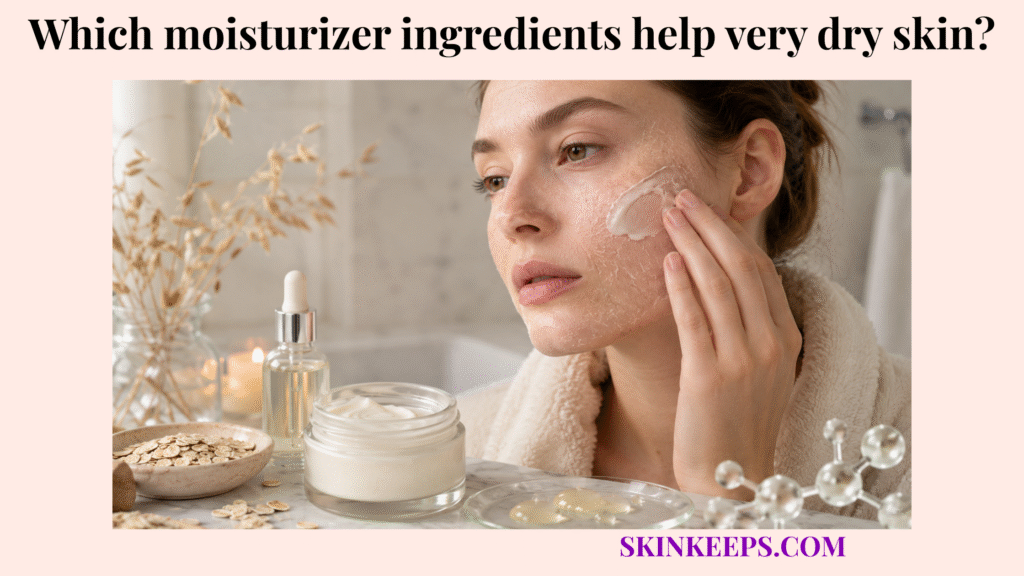
Very dry skin is helped most by moisturizer ingredients that attract water, support barrier lipids, seal moisture, smooth rough texture, and calm irritation. The most useful ingredients often include glycerin, hyaluronic acid, ceramides, cholesterol, fatty acids, petrolatum, dimethicone, shea butter, colloidal oatmeal, panthenol, and urea because each one supports a different part of dry-skin comfort.
The best choice depends on whether the skin is mainly tight, flaky, cracked, itchy, rough, burning, stinging, or irritated. This article covers humectants, barrier lipids, occlusives, soothing agents, rough-skin helpers, ingredients to avoid, symptom matching, texture choice, warning signs, and final takeaways.
Which Ingredient Categories Help Very Dry Skin Most?
The ingredient categories that help very dry skin most are humectants, emollients, barrier lipids, occlusives, and soothing agents because very dry skin usually needs water support, smoothing, barrier repair, moisture sealing, and irritation reduction together. Ingredient choice should match the broader needs of dry skin, where comfort depends on both water support and barrier protection. No single category should be treated as the complete answer for every dry-skin pattern.
Humectants attract water into the outer layer, while emollients smooth rough surface gaps. Barrier lipids support the skin barrier structure, occlusives help seal moisture in, and soothing agents calm itchy or irritated-feeling discomfort. Very dry skin often needs several of these roles in one formula.
Why Very Dry Skin Needs Water-Binding Ingredients
Very dry skin needs water-binding ingredients because the outer skin layer can feel tight, rough, or uncomfortable when it lacks enough surface hydration. Water-binding ingredients are humectants, and they help attract water into the outer layer. They are useful, but they may not be enough alone for very dry or cracked skin.
Why Very Dry Skin Also Needs Moisture-Sealing Ingredients
Very dry skin also needs moisture-sealing ingredients because water-binding ingredients work better when emollients or occlusives help reduce water loss. Sealing matters because attracted water can still evaporate from the surface. Emollients, barrier lipids, and occlusives provide support layers without pretending that one ingredient repairs all dryness.
| Ingredient Category | Main Job | Best For |
|---|---|---|
| Humectants | Pull water into the outer layer | Tight, dehydrated-feeling dry skin |
| Emollients | Smooth rough surface gaps | Rough or flaky dry skin |
| Barrier lipids | Support the skin barrier structure | Weak, recurring dryness |
| Occlusives | Seal moisture in | Very dry, cracked, or exposed areas |
| Soothing agents | Calm itch and irritation | Sensitive or uncomfortable dry skin |
Which Humectants Help Very Dry Skin Hold Water?
Humectants help very dry skin hold water by attracting moisture into the outer skin layer, but they often work best when paired with ingredients that smooth and seal. Glycerin, hyaluronic acid, urea, and aloe vera can each provide water-binding or light soothing support. Humectants work better when timing supports moisture sealing, which is why moisturizer should be applied to dry skin before surface water fully evaporates.
Humectants should not be framed as complete on their own for very dry skin. If the skin is cracked, rough, or quickly tight again, the formula often needs emollients or occlusives as well. Urea can help rough dry skin, but poorly tolerated or stronger formulas may sting when the barrier is cracked or irritated.
How Glycerin Helps Very Dry Skin Feel Less Tight
Glycerin helps very dry skin feel less tight by attracting water into the outer layer and supporting a more flexible surface feel. It is a reliable humectant for water-binding comfort. It usually works best when paired with emollients or occlusives rather than being expected to fix severe dryness alone.
How Hyaluronic Acid Supports Surface Hydration
Hyaluronic acid supports surface hydration by binding water in the outer skin layer, but very dry skin usually still needs a moisturizer that seals that hydration in. It can feel lightweight and useful for tightness. Sealing still matters because surface water can evaporate without a supportive cream or lotion layer.
Why Urea Can Help Very Dry, Rough Skin When Tolerated
Urea can help very dry, rough skin when tolerated because it can hydrate the outer layer and soften rough texture. It is more texture-focused than simple lightweight hydration. Cracked, burning, bleeding, or inflamed skin usually needs calming and sealing before stronger texture-focused ingredients.
| Ingredient | Main Benefit | Caution |
|---|---|---|
| Glycerin | Reliable water-binding comfort | Usually well tolerated |
| Hyaluronic acid | Lightweight hydration support | Needs sealing with moisturizer |
| Urea | Hydrates and softens rough skin | Higher strengths may sting |
| Aloe vera | Light soothing hydration | May not be enough alone for very dry skin |
Which Barrier Lipids Help Repair Very Dry Skin?
Barrier lipids help very dry skin by supporting the lipid structure that keeps the skin barrier more comfortable, flexible, and better able to retain moisture. Ceramides, cholesterol, fatty acids, squalane, and shea butter can each support this barrier-focused direction. Ingredients work best inside broader dry skin care tips that avoid harsh cleansing, over-exfoliation, and irritation.
Barrier lipids should not be described as curing barrier damage or chronic skin disease. Their role is to support barrier comfort and moisture retention. Very dry skin may still need humectants and occlusives when tightness, roughness, or cracking remains.
Why Ceramides Matter for Very Dry Skin
Ceramides matter for very dry skin because they are barrier-supporting lipids that help the outer layer feel more comfortable and less moisture-depleted. They belong to the skin’s barrier lipid system. Ceramides can support moisture retention, but they do not solve every dry-skin problem alone.
How Cholesterol and Fatty Acids Support Barrier Structure
Cholesterol and fatty acids support barrier structure by helping the lipid layer stay organized, flexible, and better suited to retaining moisture. They are barrier-lipid partners rather than decorative ingredient names. Formulas often combine multiple barrier-support ingredients because very dry skin can need more than one lipid role.
| Barrier-Support Ingredient | What It Supports |
|---|---|
| Ceramides | Barrier comfort and moisture retention |
| Cholesterol | Lipid-layer structure |
| Fatty acids | Barrier flexibility and smoothness |
| Squalane | Lightweight emollient comfort |
| Shea butter | Rich emollient support for very dry areas |
Which Occlusive Ingredients Seal Moisture Into Very Dry Skin?
Occlusive ingredients seal moisture into very dry skin by forming a protective layer that reduces water loss from rough, cracked, exposed, or high-friction areas. Petrolatum, dimethicone, mineral oil, lanolin if tolerated, beeswax, and rich ointment bases are common moisture-sealing directions. Occlusive support becomes more important when dry skin starts cracking or bleeding instead of only feeling mildly tight.
Occlusives are often most useful on hands, elbows, feet, heels, knees, and shins. They can feel heavy on the face, so facial use should depend on tolerance and acne tendency. The useful rule is to seal the areas that lose comfort fastest without forcing the same texture everywhere.
Occlusive Ingredients
- Petrolatum.
- Dimethicone.
- Mineral oil.
- Lanolin if tolerated.
- Beeswax.
- Rich ointment bases.
Best Use Note
- Occlusives are most useful on very dry, cracked, rough, or high-friction areas such as hands, elbows, feet, heels, knees, and shins.
- They can feel heavy on the face, so facial use should depend on skin tolerance and acne tendency.
Which Soothing Ingredients Help Irritated Very Dry Skin?
Soothing ingredients help irritated very dry skin by reducing itchy, reactive, rough, or uncomfortable sensations while the moisturizer supports the barrier. Colloidal oatmeal, panthenol, allantoin, bisabolol, and madecassoside or centella can be useful comfort-support directions when tolerated. These ingredients should be presented as comfort support, not cures for infection, allergy, eczema, or dermatitis.
Soothing ingredients work best when the formula also addresses dryness through hydration, smoothing, and sealing. Itchy or irritated-feeling skin often needs fewer irritants, not more active ingredients. If the skin is oozing, crusted, swollen, painful, or worsening, soothing skincare should not replace professional evaluation.
| Ingredient | Best For |
|---|---|
| Colloidal oatmeal | Itchy, uncomfortable dry skin |
| Panthenol | Barrier comfort and soothing |
| Allantoin | Rough or irritated-feeling skin |
| Bisabolol | Sensitive dry skin if tolerated |
| Madecassoside / centella | Redness-prone or reactive dry skin |
Which Ingredients Help Very Dry, Rough, or Scaly Texture?
Ingredients that help very dry, rough, or scaly texture usually soften the outer layer, smooth rough patches, or seal cracked areas, but they must be chosen carefully when the skin is burning, cracked, bleeding, or inflamed. Texture-support ingredients matter most when flaking and scaling are common signs of dry skin rather than simple temporary tightness. The goal is smoother comfort, not aggressive resurfacing.
Urea and lactic acid may help rough texture when tolerated, while petrolatum, ceramides, and glycerin support sealing, barrier comfort, and daily water support. Strong exfoliation is not the first step when skin is cracked or inflamed. Rough-skin ingredients need caution because gentle exfoliation may be safer for dry skin than strong acids or scrubbing.
Texture-Support Ingredients
- Urea for rough dry texture.
- Lactic acid in gentle formulas for dry roughness.
- Petrolatum for cracked areas.
- Ceramides for recurring barrier dryness.
- Glycerin for daily water support.
Important Caution
- If skin is cracked, burning, bleeding, or inflamed, the first step is barrier calming and sealing, not strong exfoliation.
Which Ingredients Should Very Dry Skin Avoid or Limit?
Very dry skin should avoid or limit ingredients and product patterns that sting, strip, irritate, over-exfoliate, or fail to seal enough moisture. “Avoid” does not mean everyone reacts the same way. It means reactive, cracked, burning, peeling, or inflamed dry skin needs more caution.
Fragrance-heavy formulas, alcohol-heavy products, strong acids, harsh essential oils, scrub particles, and lightweight lotion alone on severe dryness can all worsen comfort in some cases. Very dry skin should not be forced through stinging just because an ingredient is popular. The safer direction is simple, fragrance-free, barrier-supportive care when the skin feels reactive.
| Ingredient Pattern | Why It May Worsen Very Dry Skin |
|---|---|
| Fragrance-heavy formulas | Can irritate dry, reactive skin |
| Alcohol-heavy products | Can sting or dry the barrier |
| Strong exfoliating acids | Can worsen burning or peeling |
| Harsh essential oils | Can irritate sensitive dry skin |
| Lightweight lotion alone on severe dryness | May not seal enough moisture |
| Scrub particles | Can worsen cracks, roughness, or irritation |
How Should Ingredients Be Matched to Very Dry Skin Symptoms?
Ingredients should be matched to very dry skin symptoms by choosing water-binding support for tightness, barrier lipids for recurring dryness, occlusives for cracking, and soothing agents for itching or irritation. This matrix is for practical selection logic, not diagnosis. Burning or stinging should lead to simpler, fragrance-free, minimal-active formulas.
Symptom matching should also respect tolerance and body area. A thick ointment may make sense for cracked heels but feel too heavy on the face. If symptoms are severe, worsening, or infection-looking, ingredient matching should not replace medical evaluation.
| Very Dry Skin Concern | Better Ingredient Direction |
|---|---|
| Tightness | Glycerin, hyaluronic acid, ceramides |
| Flaking | Ceramides, fatty acids, cream base |
| Roughness | Urea, lactic acid if tolerated, emollients |
| Cracking | Petrolatum, dimethicone, ointment texture |
| Itching | Colloidal oatmeal, panthenol, rich moisturizer |
| Burning or stinging | Fragrance-free barrier cream, minimal actives |
| Very dry hands or heels | Petrolatum-rich ointment or thick cream |
What Moisturizer Texture Works Best With These Ingredients?
The moisturizer texture that works best with these ingredients depends on dryness severity, body area, skin tolerance, and whether the goal is light hydration, richer smoothing, or strong moisture sealing. Creams often suit very dry skin better than lightweight gels because they can combine hydration, emollience, and sealing support. Ointments can be useful when the skin is cracked, very rough, or exposed to high friction.
This section is about formulation texture, not product recommendations. Lotions may be enough for mild dryness but too light for severe dryness. Fragrance-free formulas are often safer when skin stings, itches, or reacts easily, but they still need the right ingredient mix and texture.
Texture Guide
- Creams work well for most very dry skin.
- Ointments work best for cracked, very rough, or high-friction areas.
- Lotions may be too light for severe dryness.
- Gels are usually not enough for very dry body skin.
- Fragrance-free formulas are safer when the skin stings, itches, or reacts easily.
When Does Very Dry Skin Need More Than Moisturizer Ingredients?
Very dry skin needs more than moisturizer ingredients when cracking, bleeding, severe itching, pain, burning, thick scaling, oozing, crusting, swelling, sudden widespread dryness, or recurring patches suggest more than routine dryness. Professional evaluation helps identify conditions that may look like ordinary dryness without forcing a home diagnosis. Professional review becomes important when persistent dry skin needs a dermatologist instead of stronger ingredient changes.
This warning boundary should stay calm and safety-focused. Moisturizer ingredients can support comfort, but they should not be framed as treatment for infection, allergy, eczema, dermatitis, psoriasis, or another condition. Persistent or severe symptoms need review rather than stronger ingredient guessing.
Warning Signs
- Cracks or bleeding.
- Severe itching.
- Pain, burning, or persistent stinging.
- Thick scaling.
- Swelling, oozing, crusting, or infection-looking skin.
- Dryness does not improve with consistent moisturizer use.
- Dry patches keep returning in the same places.
- Sudden widespread dryness.
- Suspected eczema, dermatitis, psoriasis, allergy, infection, or another condition.
What Should You Remember About Moisturizer Ingredients for Very Dry Skin?
Very dry skin usually needs moisturizer ingredients that combine hydration, barrier support, moisture sealing, smoothing, and soothing instead of relying on light hydration alone. The best ingredient choice depends on symptoms, body area, tolerance, and whether the skin mainly feels tight, flaky, cracked, itchy, rough, or irritated. Stronger or trendier ingredients are not automatically better for a weakened barrier.
Final Takeaways
- Very dry skin usually needs more than light hydration.
- Humectants pull in water, but they often need emollients and occlusives to seal it.
- Ceramides, cholesterol, and fatty acids support the barrier.
- Petrolatum and dimethicone help seal moisture into cracked or very dry areas.
- Colloidal oatmeal and panthenol help comfort itchy or irritated dry skin.
- Strong actives and fragrance-heavy formulas can make very dry skin worse.
- The best moisturizer for very dry skin combines hydration, barrier lipids, and moisture sealing.
Frequently Asked Questions
Is Glycerin Good for Very Dry Skin?
Glycerin is good for very dry skin because it helps attract water into the outer skin layer and can reduce tight-feeling dryness. Glycerin often works best when paired with emollients or occlusives that help smooth and seal the skin.
Are Ceramides Important for Very Dry Skin?
Ceramides are important for very dry skin because they support the barrier lipids that help the outer layer retain moisture and feel more comfortable. Ceramides are helpful barrier-support ingredients, but they are not a cure for every dry-skin condition.
Is Petrolatum Helpful for Cracked Dry Skin?
Petrolatum can be helpful for cracked or very dry areas because it forms a strong moisture-sealing layer that reduces water loss. Petrolatum is often best for hands, heels, elbows, feet, or rough patches, while facial use depends on tolerance and acne tendency.
Can Urea Help Very Rough Dry Skin?
Urea can help very rough dry skin by hydrating the outer layer and softening rough texture when the formula is tolerated. Urea may sting when the skin is cracked, burning, bleeding, or inflamed, so barrier calming may need to come first.
Should Very Dry Skin Avoid Fragrance?
Very dry or reactive skin often does better with fragrance-free formulas because added fragrance can sting, itch, or irritate a weakened barrier. Fragrance-free does not guarantee perfection, but it reduces one common irritation risk for uncomfortable dry skin.
Conclusion
Very dry skin usually needs moisturizer ingredients that attract water, support barrier lipids, smooth roughness, seal moisture, and calm irritation. Humectants such as glycerin and hyaluronic acid can support hydration, while ceramides, cholesterol, fatty acids, petrolatum, dimethicone, colloidal oatmeal, panthenol, and urea each serve different comfort or barrier roles.
The best moisturizer for very dry skin is not simply the lightest or richest product. It is the formula that matches the skin’s main problem—tightness, flaking, cracking, itching, roughness, or irritation—while avoiding fragrance-heavy, alcohol-heavy, or overly aggressive ingredients when the barrier is already uncomfortable.