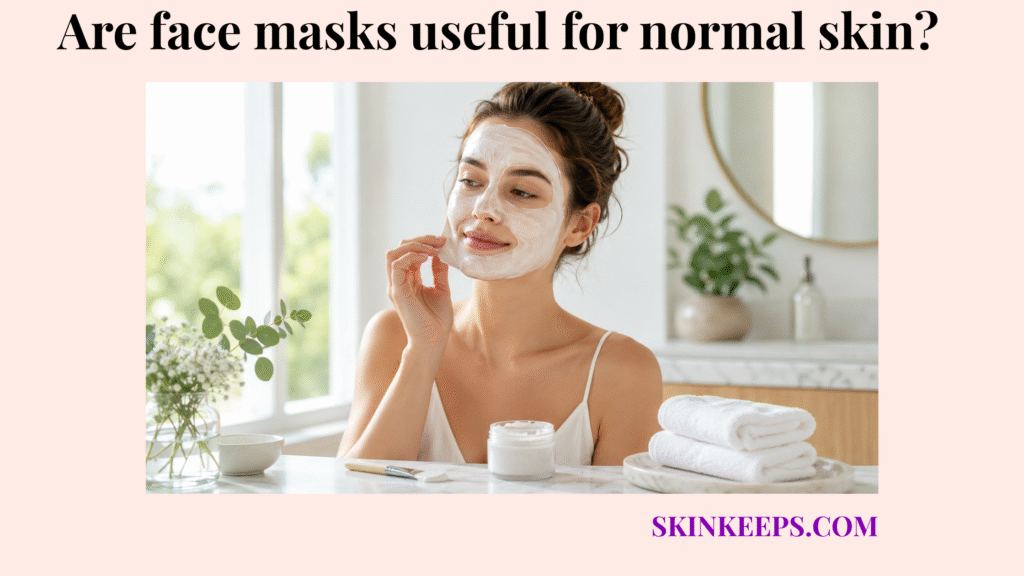
Face masks can be useful for normal skin, but they are usually optional.
They may help when normal skin needs gentle hydration, soothing, or occasional texture support. If normal skin already feels clean, smooth, comfortable, and balanced, masks are not required. Masks should support basic care, not replace cleansing, moisturizer, or sunscreen.
Why are face masks useful for normal skin usually optional?
Face masks useful for normal skin are usually optional because normal skin often stays comfortable with gentle cleansing, moisturizer when needed, and daily sunscreen.
A mask should not be added automatically when the skin already feels balanced. It should have a clear job, such as temporary hydration, soothing, or mild texture support.
This fits broader care tips that preserve normal skin balance, where simple steps come before extra treatments.
| Normal skin status | Face mask usefulness |
|---|---|
| Clean and comfortable | Usually unnecessary |
| Slightly dry or tight | Hydrating mask may help |
| Mild discomfort | Soothing mask may help |
| Dull or rough sometimes | Gentle texture-support mask may help |
| Already balanced | Skip mask if no clear benefit |
| Stinging or redness appears | Stop the mask |
Face masks useful for normal skin should solve a clear short-term need.
When are face masks useful for normal skin?
Face masks useful for normal skin are most helpful when they address a clear temporary need, such as mild dryness, dullness, roughness, post-sun dryness, or temporary discomfort.
Hydrating or soothing masks may help normal skin feel more comfortable for a short time. They should not be used as a promise of pore shrinking, detoxing, acne clearing, or lifting.
| Mask use case | When it may help normal skin |
|---|---|
| Hydrating mask | Skin feels slightly dry or tight |
| Soothing mask | Skin feels mildly uncomfortable |
| Cream mask | Short-term comfort support |
| Sheet mask | Temporary hydration or soothing |
| Gentle texture mask | Occasional dullness or roughness |
| Clay mask | Only if temporary oiliness or congestion appears |
Face masks useful for normal skin should be need-based, not trend-based.
Which mask types make face masks useful for normal skin?
Mask types that make face masks useful for normal skin are usually gentle, hydrating, soothing, or lightly texture-supporting rather than harsh, drying, peel-off, or strongly exfoliating.
Normal skin should choose mask type by current skin feel. A gentle mask can support comfort, while strong masks can create tightness, redness, burning, peeling, or clogged-feeling areas.
This overlaps with choosing ingredients normal skin should look for or avoid, especially fragrance, acids, heavy oils, and drying formulas.
| Face mask type | Fit for normal skin |
|---|---|
| Hydrating mask | Often the safest optional type |
| Soothing mask | Useful if skin feels mildly stressed |
| Cream mask | May help temporary dryness |
| Sheet mask | May help short-term hydration |
| Clay mask | Use carefully if skin feels oily or congested |
| Exfoliating mask | Use only when dullness or roughness appears |
| Peel-off mask | Higher irritation and pulling risk |
| Fragrance-heavy mask | Higher stinging or redness risk |
Face masks useful for normal skin should feel gentle after removal, not tight or irritated.
When are face masks useful for normal skin better skipped?
Face masks useful for normal skin are better skipped when the skin already feels comfortable, smooth, balanced, and not dry, dull, rough, sticky, or irritated.
Normal skin does not need masks just because a routine includes a mask day. Skip masks that leave tightness, redness, stickiness, clogged feel, or no clear benefit.
- Skin already feels balanced.
- Skin is not dry or tight.
- Skin is not dull or rough.
- The mask leaves sticky residue.
- The mask causes stinging or burning.
- The mask makes skin red.
- The mask causes clogged-feeling areas.
- The skin is sunburned or irritated.
- The routine already uses exfoliants or strong actives.
- There is no clear concern the mask is solving.
Face masks useful for normal skin should be skipped when they add no benefit or create irritation.
How often are face masks useful for normal skin?
Face masks useful for normal skin should be used occasionally and by need, not automatically every week or every day.
Hydrating or soothing masks may be used when normal skin feels temporarily dry or uncomfortable. Exfoliating, clay, or strong masks should be less frequent because irritation risk is higher.
For texture concerns, face masks should follow the same caution as exfoliation for normal skin.
| Normal skin response | Mask frequency clue |
|---|---|
| Skin feels balanced | Skip or use rarely |
| Slight dryness appears | Hydrating mask as needed |
| Mild discomfort appears | Soothing mask as needed |
| Dullness or roughness appears | Occasional gentle texture mask |
| Skin feels tight after masking | Use less often or change type |
| Redness or peeling appears | Stop masking and simplify |
Face masks useful for normal skin should follow skin response, not a fixed mask schedule.
What mistakes make face masks useful for normal skin risky?
Mistakes make face masks useful for normal skin risky when masks are too strong, too frequent, fragranced, left on too long, layered with actives, or used over irritated skin.
A mask should not make normal skin feel hotter, tighter, redder, or more reactive. If that happens, the mask is disrupting balance.
| Face mask mistake | Why it can disrupt normal skin |
|---|---|
| Using masks automatically every week | May add unnecessary product load |
| Leaving masks on too long | Can increase dryness or irritation |
| Using strong clay masks often | Can leave tightness or dryness |
| Using peel-off masks aggressively | Can pull and irritate skin |
| Using exfoliating masks too often | Can trigger stinging or peeling |
| Using fragranced masks | May cause redness or itching |
| Masking over irritated skin | Can worsen sensitivity |
| Replacing moisturizer or sunscreen with masks | Leaves basic care gaps |
Face masks useful for normal skin should not replace basic care or continue through irritation.
When should reactions to face masks useful for normal skin need attention?
Reactions to face masks useful for normal skin need attention when burning, stinging, rash-like redness, swelling, severe itching, cracked patches, painful acne, peeling, or changing lesions appear or repeat.
Normal skin can dislike one mask. Repeated or worsening reactions need review instead of trying stronger masks.
- Face masks repeatedly burn, sting, or cause rash-like redness.
- Skin reacts to many gentle masks or products.
- Dry patches crack, bleed, burn, or spread.
- Redness becomes warm, swollen, spreading, or persistent.
- Itching becomes intense or persistent.
- Breakouts become painful, deep, frequent, or scarring.
- Peeling continues after stopping the mask.
- A mole, spot, or lesion changes color, shape, size, or behavior.
One mask mismatch can happen; repeated or worsening reactions need review.
What should you remember about face masks useful for normal skin?
The key point is that face masks useful for normal skin are optional and should be used only when they add gentle hydration, soothing, or occasional texture support.
Normal skin does not need masks by default. Cleansing, moisturizer when needed, and sunscreen usually matter more.
Daily protection still matters because sunscreen is still essential for normal skin, even if a mask makes the skin feel temporarily smoother.
Frequently Asked Questions About Face Masks Useful for Normal Skin
Are face masks useful for normal skin every week?
Not always. Face masks can be useful for normal skin when there is a clear need, but they are not required every week.
Which face mask is best for normal skin?
A gentle hydrating or soothing mask is usually the safest optional choice for normal skin.
Can normal skin skip face masks completely?
Yes. Normal skin can skip face masks if gentle cleansing, moisturizer when needed, and sunscreen already keep the skin comfortable.
Are clay masks useful for normal skin?
Clay masks may help if normal skin feels temporarily oily or congested, but frequent use can make the skin feel tight or dry.
Can face masks irritate normal skin?
Yes. Strong, fragranced, peel-off, exfoliating, or overused masks can cause stinging, burning, redness, dryness, clogged pores, or peeling.
Sources & Evidence About Face Masks Useful for Normal Skin
American Academy of Dermatology facial-mask guidance was used for mask usefulness, hydration, barrier-support framing, and mask-use boundaries.
Cleveland Clinic face-mask guidance was used for sheet mask hydration, soothing uses, and face-mask expectation boundaries.
Cleveland Clinic skin-type guidance was used to ground normal skin as a balanced skin type and separate it from dry, oily, combination, and sensitive patterns.
American Academy of Dermatology face-washing guidance was used for gentle cleansing, avoiding harsh stripping, and basic routine support.
American Academy of Dermatology dry-skin relief guidance was used for moisturizer support, dryness, cracking, bleeding, burning, and itching boundaries.
American Academy of Dermatology exfoliation guidance was used for exfoliating mask caution, over-exfoliation, peeling, redness, and irritation risk.
American Academy of Dermatology product-testing guidance was used for repeated product reactions, irritation tracking, and patch-testing boundaries.
American Academy of Dermatology sunscreen guidance was used for broad-spectrum sunscreen, SPF 30 or higher, and daily UV-protection boundaries.
American Academy of Dermatology acne treatment guidance was used for painful, frequent, cystic, or scarring acne referral boundaries.
Peer-reviewed sensitive-skin review from NIH/PMC was used for burning, stinging, itching, redness, and reactive-skin symptom context.
American Academy of Dermatology melanoma signs guidance was used for changing moles, changing spots, lesion behavior, and referral boundaries.
Educational Disclaimer: This article is for general skin education only and does not diagnose, treat, or replace professional medical advice. If face masks cause repeated burning, swelling, rash-like redness, painful acne, cracked or bleeding patches, severe itching, spreading irritation, sudden unexplained changes, broader health symptoms, or changing moles or lesions, consult a qualified dermatologist or healthcare professional.