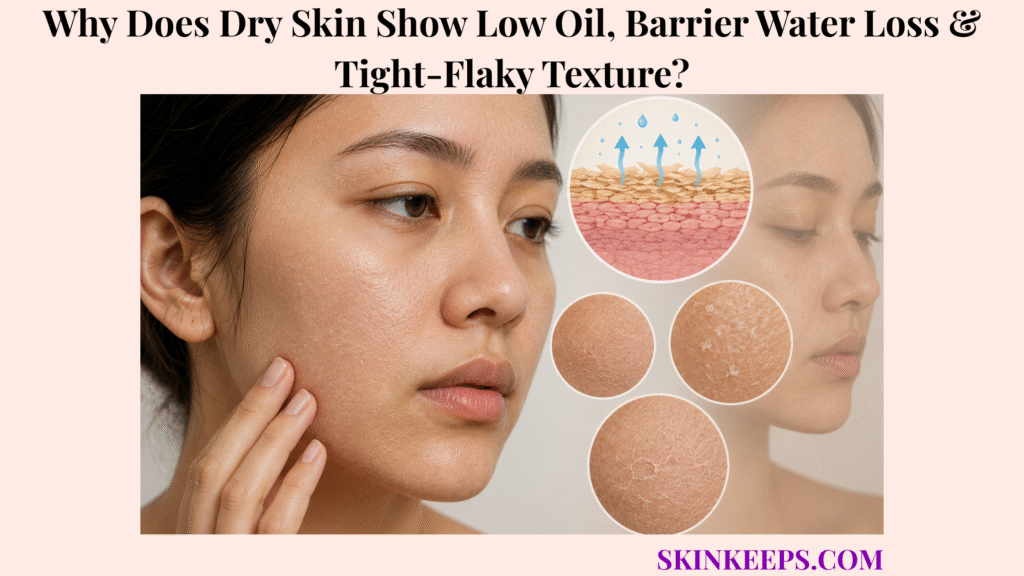
Dry skin shows low oil, barrier water loss, and tight-flaky texture because reduced sebum and weakened stratum corneum lipids allow water to escape faster than the skin can retain it. This means the lipid matrix cannot seal water effectively, leaving the surface exposed to environmental stress.
This guide explains the biology of low sebum, transepidermal water loss, and the resulting tight, rough, flaky, or scaly texture. It also covers how to avoid hydration myths, choose humectants, emollients, and occlusives, and build a simple daily barrier-repair routine to restore skin comfort.
How does a genetic underproduction of sebum biologically define the dry skin profile?
A genetic or age-related underproduction of sebum can biologically define the dry skin profile by leaving the stratum corneum with too little surface lipid to stay flexible and well sealed. Within the broader guide to different skin types, dry skin is the type most strongly defined by low oil, weak lipid sealing, and water-loss vulnerability.
The medical term for this state is xeroderma or xerosis, which is fundamentally caused by inadequate hydrolipids that result in roughness, tightness, flaking, and scaling. These dry skin features show reduced stratum corneum lipids, corneocyte retention, and reduced water-holding capacity. [NCBI Bookshelf] and [DermNet]
Clinical interpretation suggests that a sebum rate below 0.5 mg/10 cm² every three hours is associated with xerosis or a dry skin type pattern. The supporting article on dry skin characteristics explains how this low sebum becomes visible as dullness, roughness, flaking, and small-looking pores. [JCAD]
The Alipidic Lipid-Lacking Reality
The alipidic reality of dry skin means the surface lacks enough natural oil to maintain a comfortable, flexible, and well-lubricated barrier. Dry skin needs lipid replacement, not only water application, because moisture evaporates quickly when the protective seal is weak.
For example, dry skin can still feel tight shortly after washing because the surface does not naturally re-lubricate quickly. This distinct lack of internal sebum output separates a true dry skin profile from temporary surface dehydration.
The Ceramide Shortage
The ceramide shortage worsens dry skin because ceramides, cholesterol, and free fatty acids form the lipid matrix that seals spaces between corneocytes. This intercellular mortar is critical for maintaining a cohesive barrier that actively prevents moisture escape. [DermNet]
Research confirms that ceramide deficiency strongly correlates with clinical dryness, roughness, scaliness, and reduced electrical conductance on the skin surface. When this shortage occurs, the overall structural integrity of the outer epidermis becomes visibly compromised. [Nature]
Why does a depleted lipid barrier trigger severe Transepidermal Water Loss (TEWL) in a dry skin matrix?
A depleted lipid barrier triggers transepidermal water loss in dry skin because gaps in the stratum corneum lipid matrix let internal water diffuse outward into the environment. Transepidermal water loss (TEWL) acts as a primary measurement of how efficiently the skin retains its hydration.
When the intercellular mortar is missing, the diffusion barrier weakens and permits higher rates of evaporation. Consequently, elevated TEWL reliably indicates weaker barrier function and diminished moisture retention. [Springer]
Low humidity, hot water, harsh soap, and aging can further accelerate this uncontrolled barrier water loss. The supporting guide on dry skin low humidity explains why dry air increases water-loss pressure on an already weak barrier.
The Evaporation Crisis TEWL
The evaporation crisis known as TEWL occurs when the skin barrier cannot slow water diffusion from the hydrated body toward the drier external environment. A robust lipid matrix normally slows this movement, keeping the outer layers plump and flexible.
However, a depleted barrier makes this continuous water loss physically noticeable as uncomfortable tightness and rough texture. This ongoing evaporation crisis constantly drains the epidermis of vital hydration.
The Broken Brick and Mortar Model
The broken brick and mortar model explains dry skin by comparing corneocytes to bricks and barrier lipids to mortar that seals water inside the stratum corneum. The bricks represent the structural skin cells, while the mortar consists of ceramides, cholesterol, and free fatty acids.
When this essential mortar is reduced or highly disorganized, the barrier loses water more easily and fails to defend against external irritants. Restoring this structure requires targeted topical ingredients that mimic the stratum corneum lipids.
| Barrier Component | Healthy Skin Shield | Depleted Dry Barrier |
|---|---|---|
| Lipid matrix | Ceramides, cholesterol, and free fatty acids form organized barrier layers | Lipids become reduced or disorganized, weakening water retention |
| Corneocytes | Corneocytes stay more flexible and cohesive | Corneocytes become rougher, less flexible, and more prone to clumping |
| TEWL | Water diffusion remains controlled | Water loss becomes elevated when barrier integrity is impaired |
| Surface texture | Skin feels smoother and more comfortable | Skin feels tight, rough, flaky, or scaly |
How does chronic cellular dehydration physically manifest as a tight, flaky epidermal texture?
Chronic cellular dehydration manifests as a tight, flaky epidermal texture because low water content makes corneocytes less flexible and disrupts the normal shedding process. This mechanical feeling of tightness serves as a direct distress signal from the stressed epidermal surface.
Without adequate hydration, desquamation fails, leading to visible flaking and scaling as the skin struggles to renew itself. The related article on dry skin flaking and scaling explains why poorly hydrated corneocytes shed as visible flakes instead of invisible single cells.
Micro-Cracks and the Tight Sensation
Micro-cracks and the tight sensation occur when the dry stratum corneum loses flexibility and creates mechanical pulling across the skin surface. Tightness is not imaginary; it is a physical barrier-comfort signal indicating that the skin cannot stretch normally.
Using harsh cleansers or washing with hot water can intensify this uncomfortable sensation by stripping away the remaining protective oils. The supporting article on dry skin tight after washing explains why cleansing can make a weak lipid barrier feel even tight skin after washing.
Desquamation Failure: The Flaking
Desquamation failure drives visible flaking when dry corneocytes remain stuck together and shed in clusters instead of separating smoothly. Normal desquamation requires a moisture-rich environment to function invisibly.
Specific enzymes related to this process, such as KLK5 and KLK7, require adequate stratum corneum hydration to successfully degrade the bonds between dead cells. When hydration drops, this delicate balance is disrupted, making the shedding process rough, uneven, and highly noticeable. [Wiley]
What are the most common hydration myths that accidentally worsen moisture-depleted skin?
The most common hydration myths that worsen moisture-depleted skin involve relying on water alone, scrubbing away flakes, and using hot cleansing habits that weaken the lipid barrier. These misconceptions delay healing by failing to address the fundamental lack of structural lipids.
For instance, taking hot showers routinely removes crucial surface oils, leaving the skin highly vulnerable to evaporation. Gently supporting the barrier with proper moisturizers is far safer than aggressive physical intervention.
| Myth | Reality |
|---|---|
| Drinking more water cures dry skin | Water intake supports general hydration, but dry skin also needs lipid sealing and moisturizer |
| Scrubbing removes flaky skin permanently | Aggressive scrubbing can damage the barrier and make flaking worse |
| Hot showers soften dry skin | Hot water can remove surface lipids and leave dry skin tighter afterward |
| Lightweight water gels are enough for very dry skin | Very dry skin often needs humectants plus emollients or occlusives |
| Tight skin means the cleanser worked | Tightness after cleansing often signals barrier stress, not successful cleansing |
The “Drink More Water” Fallacy
The “drink more water” fallacy fails because dry skin is usually a barrier-retention problem, not simply a shortage of water entering the body. While adequate water intake supports general health, it cannot independently seal a compromised stratum corneum.
To successfully hydrate dry skin, humectants must pull water into the cells while occlusives slow outward evaporation. Addressing topical barrier needs is essential to locking in internal moisture.
The Exfoliation Trap
The exfoliation trap worsens dry skin because aggressive scrubbing can remove fragile surface cells and further weaken the lipid barrier. Flakes are a symptom of barrier imbalance, not merely excess dead skin waiting to be scrubbed away.
While gentle exfoliation may be tolerated by some dry skin types, abrasive physical manipulation carries significant risks for already vulnerable tissue. The guide on dry skin hot showers explains why hot water can leave dry skin tighter even when it feels soothing at first.
Which specific cosmetic ingredients clinically restore and seal a compromised dry skin type?
Specific cosmetic ingredients restore and seal a compromised dry skin type by combining humectants for water binding, emollients for surface smoothing, and occlusives for water-loss reduction. Formulating a routine with these distinct ingredient classes specifically targets the underlying causes of barrier failure.
The guide on dry skin moisturizer ingredients explains how humectants, emollients, and occlusives work together in barrier repair. In practice, many modern moisturizers combine all three categories to increase the skin’s water-holding capacity and overall resilience. [PMC]
Humectants to Pull Water In
Humectants serve as the first step of dry skin support because ingredients like glycerin, hyaluronic acid, and urea bind water within the stratum corneum. Glycerin acts as a classic water-attracting agent, while hyaluronic acid functions as a larger water-binding polymer.
Urea provides a unique dual benefit, acting as a humectant at lower percentages and a keratolytic ingredient at higher concentrations. To prevent the newly bound water from evaporating, humectants for dry skin work best when followed immediately by an emollient or occlusive layer.
Emollients and Occlusives to Lock It Down
Emollients and occlusives are essential for dry skin because emollients smooth rough gaps while occlusives form a protective film that slows water evaporation. Ingredients like ceramides and squalane act as powerful emollients for dry skin that functionally support the lipid matrix.
Petrolatum and shea butter function primarily as heavy occlusives for dry skin that trap moisture effectively. Because occlusives may feel heavy, they are often used mainly on very dry patches or during the nighttime routine.
| Ingredient Class | Primary Target | Mechanism of Action | Best Examples |
|---|---|---|---|
| Humectants | Water depletion | Bind water in the stratum corneum | Glycerin, hyaluronic acid, urea |
| Emollients | Rough texture and micro-gaps | Smooth the surface and fill spaces between dry cells | Ceramides, squalane, plant oils |
| Occlusives | Transepidermal water loss | Form a protective film that slows water evaporation | Petrolatum, shea butter, beeswax |
| Barrier lipids | Weak lipid matrix | Support the mortar between corneocytes | Ceramides, cholesterol, free fatty acids |
| Gentle cleansers | Cleansing irritation | Remove soil without stripping lipids aggressively | Cream cleanser, oil cleanser, non-foaming cleanser |
What is the ultimate daily checklist to halt water loss and rebuild lipids for a dry complexion?
The ultimate daily checklist to halt water loss and rebuild lipids for a dry complexion prioritizes gentle cleansing, damp-skin moisturizing, lipid-rich creams, and nighttime occlusive support when needed. This practical approach ensures that the barrier receives continuous, uninterrupted reinforcement.
For instance, washing with lukewarm water instead of hot water preserves native oils. The complete guide on dry skin care tips explains how to build a routine that cleanses gently, restores lipids, and reduces daily tightness.
However, persistent cracks, bleeding, severe itch, signs of infection, or suspected eczema require immediate evaluation by a dermatologist.
Morning Preservation
Morning preservation protects dry skin by avoiding unnecessary stripping and applying moisturizer while the skin is still slightly damp.
Morning Checklist
Evening Repair and Sealing
Evening repair and sealing supports dry skin by removing the day’s buildup with a gentle cleanser and layering water-binding and lipid-sealing ingredients before sleep.
Evening Checklist
Key Takeaways
The key takeaways about dry skin are that low oil weakens the lipid seal, barrier water loss creates tightness, and layered moisturization restores comfort better than water alone.
Key Takeaways
- Dry skin is defined by low oil, inadequate hydrolipids, reduced water-holding capacity, and barrier discomfort.
- The stratum corneum needs ceramides, cholesterol, and free fatty acids to maintain a strong lipid matrix.
- TEWL rises when the barrier cannot slow water diffusion effectively.
- Tightness often reflects a stiff, poorly hydrated stratum corneum.
- Flaking occurs when dry corneocytes shed in visible clusters.
- Drinking water supports general health but does not replace topical barrier repair.
- Humectants bind water, emollients smooth rough texture, and occlusives slow evaporation.
- Persistent cracks, bleeding, severe itching, or inflamed scaling should be assessed by a dermatologist.
FAQs
What defines dry skin?
Dry skin is defined by low oil, inadequate hydrolipids, reduced barrier comfort, and poor water retention in the stratum corneum. This pattern can create roughness, tightness, flaking, scaling, and visible dullness.
Is dry skin the same as dehydrated skin?
Dry skin and dehydrated skin are related but not identical. Dry skin usually involves low oil or weak lipid sealing, while dehydrated skin refers to low water content. Dry skin often needs lipids and occlusives, not water alone.
Why does dry skin feel tight after washing?
Dry skin feels tight after washing because cleansing can remove surface lipids from an already weak barrier. When the stratum corneum loses flexibility, the skin surface feels stiff, stretched, and uncomfortable.
Why does dry skin flake?
Dry skin flakes when poorly hydrated corneocytes remain stuck together and shed in visible clusters. Normal desquamation should be mostly invisible, but dry skin can make shedding rough, uneven, and noticeable.
Does drinking more water cure dry skin?
Drinking enough water supports overall health, but it does not automatically cure dry skin. Dry skin usually needs topical barrier support, including humectants to bind water and emollients or occlusives to reduce evaporation.
Which ingredients are best for dry skin?
Dry skin usually benefits from humectants such as glycerin, hyaluronic acid, and urea; emollients such as ceramides and squalane; and occlusives such as petrolatum or shea butter for very dry patches.
Should dry skin exfoliate flakes?
Dry skin should avoid aggressive scrubbing when the barrier feels tight, cracked, or irritated. Gentle exfoliation may be tolerated by some people, but barrier repair should come first when dryness is active.
When should dry skin need a dermatologist?
Dry skin needs a dermatologist when it becomes painful, cracked, bleeding, infected, severely itchy, inflamed, or persistent despite routine care. A dermatologist can check for eczema, psoriasis, medication effects, or other medical causes.
Conclusion
Dry skin is best understood as a lipid-seal and water-retention problem that needs barrier repair, not just surface hydration. Dry skin shows low oil, barrier water loss, and tight-flaky texture because the stratum corneum lacks enough lipid support to hold water comfortably. When sebum and barrier lipids are low, TEWL rises, corneocytes lose flexibility, and the surface becomes rough, tight, flaky, or scaly.
The best dry-skin routine restores comfort by cleansing gently, applying humectants on damp skin, sealing with emollients, and using occlusives on very dry patches when needed. SkinKeeps explains dry skin as a barrier pattern that becomes easier to manage when the routine rebuilds the lipid seal instead of chasing water alone. When dry skin is treated as a barrier-repair problem, tightness and flaking become easier to calm, control, and prevent.