
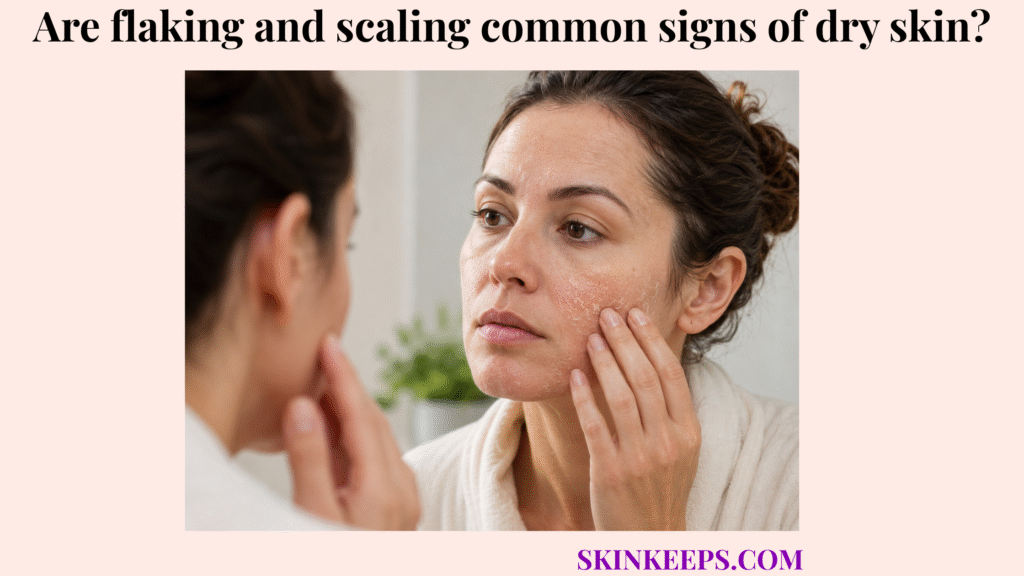
Yes, Flaking and scaling are common signs of dry skin because the dry outer layer loses flexibility and sheds visibly instead of staying smooth. Flaking usually looks like small loose pieces, while scaling usually looks thicker, rougher, or more built-up on the surface.
This guideline explains why dry skin flakes or scales, how flakes differ from scales, where visible shedding commonly appears, what triggers it, how flaky or scaly dry skin should be cared for, and when persistent scaling may need professional evaluation.
Why are flaking and scaling common signs of dry skin?
Flaking and scaling are common signs of dry skin because moisture loss makes the outer layer less flexible, causing dry surface cells to loosen and shed unevenly. This visible shedding shows that the skin surface is not staying smooth and comfortable. Flaking appears lighter, while scaling usually means the dry buildup is thicker.
These signs should be interpreted by pattern and severity. Light flakes may reflect ordinary surface dryness, while thick or persistent scaling may need closer attention. Readers who need the full dry-skin sign overview can compare this page with visible characteristics of dry skin.
Why dry skin sheds visibly instead of smoothly
Dry skin sheds visibly instead of smoothly when surface cells lose enough moisture to lift away in loose pieces or rough patches. Normal shedding is usually subtle, but dry-skin shedding becomes easier to see because the outer layer is less flexible. The result may appear as small flakes or thicker dry buildup.
Why flaking and scaling suggest the outer layer is moisture-stressed
Flaking and scaling suggest the outer layer is moisture-stressed because the skin surface is no longer holding together smoothly. Tightness or roughness may appear with the shedding because the same dry surface is less comfortable. These signs describe surface stress; they do not confirm one diagnosis by themselves.
| Step | What Happens | Visible Result |
|---|---|---|
| Moisture drops | Outer layer becomes less flexible | Skin feels tight or rough |
| Surface cells loosen unevenly | Dry cells lift away visibly | Flaking appears |
| Dry buildup thickens | Surface becomes rougher and more attached | Scaling appears |
| Barrier stress continues | Scaling may crack or inflame | Evaluation may be needed |
What does flaking mean on dry skin?
Flaking on dry skin means small loose pieces of the outer layer are lifting away because the surface has become dry, less flexible, and uneven. These flakes may look white, dusty, or powder-like. They often appear after washing, cold exposure, friction, or skipped moisturizer.
Flaking is usually more visible than dullness but less severe than cracking. A person may notice flakes around the nose, mouth, cheeks, hands, or shins before deeper dryness appears. If the skin mainly looks flat or coarse without loose pieces, the page on dull or rough dry skin may be a better match.
How small loose skin pieces form on a dry surface
Small loose skin pieces form on a dry surface when dry outer cells detach unevenly instead of shedding invisibly. These pieces can look tiny, white, dusty, or powder-like. The flake is a visible sign of surface dryness, not proof of one medical condition.
Why light flaking often appears before deeper cracking
Light flaking often appears before deeper cracking because visible shedding can begin while the dry surface is still intact. At this stage, the outer layer may be dry enough to loosen but not yet split. If split lines appear later, the pattern has moved beyond simple flaking.
| Flaking Sign | What It Usually Means |
|---|---|
| Tiny white flakes | Mild surface dryness |
| Dust-like shedding | Dry outer layer loosening |
| Flakes after washing | Cleansing or water exposure may be drying |
| Flakes with tightness | Dryness plus barrier discomfort |
| Flakes with redness | Possible irritation or inflammation |
| Flakes that keep returning | Trigger or condition may need evaluation |
What does scaling mean on dry skin?
Scaling on dry skin means the surface has formed thicker, rougher, or more plate-like dry buildup than ordinary light flaking. These scales may look more attached to the skin than loose flakes. Scaling usually suggests stronger dryness or a more persistent surface problem.
Scaling needs more caution when it is thick, inflamed, painful, widespread, or recurring. Those signs can overlap with conditions that require diagnosis rather than stronger scrubbing. The safest interpretation is that persistent scaling should be reviewed when it does not behave like simple dryness.
How scales look thicker than ordinary flakes
Scales look thicker than ordinary flakes because dry surface buildup stays more attached and creates rougher, more visible patches. A scale may look plate-like rather than powder-like. This thicker pattern usually deserves closer attention than light, scattered flaking.
Why scaling can suggest more advanced dryness or another skin condition
Scaling can suggest more advanced dryness or another skin condition when the patches are thick, persistent, inflamed, painful, or repeatedly return in the same areas. This does not mean scaling confirms a diagnosis. It means the pattern should be evaluated when it behaves differently from simple dryness.
| Scaling Sign | What It May Suggest |
|---|---|
| Thin rough scale | Moderate surface dryness |
| Thick plate-like scale | More advanced dryness or possible condition |
| Scaling with redness | Irritation or inflammation |
| Scaling with severe itching | Possible condition needing evaluation |
| Scaling that keeps returning | Trigger or diagnosis may need review |
| Scaling with cracks or bleeding | More severe barrier disruption |
How are flaking and scaling different?
Flaking and scaling are different because flaking usually appears as small loose pieces, while scaling appears as thicker, rougher buildup or dry plates on the skin surface. Flaking often looks lighter or dust-like. Scaling usually looks more attached, textured, or patch-like.
The distinction matters because scaling can carry a higher concern level when it is persistent or inflamed. Flaking may improve with gentle barrier support, while thick scaling may need evaluation if it keeps returning. If split lines appear instead of dry buildup, the guide on cracked riverbed appearance can help explain that separate severe pattern.
| Feature | Flaking | Scaling |
|---|---|---|
| Appearance | Small loose skin pieces | Thicker dry plates or rough patches |
| Texture | Light, dusty, peeling | Rougher, more built-up |
| Severity | Often mild to moderate | Often moderate or more persistent |
| Common meaning | Surface dryness | Stronger dryness or possible condition |
| Care response | Often improves with moisturizing | May need stronger care or evaluation if persistent |
| Escalation clue | Persistent flakes with irritation | Thick, painful, inflamed, or recurring scale |
Where do flaking and scaling commonly appear on dry skin?
Flaking and scaling commonly appear on dry-skin areas exposed to weather, frequent washing, friction, low moisture, or repeated irritation. The face may show light flakes, while elbows, knees, shins, hands, and feet may show thicker dry buildup. Around the mouth can also flake when wiping, weather, or irritation affects the surface.
Location helps interpret the pattern. Light flakes on the face may suggest surface dryness, while thicker scaling on elbows or shins may suggest more stubborn dry patches. If scaling appears as localized body dryness, the page on dry patches on legs or elbows can help explain that pattern.
| Area | Common Flaking or Scaling Pattern |
|---|---|
| Face | Light flakes, especially around cheeks, nose, or mouth |
| Hands | Flaking from washing, weather, or irritants |
| Elbows | Rougher scale or thicker dry texture |
| Knees | Dry, rough, or scaly buildup |
| Shins | Flaking, ashiness, or scaling in dry weather |
| Feet | Thick dry scale, especially around heels |
| Around the mouth | Flaking from wiping, saliva, weather, or irritation |
| Cold-exposed areas | Dry flakes or rough scaling |
| Frequently washed areas | Flaking with tightness or irritation |
What triggers flaking and scaling in dry skin?
Flaking and scaling in dry skin are commonly triggered by cold or dry weather, hot showers, harsh soaps, over-washing, aging, irritating products, and friction. These triggers reduce surface comfort and make the outer layer shed more visibly. The result may begin as light flakes and progress into thicker scale if dryness continues.
The trigger pattern matters because repeated exposure can keep flakes returning. Frequent washing may cause hand flaking, while cold weather may worsen shins or cheeks. If harsh cleansing is a clear trigger, the guide on harsh soaps remove natural lipids can help explain that cause.
| Trigger | How It Contributes |
|---|---|
| Cold or dry weather | Increases moisture loss and visible shedding |
| Hot showers | Removes surface oils and worsens tightness |
| Harsh soaps | Weakens surface comfort and irritation tolerance |
| Over-washing | Repeatedly removes protective lipids |
| Aging | Skin may hold less moisture and oil |
| Irritating products | Can worsen peeling, stinging, or scaling |
| Friction | Lifts dry surface cells and worsens patches |
| Indoor heating | Dries the environment and skin surface |
| Low moisturizer support | Allows flakes and scale to persist |
How should flaky or scaly dry skin be cared for?
Flaky or scaly dry skin should be cared for with gentle cleansing, lukewarm water, immediate moisturizing, richer creams or ointments when needed, and avoidance of aggressive scrubbing. These steps support the dry surface without adding more irritation. The goal is to reduce visible shedding by improving surface comfort, not by scraping flakes away.
Scrubbing flakes may make the surface look smoother for a short time, but it can irritate dry skin and worsen discomfort. Moisturizing after washing helps the surface stay more flexible before flakes return. Persistent thick scaling should be treated as a reason to seek guidance, not as a reason to scrub harder.
Why moisturizer helps flaky or scaly dry skin
Moisturizer helps flaky or scaly dry skin by supporting the dry outer layer so it feels less tight and sheds less visibly. When the surface is more comfortable, dry cells are less likely to lift in obvious pieces. This is barrier support, not an instant removal method.
Why scrubbing flakes or scales can backfire
Scrubbing flakes or scales can backfire because friction may irritate the dry surface and make peeling, redness, or scaling more persistent. Scrubbing can also make the skin feel raw or tight. The safer goal is to reduce visible shedding by supporting the surface, not scraping it.
Why creams or ointments may help more than thin lotions when scaling is visible
Creams or ointments may help more than thin lotions when scaling is visible because thicker formulas give stronger surface support to rough dry buildup. Scaling often needs more support than light flaking. A richer product can help the dry patch stay more comfortable between washes.
| Care Step | Why It Helps |
|---|---|
| Use a gentle cleanser | Reduces stripping and irritation |
| Use lukewarm water | Avoids extra dryness from hot water |
| Moisturize after washing | Supports the surface before tightness returns |
| Use creams or ointments when scaling is visible | Provides stronger support than thin lotions |
| Avoid aggressive scrubbing | Prevents irritation and worsening scale |
| Protect from cold or dry air | Reduces weather-related flaking |
| Use humidifier support if indoor air is dry | Helps reduce environmental dryness |
| Seek care for persistent scale | Helps rule out conditions needing treatment |
When are flaking and scaling more than ordinary dry skin?
Flaking and scaling may be more than ordinary dry skin when they become thick, painful, bleeding, inflamed, widespread, recurrent, crusted, oozing, or resistant to basic moisturizing. These signs suggest the surface may involve more than simple dryness. Professional evaluation is appropriate when the pattern is severe or persistent.
Persistent scaling should be treated carefully when it forms defined patches or keeps returning in the same area. Those patterns can overlap with eczema, dermatitis, psoriasis, or infection-looking changes. If the reader is unsure, the page on persistent dry skin needs a dermatologist can guide the next step.
Warning Signs Checklist
What should you remember about flaking, scaling, and dry skin?
The main point to remember is that flaking and scaling are common dry-skin signs, but scaling is usually thicker, rougher, and more persistent than light flaking. Flaking usually appears as small loose pieces of dry skin. Scaling usually appears as thicker, rougher, or more plate-like dry buildup.
Final Takeaways
- Flaking and scaling are common visible signs of dry skin.
- Flaking usually appears as small loose pieces of dry skin.
- Scaling usually appears as thicker, rougher, or more plate-like dry buildup.
- Flaking often reflects surface dryness, while persistent scaling may suggest stronger dryness or another issue.
- Cold weather, hot showers, harsh soaps, over-washing, aging, irritating products, and friction can trigger visible shedding.
- Flaky or scaly dry skin should be moisturized gently and should not be aggressively scrubbed.
- Thick, painful, bleeding, inflamed, widespread, recurrent, or resistant scaling should be checked professionally.
FAQs
Are flaking and scaling common signs of dry skin?
Yes, flaking and scaling are common signs of dry skin because the dry outer layer can shed visibly when it loses moisture and flexibility.
What does flaking mean on dry skin?
Flaking means small loose pieces of dry skin are lifting away from the surface.
What does scaling mean on dry skin?
Scaling means the dry surface has become thicker, rougher, or more built up than ordinary light flaking.
Is scaling more serious than flaking?
Scaling can be more concerning than flaking when it is thick, persistent, inflamed, painful, or repeatedly returns.
Should flaky dry skin be scrubbed?
No, flaky dry skin should not be aggressively scrubbed because friction can irritate the surface and worsen dryness.
Can dry skin flake after washing?
Yes, dry skin can flake after washing when water, cleanser, or friction removes surface comfort and leaves the outer layer tight.
When should scaly dry skin need professional care?
Scaly dry skin should be checked if it becomes thick, painful, bleeding, swollen, oozing, widespread, recurrent, or resistant to basic care.
Conclusion
Flaking and scaling are common dry-skin signs because the moisture-stressed outer layer sheds visibly instead of staying smooth. Flaking usually means small loose pieces, while scaling means thicker or rougher dry buildup. Gentle cleansing, consistent moisturizing, and avoiding aggressive scrubbing can help ordinary flaky dryness, but thick, painful, bleeding, inflamed, or persistent scaling should be evaluated professionally.
The strongest interpretation is practical: flakes and scales are visible shedding signs, not automatic diagnoses. The safer decision is to support the dry surface gently and seek professional review when scaling becomes severe, recurrent, inflamed, painful, bleeding, oozing, or resistant to basic care.