
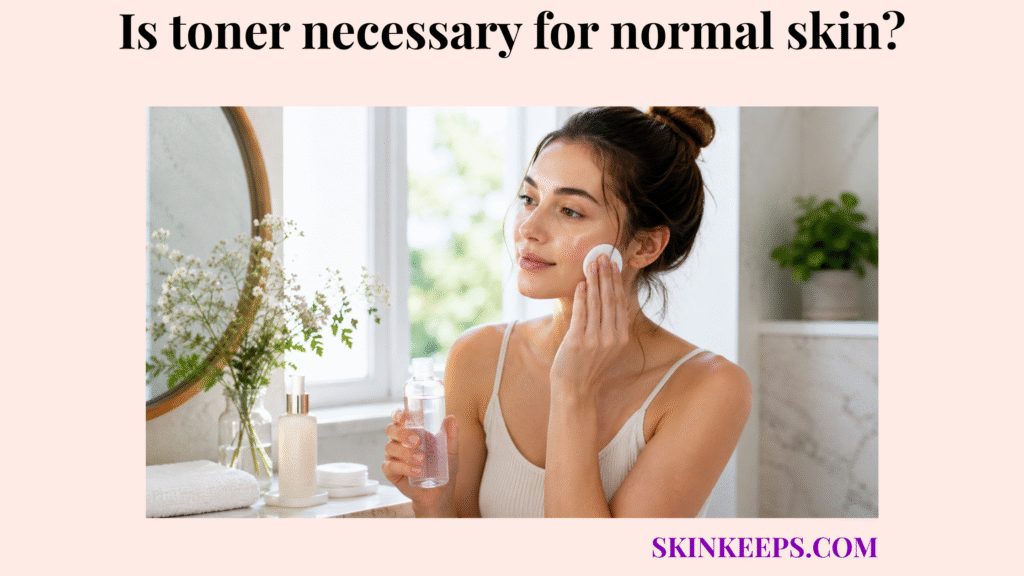
No, toner is usually not necessary for normal skin. Normal skin often does well with a simple routine built around gentle cleansing, moisturizer when needed, and daily sunscreen. Toner may still help if it adds light hydration, helps remove leftover residue, or supports a specific concern. If normal skin already feels clean, comfortable, smooth, and balanced after cleansing, toner is optional.
Why is toner necessary for normal skin usually optional?
Toner necessary for normal skin is usually optional because normal skin often does not need extra oil control, strong exfoliation, or repeated balancing steps after gentle cleansing.
Toner should not be added automatically if normal skin already feels clean and comfortable after washing. A simpler routine can protect balance better than extra steps without a clear purpose.
This fits how different skin types need different levels of oil control, dryness support, and sensitivity caution.
| Normal skin status | Toner need |
|---|---|
| Clean and comfortable after washing | Usually unnecessary |
| Slightly tight after cleansing | Moisturizer may matter more |
| Residue remains after cleansing | Better cleansing method may help |
| Dull or rough sometimes | Gentle exfoliation may help if needed |
| Skin feels balanced | Skip toner if no clear benefit |
| Skin reacts easily | Avoid irritating toner types |
If normal skin already feels balanced, toner is not a required step.
When can toner necessary for normal skin become useful?
Toner necessary for normal skin can become useful when it has a clear job, such as light hydration, gentle soothing, minor residue support, or occasional texture support.
Toner for normal skin should have a reason, not just a routine slot. If toner improves comfort without stinging, dryness, or stickiness, it may be useful.
If residue remains after washing, first check whether gentle cleansers are enough for normal skin or whether cleansing technique needs adjustment.
| Toner use case | When it may help normal skin |
|---|---|
| Hydrating toner | Skin feels slightly tight |
| Soothing toner | Skin feels mildly uncomfortable |
| Residue-removal toner | Cleansing leaves leftover buildup |
| Gentle exfoliating toner | Occasional dullness or roughness |
| Fragrance-free toner | Better if skin reacts easily |
| Alcohol-free toner | Better if skin gets dry or tight |
Toner for normal skin should have a reason, not just a routine slot.
When is toner necessary for normal skin better skipped?
Toner necessary for normal skin is better skipped when the skin already feels clean, comfortable, smooth, balanced, and not tight, rough, sticky, or residue-covered after cleansing.
Normal skin does not need toner just because a routine has a “toner step.” Skip it when it adds stickiness, redness, dryness, or no clear benefit.
- Feels clean after cleansing.
- Does not feel tight.
- Does not look dull or rough.
- Does not have residue after washing.
- Becomes sticky after toner.
- Becomes red or stingy after toner.
- Feels dry after toner.
- Already uses enough hydrating products.
- Already uses exfoliants or actives.
- Has no clear concern toner is solving.
Normal skin does not need toner just because a routine has a “toner step.”
Which toner type makes toner necessary for normal skin safer if used?
The toner type necessary for normal skin, if used, is usually alcohol-free, fragrance-free, gentle, and hydrating rather than strongly astringent or heavily exfoliating.
Strong astringent or exfoliating toners are usually unnecessary unless there is a specific repeated concern. Gentle hydration is usually safer than strong correction.
This overlaps with choosing ingredients normal skin should look for or avoid, especially with fragrance, alcohol-heavy formulas, and exfoliating acids.
| Toner type | Fit for normal skin |
|---|---|
| Hydrating toner | Best optional type |
| Alcohol-free toner | Lower dryness risk |
| Fragrance-free toner | Lower irritation risk |
| Gentle soothing toner | Useful if skin feels slightly stressed |
| Exfoliating toner | Use only when dullness or roughness appears |
| Astringent toner | Usually unnecessary |
| Strong acid toner | Higher irritation risk |
| Fragrance-heavy toner | Higher stinging or redness risk |
If toner is used on normal skin, gentle hydration is usually safer than strong correction.
What toner mistakes make toner necessary for normal skin risky?
Toner mistakes make toner necessary for normal skin risky when toner is used to feel squeaky clean, dry out the skin, exfoliate daily, stack actives, or continue despite burning.
Toner should not make normal skin feel tighter, hotter, or more irritated. If that happens, the toner is disrupting balance rather than helping.
Daily exfoliating toner belongs under the same caution used for exfoliation for normal skin.
| Toner mistake | Why it can disrupt normal skin |
|---|---|
| Using toner to feel “squeaky clean” | May dry or strip skin |
| Using alcohol-heavy toner | Can cause tightness |
| Using exfoliating toner daily | Can trigger peeling or stinging |
| Layering toner with many actives | Raises irritation risk |
| Using toner after harsh cleansing | Adds more stress |
| Using fragranced toner | May cause redness or itching |
| Using toner to treat acne alone | May not address real acne causes |
| Keeping toner that burns | Can worsen irritation |
Toner should not make normal skin feel tighter, hotter, or more irritated.
When should toner necessary for normal skin reactions need attention?
Toner reactions in normal skin need attention when burning, stinging, rash-like redness, swelling, severe itching, cracked patches, painful acne, or changing lesions appear or repeat.
A toner reaction should not be ignored just because normal skin usually tolerates products well. Repeated or worsening symptoms need review.
- Toner repeatedly burns, stings, or causes rash-like redness.
- Skin reacts to many gentle products.
- Dry patches crack, bleed, burn, or spread.
- Redness becomes warm, swollen, spreading, or persistent.
- Itching becomes intense or persistent.
- Breakouts become painful, deep, frequent, or scarring.
- Swelling appears around the eyes, lips, or face.
- A mole, spot, or lesion changes color, shape, size, or behavior.
A toner reaction should not be ignored just because normal skin usually tolerates products well.
What should you remember about toner necessary for normal skin?
The key point is that toner necessary for normal skin is usually optional, and normal skin often needs gentle cleansing, moisturizer when needed, and sunscreen first.
Toner can help only if it has a clear purpose such as light hydration, soothing, residue support, or occasional texture care. If it burns, dries, reddens, or adds no benefit, skip it.
Simple steps remain central to care tips that preserve normal skin balance.
Frequently Asked Questions About Toner Necessary for Normal Skin
Is toner necessary for normal skin every day?
No. Toner is usually optional for normal skin, especially if the skin feels clean and comfortable after cleansing.
Can toner help normal skin?
Yes, but only when it has a clear purpose, such as light hydration, gentle soothing, or occasional texture support.
Should normal skin avoid alcohol toner?
Usually, yes. Alcohol-heavy toners can make normal skin feel tight, dry, or irritated.
Is exfoliating toner good for normal skin?
It can be useful occasionally for dullness or roughness, but daily exfoliating toner is usually unnecessary and may irritate normal skin.
Can normal skin skip toner completely?
Yes. Normal skin can skip toner if cleansing, moisturizing, and sunscreen already keep the skin balanced.
Sources & Evidence About Toner Necessary for Normal Skin
Cleveland Clinic skin-type guidance was used to ground normal skin as a balanced skin type and separate normal skin from dry, oily, combination, and sensitive patterns.
Cleveland Clinic toner guidance was used for toner role, toner selection, fragrance caution, dye/preservative caution, and skin-tolerance framing.
Cleveland Clinic simple skincare routine guidance was used for toner as an optional routine step and alcohol-based toner dryness or irritation boundaries.
American Academy of Dermatology face-washing guidance was used for gentle cleansing, lukewarm water, fingertip cleansing, moisturizer support, and avoiding harsh stripping.
American Academy of Dermatology dry-skin relief guidance was used for tightness, dryness, cracking, bleeding, burning, and moisturizer-support boundaries.
American Academy of Dermatology sunscreen guidance was used for daily broad-spectrum SPF, SPF 30 or higher, and basic UV-protection framing.
American Academy of Dermatology exfoliation guidance was used for exfoliating acids, over-exfoliation, peeling, redness, irritation risk, and skin-type caution.
American Academy of Dermatology acne skin-care guidance was used for alcohol-free product advice, toner/astringent irritation boundaries, and acne-care limitations.
American Academy of Dermatology product-testing guidance was used for repeated product reactions, irritation tracking, and patch-testing boundaries.
Peer-reviewed sensitive-skin review from NIH/PMC was used for burning, stinging, itching, redness, and reactive-skin symptom context.
American Academy of Dermatology acne treatment guidance was used for painful, frequent, cystic, or scarring acne referral boundaries.
American Academy of Dermatology melanoma signs guidance was used for changing moles, changing spots, lesion behavior, and referral boundaries.
Educational Disclaimer: This article is for general skin education only and does not diagnose, treat, or replace professional medical advice. If toner causes repeated burning, swelling, rash-like redness, painful acne, cracked or bleeding patches, severe itching, spreading irritation, sudden unexplained changes, broader health symptoms, or changing moles or lesions, consult a qualified dermatologist or healthcare professional.